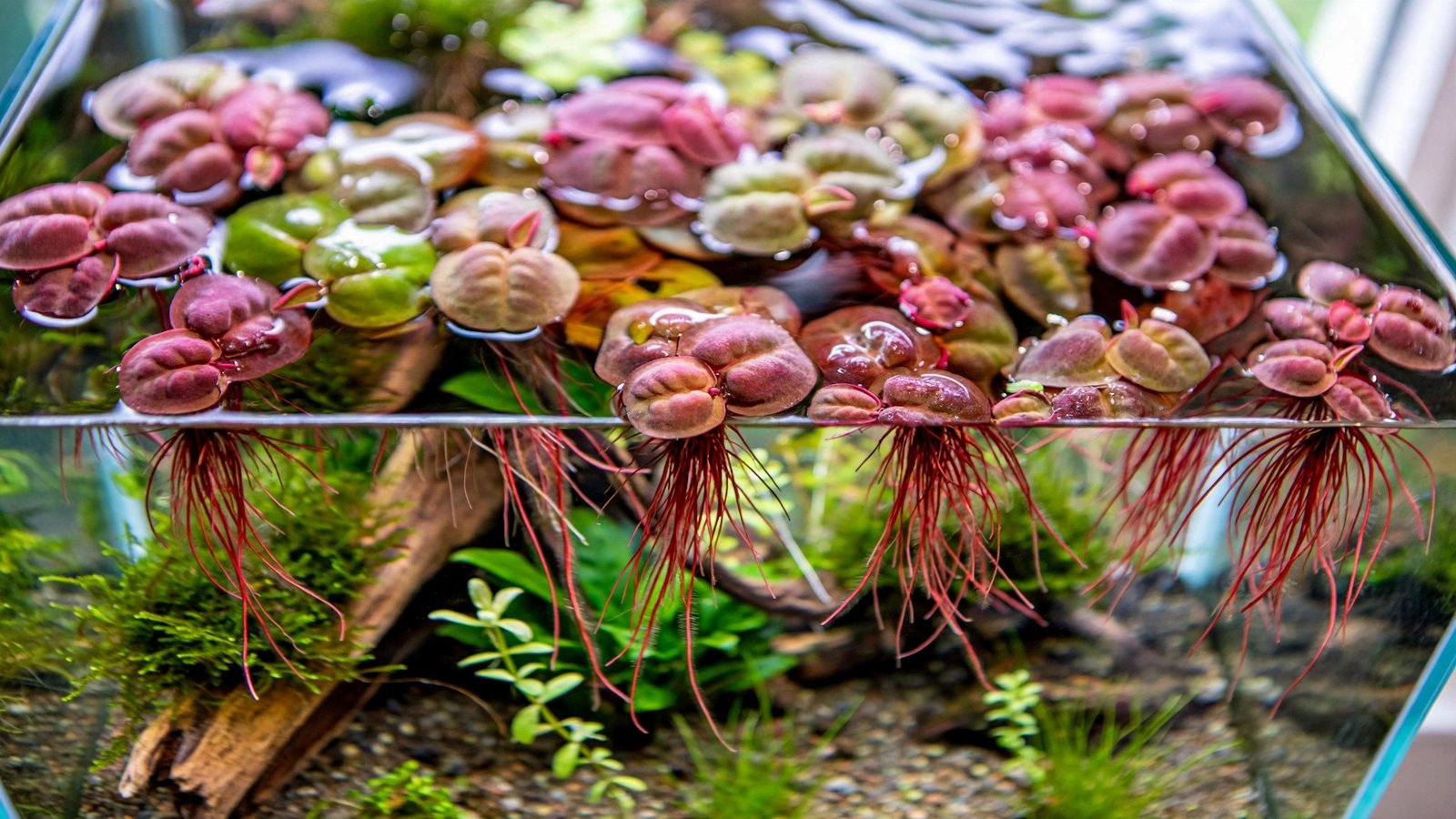
Crimson roots dangling beneath sunset-red leaves — the prettiest floater in the hobby. Red root floater care is a step up from easy floaters like frogbit: Phyllanthus fluitans demands calm water, good light, and lean nutrients to develop its signature red coloration, but the payoff is a floating plant that looks like it was designed rather than grown. Native to South American waterways, it's the floater aquascapers actually choose on purpose.
This guide covers establishing red root floaters, the light and nutrient recipe for red color, humidity management, propagation, and troubleshooting melting and green, leggy growth.
Quick Care Reference
| Parameter | Requirement |
|---|---|
| Light | Medium to high (40+ PAR at surface) |
| CO2 | Not needed (atmospheric access) |
| Growth rate | Moderate to fast |
| Placement | Floating (surface) |
| Difficulty | Easy to moderate |
| Temperature | 70–82°F (21–28°C) |
| pH | 5.5–7.5 |
| Size | Leaves 0.5–1 inch; red roots several inches |
What Makes Them Special
Red root floaters check every box for a display floater: small round leaves that blush deep red under strong light, vivid crimson roots that hang like threads, and a compact rosette form that looks deliberate rather than weedy. Under high light with lean nutrients, the whole colony glows red-green — a color no other common floater offers.
They're fussier than Amazon frogbit, their closest comparison. Frogbit tolerates flow, condensation, and neglect; red root floaters sulk in strong current, melt under dripping lids, and demand better light for their color. Think of frogbit as the utility floater and red root floaters as the ornamental one.
Establishing Red Root Floaters
Start with healthy rosettes — green to reddish leaves, visible red root nubs. Place them on the surface in the calmest part of the tank; strong flow tumbles them, damages leaves, and prevents the colony establishing. Corral them with an airline-tubing ring away from filter outflow until they multiply.
The air above matters enormously: like frogbit, they need dry leaves. Maintain an air gap under the lid and prevent condensation dripping onto the colony — wet leaves melt within days. Open-top tanks are ideal. In lidded tanks, ventilate: prop the lid slightly or use a mesh section. High humidity is fine (even good); dripping water is the enemy.
Light and Nutrients: The Red Recipe
Red coloration needs two things: strong light and lean nutrients. Under medium light with rich nutrients, red root floaters grow green and perfectly healthy — attractive, but not red. Push light to 60+ PAR at the surface and keep nitrates moderate-to-low (5–15 ppm), and leaves blush red while roots turn vivid crimson.
This is the opposite of most plant advice — you're deliberately running lean. In high-tech tanks with heavy dosing, red root floaters often stay green; reduce surface coverage or accept green. Iron dosing supports the red pigments but can't substitute for strong light. CO2 is irrelevant — they breathe air.
As nutrient sponges they're excellent but not as aggressive as frogbit — their smaller biomass absorbs less. They still help with algae control and make good indicator plants: pale new growth means the tank wants iron; stalled growth means it's running very lean.
The red recipe needs iron + nutrients dosed to the water column: an iron-inclusive liquid like Seachem Flourish.
Managing Growth and Propagation
Growth is moderate — slower than frogbit, faster than you'd expect. Rosettes multiply via runners, doubling every 2–3 weeks in good conditions. Thin regularly with a net, keeping coverage modest (20–40%) so light reaches submerged plants — red root floaters shade effectively despite their small size because they sit so close to the light.
Propagation is automatic: runners produce daughters that separate naturally. To share, scoop rosettes into a bag with a little tank water — they travel well. A starter portion of 6–10 rosettes becomes a full colony within two months.
Troubleshooting Common Problems
Melting leaves
Wet leaves (condensation, splashing, strong flow pushing them under) or major parameter shock. Ensure dry tops, calm water, and an air gap. Remove melted leaves promptly — they foul the surface film. New tanks with fluctuating parameters cause initial melt; stable tanks rarely do.
Staying green instead of turning red
More light and leaner nutrients — in that order. If your tank is heavily dosed for demanding stems, red root floaters will stay green; that's the tradeoff. Judge color on new growth. Note that some colonies are just greener genetically; source from growers showing red stock.
Leggy, stretched growth with small leaves
Insufficient light at the surface — unusual since they're at the top, but possible under dim fixtures or when shaded by a lid. Increase light or reduce the colony so all rosettes get direct exposure. Overcrowded mats self-shade into legginess.
Roots staying short or pale
Short pale roots usually mean very rich nutrients (no need to reach) or poor light. The dramatic long red roots develop under strong light with moderate nutrients. Both are healthy; aesthetics depend on conditions.
Colony declining over weeks
Check for: persistent wet leaves, too-cool temperatures (below 68°F they sulk), fish eating roots (some barbs and goldfish nip them), or complete nutrient exhaustion in very lean tanks. Red root floaters are less bulletproof than frogbit — investigate rather than assuming they'll bounce back.
Design and Tank Pairings
Red root floaters are the jewelry floater: use a corralled colony as a surface accent, letting crimson roots drape into the water column as a living curtain. They look stunning over dark substrate with a Monte Carlo carpet below — red roots, green carpet, dark background.
They suit shrimp tanks (roots grow biofilm), betta tanks (calm surface, shade, bubblenest support), and nano aquascapes where their small scale reads perfectly. In high-tech show tanks, a restrained colony adds the red surface accent that completes the composition.
Red Root Floaters in High-Tech vs Low-Tech Tanks
In low-tech tanks, red root floaters are straightforward: moderate light from a basic fixture often suffices for decent color, nutrients stay naturally lean, and the colony multiplies steadily. They're one of the prettiest low-tech surface plants, needing only calm water and dry leaves. In high-tech tanks, they're trickier: heavy fertilizer dosing keeps them green rather than red, fast-growing stems compete for nutrients, and strong surface agitation from CO2 diffusers disturbs them. High-tech keepers who want red floaters should corral a small colony in the calmest corner, accept that it may stay greener than low-tech colonies, and thin it ruthlessly so it doesn't shade the expensive stems below. Alternatively, run floating Riccia for utility nutrient export in high-tech tanks and save red root floaters for low-tech setups where their color truly shines. Either way, they're an excellent early-warning system: when floaters pale or stall, the whole tank is running lean.
Buying Healthy Stock
Red root floaters ship and adapt better than their reputation suggests — if you buy well. Look for rosettes with firm, unblemished leaves (green to red, not yellow or translucent), visible red root growth, and no slimy coating. Avoid portions that smell swampy or arrive as a melted mat; stressed floaters can recover, but starting healthy saves weeks. Quarantine new floaters in a separate container for a few days: this reveals hitchhiking duckweed (the eternal pest) before it reaches your tank, and lets damaged leaves declare themselves so you introduce only vigorous rosettes.
Frequently Asked Questions
How do I make red root floaters turn red?
Strong light (60+ PAR at the surface) plus lean nutrients (nitrates 5–15 ppm). Iron dosing helps but light is primary. Judge new growth — old green leaves won't recolor. In heavily dosed high-tech tanks they often stay green; that's normal for rich conditions.
Why are my red root floaters melting?
Wet leaves — condensation dripping from the lid, splashing, or strong flow submerging them. They need dry tops: maintain an air gap, calm the surface, corral away from outflow. Remove melted leaves and stabilize conditions; healthy colonies recover in 1–2 weeks.
Do red root floaters need CO2?
No — they access atmospheric CO2 directly at the surface. CO2 injection benefits only your submerged plants. Red root floaters care about light, calm water, dry leaves, and nutrient balance — not carbon. Focus instead on light, calm water, dry leaves, and balanced nutrients.
How fast do they multiply?
Moderately — doubling every 2–3 weeks in good conditions. Slower than frogbit or duckweed, which makes them easier to manage. Thin with a net as needed, keeping 20–40% surface coverage in planted tanks. Their moderate pace makes them far easier to manage than faster floaters.
Red root floaters vs frogbit — which should I get?
Frogbit for toughness, speed, and utility (nutrient export, fry cover); red root floaters for beauty (red color, ornamental roots) with more careful conditions. Beginners should master frogbit first; red root floaters reward the extra attention with unmatched surface aesthetics.
Can they grow in a jar or bowl?
Yes — they're excellent for unfiltered jars and bowls: a few rosettes on the surface with indirect light multiply happily. Keep the water topped up, thin as needed, and enjoy one of the prettiest no-tech setups possible. Shrimp or a snail complete the micro-ecosystem.
Bringing It All Together
Red root floaters are the floater for people who care about how the surface looks: crimson roots, blushing leaves, and a neat rosette habit — in exchange for calm water, dry leaves, and strong light. Corral them, keep them lean and bright, thin with discipline, and they become the living jewelry that makes visitors lean in close. Beautiful floaters aren't accidents; they're conditions.