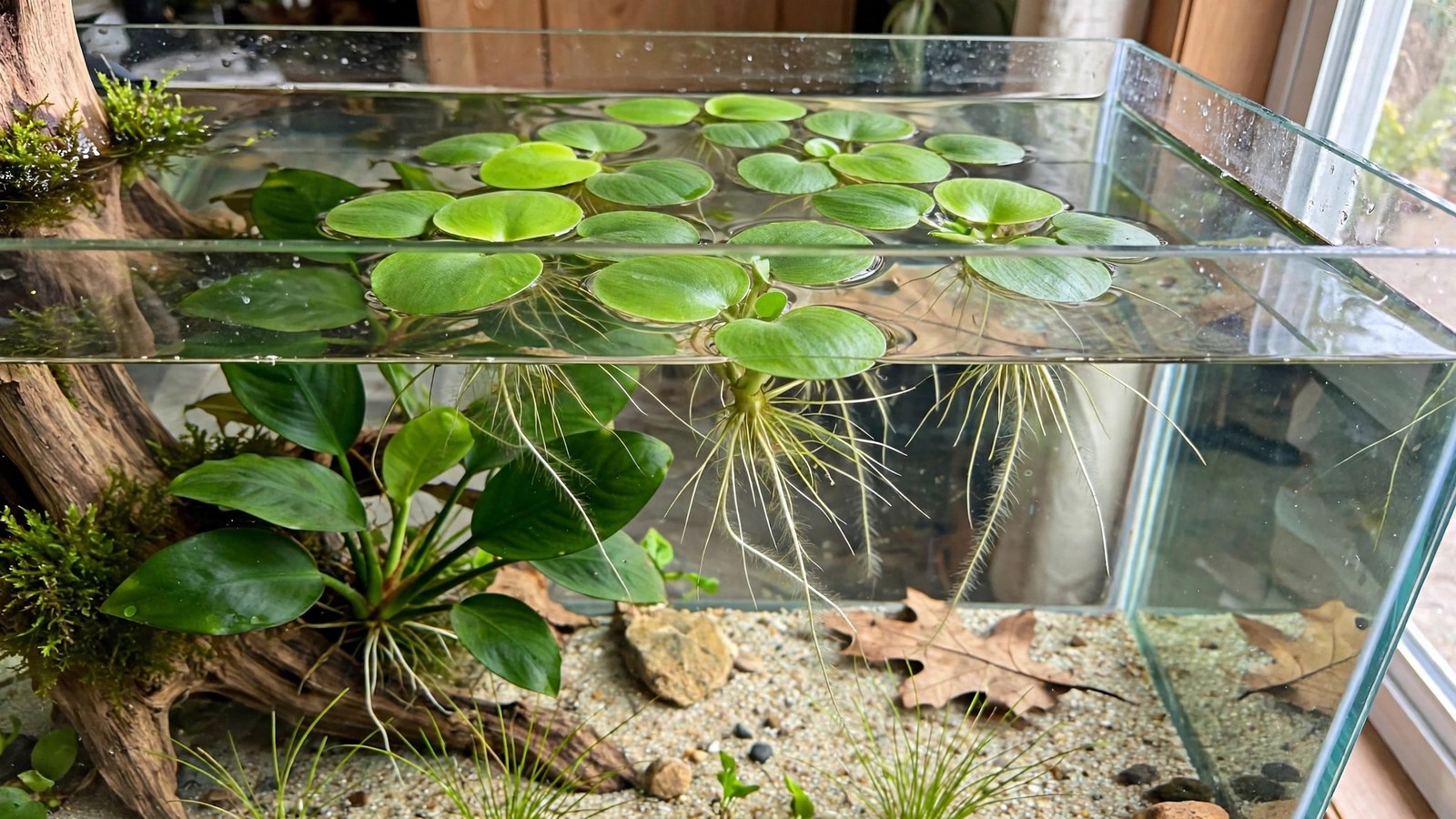
Round leaves on top, a curtain of roots below — the perfect floating plant. Amazon frogbit care is delightfully simple: Limnobium laevigatum multiplies across the water surface, its long roots dangling like a underwater forest, absorbing nitrates and phosphates so aggressively it starves algae. Native to slow waters of the Amazon basin, it's the floating plant that behaves itself.
This guide covers getting frogbit established, managing its rapid spread, the humidity and condensation issue that troubles it, propagation, and troubleshooting yellowing and melting.
Quick Care Reference
| Parameter | Requirement |
|---|---|
| Light | Low to high (adapts; brighter = faster) |
| CO2 | Not needed (accesses atmospheric CO2) |
| Growth rate | Very fast |
| Placement | Floating (surface) |
| Difficulty | Very easy |
| Temperature | 64–86°F (18–30°C) |
| pH | 5.5–8.0 |
| Size | Leaves 1–2 inches; roots to 8+ inches |
Why Frogbit Beats Duckweed
Every floating-plant discussion eventually asks: frogbit or duckweed? Frogbit wins for most hobbyists. Its leaves are large (1–2 inches) — easy to scoop out, unlike duckweed's infuriating tiny fronds that cling to everything. Its roots grow long and dramatic, providing shelter and grazing for fish and shrimp. And it's far easier to control: remove a few rosettes and you're done, versus duckweed's eternal war.
Frogbit's round, slightly cupped leaves float flat on the surface, connected by runners that produce daughter plants — a strawberry-like habit that lets it carpet the surface in weeks. The dangling root mass is its secret weapon: enormous surface area for nutrient absorption and biofilm, making it one of the best natural filters in the hobby.
Getting Established
Start with a handful of healthy rosettes — firm green leaves, white roots. Drop them on the surface in an area of gentle flow; strong current pushes frogbit around and prevents it establishing. Many aquarists corral new frogbit with a ring of airline tubing until it multiplies enough to hold position.
The critical factor is the air above the water: frogbit leaves rot if constantly wet. Leave an air gap between the water surface and the lid — an inch or more — and avoid lids that drip condensation onto the leaves. In open-top tanks it thrives; in tightly lidded tanks with heavy condensation, leaves melt. If your lid drips, wipe it or switch to a mesh/glass cover with ventilation.
Light and Nutrients
Frogbit adapts to any light — it sits at the surface, closest to the fixture, so even "low light" tanks give it plenty. Brighter light means faster multiplication. It accesses atmospheric CO2 directly, so CO2 injection is irrelevant to it (though your submerged plants still benefit).
Nutrient-wise, frogbit is a hungry surface feeder: it absorbs nitrates, phosphates, and micronutrients from the water column aggressively. In high-tech tanks it can actually outcompete submerged plants — if your stems pale while frogbit thrives, the frogbit is hogging nutrients, and you should thin it or fertilize more. In low-tech tanks it's the perfect algae preventer, soaking up the excess that would otherwise feed green water and hair algae.
Iron deficiency shows as yellowing new leaves — dose comprehensive fertilizer if the whole colony pales. Frogbit's fast growth makes it an excellent indicator plant: when it slows or yellows, the tank is running lean.
Floaters drink from the water column; gentle liquid dosing replaces drained nutrients: a gentle liquid fertilizer like Seachem Flourish.
Managing Growth
Frogbit multiplies fast — rosettes double every 1–2 weeks in good conditions. Management is simple but mandatory: scoop out excess weekly with a net, maintaining 30–50% surface coverage in planted tanks. Full coverage shades submerged plants into decline — the number one frogbit mistake is letting it take the entire surface.
Use airline-tubing corrals to keep it in designated areas — a ring floating on the surface contains the colony neatly. This is especially useful in aquascaped tanks where you want the root-curtain effect in one zone without shading the whole tank. Removed frogbit composts well or feeds herbivorous fish and turtles.
Propagation
It does it itself: runners extend from mother rosettes, forming daughters that eventually separate. To propagate deliberately, just let it grow and thin into new tanks. A single rosette becomes dozens within two months. Frogbit is the plant you give away by the bagful — every hobbyist with a tank ends up with surplus.
Troubleshooting Common Problems
Leaves melting or rotting
Almost always wet leaves — condensation dripping from the lid, or leaves pushed underwater by strong flow. Ensure an air gap, reduce surface agitation where frogbit sits, and remove rotted leaves promptly. Frogbit with dry tops and wet roots thrives; frogbit with wet tops rots.
Yellowing leaves
Nutrient deficiency — usually iron or general macros in a tank where frogbit has consumed everything. Dose comprehensive fertilizer. Note the irony: yellowing frogbit often means it's doing its job too well, stripping the water clean. Feed the tank, not just the frogbit.
Stunted, tiny new leaves
Nutrient exhaustion or too little light reaching the colony (paradoxically, when it's shaded by itself in over-thick mats). Thin the colony so light reaches all rosettes, and fertilize. Overcrowded mats stunt themselves — regular thinning keeps individual rosettes large and healthy.
Roots not growing long
Short roots usually mean abundant nutrients — the plant doesn't need to extend to feed. Long, dramatic roots develop when nutrients are moderate and the plant reaches for more. Both are healthy; root length reflects conditions, not problems. If you want the curtain effect, keep nutrients moderate rather than rich.
Not multiplying
Unusual — check that leaves stay dry (wet leaves stall growth), temperature isn't too low (below 60°F it sulks), and that fish aren't eating the roots (goldfish and silver dollars graze them). Healthy frogbit in a normal tank multiplies relentlessly.
Frogbit for Specific Setups
Bettalabs: bettas love frogbit — the roots provide shelter, the shade calms them, and males build bubblenests among the roots. Shrimp tanks: roots grow biofilm that shrimplets graze; the shade encourages breeding behavior. Breeding tanks: unmatched fry cover at the surface where many fry instinctively gather. High-tech tanks: use sparingly as a nutrient safety valve, thinning aggressively so it doesn't shade or starve your stems.
Compared with red root floaters, frogbit is larger, faster, and tougher — red root floaters offer prettier color but demand more careful conditions. Many keep both: frogbit for utility, red root floaters for beauty.
Combining Floating Plants
Frogbit plays well with other floaters if you manage the mix. A popular combination is frogbit for fast nutrient export plus red root floaters for color — the frogbit does the heavy filtering while the red roots provide the beauty, and corral rings keep them in separate zones. Floating Riccia adds fine texture underneath larger floaters, sheltering the tiniest fry. Avoid mixing frogbit with duckweed unless you enjoy eternal regret — duckweed infiltrates everything and is nearly impossible to remove once introduced. As a rule, run one dominant floater per tank (frogbit is the best default) plus at most one accent species, and thin weekly so the combination stays a design choice rather than a takeover.
Frequently Asked Questions
How do I stop frogbit from covering the whole surface?
Thin weekly with a net, keeping 30–50% coverage in planted tanks. Use an airline-tubing ring to corral it into one area. Full surface coverage shades submerged plants into decline — regular removal is the entire maintenance program, and it takes two minutes.
Why is my frogbit melting?
Wet leaves — almost always condensation dripping from the lid or strong surface flow pushing leaves under. Frogbit needs dry tops and wet roots: maintain an air gap under the lid, baffle flow where it floats, and remove rotted leaves. In open-top tanks it rarely melts.
Does frogbit need fertilizer?
It absorbs nutrients aggressively from the water column, so in stocked tanks fish waste often suffices. If the colony yellows or stalls, dose comprehensive liquid fertilizer — yellowing frogbit usually means it's stripped the water clean doing its job. Fast growth makes it a great indicator of tank nutrition.
Can frogbit grow in a lidless tank?
Beautifully — open-top tanks are ideal, with dry air above the leaves and no condensation issues. Just top off evaporated water regularly, since open tanks lose water fast and frogbit strands on glass as levels drop. Keep water levels consistent.
Frogbit vs red root floaters — which is better?
Frogbit is tougher, faster, and larger — the utility choice for nutrient export and fry cover. Red root floaters are prettier (red roots, sun-stressed red leaves) but fussier about humidity and flow. Beginners should start with frogbit; add red root floaters for beauty once the tank is stable.
Will frogbit roots clog my filter?
Long roots can reach filter intakes in small tanks. Use a pre-filter sponge on intakes — which you'd want anyway for shrimp and fry — and thin the colony before roots get extreme. Corralled colonies positioned away from intakes avoid the issue entirely.
Bringing It All Together
Amazon frogbit is the floating plant that earns its keep: dramatic roots, relentless nutrient uptake, fry shelter, and easy control — everything duckweed promises without the regret. Keep its leaves dry, thin it weekly, and let it do what it does best: turning excess nutrients into beautiful green rosettes while your submerged plants enjoy the clean water it leaves behind.