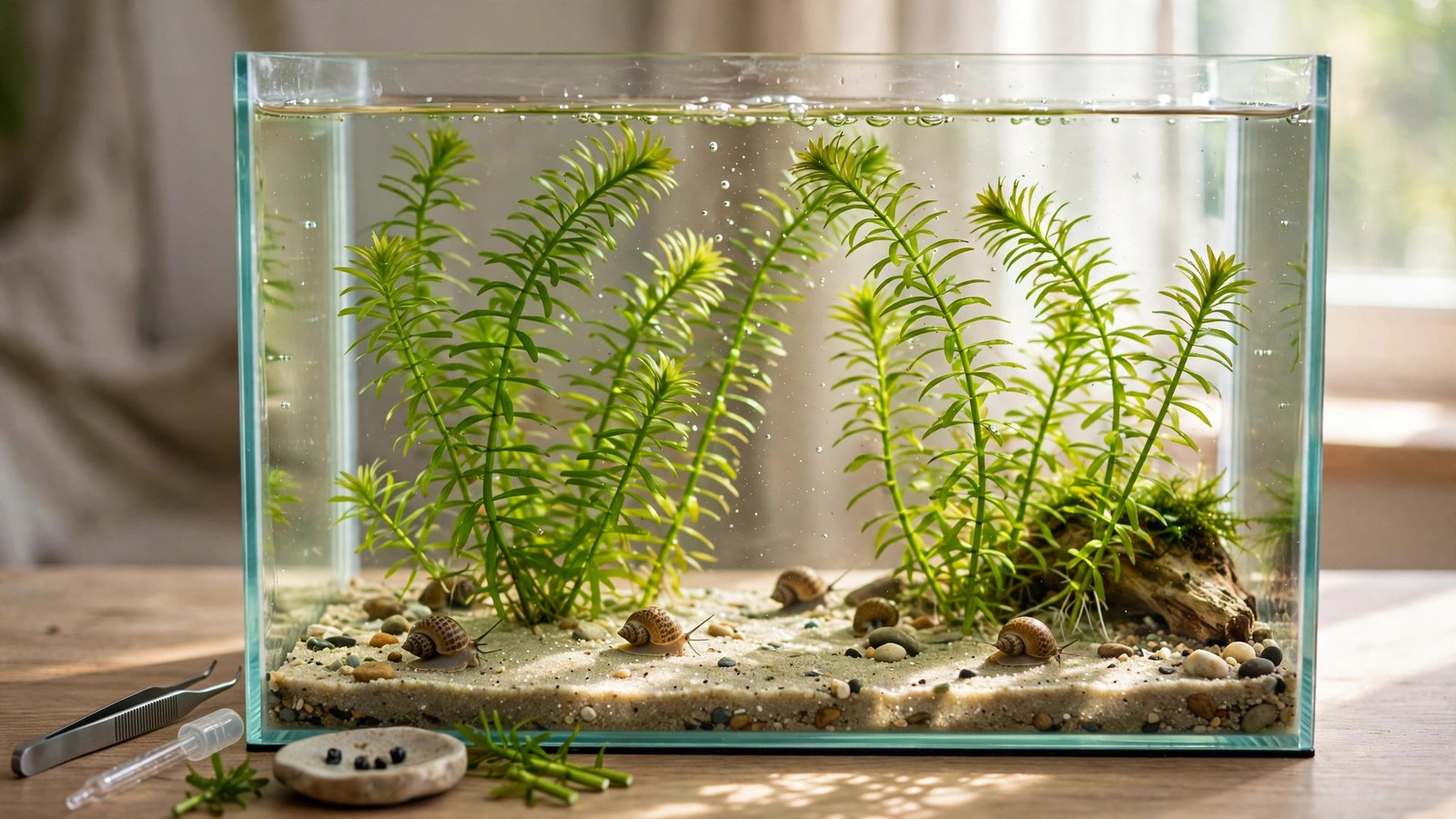
Every hobbyist's first plant, and still one of the most useful. Egeria densa care (sold as anacharis or Brazilian waterweed) is about as simple as aquarium plants get: it grows in almost any water, tolerates cold, needs no CO2, and can be planted or floated. Native to South America, it's a beginner's best friend — and, like all vigorous plants, one to keep out of local waterways.
This guide covers planting and floating, light and temperature tolerance, its role in new tanks and ponds, propagation, and the invasive-species responsibility that comes with such a vigorous plant.
Quick Care Reference
| Parameter | Requirement |
|---|---|
| Light | Low to high (25+ PAR) |
| CO2 | Not required |
| Growth rate | Very fast |
| Placement | Background or floating |
| Difficulty | Very easy |
| Temperature | 50–82°F (10–28°C) |
| pH | 6.0–8.5 |
| Height | 12–40 inches (30–100 cm) |
The Classic Beginner Plant
Egeria densa has been sold in pet shops for generations — often as loose bunches labeled "anacharis" — because it survives conditions that kill nearly everything else. Its whorls of bright green leaves grow on sturdy stems, and it keeps growing in cool water down to 50°F, making it one of the few aquarium plants suitable for unheated tanks and temperate ponds.
It's also a genuine workhorse for water quality: Egeria absorbs ammonia, nitrates, and phosphates aggressively, and it oxygenates water heavily during the day. That's why it's recommended for cycling new tanks and for goldfish setups, where hardy, fast nutrient uptake matters more than aquascaping finesse.
Responsibility note: Egeria densa is invasive in many regions — it has choked waterways on multiple continents. Never release it into the wild, never dump tank water containing fragments into drains leading to waterways, and compost or trash trimmings. The same rule we noted for Hygrophila polysperma applies doubly here given Egeria's cold tolerance.
Planting or Floating: Your Choice
Egeria is unusually flexible. Plant stems an inch deep in the substrate — it roots readily, though never very deeply — or simply let it float. Floating Egeria grows just as well, trailing roots from its nodes, and makes excellent cover for fry and shy fish. Many breeders keep it exclusively floating.
Planted in the background, space stems 1–2 inches apart; it grows tall (up to 3 feet in ideal conditions) so give it vertical room. In ponds, weight bunches or plant in pots of gravel — it will fill the water column fast. It tolerates plain gravel fine; rich substrate isn't necessary, though root tabs don't hurt.
Light, Temperature, and CO2
Light: low to high all work. In low light it grows steadily and stays green; in strong light it grows explosively and develops denser whorls. An 8-hour photoperiod is plenty. It's not picky about spectrum either — basic shop lights grow it fine.
Temperature is where Egeria stands out: it thrives from 50°F to 82°F, tolerating unheated indoor tanks, temperate ponds, and cool basements where tropical plants fail. Above ~82°F growth slows and it can struggle — it's one of the few common plants that prefers it not too warm. For warm tanks above 80°F, hornwort is a better cold-and-warm-tolerant alternative with similar vigor.
CO2 is unnecessary. Egeria grows fast on dissolved CO2 alone and is actually efficient at using bicarbonate, which is part of why it does well in hard, alkaline water that stunts fussier plants.
Fertilizer Needs
Minimal. In stocked tanks, fish waste is usually enough. Egeria is such an aggressive nutrient absorber that it can actually strip a tank of nitrates — if other plants pale while Egeria thrives, the Egeria may be outcompeting them, and you may need to fertilize more or thin the Egeria. Add comprehensive liquid fertilizer if growth slows or older leaves yellow.
It's sensitive to some algaecides and liquid carbon products at high doses — dose conservatively around it, or better yet, rely on its natural vigor instead of chemical algae control.
Trimming and Propagation
Trim by cutting stems anywhere — Egeria doesn't care about nodes the way fussier plants do, though cutting above a whorl gives the tidiest regrowth. It grows inches per week in good conditions, so trim every 1–2 weeks in the growing season. Remove excess entirely rather than replanting everything; it multiplies faster than any tank needs.
Propagation: every cutting roots. Drop a 4-inch piece in water and it grows. This is why it's both beloved and ecologically dangerous — fragments the size of a fingernail can start new colonies, which is exactly why responsible disposal matters.
Troubleshooting Common Problems
Melting or shedding leaves
Newly purchased Egeria sometimes sheds lower leaves while adjusting — usually transient. Persistent melting suggests too-warm water (above 82°F), ammonia in an uncycled tank, or exposure to algaecides/copper. Egeria is copper-sensitive, so check medications and algaecides if it suddenly declines.
Slow or stalled growth
Unusual for Egeria — investigate. Common causes: water too warm, severe nutrient depletion (it's usually the cause of depletion, not the victim, but in very lean tanks even it stalls), or very dim light. In ponds, winter dormancy is normal; it resumes in spring.
Taking over the tank
The standard Egeria experience. Trim ruthlessly, remove whole stems, and consider whether a slower plant suits a display tank better — Egeria is a utility plant, not a fine aquascaping specimen. Its coarser texture suits natural-style and biotope tanks better than manicured Dutch layouts.
Fish eating it
Goldfish, silver dollars, and some cichlids graze Egeria enthusiastically — which is actually a point in its favor for goldfish tanks, since it grows faster than they eat it (usually). If fish strip it bare, switch to tougher plants like Anubias or Java fern, or grow Egeria in a separate refugium as a renewable snack.
Brittle stems breaking apart
Egeria stems snap easily when handled — normal. Fragments root and grow, so breakage during trimming just means more plants. In high-flow tanks, position it out of direct filter outflow to reduce constant fragmentation.
Best Uses: Where Egeria Earns Its Keep
Egeria densa is a utility player. Best deployments: cycling new aquariums (ammonia sponge), goldfish and coldwater tanks (one of few plants that thrives), breeding tanks (floating cover for fry), temperate ponds, quarantine/hospital tanks (hardy, disposable, oxygenating), and algae-fighting duty in any new setup. It's less suited to high-end aquascaping competitions — its coarse texture and explosive growth fight against manicured aesthetics — but for practical fishkeeping it's invaluable.
Pair it with other tough utility plants like hornwort and water wisteria for a bulletproof low-tech background that survives almost anything.
Pond and Outdoor Use
Egeria densa is one of the best oxygenating plants for temperate ponds. Plant weighted bunches in the shallow margins in spring; by midsummer it fills the water column, providing shade, shelter for fry and tadpoles, and serious nutrient uptake that starves blanket weed. In autumn, growth slows; in freezing climates it dies back to the crown and resprouts in spring, though a hard freeze solid through the pot can kill it — in very cold regions, overwinter a bucket of it indoors. Never plant it in natural ponds or waterways connected to wild systems; garden ponds with no outflow are the responsible limit.
Frequently Asked Questions
Is anacharis the same as Egeria densa?
Yes — anacharis is the trade name for Egeria densa (also sold as Brazilian waterweed). "Anacharis" bunches in pet shops are virtually always Egeria densa. A related plant, Elodea canadensis (American waterweed), is similar but less common in the trade and even more cold-hardy.
Can Egeria densa grow floating?
Absolutely — it grows just as well floating as planted, trailing roots from stem nodes. Floating Egeria is excellent fry cover and a great way to hold trimmings. It will shade plants below, so manage the surface coverage in planted tanks.
Does it need substrate?
No. Egeria absorbs most nutrients through its leaves and grows fine floating or weighted without substrate. Planted stems root lightly for anchorage. This makes it ideal for bare-bottom breeding and quarantine tanks. This flexibility makes it perfect for bare-bottom breeding and quarantine setups.
What temperature can Egeria densa handle?
An impressive 50–82°F (10–28°C). It thrives in unheated tanks and temperate ponds, going semi-dormant in cold winters and resuming in spring. Above ~82°F it struggles — keep it out of very warm discus-style tanks. Few aquarium plants match this remarkable temperature tolerance.
Why is my Egeria melting?
Check temperature first (too warm is the common cause), then copper/medication exposure — Egeria is copper-sensitive — then ammonia in new tanks. Brief leaf-shedding after purchase is normal adjustment. Established Egeria rarely melts without a clear cause. Healthy established Egeria is remarkably resilient once the cause is corrected.
Is Egeria densa invasive?
In many regions, yes — it has invaded waterways worldwide, forming dense mats that choke native ecosystems. Never release it or dump tank water containing fragments outdoors. Dispose of trimmings in the trash or compost. Its vigor in the aquarium is exactly what makes it dangerous in the wild.
Bringing It All Together
Egeria densa won't win aquascaping contests, and it doesn't try to. It's the plant you buy by the bunch for a new tank, a goldfish setup, a pond, or a breeding project — and it does the unglamorous work of cleaning water, sheltering fry, and outcompeting algae while asking for nothing. Respect its invasive potential, trim it often, and appreciate the hardest-working cheap plant in the hobby.