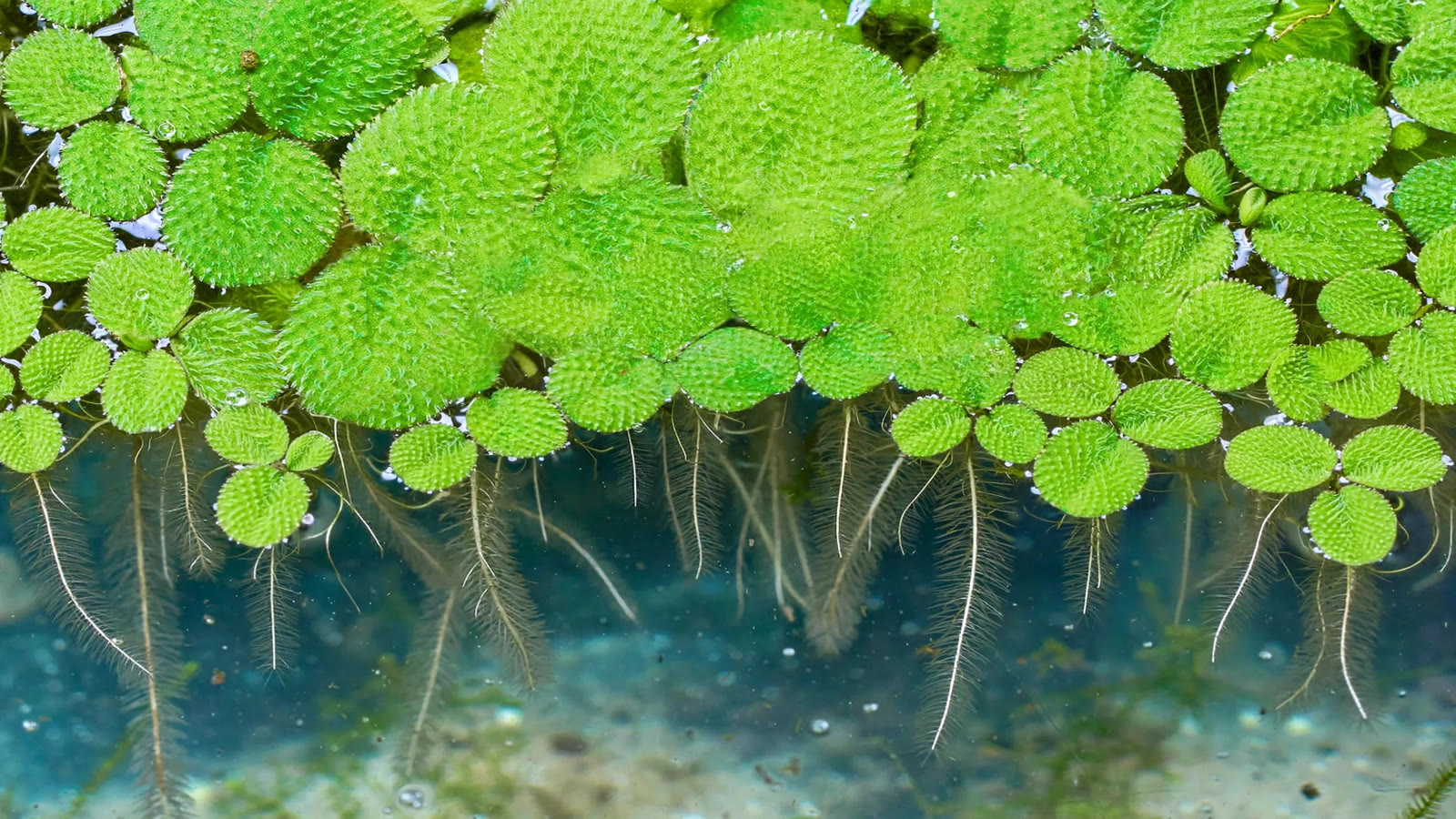
Every aquarist who has fought duckweed knows the frustration: once it gets into a tank, it never leaves. Salvinia aquarium plant care is refreshingly different — this floating fern delivers all the benefits of a nutrient-hungry surface plant, from nitrate control to dappled shade, while staying easy to remove whenever you want it gone.
What Is Salvinia? The Floating Fern
Salvinia is a genus of true floating ferns, not a moss or flowering plant. Every plant grows as a trio of fronds: two round floating leaves that sit flat on the surface, and a third submerged leaf dangling below like a feathery root. These dangling fronds anchor nothing — the plant floats freely — but they absorb nutrients from the water and shelter tiny fry and shrimp.
What makes Salvinia instantly recognizable is its leaf texture. Each floating leaf is covered in tiny hairs that trap air and repel water, so droplets bead up and roll off like mercury. Under magnification, some species reveal "eggbeater" hairs — groups of four filaments joined at the tips.
The species most commonly sold in the aquarium trade are Salvinia natans and Salvinia minima. S. natans, native across Europe and Asia, is the classic form with leaves around 1–3 cm across. S. minima — sold as "water spangles" — is smaller and handles warm aquarium water especially well. Care for both is virtually identical, so this guide covers them as one plant. (A third name, Salvinia molesta or giant salvinia, is a notoriously invasive species — covered in the responsibility note below.)
Because Salvinia is a fern, it never flowers. It spreads by growing longer chains of connected fronds that eventually break apart into new, independent plants. That vegetative reproduction is exactly why it colonizes a surface so fast — and why the humble corral ring, covered later, is such an important tool.
Salvinia Aquarium Plant Care Parameters
Salvinia is one of the most forgiving plants in the hobby. It floats at the surface, with unlimited access to atmospheric CO2 and the strongest light in the tank — so it escapes the two biggest headaches of submerged plant care.
| Parameter | Ideal Range | Notes |
|---|---|---|
| Light | Low to high | Standard kit LEDs fine; brighter light = faster, redder growth |
| Temperature | 18–30°C (64–86°F) | S. minima prefers the warmer end |
| pH | 6.0–8.0 | Adapts to soft and hard water alike |
| Hardness | Soft to hard | Tolerates a wide GH range |
| Surface flow | Still to gentle | Strong flow sinks leaves and causes rot |
| CO2 injection | Not needed | Pulls CO2 from the air |
| Fertilizer | Light liquid dosing | Pale leaves signal iron/micronutrient deficiency |
Light
Salvinia thrives under anything from dim stock lighting to intense aquascaping LEDs. Growth rate scales with light, and under strong light some strains blush red or bronze — a harmless stress color many aquarists like. The trade-off is shade underneath: the more surface it covers, the less light reaches the plants below.
Temperature and Water Chemistry
This is a tropical plant at heart, growing fastest between 22 and 28°C; S. minima stalls below 18°C for long stretches. It is broadly indifferent to pH and hardness — soft acidic blackwater and hard alkaline tap water both work. The one condition it dislikes is nutrient-starved water: in a sterile, fishless tank it may yellow from lack of nitrogen unless you dose a light liquid fertilizer.
Flow: The Still-Water Rule
Salvinia evolved for ponds and backwaters — still water. A hang-on-back filter blasting the surface will push the plants under, where leaves rot and the colony dies back in patches. Diffuse the outflow with a baffle or sponge and keep it out of the blast zone; the fern settles and spreads within days. If your Salvinia keeps vanishing, check your filter current first.
Growth Rate and Nutrient Uptake
Under good light and nutrients, Salvinia is one of the fastest-growing plants you can own — a starter portion can double its coverage every week, forming a continuous mat within weeks. Every new frond is built from nitrate, phosphate, and micronutrients pulled straight out of the water column, making it one of the most effective natural filters in the planted-tank toolkit.
This is why Salvinia earns its reputation as a nitrate sponge. In heavily stocked tanks where nitrates creep upward between water changes, a floating colony works around the clock, consuming the same dissolved waste that would otherwise feed algae. By monopolizing nutrients and shading the tank, it starves algae of both food and light. The caution: an aggressive mat can out-compete rooted plants for iron and micronutrients, so dose lightly if your submerged plants start showing deficiencies.
A full surface mat blocks the vast majority of light from reaching the substrate, which slowly starves carpeting plants and low-light species. Confine Salvinia to one area (see the corral section) so part of the surface stays open.
Propagating Salvinia
You do not propagate Salvinia so much as restrain it. New fronds bud from growing tips, and chains naturally fragment into daughter plants. To seed a new tank, scoop a handful of healthy fronds and drop them on the surface — they establish within days. Choose firm, green leaves with dry-looking fuzzy tops; waterlogged arrivals usually perk up after a day or two under light.
Rinse new stock in tank water before adding it. The dangling fronds can harbor algae strands, snail eggs, and — the classic hitchhiker — duckweed grains tucked between the leaves.
Salvinia vs. Duckweed: An Honest Comparison
Duckweed is the plant Salvinia is most often measured against: both are fast-growing floating nitrate absorbers. But they are very different tenants in practice.
| Trait | Salvinia | Duckweed |
|---|---|---|
| Leaf size | 0.5–3 cm, easy to see and handle | 2–5 mm, gets everywhere |
| Removal effort | Scoop whole mats by hand in seconds | Tedious — clings to everything, returns for months |
| Appearance | Velvety, textured, fern-like | Plain tiny green dots |
| Growth speed | Very fast (doubling weekly) | Extremely fast — can double in days |
| Nutrient uptake | Excellent | Excellent |
| Fry/shrimp habitat | Superb — long dangling fronds | Minimal — tiny rootlets only |
| Filter clogging | Rare — leaves too large for most intakes | Common — sucked into pre-filters and pumps |
The honest verdict: duckweed's tiny grains wedge into filter slots, hitchhike on every hand and net, and reappear weeks after you think it is gone. Salvinia delivers roughly the same benefits — nutrient uptake, shade, fry cover — while staying manageable, because each leaf is big enough to grab. If you have ever battled duckweed, Salvinia feels like a revelation.
How It Stacks Up Against Frogbit and Red Root Floater
Floater fans usually end up choosing between three premium options. Amazon frogbit is larger and lily-like, with dramatic trailing roots — but it needs humid air and melts easily under a closed lid. Red root floater is the beauty queen, with red undersides and crimson roots under bright light, but it is more demanding and slower to establish.
Salvinia wins on reliability. It does not care whether your lid is open or closed, it tolerates a wider range of water, and it establishes fastest of the three. Frogbit is the elegant centerpiece, red root floater is the collector's showpiece, and Salvinia is the workhorse that cleans your water while looking quietly good. For a similar hardy-and-useful alternative that grows submerged too, hornwort is another classic nutrient sponge.
Managing Overgrowth: Corrals and Skimming
Salvinia's one real demand is that you manage its ambition. Left alone it will carpet the entire surface, block light, and start dying underneath itself in thick, layered mats. Control, fortunately, is trivial compared to duckweed.
The classic tool is a floating corral ring: a loop of airline tubing (or a purpose-made feeding ring) floating on the surface that traps the plants in one area, leaving the rest open for gas exchange and light. Corrals also keep Salvinia out of the filter outflow — the main cause of leaf rot. Every week or two, scoop out a handful: each harvest exports the nitrates the plants absorbed, and regular skimming measurably slows nitrate creep in heavily fed tanks.
What you remove does not have to be wasted — it composts well, supplements herbivorous fish and shrimp in small amounts, or makes free starter portions for friends. Just never pour it down a drain connected to waterways or dump it in ponds and ditches.
Tank Mates: Betta, Shrimp, Fry and Fish
Salvinia is one of the best plants for the welfare of small livestock. Bettas are the classic pairing: the floating mat gives these surface-dwellers security from above, diffuses bright tank light they dislike, and anchors bubble nests — males happily build nests tucked among the dangling fronds. For shrimp colonies, the submerged fronds grow a film of biofilm and micro-algae that shrimplets graze, while the cover overhead makes shy shrimp bolder.
Fry of all kinds — livebearer babies, betta fry, killifish fry — find refuge in the dangling fronds, too fine for adult fish mouths to penetrate. Many breeders skip separate rearing containers for hardy species and just keep a Salvinia colony as a nursery layer.
The exceptions: goldfish, silver dollars, and large cichlids will eat Salvinia faster than it can grow — in their tanks it is an expensive salad. For most community fish, though, it is ignored, beneficial, and completely safe.
A Responsibility Note: Never Release Salvinia Into Local Waterways
Here is the serious side of a very easy plant. Several Salvinia species are invasive outside their native ranges. Giant salvinia (Salvinia molesta) is a Federal Noxious Weed in the United States and is prohibited in Florida, where the University of Florida's Center for Aquatic and Invasive Plants ranks it among the most damaging aquatic weeds in the world — its dense mats block sunlight, deplete dissolved oxygen, and clog waterways. Even the common aquarium species can naturalize in warm regions after casual disposal.
The rule is simple: never dump aquarium water, plants, or trimmings into ponds, ditches, storm drains, or natural waterways. Dry excess Salvinia completely and throw it in the household trash, or compost it far from any water body. Apply the same discipline to other vigorous plants — hardy species like water sprite and fast growers such as Rotala rotundifolia deserve the same respect. Keeping the hobby's plants inside our tanks is how we keep the hobby legal and welcome everywhere.
Frequently Asked Questions
How fast does Salvinia grow in an aquarium?
Very fast. In warm water with moderate to strong light and available nutrients, a colony can roughly double its surface coverage every week. A golf-ball-sized portion can cover a 20-gallon tank's surface within a month. Growth slows dramatically in cool water, low light, or sterile tanks with no nutrient source — pale, shrinking plants usually mean the water is too clean, and light liquid fertilization will restart growth quickly.
Does Salvinia need CO2 or special fertilizer?
No CO2 injection is needed because floating leaves draw carbon dioxide directly from the air. In stocked tanks, fish waste supplies plenty of nitrogen and phosphorus. Fertilizer only becomes necessary in lightly stocked or heavily planted tanks where the Salvinia competes with rooted plants — in that case, a standard all-in-one liquid fertilizer dosed lightly is enough. Watch for pale new leaves, which typically indicate iron or micronutrient deficiency rather than a lack of CO2.
Can I keep Salvinia in a tank with a lid?
Yes — Salvinia is one of the most lid-tolerant floaters, a big advantage over Amazon frogbit, whose leaves melt from condensation. Keep a small air gap between the lid and the water surface so leaves are not pressed flat and dripping wet, and avoid condensation raining directly onto the leaves. The fuzzy hairs repel water, but leaves sitting permanently waterlogged will eventually rot. An open-top tank is still ideal, but a lidded tank works fine.
Why is my Salvinia melting or sinking?
The three usual culprits are strong surface flow, leaves being kept permanently wet, and sudden temperature drops. Check that your filter outflow is not pushing the plants under, and keep them out of the direct blast zone. Melting after a cold water change or a cold shipping trip is also common — trim the mushy parts, keep the colony warm and well-lit, and new growth usually appears within days since the plant reproduces from healthy fragments.
Is Salvinia safe for betta fish and shrimp?
Completely safe, and actively beneficial. Bettas use it for bubble-nest anchors, shade, and a sense of security; shrimp and their babies graze the biofilm that grows on the submerged fronds. It is non-toxic to all common aquarium livestock. The only livestock caveat involves goldfish and large herbivorous cichlids, which will eat it — and in that case it is the plant, not the fish, that needs protecting.
The Bottom Line
Salvinia is the floating plant for people who want duckweed's benefits without duckweed's curse. It scrubs nitrates, shades out algae, and shelters bettas, shrimp, and fry — asking for almost nothing in return beyond calm water and the occasional handful scooped from the corral. For more surface-plant ideas, explore our guides to crystalwort as a floating carpet and hornwort, plus the species reference on Salvinia natans and the UF/IFAS guide to invasive giant salvinia.
Tissue-culture plants are the exception — they’re grown in sterile gel and adapt with minimal melting, which is part of what you’re paying for. Plants bought submersed from another hobbyist’s tank also transition with little melt, since they’re already in the right form.
Which Plants Melt Most (and Least)
Heavy melters (expect significant leaf loss)
- Cryptocorynes — infamous for “crypt melt,” sometimes dropping every leaf after any disturbance. They almost always recover from the roots within weeks.
- Stem plants grown emersed — rotala, ludwigia, and hygrophila often shed lower emersed leaves while the growing tips transition.
- Amazon swords — emersed-grown swords typically lose their broad oval aerial leaves and replace them with longer submersed ribbon leaves.
Light melters
- Anubias, java fern, bucephalandra — slow-growing rhizome plants transition gradually; occasional old-leaf melt but rarely dramatic.
- Vallisneria — usually transitions well, though it dislikes the move itself and may sulk for a week.
- Floating plants — minimal melt since their leaves were already at the air-water interface.
The Acclimation Protocol
Step 1: Quarantine or dip first
Before acclimating to your tank’s conditions, make sure you’re not acclimating pests along with the plant. Run new arrivals through our quarantine and dip protocol — it adds days upfront but prevents months of regret.
Step 2: Float to temperature-match (30 minutes)
Float the bag or container in your tank for 20–30 minutes to equalize temperature. Plants are less temperature-sensitive than fish, but a 10°F shock on top of transplant stress is an avoidable insult.
Step 3: Trim before planting
Remove any leaves that are already damaged, yellowing, or heavily algae-covered — they won’t recover and they’ll rot in your tank, feeding algae. For stem plants, trim off the bottom inch and any emersed leaves that look unlikely to adapt; the plant wastes energy maintaining leaves it’s going to shed anyway. Keep the healthy growing tips — that’s where recovery starts.
Step 4: Plant correctly the first time
Follow our planting guide — right depth, crown exposed on rosettes, rhizomes unburied on epiphytes. Every uprooting and replanting restarts the acclimation clock, so get placement right on the first attempt. Decide where each plant goes before it goes in the water.
Step 5: Run a gentle first week
For the first 7 days after planting:
- Moderate light — run your normal photoperiod but consider dropping intensity 20–30% if your light is dimmable. Blast-level light on a melting plant grows algae on the dying leaves, not recovery.
- Stable CO2 — if you inject CO2, keep it consistent. Fluctuating CO2 during acclimation is a melt accelerator. If you’re low-tech, this doesn’t apply — see growing without CO2.
- Half-strength fertilizer — new plants with damaged leaves can’t use full dosing, and the excess feeds algae. Ramp to full strength over 2–3 weeks per our fertilizer schedule.
- No disturbance — don’t move, trim, or “check on” new plants for at least two weeks. Every touch resets root establishment. This is especially critical for crypts.
Step 6: Remove melt, keep the base
As emersed leaves melt, remove the mushy material promptly — decaying leaves release ammonia and grow fungus that can spread to healthy tissue. But never discard the plant while the crown, rhizome, or roots are firm and alive. A crypt that’s lost every leaf but has firm roots is a plant that’s about to recover, not a dead plant. Give it 3–4 weeks before judging.
Telling Normal Melt From Real Problems
Normal transition melt:
- Affects oldest/emersed leaves first, newest growth last
- New submersed leaves emerge even as old ones dissolve
- Roots and crown stay firm and white/green
- Timeline: 1–4 weeks, then obvious new growth
Concerning melt (see our full melting diagnosis guide):
- New growth also melts or emerges deformed
- Rhizome or crown turns mushy and brown — this is rot, not transition
- Entire plant dissolves within days with no new growth after 4+ weeks
- Melting spreads to established plants that weren’t recently moved
Buying Tips to Minimize Melt
- Buy submersed-grown when available — hobbyist-grown cuttings transition with almost no melt.
- Choose tissue culture for sensitive species — crypts and delicate stems establish far more reliably from sterile cups.
- Avoid plants already melting in the store tank — some melt is normal, but a plant that’s mostly mush at purchase has less energy for recovery.
- Transport carefully — keep plants damp and out of direct sun/heat. A plant that dries out or cooks in a hot car melts far worse than one transported properly.
The First-Month Timeline: What to Expect Week by Week
Knowing what’s normal when removes most acclimation anxiety. Here’s the typical timeline for a healthy plant adapting to a new tank:
Week 1: The quiet week
Almost nothing visible happens. The plant is growing roots you can’t see and assessing its new environment. Some species (vallisneria, stem plants) may start shedding their lowest leaves. This is normal. Resist the urge to “help” — no moving, no extra fertilizer, no light changes. The most common beginner mistake is intervening during a week when the correct action is nothing.
Week 2: Melt peaks
This is when emersed leaves give up in earnest. Crypts may drop everything; swords shed their broad aerial leaves; stem plants lose lower foliage. It looks catastrophic and it’s usually fine. Keep removing mushy material, keep conditions stable, and watch the crown and growing tips — if those are firm and green, recovery is already underway.
Week 3: The turn
New submersed-adapted leaves emerge — smaller, thinner, often a slightly different shade of green than the emersed foliage. Stem plant tips start growing visibly; crypts push tiny curled leaves from the crown; swords unfurl narrow ribbon leaves. This is the moment most beginners exhale for the first time.
Week 4+: Established
New growth outpaces melt, and the plant is functionally yours. You can resume full-strength fertilizer, normal trimming, and stop treating it as fragile. Some slow growers (anubias, bucephalandra) take 6–8 weeks to show obvious progress — that’s their normal speed, not a problem.
Acclimating Different Plant Formats
Tissue-culture cups
Sterile, pest-free, and already adapted to high-humidity (not emersed) growth — tissue cultures melt the least of any format. Rinse the agar gel off gently (leftover gel rots and feeds fungus), split the portion into small plantlets, and plant per our planting guide. They establish slowly for the first two weeks, then accelerate. No dip needed, minimal acclimation stress — this is the premium experience you’re paying for.
Potted plants
Remove the pot and strip away the rockwool completely — leftover rockwool traps debris and rots. Tease the root mass apart gently; if it’s a dense mat, splitting it into 2–3 smaller portions actually establishes faster than planting one big clump (more growing points, better water flow around roots). Potted plants are usually emersed-grown, so expect the standard 2–4 week melt cycle.
Bare-root / bunched stems
Typically sold as weighted bunches. Remove any bands, foam, or weights, strip the lower leaves, and plant stems individually or in small groups. Bunched stems from the store are often already transitioning — check for new submersed growth at the tips, which tells you the plant is mid-adaptation and will settle quickly.
Hobbyist cuttings
Already submersed-grown and the fastest to establish — often showing new growth within days. The main acclimation factor is water-parameter difference between the two tanks. Float to temperature-match, plant promptly, and they’ll usually take off with minimal melt. This is why experienced hobbyists prefer trading cuttings over buying potted plants.
Frequently Asked Questions
Should I use a “plant starter” or transplant fertilizer?
Products marketed for transplant shock are mostly B-vitamins and mild hormones. They don’t hurt, but there’s no strong evidence they help aquarium plants specifically. Stable conditions and patience outperform any bottle. Save the money for more plants.
My new plant melted completely — bare crown, no leaves. Is it dead?
Probably not, if the crown or rhizome is firm. Crypts and swords routinely lose 100% of their leaves and regrow from the base within a month. The test is firmness: firm and pale/green means alive; mushy and brown/black means rot. Give firm-but-leafless plants a full 4 weeks before declaring them dead.
Can I speed up acclimation with extra light or CO2?
No — and trying usually backfires. A melting plant can’t use extra light; the excess just grows algae on its dying leaves. Keep light moderate and CO2 stable (not boosted) during acclimation. Growth speed comes from the plant’s own adaptation timeline, which you can’t rush, only avoid delaying.
Should new plants go straight into my main display tank?
After quarantine/dipping, yes — there’s no benefit to a separate “growing-in” tank for most plants. They acclimate to your water fastest in the tank they’ll live in. The exception is very delicate species going into a tank with boisterous fish; give those a few weeks in a calm corner or breeder box first.
The Patience Rule
The single most important acclimation skill is restraint: plant it right, set gentle conditions, remove decay, and then leave it alone for a month. The hobbyists with the best plant growth aren’t doing something clever in week one — they’re simply not interfering in weeks two through four while the plants do what they’ve evolved to do. Melt looks like failure and feels like failure, but in most cases it’s the visible part of a plant successfully becoming yours.