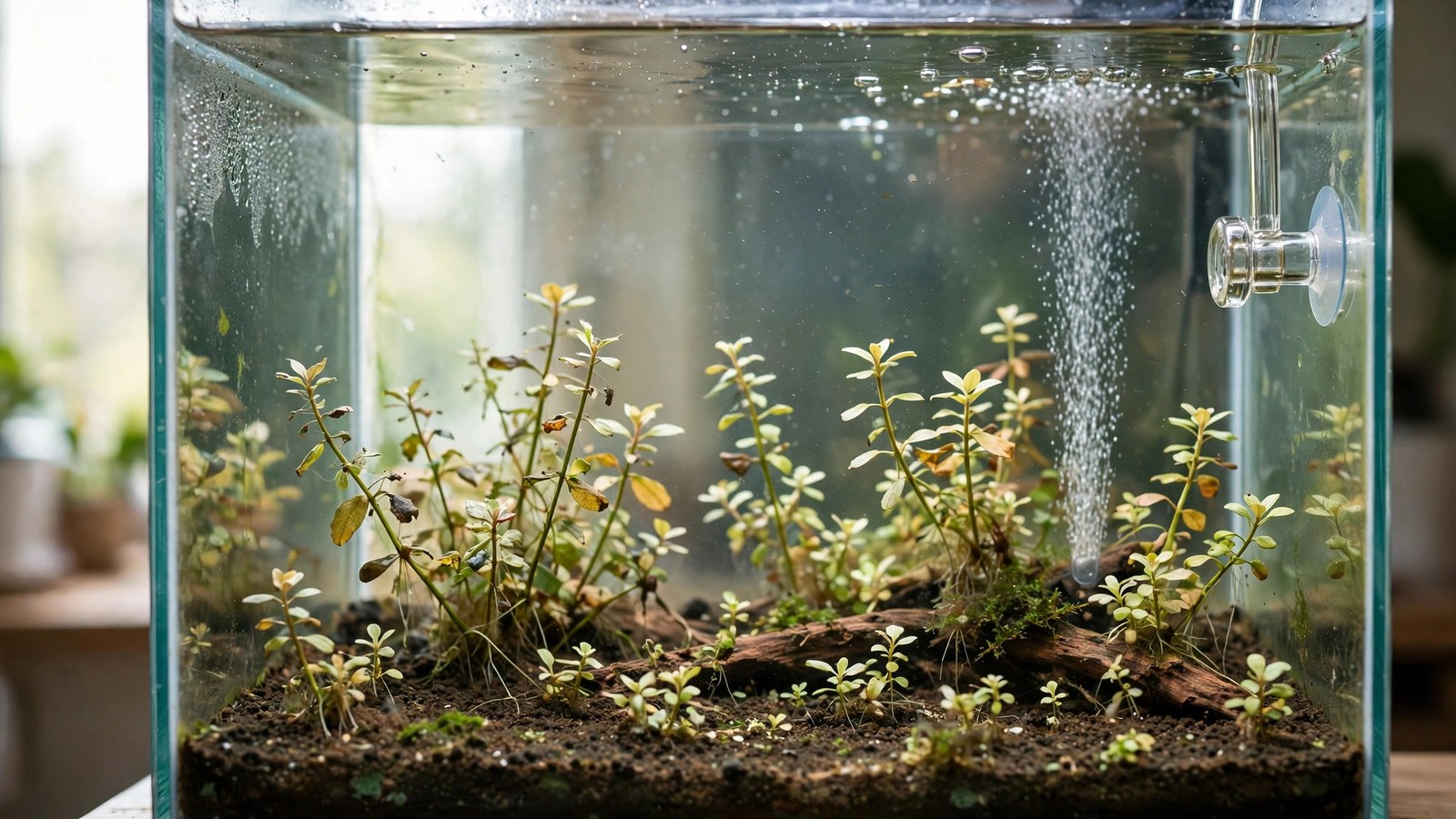
Your plants are alive but joyless: slow, pale, covered in algae, melting at the edges — and your fertilizer, light, and water parameters all check out. When everything tests fine but plants still struggle, the invisible culprit is usually carbon. CO2 deficiency is the most under-diagnosed problem in planted tanks because you can't see CO2, most test kits don't measure it directly, and its symptoms masquerade as half a dozen other issues. These seven signs will teach you to spot carbon starvation — in both injected and low-tech tanks.
Why CO2 Matters More Than Fertilizer
Carbon is the primary building block of plant tissue — roughly 40% of a plant's dry mass is carbon, versus single-digit percentages for nitrogen and fractions for everything else. Aquatic plants get carbon almost entirely from dissolved CO2 (not from carbonates — the "liquid carbon" myth dies hard). In water, CO2 diffuses 10,000 times slower than in air, so submerged plants live in a permanent carbon desert compared to their terrestrial cousins.
This is why CO2 injection transforms tanks so dramatically: you're removing the single biggest growth bottleneck. And it's why CO2 deficiency — too little, or unstable levels — produces such wide-ranging misery: every process in the plant is carbon-limited simultaneously.
The 7 Signs of CO2 Deficiency
Sign 1: Stalled growth despite good light and fertilizer
The classic. Light is strong, fertilizer is dosed, water parameters are fine — and plants just sit there, growing millimeters per week. When all other inputs are adequate, carbon is the limiting factor by elimination. Plants can't build tissue without carbon no matter how much nitrogen you pour in. If your tank has "everything right" but nothing grows, suspect CO2 first. Our plants not growing guide walks through this elimination.
Sign 2: Algae — especially black beard and staghorn
CO2-stressed plants leak organic compounds and stop consuming resources, creating exactly the conditions algae exploit. Black beard algae (BBA) is the signature CO2-fluctuation algae — it appears within days of CO2 instability in injected tanks. Staghorn algae similarly tracks CO2/flow issues. If BBA blooms after your CO2 cylinder ran empty or your diffuser clogged, that's not coincidence — it's diagnosis. See our BBA guide and staghorn guide.
Sign 3: Plants "pearling" never happens
Pearling — streams of oxygen bubbles rising from leaves — indicates photosynthesis running faster than the water can absorb oxygen. In a healthy injected tank, pearling starts 2–4 hours into the photoperiod. A tank that never pearls despite strong light is photosynthesizing weakly — and weak photosynthesis with strong light points at carbon limitation. (Low-tech tanks pearl less dramatically; judge against your own tank's baseline, not someone's high-tech video.)
Sign 4: New leaves are small and deformed
Carbon-starved plants produce undersized, sometimes curled new leaves — they simply can't build full-size tissue. This differs from calcium twisting (structural deformation) and iron paleness (color failure): CO2-deficient new growth is often normally colored but miniature, as if the plant ran out of building material mid-leaf. Which is exactly what happened.
Sign 5: Melting that follows CO2 changes
Plants adapted to injected CO2 levels that suddenly drop — cylinder empty, solenoid failure, diffuser clogged — melt within days. The plant built high-CO2 tissue it can no longer maintain. If melting coincides with any CO2 equipment issue, treat it as carbon crash until proven otherwise. Our melting after CO2 changes guide covers this specifically.
Sign 6: pH swings wildly between day and night
CO2 acidifies water; plants and outgassing remove it. In a tank with unstable CO2, pH swings more than 0.5 units between morning and evening indicate carbon chaos. A stable injected tank drops ~1.0 pH unit when CO2 turns on and holds it steady all day — the swing within the photoperiod is what matters. pH crashing mid-day means your CO2 delivery is failing intermittently.
Sign 7: Only "easy" plants survive; demanding species fail
Anubias, java fern, and moss thrive while rotala, ludwigia, and carpeting plants melt or stall. Low-demand plants tolerate low CO2; high-demand species don't. When the easy/hard divide maps exactly onto plant CO2 demand, the tank is telling you its carbon budget — and that your ambitions exceed it. Either add CO2 or align your plant choices with a low-tech reality.
CO2 Deficiency in Low-Tech Tanks
Low-tech keepers: this applies to you too. Your tank has CO2 — from fish respiration, decomposition, and atmospheric exchange — just less of it, delivered less reliably. Signs of carbon limitation in low-tech:
- Plants grow, but very slowly even with moderate light and fertilizer.
- Surface film (protein/oily layer) blocks atmospheric CO2 exchange — skimming it measurably improves plant growth.
- Overstocked-feeling tanks with few fish — fewer fish means less respiratory CO2. Lightly stocked low-tech tanks are the most carbon-limited.
- Still surface water — gentle surface agitation increases CO2 exchange in low-tech tanks (the opposite of injected tanks, where agitation outgasses precious CO2).
Low-tech CO2 improvements: skim surface film regularly, ensure gentle surface movement, don't over-filter (excessive agitation outgasses what little CO2 exists — balance is key), and consider liquid carbon supplements (glutaraldehyde-based) as a modest carbon boost — they're no replacement for gas injection, but they help low-tech tanks measurably.
Diagnosing CO2: The Drop Checker and pH Profile
The drop checker (essential for injected tanks)
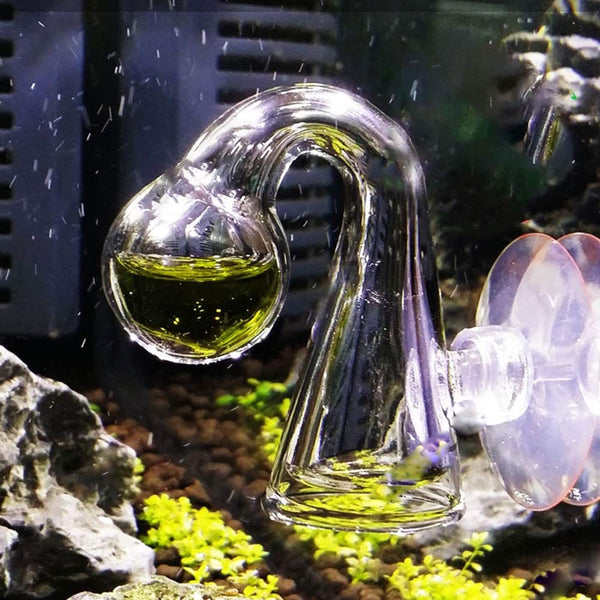
A drop checker — the little glass bulb with pH indicator solution — is the only practical continuous CO2 monitor:
- Blue = too little CO2
- Lime green = good (~30 ppm)
- Yellow = too much (livestock danger)
Check it 2–3 hours into the photoperiod — it lags about two hours behind actual levels. Lime green at lights-on means your CO2 timing is right (on 1–2 hours before lights). Still blue at midday means delivery failure: empty cylinder, clogged diffuser, or insufficient bubble rate.
The pH profile method
Measure pH before CO2 turns on and again 3 hours into the photoperiod. A 1.0 pH unit drop indicates roughly 30 ppm CO2 — the standard target. Less than 0.6 drop = under-injected. More than 1.4 = danger zone for livestock. This method calibrates your bubble rate to your specific water — more reliable than any "bubbles per second" rule.
The drop checker this section is built around; ships with 4dKH solution: FZONE CO2 drop checker.
 ★4.6
FZONE Glass CO2 Drop Checker Kit
Check Price on Amazon ★4.6Fixing CO2 Deficiency
For injected tanks
- Stabilize first, increase second. Consistent 20 ppm beats fluctuating 30 ppm — fluctuations trigger BBA and melting worse than steady low levels.
- Verify timing: CO2 on 1–2 hours before lights, off 1 hour before lights-out.
- Clean or replace the diffuser monthly — clogged ceramic diffusers are the top cause of gradual CO2 decline.
- Improve distribution: CO2 mist should reach every area. Dead spots = local deficiency = local algae. Adjust flow before increasing bubble rate.
- Check for leaks: soapy water on all connections. A slow leak at the regulator wastes gas and destabilizes levels.
- Increase gradually toward the 1.0 pH drop target, watching livestock for distress (gasping at surface = too much).
For low-tech tanks
- Skim surface film; ensure gentle surface agitation.
- Consider liquid carbon as a supplement (follow dosing exactly — overdoses melt vallisneria and stress shrimp).
- Match plant choices to carbon reality — or add CO2 and join the high-tech world.
- Don't chase high light without carbon — light drives CO2 demand. Reducing light intensity is a legitimate fix for carbon limitation.
Bioavailable carbon for low-tech tanks that can't run injected CO2: Seachem Flourish Excel.
The Stability Commandment
If this article has one commandment, it's this: stable CO2 beats high CO2. The worst CO2 regime isn't low — it's inconsistent. Plants adapt their enzymes and leaf structure to available carbon over 1–2 weeks; every fluctuation forces re-adaptation, during which growth stalls and algae invades. A tank at steady 15 ppm grows better than one swinging between 10 and 40. Fix the consistency before chasing the number — your plants will thank you with the kind of growth that makes the whole hobby worthwhile.
Frequently Asked Questions
Do I need CO2 injection for a planted tank?
No — but you need to match expectations to carbon. Low-tech tanks grow anubias, ferns, mosses, crypts, and many stems beautifully, just slower. CO2 becomes near-necessary for demanding carpeting plants (HC Cuba, dwarf baby tears), intense red coloration, and fast, lush stem growth. The mistake isn't skipping CO2 — it's skipping CO2 while demanding high-tech results. Choose one path and commit.
Can too much CO2 harm fish?
Yes — CO2 above ~40 ppm causes respiratory distress: fish gasp at the surface, become lethargic, and can die. Signs appear within hours of over-injection. The drop checker turning yellow is your warning; gasping fish is the emergency. Increase surface agitation immediately and reduce the bubble rate. Target lime-green (30 ppm), never push into yellow "for the plants" — dead fish grow no plants.
Why did my plants melt when my CO2 ran out for two days?
Because they'd built high-CO2 tissue — thinner cuticles, more photosynthetic machinery — that can't function at low carbon. It's like an athlete suddenly breathing thin air. Two days is enough to trigger melt in sensitive species. This is why backup cylinders, low-pressure alarms, and consistent refills matter more than maximum bubble rates. Stability, always. See our carbon crash guide for recovery.
Is liquid carbon (Excel-type products) a replacement for CO2 gas?
No — it's a supplement, not a substitute. Glutaraldehyde-based products provide a modest usable carbon source and have mild algaecidal effects, which genuinely helps low-tech tanks. But they can't match dissolved gas for demanding plants, and overdosing melts vallisneria, stresses shrimp, and in extreme cases harms fish. Useful tool, wrong expectations — don't expect gas results from a bottle.
My drop checker is green but plants still struggle. Now what?
Green means adequate CO2 at the checker's location — usually mid-tank. Struggling plants in dead spots may still be carbon-starved locally. Check distribution: is mist reaching the problem area? Also verify the checker solution is fresh (replace monthly) and that you're reading it mid-photoperiod, not at lights-on. If CO2 is truly fine everywhere, move down the diagnostic chain: light, then nutrients via our deficiency guide.
Carbon: The Invisible Foundation
Every planted tank sits on an invisible foundation of carbon, and most mysterious "everything's fine but nothing grows" cases are foundation problems. Learn the seven signs, monitor with a drop checker, prioritize stability over intensity, and match your ambitions to your carbon budget. Get carbon right and the rest of the hobby — fertilizer, light, aquascaping — finally starts working the way the guides promised.