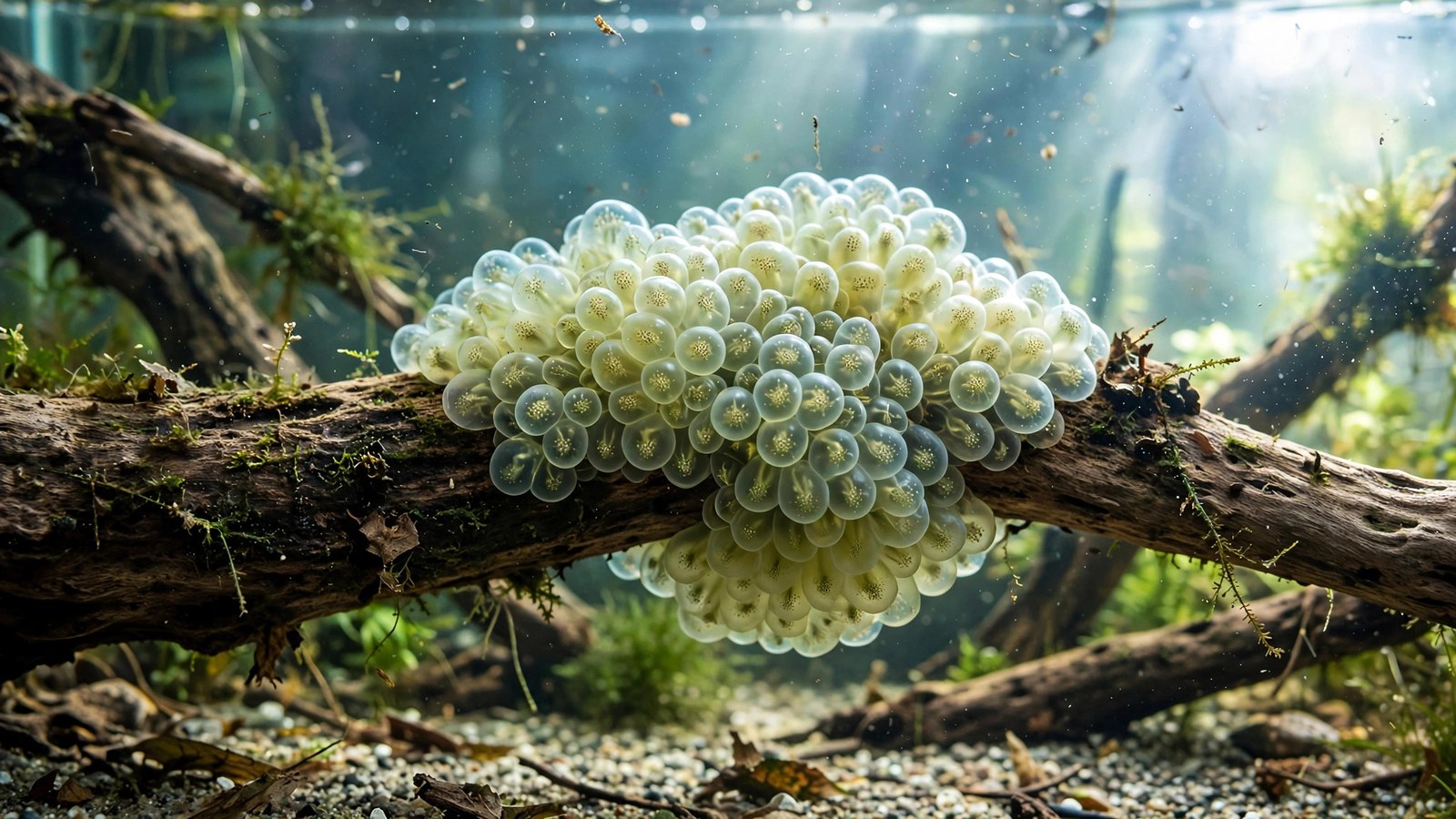
Yesterday your driftwood was bare; this morning a translucent jelly blob with a faint brain-wrinkle texture has grown on it, and you are fairly sure it is alive. It is not a fungus, a parasite, or anything dying — the likely answer is freshwater bryozoans in aquariums, harmless colonial filter-feeders found almost exclusively in mature, healthy tanks. This guide will help you identify the colony, rule out the look-alikes, and decide whether to leave it or remove it.
Freshwater bryozoans in aquariums: what that jelly blob actually is
A bryozoan colony is hundreds to thousands of identical tiny animals called zooids living in a shared gelatinous structure. Each zooid is a fraction of a millimeter long and feeds with a tentacle crown that sweeps bacteria and infusoria from the water — the "jelly" is simply the housing they built together.
The showpiece form is Pectinatella magnifica: firm, translucent masses from marble to softball size with a faintly wrinkled, brain-like surface — exactly what most people photograph in a panic. Cristatella and Plumatella grow as branching, mossy mats creeping along driftwood and rock. All are translucent to brownish, firm like jelly (not slimy), and never fuzzy. For the full biology, a detailed overview of bryozoan biology is a solid starting point.
Colonies seem to appear overnight because of the statoblast: a dormant, seed-like capsule produced by the dozen that survives drying, freezing, and months of neglect. Statoblasts ride into tanks invisibly on new plants and driftwood, then hatch once the tank's microscopic food supply is rich enough. Your tank was colonized long before you ever saw the blob.
Why they show up in mature tanks
Bryozoans are picky eaters. A colony needs a constant supply of suspended micro-organisms — infusoria, bacteria, fine detritus — which only exists in an established tank with a settled filter and a developed biofilm community. This is why they almost never appear in tanks younger than a few months, and why a sudden colony usually coincides with a tank that has finally stabilized.
New plants and hardscape are the usual delivery vehicle: statoblasts hide in root masses and driftwood cracks, invisible to the naked eye. Rinsing and inspecting new stock — as covered in this freshwater aquarium plants guide — reduces the odds, though no routine dip kills every statoblast without damaging the plant.
What it could be instead: four common look-alikes
Bryozoans are frequently misidentified, and the mistaken identity usually leads to the wrong treatment. Check this table before you do anything:
| Feature | Bryozoan colony | Hydra | Freshwater sponge | Water mold (saprolegnia) | Snail or fish eggs |
|---|---|---|---|---|---|
| Texture | Firm jelly, wrinkled or brain-like | Soft tentacled polyps, no jelly | Crusty, rough, often greenish | Cottony white fuzz | Individual round capsules |
| Harm | None | Stings fry and baby shrimp | None | Infects stressed fish and eggs | Varies by species |
| Treatment | Leave or scrape off | Targeted removal needed | Leave or scrape off | Medication required | Identify the layer |
The hydra confusion is the costly one. Hydra are tiny stinging polyps that genuinely harm fry and newborn shrimp — see our hydra identification and removal guide if your blob resolves into tentacled individuals rather than solid jelly. Water mold is the other dangerous misread: it grows on the fish itself or uneaten food as cottony fuzz, never as firm brain-textured jelly on wood.
Clusters of tiny translucent dots that appeared after adding snails are probably eggs — our pest snails guide will identify the layer. And our freshwater limpets guide covers another hitchhiker that startles planted-tank keepers.
Are bryozoans harmful to fish, shrimp, or plants?
No — this is unambiguous. Freshwater bryozoans do not sting, bite, parasitize, eat plants, or foul the water. They feed entirely on particles you cannot see, and a colony is, if anything, doing your filtration a small favor.
Shrimp are the best judges: neocaridina and amano shrimp graze happily over colonies and are never harmed — one reason colonies so often appear in shrimp-heavy tanks, where the abundant biofilm supports both. For stocking that pairs well with delicate invertebrates, see this aquarium plants for fish tanks guide.
Bryozoans are pollution-sensitive: in the wild, scientists use them as bioindicators of clean water. A colony thriving on your driftwood means water quality, stability, and the food web are all in good shape — the opposite of an emergency.
Leave them, remove them, or prevent them: your options
Leave them (recommended). Most colonies stabilize at a modest size, shrimp graze them back, and within weeks they become just another texture in the scape — a living filter you did not have to buy.
Remove them. If the blob ruins the aquascape, scrape it off with a toothbrush during a water change and siphon out the pieces before they resettle. Colonies can regrow from fragments, so expect to repeat once or twice. On a plant leaf, the fastest fix is trimming the affected leaf entirely.
Prevent the next one. Swish new plants in a bucket of old tank water and check stems for gelatinous smears. Scrub new driftwood and rocks, and never move wet decor or nets between tanks without drying them first — statoblasts survive the trip. The same arriving-by-stealth pattern applies to other micro-fauna in our tiny white bugs guide.
On prevention honesty: statoblasts are tough. Boiling small hardscape kills them, but boiling a large driftwood centerpiece is impractical, and chemical dips strong enough to kill statoblasts reliably also damage plants. Aim for reduction, not a guarantee — and if one gets through, the worst outcome is a harmless jelly blob.
Frequently Asked Questions
Are freshwater bryozoans harmful to fish or shrimp?
No. Freshwater bryozoans cannot sting, bite, or parasitize anything — they feed only on microscopic suspended particles. Fish, shrimp, and snails are completely safe, and shrimp often graze directly on colonies without harm.
How do I get rid of bryozoans in my aquarium?
Scrape the colony off with a toothbrush during a water change and siphon out the fragments, since colonies can regrow from pieces. Never use copper, algicides, or antifungals — these endanger shrimp, snails, and filter bacteria far more than the colony does.
Do bryozoans mean my water is dirty or clean?
Clean. Bryozoans are sensitive to pollution and thrive only where water quality is good and the micro-food web is established. In wild habitats they serve as bioindicators of healthy water — a colony is evidence of stability, not a warning sign.
What is the difference between bryozoans and freshwater sponges?
Bryozoans are smooth, firm, translucent jelly — often brain-wrinkled — that feels gelatinous when touched. Freshwater sponges are crusty and rough, often greenish from symbiotic algae, looking more like a hard scab than a jelly. Neither is harmful; both can simply be left alone.
Can bryozoans spread to my other tanks?
Yes, via statoblasts — dormant capsules that survive drying and ride on wet nets, decor, or plant trimmings. Let equipment dry fully between tanks and never move decor directly from one wet tank to another. Never release aquarium water into local waterways.
The bottom line: congratulations, your tank passed inspection
That jelly blob is the planted-tank hobby's equivalent of a compliment. Your water is clean, your tank is mature, and a colony of wild filter-feeders chose your driftwood as a good place to live. Leave it be, let the shrimp graze it, and the next time it appears you will smile instead of panic.