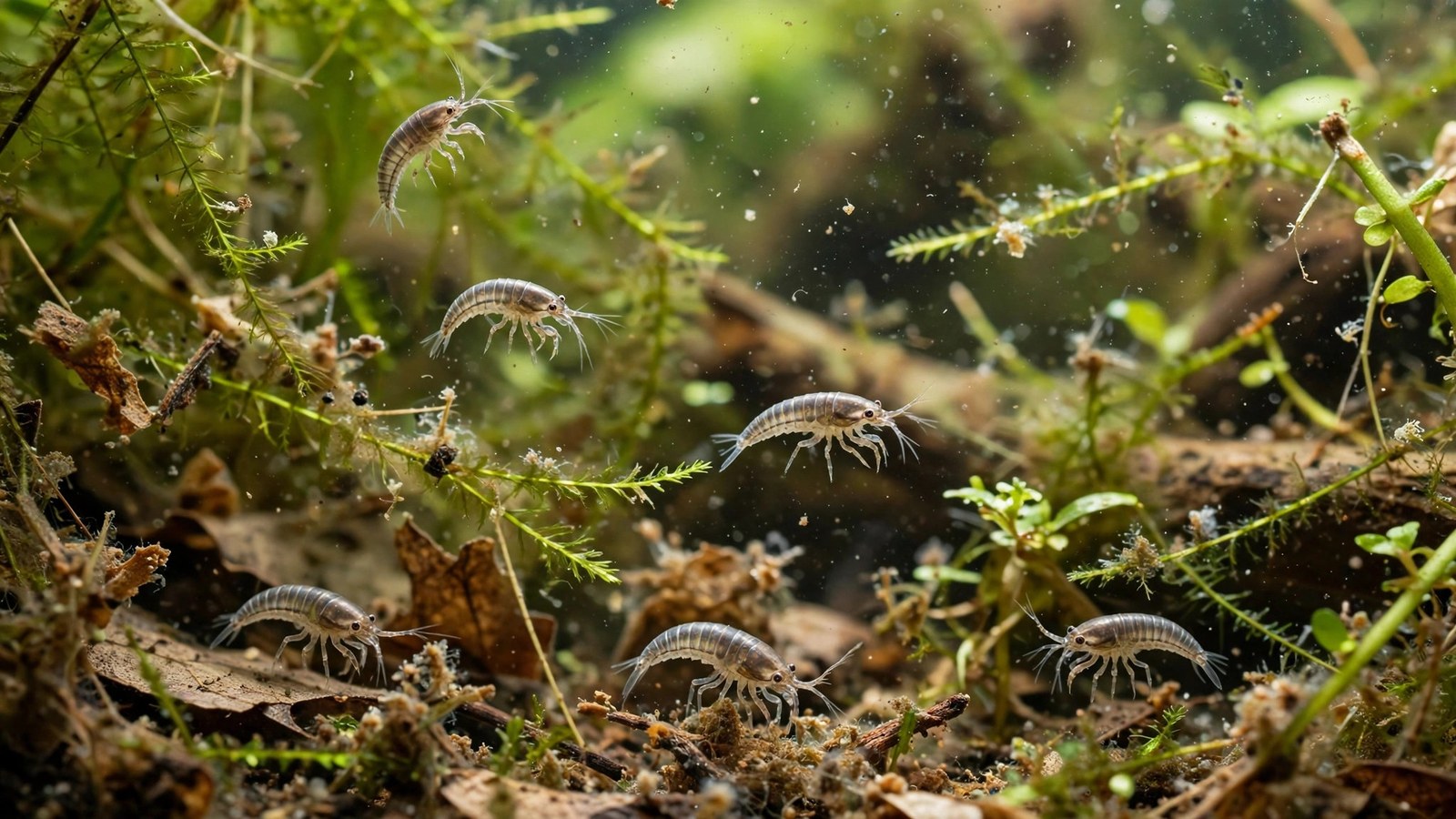
They rode in on a plant you forgot to dip. Now, after lights-out, comma-shaped swimmers are kicking up detritus around the base of your stem plants — and you're on your phone at 1 a.m. searching "scuds in aquarium good or bad," hoping the answer is "good."
Here's the honest answer: scuds are both, depending on your tank. These little crustaceans — freshwater amphipods, mostly Gammarus species, nicknamed "scuds" or "sideswimmers" — are a legitimate cleanup crew and a genuine headache in equal measure. By the end of this guide you'll identify them with certainty, know whether they belong in your setup, and be able to remove them humanely if they don't.
What You're Actually Looking At
A scud is a freshwater amphipod, a tiny crustacean in the order Amphipoda — distant cousin to shrimp, not a baby one. Aquarium hitchhikers are usually Gammarus species, though relatives like Hyalella and Crangonyx show up too. Adults run 5–20 mm, translucent grey, olive, or brownish, and their body is laterally compressed — flattened from side to side — which forces that signature curved, comma-like posture.
Watch one for ten seconds and the ID is unmistakable: they don't swim upright like fish or glide like worms. They kick with seven pairs of legs and dart sideways in sharp, jerky bursts, hence "sideswimmer." Two pairs of long antennae sweep ahead of the head. If you want to double-check the taxonomy, the Gammarus lacustris species profile confirms the amphipod body plan and notes their role as freshwater detritivores.
One reason they're so persistent: reproduction is ruthlessly efficient. Females carry 10–50 eggs in a brood pouch on the underside, and the young hatch as miniature adults — no larval stage, no waiting around. In a well-fed tank with no predators, a few invisible juveniles can become a visible colony in six to eight weeks.
How They Got Into Your Tank
Scuds don't appear from nowhere; every colony started as stowaways. The usual suspects, in order:
- Live plants. Juveniles the size of a grain of sand cling to leaves, roots, and especially moss. Eggs ride in the crevices of stems bought from shop tanks.
- Live food cultures. Daphnia and blackworm tubs from fellow hobbyists frequently contain scud hitchhikers or their eggs.
- Used hardscape or substrate. Rocks, wood, and gravel from an established tank carry eggs in every crevice.
- Pond and wild plants. Anything pulled from an outdoor source is practically guaranteed to host them.
The annoying part is timing: the 2–3 mm juveniles are nearly invisible, so you won't notice anything until weeks later when the first generation reaches breeding size and the population graph goes vertical. This is the same reason aquarists quarantine against pest snail hitchhikers on new plants — dipping works for scuds too, as you'll see below.
Scud or Something Else? A Quick ID Check
Not everything that crawls in your tank is a scud, and the fix depends on the ID. Run through this table before you act:
| Creature | Size | What to look for | Where you see it |
|---|---|---|---|
| Scuds | 5–20 mm | Curved, comma/C-shaped body; darts sideways in jerky kicks | Substrate, plant bases, moss |
| Neocaridina shrimplets | ~3 mm at birth | Straight miniature-shrimp shape; swims upright, not sideways | Everywhere; look for berried females |
| Copepods / seed shrimp | 1–2 mm | Tiny dots that dart or inch along glass; no visible curve | Glass, especially near light |
| Detritus worms | 2–5 mm | Thin white threads, wriggling freely in the water column | Water column after disturbance |
| Planaria | 3–10 mm | Flat, arrow-headed worms that glide on glass | Glass and hardscape at night |
If what you're seeing is a 1 mm speck on the glass rather than a curved side-swimmer, you're dealing with the tiny white bugs like copepods and seed shrimp — a different organism with different management. Detritus worms are another common lookalike that only resemble scuds at a glance. And if you spot flat, arrow-headed worms gliding on the glass, that's planaria — which, unlike scuds, are an unambiguous pest in shrimp tanks.
The Case for Keeping Them: A Genuine Cleanup Crew
In the right tank, scuds earn their keep. They eat the things you'd rather not have: decaying plant matter, uneaten fish food, soft algae film on leaves and hardscape, and the mulm that settles into substrate. A healthy colony quietly converts waste into live biomass instead of letting it rot into ammonia.
They're also outstanding live food. Guppies, Endlers, tetras, bettas, and dwarf cichlids hunt them with obvious enthusiasm, and the chase triggers natural foraging behavior that flake food never does. Fish fry raised with scuds to pick at grow noticeably faster and hardier. Some breeders keep a dedicated scud colony in a spare bucket or jar for exactly this reason — it's free, self-replenishing live food.
Finally, scuds lightly churn the top layer of substrate as they forage, which discourages anaerobic pockets in fine gravel. In a community fish tank with robust plants and a normal stocking level, a scud population usually settles into the background as just another member of the cleanup crew — working alongside detritus worms and snails without anyone noticing.
The Case Against Them: When They Turn Pest
So why do so many planted-tank keepers declare war on them? Because scuds don't limit themselves to dead matter when hungry.
They nibble tender plants. In a lean, well-fed fish tank this is rare, but in tanks where scuds outnumber the food supply they'll rasp at the softest growth available: carpet runners, moss tips, fresh stem-plant shoots, and the tender leaves of delicate species. If your carpet plants refuse to spread despite good light and nutrients, scuds grazing the runners are a real suspect — not just algae or trimming issues. Mysterious bite marks and missing leaf tips are also easy to misread as holes in plant leaves from nutrient deficiency, so check for the culprits at night before blaming your fertilizer.
They compete with shrimp. This is the big one. Scuds are faster and bolder than cherry shrimp at a food pellet, and in a crowded colony they'll push shrimp aside at feeding time. Worse, large scuds harass molting shrimp and newborn shrimplets, which are soft and defenseless for hours after a molt. Shrimp keepers who notice shrimp dying in a planted tank without obvious water-parameter causes should check the scud census — a booming population plus dwindling shrimplets is a classic pattern.
They explode. Females breeding every few weeks with no predators means populations can go from a handful to hundreds in a single season. At that density they're a visible pest crawling over everything, adding bioload and stealing food meant for your livestock. A scud explosion is never about the scuds being evil — it's a symptom of overfeeding, and the fix starts there.
Keep or Remove? Decide in 60 Seconds
| Your tank | Verdict | Why |
|---|---|---|
| Community fish tank, robust plants | Keep them | Fish hunt them, they clean detritus, plants are too tough to tempt them |
| Shrimp-only breeding tank | Remove | Food competition and shrimplet harassment; no fish to control numbers |
| High-tech aquascape with delicate carpets | Remove or minimize | Carpet runners and moss are their favorite snacks when hungry |
| Fishless plant grow-out tank | Keep them | Free cleanup crew with zero downside — plants benefit from the detritus processing |
| Tank with shy fish you never see hunting | Reduce | Scuds outbreed slow predators; trap and siphon to keep numbers in check |
How to Remove Scuds Humanely (What Actually Works)
If you've decided they don't belong, work through these methods in order. None require chemicals, and all of them spare your shrimp and snails.
1. Cut the food supply first
A scud boom is an overfeeding signal. Feed only what livestock eat in two minutes, remove uneaten food the same day, and siphon the mulm line along the glass during weekly water changes. Reduce the food by a third and the population starts shrinking within two to three weeks — this single step fixes half of all "pest" scud situations.
2. Set a bottle trap
The classic scud trap is brutally effective. Take a small plastic bottle, cut the top off, invert it into the body to form a funnel, and drop in a blanched zucchini slice or half an algae wafer. Lay it on the substrate after lights-out. By morning dozens of scuds will have walked in and failed to find the exit. Empty it, reset it, and repeat nightly for two to three weeks. You'll pull hundreds out of a bad infestation without touching a single shrimp — they simply don't enter baited funnel traps the same way.
3. Add predator fish (if your tank allows)
In a community tank, hungry micro-predators do the work for you: a small group of Endlers or guppies, a single betta, or a scarlet badis will graze scuds down to background levels within a month. This only works where fish fit the plan — don't add fish to a shrimp breeding tank just to kill scuds, because you've traded one livestock problem for another.
4. Siphon during water changes
Scuds gather where detritus collects: along the front glass, under hardscape, in plant thickets. A gravel vacuum run slowly along those zones during each water change removes juveniles faster than they can replace them. Combine siphoning with trapping for a two-front squeeze.
5. Quarantine all new plants going forward
Removal is pointless if the next plant order re-seeds the tank. Dip every new plant before it enters your display: a 90-second hydrogen peroxide dip (1 part 3% peroxide to 4 parts water), or an overnight alum soak for moss and delicate stems, kills scuds, eggs, and most other hitchhikers. The discipline is the same one that stops pest snails arriving on new plants — one dip routine protects against both. Tissue-culture plants are sterile by definition and the safest buy for a scud-free shrimp tank.
Frequently Asked Questions
Are scuds harmful to fish?
No. Scuds don't bite fish, don't carry fish diseases, and are actively hunted by most fish as natural prey. The only scenario where fish and scuds conflict is extreme overcrowding, where scuds outcompete bottom-feeders for sinking food — a feeding problem, not a scud problem. In a community tank, scuds are at worst neutral and usually beneficial.
Will scuds eat my aquarium plants?
Healthy, established plants are generally safe. Scuds become plant pests when they're overpopulated and underfed: then they rasp tender new growth, carpet runners, moss tips, and soft stem shoots. Delicate species and freshly planted carpets are most at risk. If you see damage, confirm it's scuds with a nighttime check before changing your fertilizer routine.
Are scuds the same as shrimp?
No, though they're both crustaceans. Scuds are amphipods (order Amphipoda): laterally flattened, C-shaped, swimming on their sides. Aquarium shrimp like Neocaridina and Caridina are decapods: straight-bodied, swimming upright. Baby shrimp (shrimplets) can look similar at a glance, but they swim like tiny upright shrimp, not sideways kickers. The two groups don't interbreed.
How do I stop scuds from coming back after removing them?
Two rules: dip every new plant (peroxide dip or alum soak), and buy tissue-culture plants when a sterile start matters. Eggs are the silent vector — a tank can look scud-free for weeks, then a new plant shipment hatches a fresh generation. Never share hardscape or substrate between tanks without sterilizing it first.
Can I keep scuds on purpose as live fish food?
Absolutely — many breeders do. A 5-gallon bucket or spare tank with a sponge filter, some leaf litter or moss, and occasional vegetable scraps sustains a perpetual scud colony. Harvest with a small net or a bottle trap and feed directly to fish. Keep the culture physically separate from shrimp tanks, since even a few escapees can recolonize.
The Verdict: Cleanup Crew or Pest?
Scuds are a cleanup crew that becomes a pest when the conditions favor them. In a community fish tank with sensible feeding, they're free janitors and free live food — welcome them. In a shrimp breeding tank or a carpet-focused aquascape, they're competitors and plant nibblers — remove them with traps, predators, and strict plant quarantine. Either way, the answer to "scuds in aquarium good or bad" was never about the scud. It was always about your tank — and now you know exactly which side yours is on.