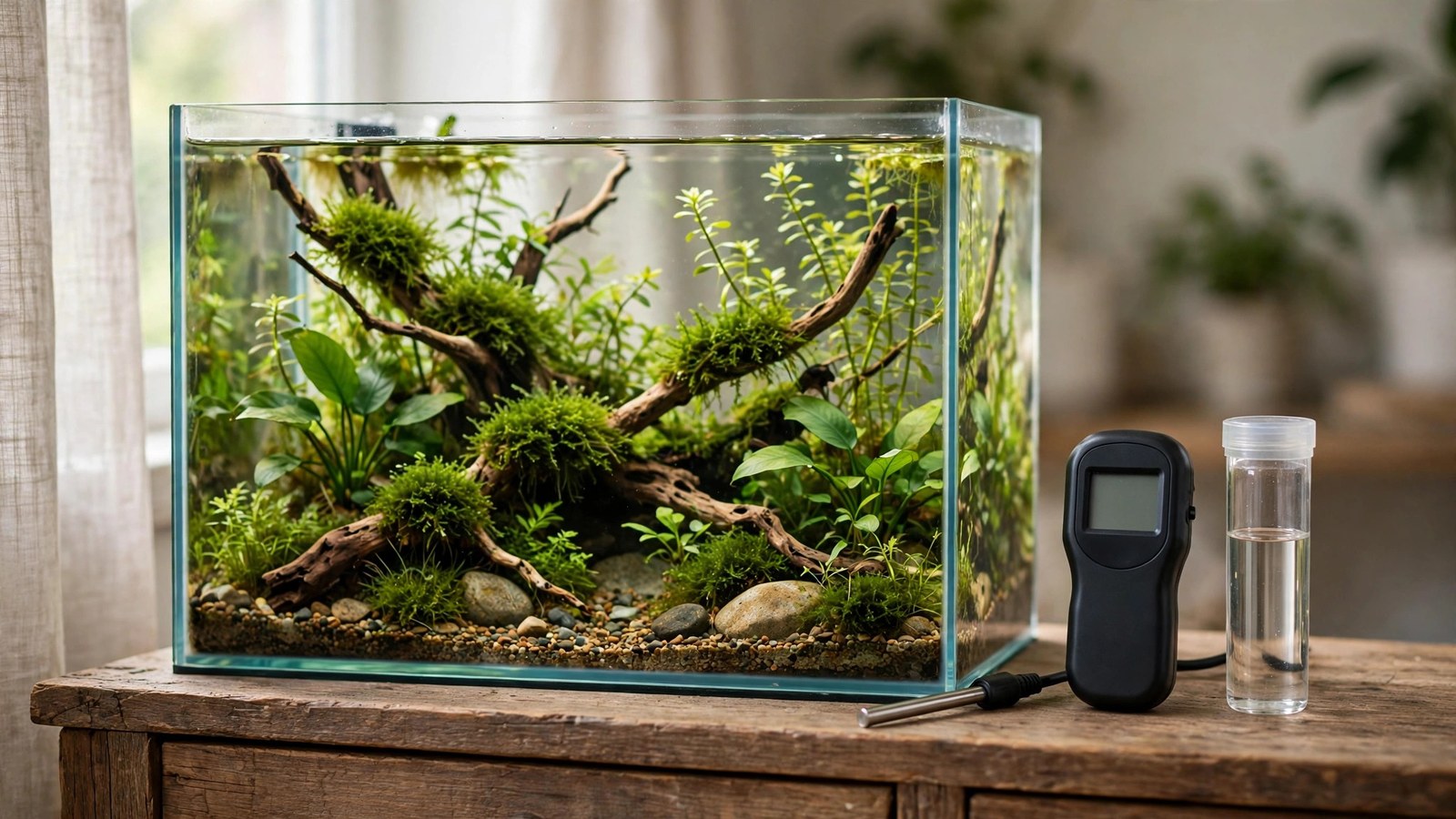
The meter read 480 ppm, and Maya had done everything right: weekly water changes, premium aquasoil, fertilizer measured to the milliliter. Yet her Rotala looked pale and stalled while a friend's scraggly tank thrived at 190 ppm. If you've ever wondered what those three digits on your TDS meter actually mean for your plants, this guide will turn the number into a tool — and tell you exactly where your TDS planted aquarium reading should sit for your setup.
Why Your TDS Number Deserves Attention (Even Though It Says Nothing Specific)
Total dissolved solids is everything dissolved in your water — calcium, magnesium, carbonates, nitrate, phosphate, sodium, plus the residue of every fertilizer dose you've added — summed into one number in parts per million. A TDS meter reads electrical conductivity and converts it, so it's really measuring how "charged" your water is, not counting individual minerals.
That makes TDS a blunt instrument: it can't tell you nitrate is at 40 ppm or calcium is low. What it does brilliantly is track change. A tank at 220 ppm one week and 350 ppm three weeks later is accumulating dissolved stuff faster than maintenance removes it — and your plants will usually show it first. For the full picture of what matters alongside it, see the broader planted tank water parameters guide.
TDS vs GH: What's the Actual Difference?
This is the confusion that trips up nearly every beginner, because both numbers describe "hardness-ish" things. They're related but not interchangeable:
| TDS (total dissolved solids) | GH (general hardness) | |
|---|---|---|
| What it measures | All dissolved substances combined | Only calcium and magnesium ions |
| Typical unit | ppm (or mg/L) | degrees (dGH) or ppm |
| How you measure it | Handheld conductivity meter | Liquid titration test kit |
| It tells you | Overall mineral load and its trend over time | Whether plants have the Ca/Mg they need for growth |
| It can't tell you | Which minerals make up the number | Anything about nitrates, phosphates, or carbonates |
Practically: GH answers "do my plants have enough calcium and magnesium?" TDS answers "how much stuff has built up since the last change?" A tank can have a perfect GH of 5 dGH and a TDS of 500 ppm — the minerals are right, but fertilizer salts and waste are piling up. Run both tests: GH sets your remineralization target, TDS tells you when maintenance is falling behind.
Ideal TDS planted aquarium targets, tank by tank
There is no universal magic number — the right target depends on your water source and what you're keeping. Aim for stability over precision: plants adapt to a consistent 250 ppm far better than to a number bouncing between 150 and 400. Starting from pure RO? Remineralize to your target before it ever touches the tank — our guide to remineralizing RO water for plants gives the exact dosing.
| Setup type | Target TDS (ppm) | Notes |
|---|---|---|
| Soft-water high-tech (CO2, RO-based) | 120–180 | Remineralize RO to 4–6 dGH; the favorite range of demanding stems and carpeting plants |
| Typical community planted tank (tap water) | 150–300 | Where most healthy tanks land; hardy plants thrive throughout this range |
| Hard tap-water tank | 200–400 | Works fine for tough species; blend with RO to bring stubborn tanks below 300 |
| Caridina shrimp breeding tank | 100–140 | Shrimp come first here — low, stable TDS with near-zero KH |
For context, even the EPA's secondary drinking-water guideline caps TDS at 500 mg/L — and your plants are fussier than your tap.
Why Your TDS Keeps Rising
A slow upward drift of 5–15 ppm per week is completely normal. When the number climbs fast, one of these is usually responsible:
- Evaporation topped off with tap water. Pure water evaporates; minerals stay behind. Top off with distilled water or RO instead.
- Fertilizer accumulation. Skipping water changes lets potassium, nitrate, and sulfate salts stack up.
- Leaching décor. Certain rocks (seiryu, limestone-based stone) and crushed-coral substrates release carbonates for months.
- Aging aquasoil. Active soils absorb hardness early on, then can release minerals as they break down.
- Waste. Fish food, fish waste, and decaying plant matter all end up as dissolved salts.
Track the rate, not just the reading. Note TDS right after each water change and again before the next — a steady weekly climb means your maintenance matches the tank; an accelerating climb means something new is leaching.
How to Lower TDS Without Wrecking Your Tank
Cutting TDS is simple; cutting it safely takes restraint. Big, sudden drops shock livestock and stall plants — move the number no more than 50–80 ppm per day.
- Series of partial changes with lower-TDS water. Two or three 30% changes over a week with an RO/tap blend lowers readings smoothly. (See water change technique for planted tanks.)
- Top off evaporation with RO or distilled only. This one habit prevents roughly half of all TDS creep.
- Reassess dosing. If TDS climbs between every change, cut your macro dose by a quarter for two weeks — most tanks are dosed richer than their plants consume.
- Test suspect hardscape. Pull questionable stones and soak each in RO water for a week; a rising bucket TDS convicts them.
- Reconsider change frequency. Lightly stocked, dense tanks consume enough that some setups run fine on minimal changes, keeping TDS stable instead of yo-yoing.
Choosing a TDS Meter Worth Trusting
You don't need an expensive instrument — the pen-style handheld meters that dominate the hobby (the HM Digital TDS-3 and TDS-4, or the AP-1 for a step up) track trends well enough and cost less than a bottle of fertilizer. Get one with automatic temperature compensation (ATC) and a hold button.
Frequently Asked Questions
What should TDS be in a planted aquarium?
Most planted tanks thrive at 150–300 ppm; soft-water high-tech setups do best at 120–180 ppm, and Caridina shrimp tanks need 100–140 ppm. Stability matters more than the exact number — a steady 250 ppm beats a reading that swings 100 points every week.
Does TDS matter for aquarium plants?
Indirectly, yes. Plants don't care about the number itself — they care about the minerals and salts it represents. Very high TDS (above ~500 ppm) can inhibit nutrient uptake, while near-zero TDS means no minerals at all. TDS is most useful as a trend: a steadily rising reading tells you dissolved waste is accumulating faster than maintenance removes it.
TDS vs GH — which should I test?
Test both — they answer different questions. GH measures only calcium and magnesium, so it sets your remineralization target. TDS measures everything dissolved, so it tracks buildup and tells you when maintenance is falling behind. Both tests are cheap; together they cover what either one misses.
Why does my TDS keep rising?
The usual suspects are evaporation topped off with hard tap water (minerals stay behind while water leaves), fertilizer salts accumulating between water changes, and mineral-leaching rocks or substrates. A slow rise of 5–15 ppm per week is normal. Fast spikes point to a leaching stone — pull suspects and soak each in RO water for a week to find the culprit.
How do I lower TDS in my tank?
Do several small water changes over a week using lower-TDS water (an RO/tap blend), never more than a 50–80 ppm drop per day. Top off evaporation with RO or distilled water only, and cut back fertilizer if salts are the driver. Never do one massive swap with pure RO — the sudden shift stresses livestock far more than high TDS does.
Your Next Step
Take a baseline before your next water change and note it in your phone. Take another right after the change and one more before the next. Two weeks of those three numbers will teach you more about your tank's chemistry than any article can: whether your maintenance is keeping up, whether something is leaching, and whether that pale Rotala is starving — or just swimming in water that's gotten too salty.