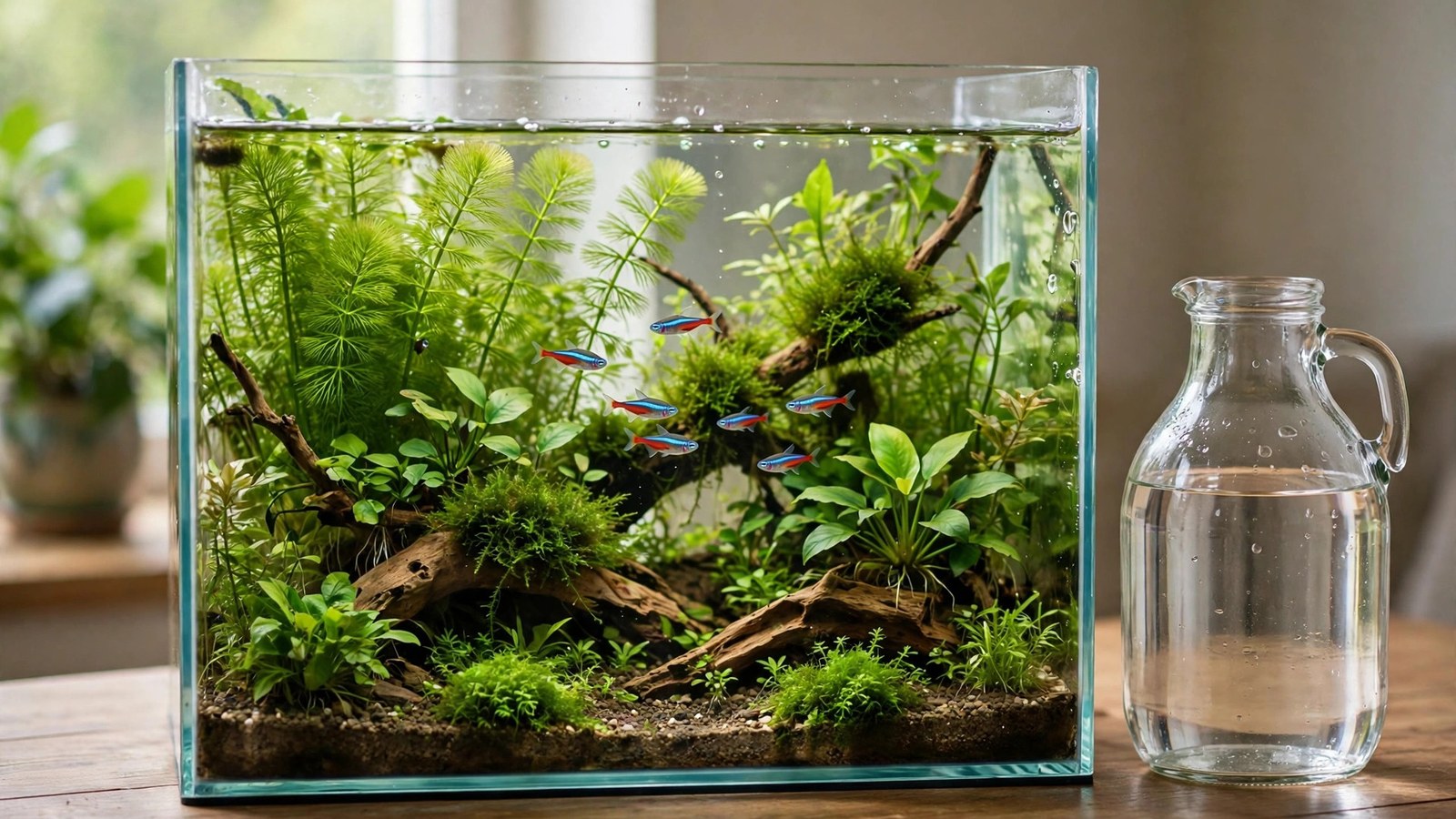
Dumping a fresh jug of distilled water straight into your planted tank will not melt your plants overnight — but if you keep doing it, expect stalled growth, shredded shrimp molts, and fish gasping at the surface within a week. Distilled water has zero minerals, which means zero buffering capacity, and that turns every water change into a chemistry roulette wheel. The good news: a distilled water planted tank can absolutely thrive — the grocery-store jug is one of the cheapest ways to take control of your water — if you know the three jobs distilled water is good for and how to put minerals back in. It all builds on remineralizing RO water for aquarium plants, the same principle in action.
Why pure distilled water is dangerous for tanks
Distillation boils water and condenses the steam, leaving virtually every dissolved solid behind — no calcium, no magnesium, no carbonates. In a planted tank, that emptiness is the problem.
First, there is osmotic stress. Fish and shrimp regulate their internal salt balance against the water around them. Drop a neon tetra into water with zero dissolved minerals and water floods into its cells faster than its kidneys can handle — lethargy, clamped fins, then death. Shrimp are even more vulnerable: a molt in mineral-free water produces a paper-thin shell that crumples instead of hardening.
Second, there is zero buffering capacity. Carbonate hardness (KH) is what stops your pH from swinging when you inject CO2 at lights-on or when bacteria release acids as waste breaks down. With 0 KH, a normal CO2 dose can crash pH by a full point in an afternoon — often fatal in a small tank. And your plants stall: calcium and magnesium are the two macronutrients water itself is supposed to carry, so a pure-distilled tank is functionally starving at the leaf level.
The three safe ways to use distilled water
Used correctly, distilled water is one of the most useful tools in a planted-tank keeper's cabinet. It just has three jobs — and only three:
- Mixing with tap to cut hardness. If your tap runs 12+ dGH, a 50/50 blend with distilled gives a predictable 6 dGH baseline — far cheaper than an RO unit for changes under 20 gallons a week.
- Topping off evaporation. Only pure water evaporates; minerals stay behind. Topping up with tap slowly concentrates hardness over months — distilled top-ups keep parameters flat.
- Building a target profile for soft-water setups. Keeping caridina shrimp or breeding discus? Start from zero-TDS distilled and dose a remineralizer to exactly the numbers you want — say 5 dGH and 1 dKH — with no RO filter required.
If your tap water is already reasonable, check whether your tap water is safe for aquarium plants before buying jugs — many keepers complicate their lives solving a problem they do not have.
Distilled vs RO vs tap: the comparison
Distilled and RO water are near-twins: both come out near 0 ppm TDS and both need identical remineralization before livestock. The real difference is convenience:
| Source | TDS (typical) | GH / KH | Cost | Best for |
|---|---|---|---|---|
| Distilled (store jug) | 0–5 ppm | 0 / 0 | ~$1/gallon | Nano tanks, top-offs, occasional mixes |
| RO/DI (home unit) | 0–10 ppm | 0 / 0 | High upfront, pennies/gallon after | Tanks over 20 gallons, weekly large changes |
| Tap (dechlorinated) | 50–400 ppm | Varies wildly | Nearly free | Soft-to-moderate tap; the default |
One warning: read the jug. "Drinking water" jugs are often just filtered tap, and some "distilled" brands add minerals back for taste — you want plain distilled with nothing added. The RO water for planted tanks guide covers the same chemistry if you are choosing between the two paths.
Distilled water planted tank setup: a step-by-step
Here is the exact workflow for setting up or converting a tank on distilled water. Follow the order — it matters.
- Mix in a bucket, not the tank. Add tap portion now if blending, so the dechlorinator dose matches the final volume.
- Dose a GH/KH remineralizing powder to target. Dissolve in warm water first, add in thirds, and check with a TDS meter between additions — roughly 18–20 ppm TDS equals 1 dGH, so 100 ppm added lands near 5 dGH. Verify once with a liquid GH/KH kit; the TDS meter alone suffices after that. Manufacturer directions — reproduced on retail pages like this Seachem Equilibrium listing with the full dosage directions — give exact starting doses.
- Aerate and temperature-match. Air stone 30 minutes, within 2°F of the tank — fresh mineral mixes have no stability buffer, so temperature shock hits harder.
- Change, then fertilize — in that order. Remineralization covers calcium and magnesium only, so dose your normal fertilizer right after the water change on a consistent all-in-one fertilizer schedule.
Plants still need fertilizer on top
This is the mistake that kills most first distilled-water setups: stems melt over two weeks and the keeper blames the water. The water is not the problem — the missing minerals are, and remineralizers only replace calcium, magnesium, and carbonate.
Nitrogen, potassium, iron, and micros still have to come from fertilizer. A distilled-plus-remineralizer tank is actually more fertilizer-dependent than a tap-water tank, because tap carries a background trickle of minerals the jug does not. Pale new growth or pinholes after switching means a dosing gap — check your water change technique for planted tanks and fertilize right after every change.
How much distilled water does a tank actually need?
A 10-gallon nano at 30% weekly changes plus top-off uses ~4 gallons — about $16 a month, fine indefinitely. A 55-gallon at 50% weekly changes needs 27+ gallons: over $100 a month, where a home RO unit pays for itself. In aquasoil tanks keep 1–2 dKH minimum — active substrates strip KH, making unbuffered distilled extra volatile.
Frequently Asked Questions
Can I use distilled water in my aquarium without remineralizing it?
Only to top off evaporation — evaporation removes pure water only, so distilled top-offs keep parameters stable. For water changes or new tanks, never use it straight: zero GH, KH, and buffering means osmotic shock for fish, failed shrimp molts, pH crashes under CO2, and starved plants. Remineralize to at least 3–4 dGH with a KH buffer first.
Is distilled water better than RO water for planted tanks?
They are functionally equivalent: both come out near 0 ppm TDS with zero GH and KH, and both need identical remineralization. Distilled wins on accessibility — any grocery store, no equipment — while RO wins on cost for large or frequent changes, since a home unit makes water for pennies a gallon afterward. For nano tanks and top-offs, distilled is simpler.
How do I remineralize distilled water for aquarium plants?
Mix in a bucket, not the tank. Add a commercial GH/KH remineralizing powder dissolved in warm water, targeting 4–6 dGH and 1–2 dKH. Track it with a TDS meter — about 18–20 ppm added TDS per degree of GH — then verify once with a liquid GH/KH test kit. Aerate 30 minutes, temperature-match within 2°F, and dose fertilizer after the water change.
Will distilled water kill my fish or shrimp?
Pure, un-remineralized distilled water absolutely can. Fish suffer osmotic stress as water floods their cells, and shrimp fail to molt because shells cannot harden without calcium. Even hardy community fish show stress within days at zero TDS. The fix is simple and total: remineralize to species-appropriate GH and KH before the water goes in, and distilled water becomes completely safe.
Distilled water is not a shortcut and it is not a hazard — it is a blank canvas. Decide your numbers, put the minerals back in deliberately, top off with the pure stuff, and fertilize on top. Master that routine and you will have water as consistent as any RO keeper's, straight from a grocery-store jug.