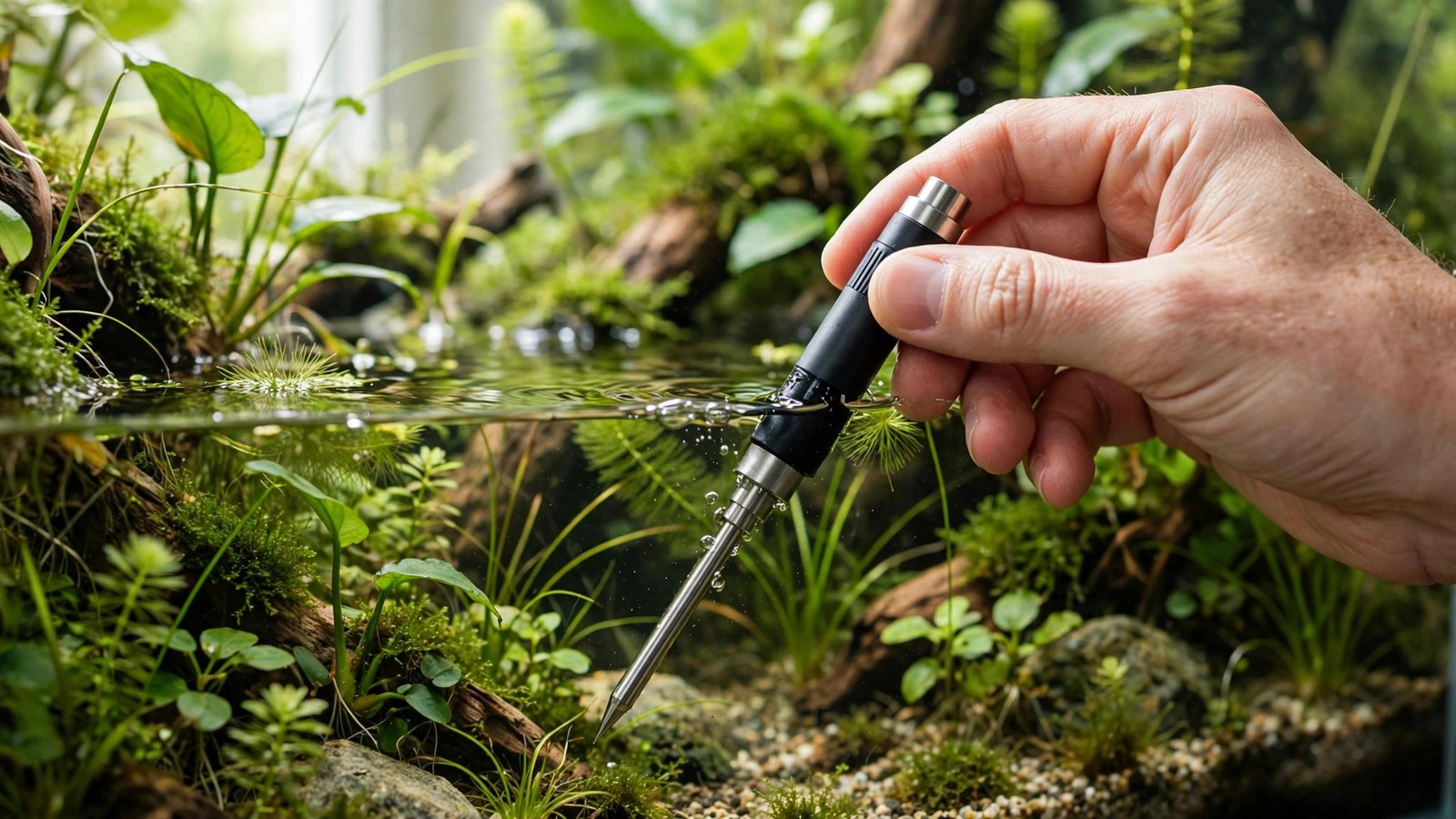
The TDS meter planted tank keepers rely on costs under $20 and tells you more about your water than any test strip — when you use it right. Most factory-fresh meters drift within months, and sloppy technique can swing a reading by 100 ppm. By the end of this guide you'll know how to choose a TDS meter for a planted tank, calibrate it in five minutes, and take a reading you can actually act on.
New to the number itself? Our companion guide to TDS ranges and what they mean in a planted tank covers ideal ranges and why readings rise — this article is about the instrument.
Do You Really Need a TDS Meter for Your Planted Tank?
Not every planted tank needs one. With tap water, a basic all-in-one fertilizer, and weekly water changes, your TDS stays in a predictable band and a meter is a nice-to-have. But three situations make it close to essential: you're remineralizing RO water (guessing mineral doses without a meter is how shrimp die), your tap water shifts seasonally, or you're troubleshooting algae, melting, or stalled growth. If you're unsure whether RO water is worth it for your setup, read that first, then decide if you need the meter that makes RO manageable.
TDS Meter Planted Tank: How the Tool Actually Works
A TDS meter doesn't count dissolved solids directly. It measures electrical conductivity — how easily current flows between two probes — then multiplies by a conversion factor to estimate parts per million. Cheap meters use the NaCl factor of 0.5; others use the "442" factor of 0.7. Neither is wrong, but two meters can read 200 and 280 ppm in the same water and both be "accurate."
Temperature matters too: conductivity rises about 2% per degree Celsius, so warm tank water reads higher than the same water at room temperature. That's why automatic temperature compensation (ATC) is non-negotiable — it normalizes every reading to 25°C. Treat anything without ATC as a toy. Expect ±2% accuracy on a decent pen meter, which is plenty when you're watching trends in the tens of ppm.
The 3 Tiers of TDS Meters (and Which One You Actually Need)
Skip the paralysis — tier two is the right answer for almost everyone. Here's the breakdown.
| Tier | Typical price | Accuracy | Calibration | Temperature | Best for |
|---|---|---|---|---|---|
| Budget pen meter | $12–$20 | ±2% | Trimmer screw on the back | Basic ATC | First meter; tap-water tanks |
| Mid-range handheld | $25–$45 | ±2% | Digital push-button calibration | ATC + temperature display | Planted tanks, RO remineralization |
| Pro / multi-parameter | $60–$150+ | ±1–2% | Digital, sometimes multi-point | ATC; EC/pH modes on combo units | Breeders, high-tech CO2 setups |
Budget pens work — their weakness is fiddly trimmer-screw calibration and faster-drifting probes. Mid-range handhelds are the sweet spot: digital calibration takes seconds and the temperature readout doubles as a thermometer check. Pro units and pH/EC/TDS combos earn their price only if you're already measuring EC for dosing. The COM-360's own manual shows how digital calibration works on combo meters — but don't buy the feature unless you'll use it. Whatever tier you pick, add a bottle of 342 ppm NaCl calibration solution to the same order; the meter is useless without it within a few months.
How to Read a TDS Meter Correctly
Technique is everything. Scoop tank water into a clean glass or plastic cup — never dip straight into the tank, where flow, heater currents, and stray voltage from equipment skew the reading. Rinse the probe in distilled water first, shake off droplets, submerge it to the marked immersion line, and stir gently to dislodge air bubbles.
Wait 30–60 seconds for the number to settle; the first reading is almost never the final one. Measure at a consistent time — before your weekly EI dosing routine, not right after, since fertilizers spike TDS by 30–80 ppm for hours — and always test your tap water for a baseline. If you're unsure what your tap water contains, its TDS reading is the single most useful first datapoint you can take.
How to Calibrate a TDS Meter
Every meter leaves the factory calibrated — HM Digital units ship calibrated to a 342 ppm NaCl standard — and every meter drifts with use. Recalibrate monthly, or whenever readings stop making sense. You need one thing: a bottle of 342 ppm NaCl calibration solution (about $6–$10, lasts a year). Keep it sealed between uses; an opened, evaporating bottle concentrates and lies to you.
- Pour fresh solution into a clean cup — never dip the meter into the bottle itself.
- Rinse the probe in distilled water, shake dry, and submerge it to the immersion line.
- Stir gently, wait for the reading to stabilize (30–60 seconds).
- If it reads within 2% of 342 (335–349 ppm), you're already calibrated — stop here.
- If not: on a budget pen, turn the trimmer screw (tiny hole on the back) clockwise to raise the reading, counterclockwise to lower it, until it reads 342. On a digital meter, hold CAL and adjust per the manufacturer's own calibration instructions, which walk through the same button sequence.
- Rinse the probe in distilled water, cap it, and write the date on the bottle.
Calibrate to a solution near the range you actually measure — 342 ppm suits planted tanks perfectly. Don't calibrate in distilled water (0 ppm); it tells the meter nothing useful about the range you care about.
TDS Meter Maintenance: Cleaning, Batteries, Storage
A TDS meter asks for almost nothing. Rinse the probe in distilled water after every use and shake it dry — mineral crust on the electrodes is the number one cause of slow drift. Replace batteries the moment readings get sluggish; a dying battery reads low and sends you chasing problems that don't exist. Store the meter capped, upright, and out of direct sunlight or a hot fish-room cabinet.
Keep a simple log: date, tank TDS, tap TDS. Five minutes a week turns the meter from a gadget into a diagnostic system, especially alongside consistent water changes that reset TDS creep.
Frequently Asked Questions
Can I trust a $15 TDS meter?
Yes — for planted-tank purposes. Budget pens hold ±2% accuracy when calibrated, plenty for tracking trends. Their weakness is faster probe drift and fiddly trimmer-screw calibration, not accuracy. A calibrated cheap pen beats an uncalibrated $100 meter in the same tank every time.
How often should I calibrate my TDS meter?
Monthly for regular use, and any time readings stop making sense — like your tank reading lower than your tap water. Probes drift as they age and collect mineral film. Date the bottle when you open it and replace the solution yearly.
Should I calibrate with 342 ppm or 1413 µS/cm solution?
Use 342 ppm NaCl for aquarium work — it's the standard most handhelds ship calibrated to, and it sits right in the range planted tanks measure (100–400 ppm). The 1413 µS/cm standard is for EC-mode meters and lab gear. Matching the calibration point to your range keeps readings accurate.
Can I measure TDS straight in the tank, or do I need a cup?
Always use a cup. Tank water is moving, often warmer near heaters, and exposed to stray voltage from equipment — all of which shift readings. A still sample in a clean cup gives you a repeatable number you can compare week to week. Ten extra seconds, and the biggest accuracy upgrade available.
Your 60-Second Weekly TDS Routine
Scoop, dip, wait, note the number. A steady 10–20 ppm weekly climb means your fertilizer dosing and top-offs are accumulating as expected; a sudden 50+ ppm jump means something changed — check your dosing schedule, especially if you recently changed how often you fertilize. Calibrate monthly, log weekly, and your $20 meter becomes the most honest instrument on your fish-room shelf. For the rest of the system your readings protect, see our complete guide to freshwater aquarium plants.