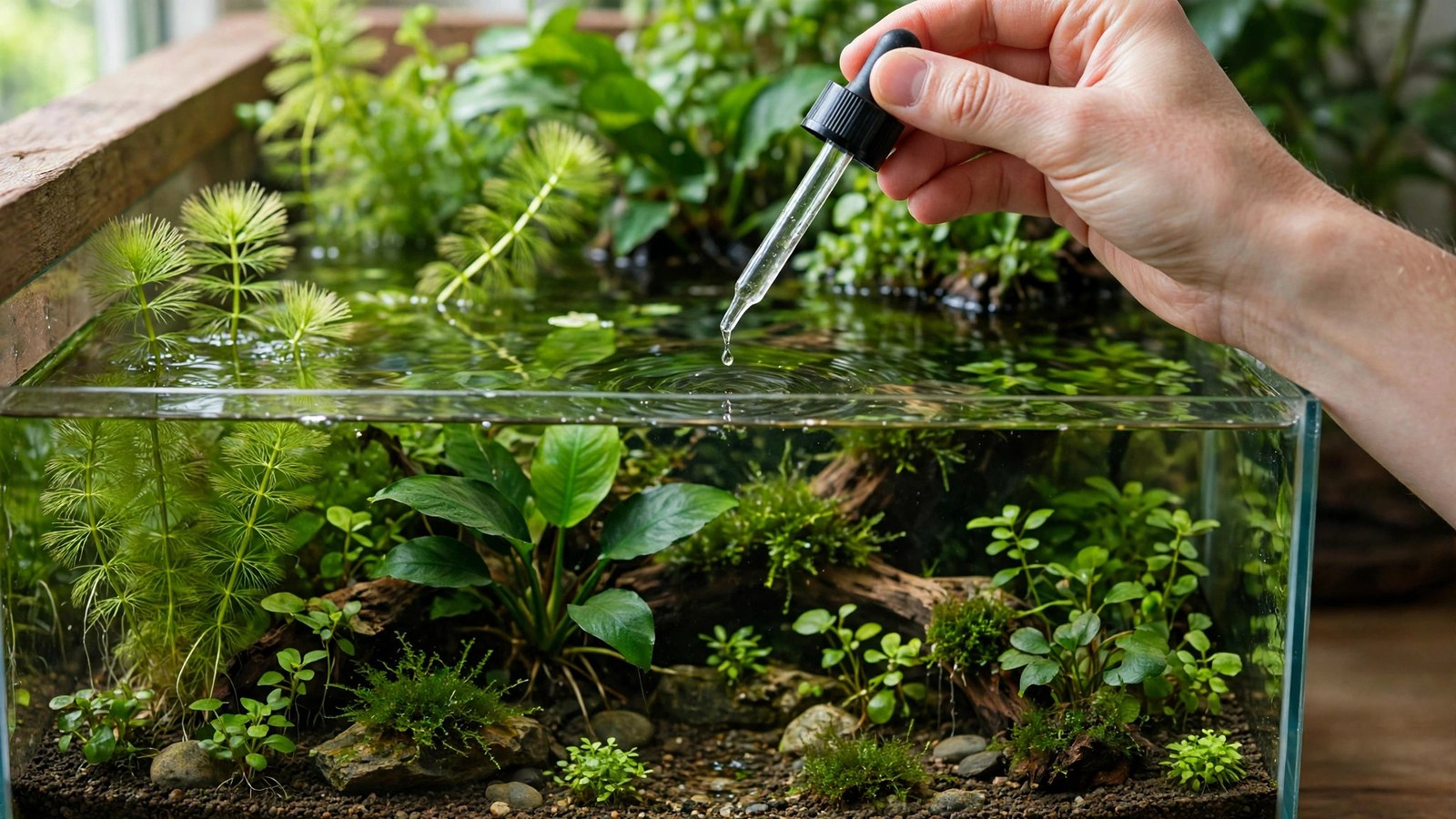
If fertilizing a planted tank feels like guesswork — a little of this bottle on Monday, a pinch of that powder when the plants look sad — EI dosing was invented to end that guessing. Short for the Estimative Index, EI is a fertilization method created by hobbyist Tom Barr that works on a beautifully simple premise: instead of trying to measure exactly what your plants consume, you dose slightly more nutrients than they could possibly need, then reset everything with a large weekly water change. No test kits, no spreadsheets, no deficiency detective work. Just a routine.
This guide walks you through exactly how EI dosing works for aquarium plants, the standard schedule, how to mix your own solutions from cheap dry salts, and — just as important — when EI is the wrong method for your tank.
What the Estimative Index Actually Is
Tom Barr introduced the Estimative Index in the early 2000s as a rebellion against the test-kit culture of planted tanks. His argument: hobbyist test kits are imprecise, plant uptake varies constantly, and chasing exact nutrient numbers keeps you forever reacting. The alternative is to stop estimating demand and simply supply everything in abundance.
The name "Estimative Index" comes from the method's core idea: you estimate a range of nutrient uptake and dose at the top of that range. You don't need to know whether your tank consumes 8 or 12 ppm of nitrate per week — you dose 20 and the question becomes irrelevant. The weekly 50% water change then flushes the excess before it can accumulate.
EI is not a product. It's a philosophy with a schedule. You can run it with dry fertilizer salts (the classic approach, and by far the cheapest) or with pre-mixed liquid EI bottles. The method is the same either way.
The Core Idea: Non-Limiting Nutrients Plus a Weekly Reset
EI has two pillars, and both matter equally:
Pillar 1: Dose everything in slight excess
Plants need macronutrients (nitrogen, phosphorus, potassium) and micronutrients (iron, manganese, zinc, copper, boron, molybdenum, and others — collectively "traces"). Under EI, you dose all of them at levels that exceed what even a fast-growing, CO2-injected tank can consume in a week. The goal is that no nutrient ever becomes the limiting factor for growth. When every nutrient is abundant, the only things controlling growth are light and CO2 — which is exactly what you want, because those are the dials you can actually control deliberately.
Pillar 2: The 50% weekly water change
Excess has to go somewhere. The weekly 50% water change is the reset button: it caps accumulation, exports the unconsumed fertilizer, removes organic waste, and replenishes carbonate buffers. This is non-negotiable in classic EI. If you skip water changes for three weeks, nutrient levels don't just drift — they compound. The method was designed around the reset, and it falls apart without it. If weekly 50% changes don't fit your life, see our comparison of PPS-Pro daily dosing, which was designed specifically for smaller water changes.
The Standard EI Dosing Schedule
The classic Tom Barr schedule is written for a 20-gallon (75 liter) tank, dosed with dry salts. Scale up or down proportionally for your tank size — the math is in the next section.
| Day | Dose | Amount (per 20 gal) |
|---|---|---|
| Monday | Macros (NPK) | ¼ tsp KNO₃ + 1/16 tsp KH₂PO₄ |
| Tuesday | Micros (traces) | 1/16 tsp trace mix (CSM+B or equivalent) |
| Wednesday | Macros (NPK) | ¼ tsp KNO₃ + 1/16 tsp KH₂PO₄ |
| Thursday | Micros (traces) | 1/16 tsp trace mix |
| Friday | Macros (NPK) | ¼ tsp KNO₃ + 1/16 tsp KH₂PO₄ |
| Saturday | Micros (traces) | 1/16 tsp trace mix |
| Sunday | Rest + 50% water change | Dose nothing before the change |
A few notes on this schedule:
- Macros and micros are dosed on alternating days because iron in the trace mix can react with phosphate and precipitate out, making both less available. Alternating days keeps them apart. This is a real chemistry concern, not superstition — see the section on mixing stock solutions below for how to handle it in bottles.
- KNO₃ supplies both nitrogen and potassium; KH₂PO₄ supplies phosphorus and more potassium. Together they cover the full NPK spectrum. If your tank already has high nitrates from fish waste, you can reduce or skip the KNO₃ and dose potassium separately — more on adjustments below.
- The trace mix is typically CSM+B (also sold as Plantex CSM+B), a chelated micronutrient blend formulated for exactly this purpose. Dose it dry with the little measuring spoon that comes with most dry-fertilizer kits, or mix it into a solution.
What does this actually put in the water? Roughly: nitrate ~20 ppm, phosphate ~3 ppm, potassium ~20 ppm, and iron ~0.5 ppm per week. These are deliberately generous numbers — most aquatic plants grow perfectly well at a third of these levels, and the excess is the safety margin that makes testing unnecessary.
Scaling EI to Your Tank Size
The 20-gallon schedule above scales linearly. For a 10-gallon tank, halve everything; for a 40-gallon breeder, double it; for a 75-gallon, multiply by 3.75 (or just call it 4x and don't stress — EI's whole point is that precision doesn't matter).
Practical examples:
- 10 gallons: ⅛ tsp KNO₃ + a pinch (1/32 tsp) KH₂PO₄, 3x weekly; a pinch of traces 3x weekly.
- 55 gallons: ~⅔ tsp KNO₃ + ~⅛ tsp KH₂PO₄, 3x weekly; ~⅛ tsp traces 3x weekly.
For nano tanks under 10 gallons, dry teaspoon dosing gets fiddly — measuring milliliters of stock solution is easier than eyeballing sixteenths of a teaspoon. See our complete fertilizer schedule guide for how EI fits into a weekly routine alongside water changes and maintenance.
Mixing Your Own EI Stock Solutions
Dry salts are cheapest bought in bulk, but daily teaspoon measuring gets old. Stock solutions — concentrated liquids you mix once and dose by the pump or capful — are the convenience upgrade. Here's a reliable pair of recipes using standard 500 ml dosing bottles:
Macro solution (NPK)
- 500 ml distilled water
- 33 g potassium nitrate (KNO₃)
- 7 g potassium phosphate (KH₂PO₄)
- Optional: 25 g potassium sulfate (K₂SO₄) for extra potassium — useful if you reduce KNO₃ because of high fish-waste nitrates
Dose 2 ml (about half a pump) per 10 gallons, 3x weekly on macro days. Shake before use. Lasts roughly two months on a 20-gallon tank.
Micro solution (traces)
- 500 ml distilled water
- 15 g CSM+B or equivalent trace mix
- Optional: a few drops of hydrochloric acid or a pinch of ascorbic acid + potassium sorbate as preservative — trace solutions can grow mold over months
Dose 2 ml per 10 gallons, 3x weekly on micro days. Keep this bottle separate from the macro bottle — never mix macros and micros in the same container, because the iron and phosphate will precipitate into useless sludge at the bottom.
Use distilled or RO water for mixing, not tap water — tap water's minerals and chlorine can react with the concentrates. Stored cool and dark, stock solutions stay good for 3–6 months. If you'd rather skip mixing entirely, our roundup of the best liquid fertilizers includes pre-mixed EI-style bottles where someone else did the chemistry.
Present as a shortcut to EI: pre-mixed macro and micro concentrates dosed on the EI schedule without weighing powders: NilocG EI macro + micro dosing set.
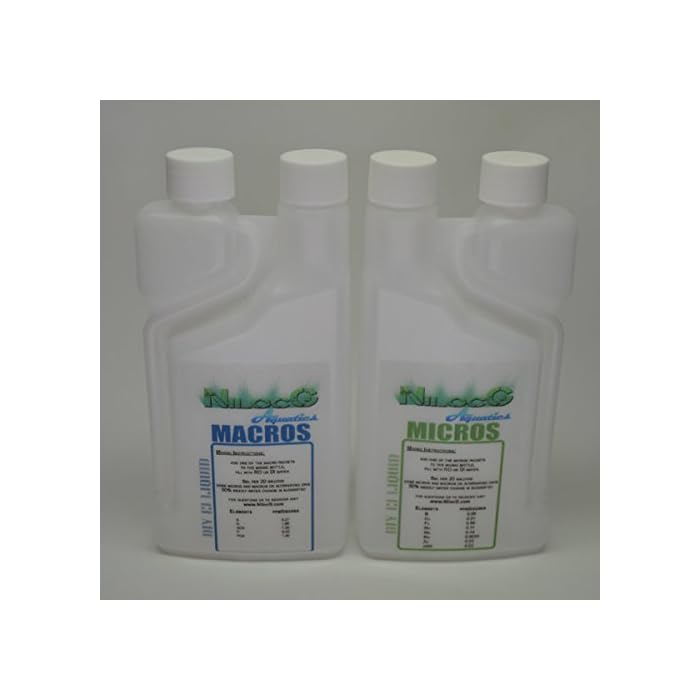
NilocG Liquid Refill Set
Check Price on AmazonWhat EI Demands From You: Light, CO2, and Plant Mass
EI was designed for high-energy tanks: strong light, pressurized CO2, fast-growing stem plants. In that environment, plants devour nutrients, the excess gets consumed or flushed, and everything balances. But the method's logic shifts in calmer tanks:
- High-tech tanks (strong light + CO2): Run full EI exactly as written. Your plants will use most of it, and the weekly reset handles the rest. This is EI's home turf.
- Medium-tech tanks (moderate light, no CO2 or liquid carbon): Run EI at half to one-third strength. Without injected CO2, growth is slower, uptake is lower, and full EI dosing mostly accumulates. Halve the schedule above and you'll still be in comfortable excess. Our guide to growing aquarium plants without CO2 pairs well with a reduced EI routine.
- Low-tech, low-light tanks: Full EI is overkill. Consider PPS-Pro or a lean all-in-one dosing routine instead — both were designed around smaller water changes and gentler nutrient levels.
One more prerequisite people miss: EI assumes meaningful plant mass. A tank with three anubias and a java fern cannot absorb EI-level nutrients no matter what. In sparsely planted tanks, dose at quarter strength until the garden fills in, then ramp up. Algae doesn't care about your schedule — it happily eats the surplus your plants can't.
Reading Your Plants: When to Adjust EI
EI's promise is "no testing," but you should still look at your plants. They're better instruments than any kit. Adjust when you see:
- Pinholes in older leaves with yellowing edges: Classic potassium deficiency. Even on EI this can appear in very fast-growing tanks — add extra K₂SO₄ on macro days. Our potassium guide covers diagnosis in detail.
- New leaves pale or white while veins stay green: Iron deficiency. Increase the trace dose slightly, or add a dedicated iron supplement — see iron dosing for redder plants.
- Stunted, twisted new growth: Often calcium/magnesium (GH) related rather than a fertilizer issue — EI doesn't add GH minerals. If your water is very soft, you may need a GH booster alongside EI.
- Persistent green-spot algae on slow growers: Often a phosphate-limitation signal, ironically in a method that doses phosphate generously. Before increasing anything, check that your trace dosing isn't precipitating — the alternating-day schedule exists for this reason.
- Nitrates climbing past 40–60 ppm despite weekly changes: Your bioload is contributing more nitrogen than the schedule assumes. Cut the KNO₃ dose in half or drop it entirely and let the fish feed the plants — keep dosing KH₂PO₄ and traces normally.
The adjustment principle: change one thing, wait two weeks, observe. EI's excess gives you a wide safety margin, so small tweaks are safe — but changing three variables at once teaches you nothing.
EI vs. Other Dosing Methods
EI isn't the only philosophy. The main alternatives each solve a different problem:
- PPS-Pro (Perpetual Preservation System): Daily micro-doses calibrated to actual uptake, with monthly (not weekly) water changes. Better for low-tech tanks and people who hate big water changes. More measuring, less flushing.
- All-in-one liquid fertilizers: One bottle, one pump, done. Less flexible and more expensive per dose than dry salts, but unbeatable for simplicity — ideal for beginners with one or two tanks.
- Dry vs. liquid fertilizers: Our full comparison of the two formats, including cost math that usually surprises people (dry salts typically cost under $20 per year even for large tanks).
There's no universally "best" method — there's the method whose maintenance demands match your life. EI's demand is the weekly 50% water change; if you'll actually do it, EI is the most forgiving high-performance method in the hobby.
A reliable pick here is Seachem Flourish Potassium.
Common EI Mistakes
- Skipping the water change. The single most common failure. EI without the reset is just "dump fertilizer in weekly," and nutrient soup is what grows algae, not plants.
- Dosing full EI into a brand-new tank. Fresh aquasoil already leaches ammonia and nutrients; adding full EI on top is asking for an algae bloom. Start at quarter strength and ramp up over the first month — our guide to fertilizing a new aquasoil tank lays out the week-by-week ramp.
- Mixing macros and micros in one bottle. The iron-phosphate precipitate is real. Two bottles, alternating days, always.
- Chasing test-kit numbers anyway. If you're going to test nitrates daily and stress over 5 ppm swings, you've missed the point. Trust the excess, watch the plants, change the water.
- Running EI with inadequate CO2. In high-light tanks, EI-level nutrients with fluctuating or insufficient CO2 is the classic recipe for staghorn and BBA. Nutrients were never the limiting factor — carbon was. If you're adjusting CO2 levels, read our guide to acclimating plants to new CO2 levels first.
For the canonical source material, Tom Barr's original EI write-ups live on the Barr Report forums, and the method's underlying plant-nutrition science is well summarized in university extension material on aquatic plant nutrient requirements.
Frequently Asked Questions
Is EI dosing safe for fish and shrimp?
Yes, at standard doses. The nutrient levels EI produces (nitrate ~20 ppm, traces of copper from the CSM+B) are well within safe ranges for fish, and the vast majority of shrimp keepers run EI without issues. The copper in trace mixes is chelated and dosed in tiny amounts — far below toxic thresholds. The real livestock risk in EI tanks isn't the fertilizer, it's CO2 mismanagement, which is a separate issue.
Can I do EI with liquid fertilizers instead of dry salts?
Absolutely. Several brands sell pre-mixed EI macro and micro bottles — you just follow the pump counts on the label instead of measuring teaspoons. It's the same method with training wheels. The trade-off is cost: pre-mixed liquids run roughly 5–10x the price per dose of dry salts. For one small tank the convenience is worth it; for multiple or large tanks, dry salts win.
Do I really need the 50% water change, or is 25% enough?
The 50% figure is doing mathematical work: it caps accumulation at roughly 2x your weekly dose no matter how long you run the method. A 25% change caps it at 4x, which is still usually fine biologically but gives you less margin for skipped weeks and heavy bioloads. If 50% weekly is genuinely unsustainable for you, switch methods rather than running compromised EI — PPS-Pro was literally designed for this situation.
How long until I see results from EI?
New growth responds within 1–2 weeks — look at fresh leaves and growing tips, not existing foliage, which won't repair itself. Full transformation of a deficient tank takes 4–6 weeks as old damaged leaves are replaced. If nothing changes after a month of consistent EI plus adequate light and CO2, the limiting factor is something EI doesn't address: usually carbon, light, or a GH deficiency.
Should beginners start with EI?
It depends on the beginner. If you're setting up a CO2-injected tank and you're willing to do weekly 50% water changes, EI is actually one of the most beginner-proof methods because it removes all decision-making. If you're running a low-tech first tank, start simpler — an all-in-one liquid at label dose teaches you the routine without the chemistry. You can graduate to EI dry salts whenever you're ready.
Start Simple, Stay Consistent
EI dosing rewards one virtue above all others: consistency. The hobbyists who get spectacular results from the Estimative Index aren't measuring more precisely than you — they're just dosing on schedule, changing water on Sunday, and leaving the test kits in the drawer. Pick the scaling that fits your tank, mix your two bottles, set a phone reminder for dose days, and let the abundance do the work.