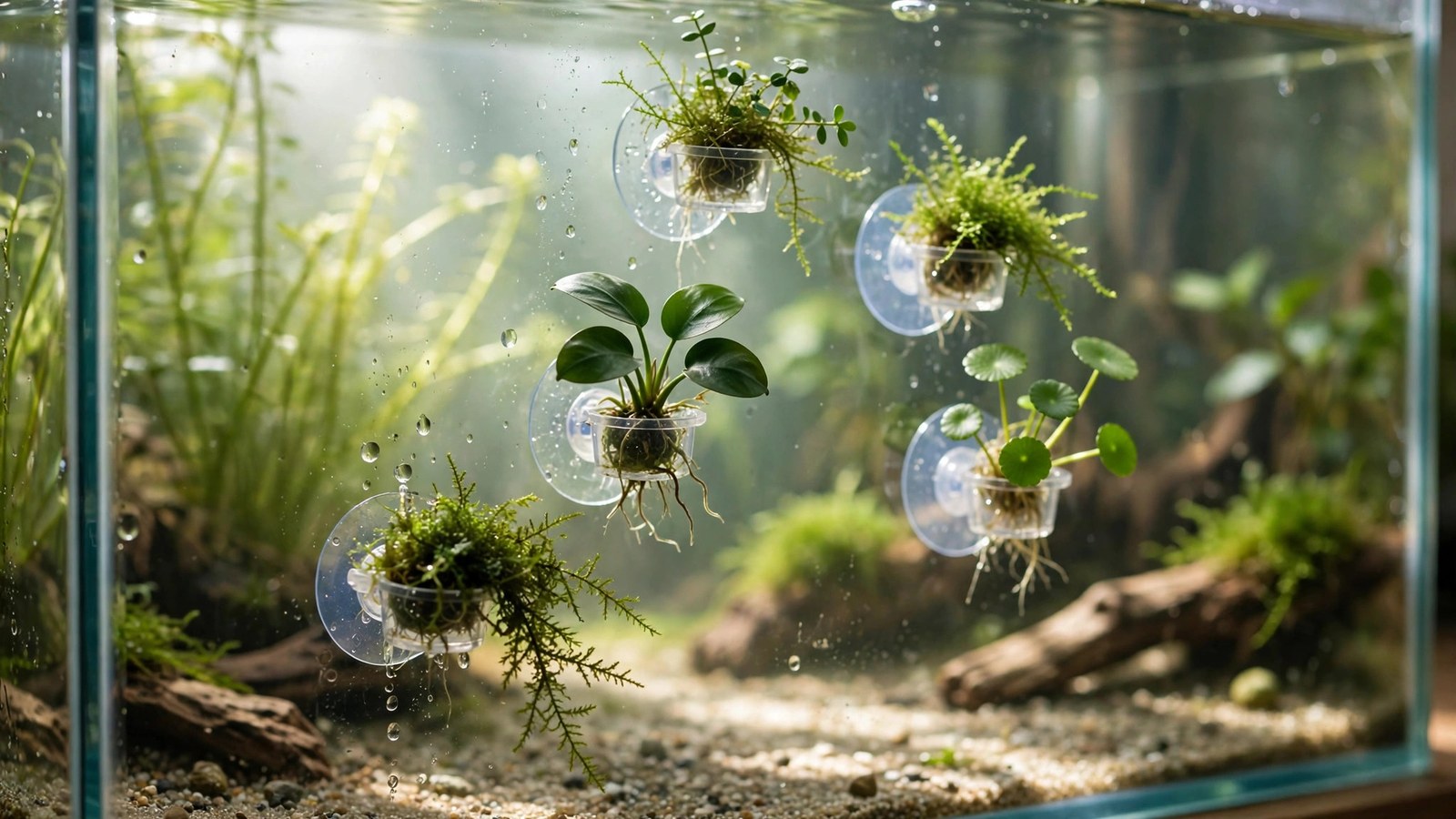
The pothos cutting you draped over your tank rim slid into the water overnight and melted into brown mush. A twelve-dollar suction cup plant holder aquarium owners swear by would have kept the roots submerged and the leaves dry — that single difference decides whether emergent growth explodes with new leaves or rots into a nutrient bomb. By the end of this guide you'll know the three mounting styles, how to size one for your rim and bioload, and which plants actually thrive in them.
What a Suction Cup Plant Holder Actually Does
A suction cup plant holder is a small basket that sticks to your aquarium glass and cradles a plant with its roots dangling in the water — a riparium in miniature. That division of labor is why emergent growth outpaces fully submerged growth two to three times over for the same species — a mature pothos vine can pull 5–10 ppm of nitrate per week out of a 20-gallon tank, visibly flattening the spike between water changes.
The growing technique itself is covered in our guide to growing emergent plants with aquarium plant holders; this article is the buying guide — how to choose hardware that won't fail, crack, or sink.
Three Mounting Styles, Compared
| Style | Mounts by | Best for | Price (set of 2–4) | Watch out for |
|---|---|---|---|---|
| Suction cup | 1–3 cups pressed onto clean glass | Rimless and standard glass tanks; scapers who rearrange often | $8–$15 | Loses grip on textured or curved glass; cheap single-cup models peel off within weeks |
| Rim hook | Hangs over the tank rim like a saddle | Rimmed tanks with 6–25 mm rims; heavy plants up to ~500 g | $10–$18 | Won't fit rimless tanks; verify rim width with calipers before ordering |
| Horizontal / ledge mount | Bridges across the tank or clips to a lid edge | Shallow tanks and glass lids; wide, sprawling plants | $12–$22 | Can lift lids 5–10 mm — enough to let jumpers out |
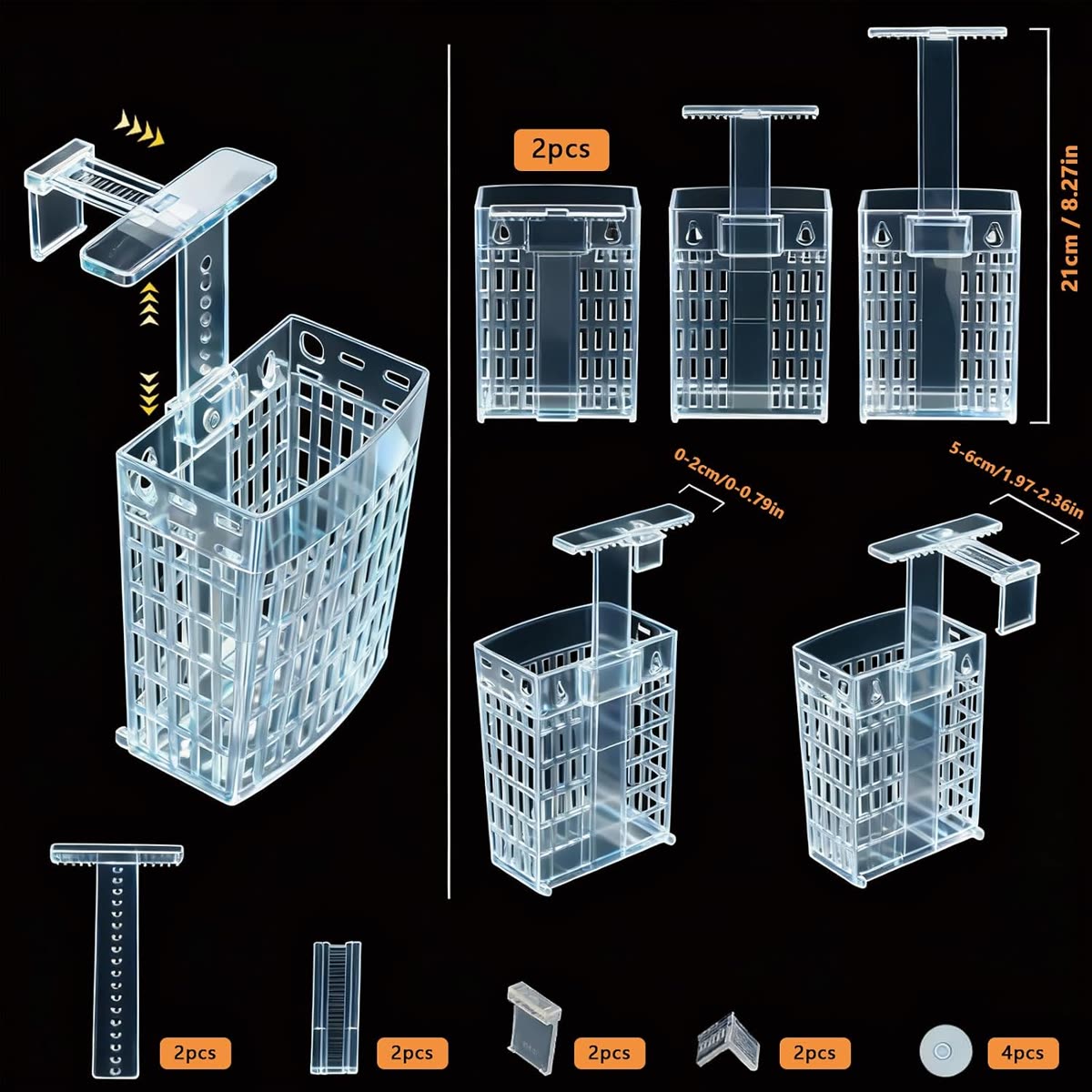
The 2026 generation shares one trend worth paying for: adjustable arms and modular baskets. Telescoping arms slide 3–8 cm so you can raise the basket as roots lengthen, and clip-in baskets swap between fine mesh (cuttings) and wide slotted trays (established plants).
Your Suction Cup Plant Holder Aquarium Buyer's Checklist (2026)
1. Suction cup count and quality
This is where cheap holders die. A single cup holds for a month or two, then lets go — usually at 3 a.m., dumping a waterlogged plant across your filter intake. Look for two or three cups rated at least 150 g each, with a locking lever or screw-tightened plate. Test before planting: press the cup dry onto clean glass and push it sideways — if it slides, it won't hold a wet, root-heavy load long-term.
2. Basket size and drainage
Baskets run 7–15 cm wide: 7 cm fits a pothos cutting, 12–15 cm fits a peace lily or a cluster of three cuttings. Slots should be 3–8 mm — narrow enough to hold the plant, wide enough for roots to pass through. Reject any sealed-cup design; holders without drainage trap stagnant water and breed anaerobic rot.
3. Material safety
Stick to food-safe ABS or PLA with no paint. Avoid unknown "resin" 3D-printed holders unless the seller states food-safe material — cheap resin can leach plasticizers for months. If a holder smells of chemicals out of the box, soak it 48 hours with a water change before it goes near livestock.
4. Weight limit vs. your plant
Loaded weight means plant + wet roots + retained water. Published limits cluster at 200–500 g: a pothos cutting is ~50 g, but a six-month pothos with wet roots is 300–400 g. Size up one bracket — a $16 four-cup model rated 500 g is cheaper than re-scaping after a collapse.
5. Rim and lid compatibility
Rimless tanks take any suction cup model. Rimmed tanks need hook models matched to the rim (most fit 6–15 mm; euro-braced rims up to 25 mm need long-lip variants). If you run a glass lid, check the holder clears the front edge before ordering.
2026 adjustable design with all 3 mounting options covered in the guide: adjustable aquarium plant holder.
 ★4.6
Amminle Adjustable Aquarium Plant Holder
Check Price on Amazon ★4.6Which Plants Actually Work in Suction Cup Holders
The winners share one trait: they tolerate perpetually wet roots and produce foliage meant for air.
- Pothos (Epipremnum aureum) — the default. Roots drink nitrates, vines sprawl for meters. See growing pothos in your aquarium.
- Lucky bamboo (Dracaena sanderiana) — stalks stay upright in tall holders; keep the leaf crown 5–10 cm above water. Full details in our lucky bamboo aquarium guide.
- Heart-leaf philodendron — same playbook as pothos, slightly slower, more shade-tolerant.
- Peace lily (Spathiphyllum) — a dramatic nitrate sponge, but it wants a 12 cm+ basket and bright indirect light on the foliage.
- Spider plant and inch plant — fast rooters, good for beginners who want visible progress in two weeks.
What fails: succulents (rot within days), true aquatic stems held half-out (they melt at the waterline), and anything buried in substrate inside the basket. For the broader houseplant-crossover trend, read our riparium-style houseplant guide and the emersed growing guide; verify exact species needs against an authoritative reference like the Tropica plant database.
Two honest expectations. First, expect a 2–4 week adjustment: soil-grown cuttings shed terrestrial roots and grow water roots; yellowing in weeks 1–3 is normal. Second, emergent plants change your maintenance rhythm — heavy nitrate uptake can starve submerged stems, so watch for deficiency signs after adding holders. If you also run floating plants, balance the two — both draw from the same nutrient pool, as our floating plants for beginners guide explains. New to planted tanks? Start with our complete freshwater aquarium plants guide, then add holders as phase two, and use a TDS meter reading before and after to see how much the new plants are actually pulling.
Frequently Asked Questions
How much weight can a suction cup plant holder hold?
Most consumer models are rated 200–500 g loaded (plant + wet roots + retained water). A rooted pothos cutting starts near 50 g but can reach 300–400 g within six months, so buy one bracket above your current plant. Multi-cup designs with locking levers hold their rating far longer than single-cup models, which commonly fail within a few months.
Will suction cups damage aquarium glass or silicone?
No. Silicone suction cups can't scratch glass and don't bond to seams. The real risk is a cup placed half on the silicone bead — it seals poorly and pops off early. Mount cups fully on flat glass, at least 2 cm from any seam, and wipe the spot with vinegar first for maximum hold time.
Can I put substrate or soil in a suction cup plant holder?
Don't. Soil or gravel triples the weight and traps stagnant water, creating anaerobic pockets that rot roots. Emergent plants want bare roots hanging through the basket slots into open tank water. The holder is a scaffold, not a pot — a few clay pebbles are the most substrate any holder should carry.
Do suction cup plant holders work on acrylic tanks?
Yes, with caveats. Cups grip smooth acrylic well, though micro-scratches reduce hold over time. Acrylic flexes more than glass, so rim-hook models are the safer pick on acrylic, and keep loaded weight under 300 g to avoid bowing the panel.
How often do suction cup plant holders need maintenance?
Reseat the cups once a month with a firm press — a 10-second job that prevents most failures. Rinse the basket every 2–3 months to clear algae from the slots, and trim roots when they tangle into filter intakes. Replace cups that have gone cloudy or stiff; silicone degrades after 12–18 months in warm water.
The Bottom Line
A suction cup plant holder is a $8–$18 piece of plastic that buys the single most effective nitrate filter in the hobby: a living, growing plant. Buy adjustable, buy multi-cup, size for the plant you'll have in six months — then stick it on clean glass and let the roots do the filtration your filter wishes it could.