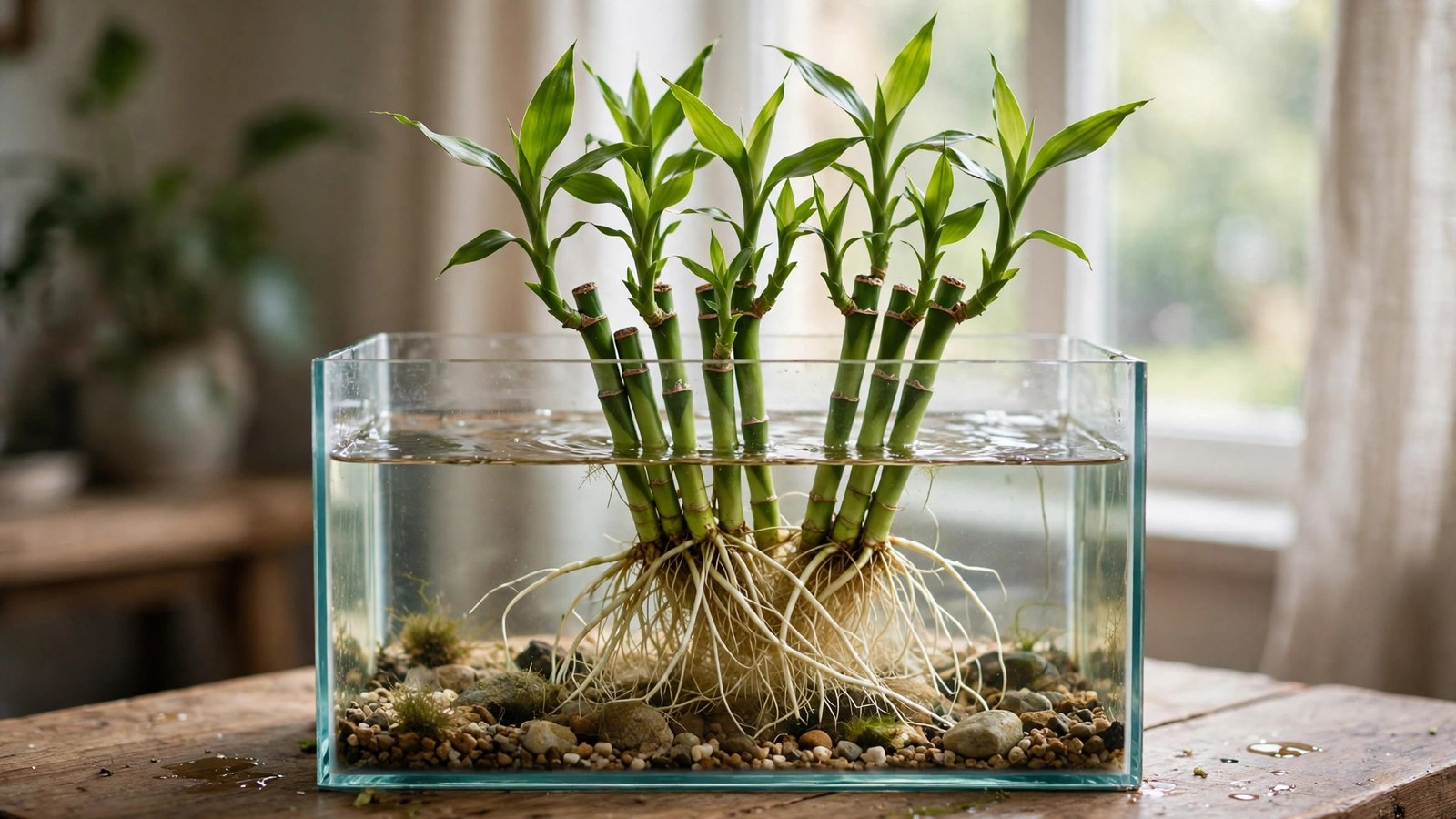
Lucky bamboo in aquarium setups is one of the most misunderstood ideas in the hobby. Stalked by the hundreds of forum threads asking whether this elegant houseplant can live underwater, the answer matters — because getting it wrong kills the plant in a matter of weeks. The short version: lucky bamboo can absolutely thrive on your aquarium, but it cannot live in it.
Lucky bamboo is Dracaena sanderiana, a terrestrial plant from the rainforests of Central Africa, not an aquatic species. In the wild it grows in moist, shaded understories — never fully submerged. The winning formula for lucky bamboo in an aquarium is emersed growth: roots and the base of the stalk sit in the water, while all the leaves stay above the surface, breathing room air and drinking nutrients straight from the tank. Done this way, lucky bamboo becomes one of the most striking riparium plants you can keep — and a genuinely useful natural nitrate absorber.
The Correct Answer: Emersed, Never Submerged
Every beginner guide that says "just stick it in the tank" skips the critical detail: what part of the plant goes in the water. A lucky bamboo stalk pushed fully below the surface will look fine for a week or two. Then the leaves yellow, the stalk turns translucent and mushy, and the whole thing collapses into a slimy mess that fouls your water.
The plant fails underwater for straightforward biological reasons:
- No underwater gas exchange: Dracaena leaves are built for air. They lack the thin, adapted foliage of true aquarium plants like anubias or vallisneria, so submerged leaves cannot photosynthesize efficiently or take in enough carbon dioxide.
- Anoxia and rot: Submerged stalks sit in low-oxygen conditions. Bacteria and fungi colonize the weakened tissue, and rot spreads up the cane.
- Light starvation: Water absorbs light rapidly. At typical tank depths, a submerged lucky bamboo receives a fraction of the light its canopy would get in air.
- Wrong root zone: Lucky bamboo roots are happy in water, but they expect the flowing, oxygenated surface layer — not burial deep in anaerobic substrate.
Keep the foliage in the air and the roots in the water, and the story flips completely: growth is vigorous, the cane stays firm and green, and the root mass explodes into the tank, pulling nitrates and phosphates out of the water column.
How to Grow Lucky Bamboo in an Aquarium: Four Proven Methods
All four approaches achieve the same geometry — roots wet, leaves dry. Pick the one that suits your tank's lid, rim, and livestock.
1. Rim Plant Holders and Hanging Baskets
The simplest method is a small plastic or wire basket that hooks over the tank rim. The stalk sits in the basket with its base 2–5 cm below the waterline, roots dangling freely into the tank. DIY versions use a hydroponics net pot wedged into a piece of filter foam.
This is also behind the biggest product trend in the riparium space right now: purpose-built hang-on plant holders with suction-cup or magnetic mounts, designed to keep houseplant stalks at exactly the right depth while hiding the roots behind frosted plastic. They prevent the stalk from tipping in during water changes and make removal for cleaning effortless. If you go DIY, make sure nothing you use (painted baskets, unknown plastics) leaches chemicals into the water.
2. Suction-Cup Planters
Small glass or acrylic cups with a suction cup mount directly to the inside glass, above or right at the waterline. Fill the cup partially with water (or a handful of pebbles to anchor the stalk), let the roots trail down into the tank, and keep leaves high. These work especially well in rimless tanks where there is no lip to hang anything on.
The tradeoff: suction cups lose grip over time, particularly on tanks with algae film on the glass. Check mounts monthly, and keep a spare cup in case one lets go while you are away.
3. Growing It in the Filter Compartment
If you run a hang-on-back filter with a spare chamber — or a sump with a refugium section — tuck the stalks in there. The constant flow gives roots excellent oxygenation, growth rates are the fastest of any method, and the plant is completely protected from nibbling fish. This is a favorite of experienced keepers running plant-heavy or overstocked tanks who want maximum nitrate export.
Watch the filter media: a mature lucky bamboo root mass can slow flow. Prune roots back a few times a year, the same way you would thin any filter media.
4. Riparium-Style Planting at the Waterline
A true riparium approach plants lucky bamboo in a raised substrate pocket — a planter box or mesh bag filled with gravel or lava rock — positioned so the waterline falls across the lower stalk. This looks the most natural, almost like a flooded riverbank, and suits tall tanks where the plant can become a dramatic emergent centerpiece. Stabilize tall stalks with a rock or plant weight so they do not lean as they grow.
Tank Conditions That Keep It Thriving
Once the geometry is right, lucky bamboo is remarkably forgiving. But a few parameters separate "surviving" from the glossy, fast-growing stalks you see in display tanks.
- Water temperature: 20–28°C (68–82°F) — the exact range of most tropical community tanks.
- pH and hardness: Adaptable from soft to moderately hard water, pH 6.0–7.5.
- Light: Bright, indirect light on the leaves. A window nearby or a decent room light is plenty; direct midday sun scorches leaves. Tank lighting pointed at the glass is usually unnecessary — the foliage is above the tank, lit by the room.
- Depth of submersion: Keep no more than the bottom 2–5 cm of stalk underwater. If the waterline rises during top-offs, reposition the plant.
- Water quality: Sensitive to high chlorine and fluoride. Use dechlorinator on water changes, and if your tap water is heavily fluoridated, the plant will tell you with brown leaf tips.
New plants benefit from a gentle introduction to tank life. Read our guide to acclimating new aquarium plants to avoid the melt-and-recover cycle that stresses fresh stalks.
Feeding: Does Lucky Bamboo Need Fertilizer?
In a stocked tank, fish waste supplies most of what lucky bamboo needs — nitrate, phosphate, potassium, and trace metals — which is exactly why the plant is valued as a natural nutrient sink. In most community aquariums, no extra feeding is required.
If growth stalls and older leaves yellow despite clean water, the tank may be running too clean — common in lightly stocked setups. A small, regular dose of an aquarium-safe fertilizer fixes it. Follow a measured aquarium plant fertilizer schedule rather than eyeballing it, and learn how all-in-one fertilizer dosing works before adding anything — overdosing feeds algae, not your bamboo.
Important: never use standard houseplant fertilizer drops in the water. They are formulated for soil, often contain urea or ammonia at levels that are fine for a potted plant but can spike a closed aquarium and harm fish. Aquarium-formulated products only.
Light iron/potassium feeding suits lucky bamboo's low nutrient appetite: API Leaf Zone.
Livestock Compatibility
Lucky bamboo roots dangling in the tank are generally safe with community fish, shrimp, and snails. A few notes:
- Herbivorous fish: Goldfish, silver dollars, and large cichlids may chew roots or batter the stalk. Use the filter-compartment method to keep the plant out of reach.
- Shrimp: Cherry shrimp and amanos love grazing biofilm off the root mass — a genuine benefit, since it keeps roots healthy.
- Jumpers: Emersed plants need a gap in the lid. If you keep known jumpers like bettas or hatchetfish, leave the lid on and use a small cutout for the stalk, or grow the bamboo at the back where the lid meets the filter.
- Cats and dogs: Dracaena species are toxic to cats and dogs if chewed, according to the ASPCA. Keep tanks with emersed bamboo out of reach of curious pets, or choose a closed-canopy setup.
Common Problems and Fixes
| Symptom | Likely Cause | Fix |
|---|---|---|
| Yellow leaves (whole leaf) | Too much direct sun, or natural shedding of old leaves | Move to indirect light; trim dead leaves — one or two yellowing lower leaves on new plants is normal |
| Brown, crispy leaf tips | Fluoride or chlorine in tap water; very dry air | Use a quality dechlorinator; consider filtered water for top-offs; mist occasionally |
| Soft, translucent stalk | Rot — usually from submersion or stagnant water around the base | Cut above the mushy section into firm tissue, let the cut dry for a day, restart emersed with only roots wet |
| Algae on submerged roots | Excess light hitting roots + excess nutrients | Shade the root zone (darker holder, or a baffle); trim the worst roots — they regrow fast |
| No growth for months | Low nutrients, too cold, or not enough light on leaves | Check room temperature and leaf lighting; add a light fertilizer dose |
| White crust on stalk | Mineral deposits from hard water evaporating | Wipe with a damp cloth; harmless, cosmetic only |
Lucky Bamboo vs. Pothos: Not the Same Thing
Search results constantly lump lucky bamboo together with pothos as "houseplants you can grow out of your tank," and the confusion is understandable — both grow emersed with roots in the water. But they are entirely different plants with different needs.
Pothos (Epipremnum aureum) is a fast, vining aroid that tolerates its stems and even some leaves at or near the waterline — the classic beginner emersed plant. Lucky bamboo is a slower, more architectural dracaena that demands its foliage stay fully in the air and appreciates gentler light. Pothos forgives deep submersion of its nodes for a while; lucky bamboo rots.
Both plants, along with spider plants and peace lilies, belong to the broader world of houseplants growing out of aquariums, and the emersed-growing principles overlap even where the species differ.
Quarantine and Pest Control for New Stalks
Store-bought lucky bamboo usually arrives in decorative pots with gel, rocks, or unknown water — a perfect vector for snails, snail eggs, and algae. Strip off all packaging, rinse stalks and roots thoroughly, and inspect leaf axils for mealybugs or spider mites. Then give it a short disinfecting dip: our walkthrough of the bleach dip method for aquarium plants works for hardy stalks — follow the dilutions exactly, then rinse and dechlorinate. Skipping quarantine is the one corner you should never cut.
Frequently Asked Questions
Can lucky bamboo live fully underwater in a fish tank?
No. Lucky bamboo (Dracaena sanderiana) is a terrestrial plant, not a true aquatic. Fully submerged, its leaves cannot photosynthesize or exchange gases properly, and the stalk rots within weeks. Grow it emersed instead: keep the bottom few centimeters of stalk and the roots in the water, with all leaves above the surface. That setup can thrive for years.
How deep in the water should the stalk sit?
Only the lowest 2–5 cm of the stalk should be underwater, with the root mass below that. Any higher and you risk the leaves' lower nodes staying wet, which encourages rot. When you top off evaporated water, check that the waterline has not crept up the cane — reposition the holder if it has.
Will lucky bamboo lower nitrates in my aquarium?
Yes, meaningfully. A healthy, actively growing stalk pulls nitrate, phosphate, and potassium from the water column through its roots, acting as a natural nutrient export. It will not replace water changes or a proper filter, but in lightly stocked tanks it visibly flattens nitrate creep between maintenance. Faster growth equals faster uptake, so good leaf lighting matters.
Why are my lucky bamboo leaves turning yellow in the tank?
Whole-leaf yellowing usually means too much direct sunlight, fluoride or chlorine in the water, or simply old leaves shedding on a newly introduced plant — the last is normal. Brown crispy tips specifically point to water chemistry. Check your dechlorinator handles fluoride, keep the plant in bright indirect light rather than direct sun, and give new stalks two to three weeks to settle before worrying.
Is lucky bamboo safe for bettas, shrimp, and snails?
Yes, with the usual caveat that nibbling fish like goldfish may chew the roots. Shrimp and snails are entirely compatible and will graze biofilm from the roots, which benefits the plant. For bettas, keep a lid with a small cutout for the stalk rather than leaving the tank fully open, since bettas are jumpers. The plant itself is not aquatic-toxic to any common aquarium livestock.
Can I plant lucky bamboo in aquarium substrate?
Only at the waterline, never deep. Burying the stalk's base in wet substrate with the leaves above water works in a riparium-style setup — the crown stays oxygenated. But pushing it deep into the substrate below the waterline reproduces the same rot problem as full submersion. Roots in open water or shallow substrate at the surface are what the plant wants.
The Bottom Line
Lucky bamboo in an aquarium is a wonderful idea executed the wrong way by most beginners. Remember the one rule — roots wet, leaves dry — and it transforms from a doomed decoration into a long-lived, nitrate-scrubbing showpiece. A $5 stalk in a rim holder, given bright indirect light and tank water, will outgrow every expectation the "fully underwater" myths set. Set it up emersed, quarantine it first, and enjoy one of the easiest high-impact plants in the hobby.