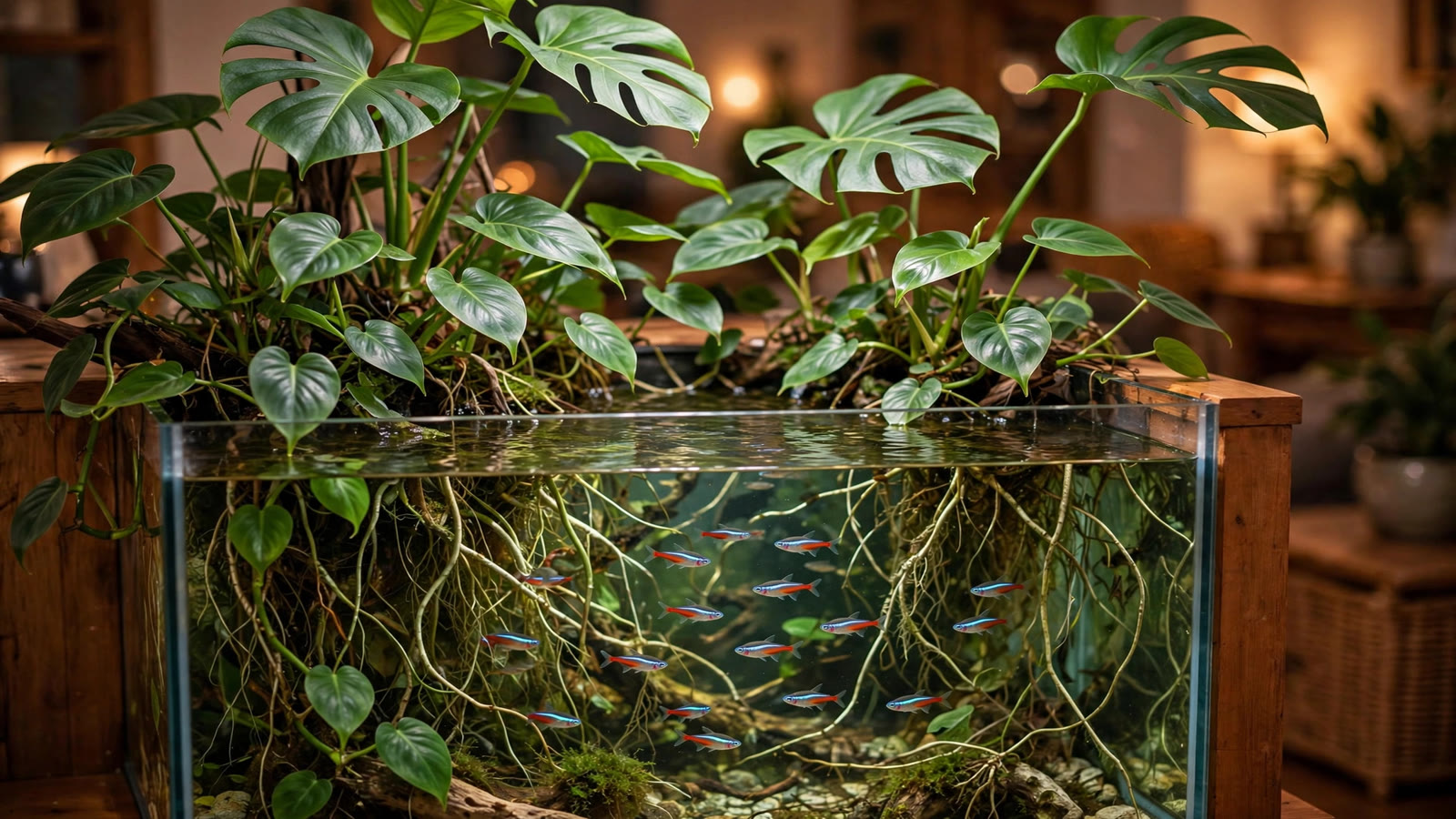
Scroll any aquarium hashtag long enough and you'll find it: a lush tropical jungle spilling out of the back of a fish tank, thick green roots hanging in crystal-clear water while monstera leaves unfold above the rim. Growing houseplants in aquarium water — the riparium-style, emersed setup — is one of the biggest crossover trends in the hobby, and it works far better than most people expect. Tank water is nutrient-rich, roots get constant oxygen, and the plants pay you back by drinking up nitrates.
Done wrong, though, the trend ends with a rotted crown, a clogged filter, and a cloudy tank. This guide shows you how to do it safely: which houseplants genuinely thrive with roots in a fish tank, the mounting methods that hold up, the roots-only-submerged rule that prevents most failures, and what to realistically expect from nitrate uptake.
Why Growing Houseplants Out of a Tank Works
Every healthy aquarium is, chemically, a dilute fertilizer factory. Fish excrete ammonia, bacteria convert it to nitrate, and nitrate accumulates until the next water change. Terrestrial plants are constantly hungry for nitrate — it's the same nitrogen they absorb from soil, delivered here in a steady, dilute drip.
The roots also get constant access to oxygenated water without ever sitting in stagnant soil. A well-aerated tank bathes roots in dissolved oxygen around the clock, which is why cuttings that would rot in a jar of still water often explode with growth in a filtered aquarium. Add bright indirect light above the tank, and the plant frequently outgrows the same species in a windowsill pot — while all leaves and stems stay safely above the waterline.
This is aquaponics scaled down to a glass box. The plant filters the water, the fish feed the plant, and you get the aesthetic that makes the social-media photos work. Emersed-grown aquarium plants use a similar principle, so if you know that technique, this will feel familiar.
The Rules That Keep It Safe
Most failures come from one mistake: submerging the crown. The golden rule is roots submerged, crown and stems dry. The crown — where stem meets root, or leaves emerge from a rhizome — rots within days underwater, and a rotting plant in a stocked tank is an ammonia event waiting to happen.
- Waterline touches root tissue only. For cuttings this is easy; for nursery plants, wash off all soil and trim the root ball back so it regenerates in the water.
- Start with pest-free cuttings. Fresh stem cuttings from healthy mother plants root fastest. Soil from nursery pots introduces organics and possible pesticides — rinse it all away.
- Quarantine before planting. Houseplant cuttings can carry spider mites, mealybugs, and scale into your fish room. Hold new plants separately for a week or two, just as you would quarantine new aquarium plants.
- Never treat the plant. No fertilizer spikes, pesticide sprays, or systemics — anything in the roots can leach into the tank and harm fish and invertebrates. Only aquarium-safe liquid fertilizers, at normal tank doses.
- Match the temperature. Most tropical houseplants are comfortable at 72–80°F (22–27°C), which covers most community tanks. Coldwater tanks are a poor match for everything on this list.
The Best Species for Growing Houseplants in Aquarium Setups
Not every houseplant tolerates permanent root submersion. The reliable performers share three traits: aggressive root growth, tolerance for constant moisture at the root zone, and leaves that handle tank humidity. Here are the species worth growing, with light needs and pet-safety notes.
Monstera Deliciosa
The poster plant of the whole trend. Monstera cuttings root enthusiastically in water, and the aerial roots they produce are built for grabbing moisture from humid air. Give it bright indirect light — direct sun on the tank area invites algae. Keep the node (the knobby joint where roots emerge) at the waterline and let the white roots trail down. Pet safety: toxic to cats and dogs (calcium oxalate crystals cause oral irritation and vomiting) — fine in fish-only homes, risky with a nibbling cat.
Lucky Bamboo (Dracaena sanderiana)
The easiest plant on this list. Lucky bamboo is already sold in water-filled vases, so an aquarium is barely a change. Stalks grow straight up, the look is clean and sculptural, and it tolerates lower light than the others — a solid pick for dimmer rooms. Keep cut tops dry (seal with wax if needed). Pet safety: toxic to cats and dogs — keep out of reach.
Peace Lily (Spathiphyllum)
A surprisingly willing partner. Peace lilies grow vigorously in water culture, and their broad leaves create the dramatic "jungle canopy" look. The crown must stay firmly above water — peace lilies rot fast if the rhizome submerges. They prefer bright indirect light and drink a lot of nitrate. Pet safety: toxic to cats and dogs (oxalates).
Spider Plant (Chlorophytum comosum)
The pet-safe star of the list. Spider plant roots adapt to constant water beautifully, it's cheap to propagate from runners, and — importantly — it is non-toxic to cats and dogs, the one species here with zero worry in a multi-pet home. It likes bright indirect light and handles tank humidity well. Dangle rooted plantlets so only the root mass touches the water.
Philodendron
Heart-leaf philodendrons root from almost any node and adapt to submerged roots in days. They're fast, forgiving, and excellent nitrate sponges — a cutting can fill a tank corner with roots within a month. Give them moderate to bright indirect light and trim aggressively; an unpruned philodendron will attempt to colonize your ceiling. Pet safety: toxic to cats and dogs.
Pothos: The Classic (Covered in Depth Elsewhere)
Pothos is the original aquarium houseplant and arguably still the best beginner choice — nearly indestructible, happy in any light, and a notorious nitrate hog. We've covered the full method elsewhere, so consider this your signpost: read our complete guide to growing pothos in aquariums for rooting technique, holder options, and troubleshooting. Every rule in this article applies to pothos too.
Quick Comparison
| Plant | Light Needs | Pet Safety | Difficulty |
|---|---|---|---|
| Monstera deliciosa | Bright indirect | Toxic to cats/dogs | Easy |
| Lucky bamboo | Low to moderate | Toxic to cats/dogs | Easiest |
| Peace lily | Bright indirect | Toxic to cats/dogs | Easy |
| Spider plant | Bright indirect | Pet safe | Easy |
| Philodendron | Moderate to bright | Toxic to cats/dogs | Easiest |
| Pothos | Low to bright | Toxic to cats/dogs | Easiest |
Honorable mentions: inch plant (Tradescantia), which roots like crazy in bright light, and arrowhead plant (Syngonium), a philodendron cousin with the same habits. Start with one plant, learn its rhythm, then expand.
Mounting Methods: Holding Plants Above the Tank
The logistics problem: the plant must be secured at the rim, roots dangling in water, crown dry. Here are the methods that work, from simplest to most ambitious.
Suction-Cup Planting Baskets
The cheapest entry point. Mesh baskets stick to the inside glass near the surface; drop in the cutting and roots grow through the mesh. Perfect for spider plant babies and small philodendron cuttings. Check suction cups monthly — they weaken over time — and know that large plants outgrow small baskets fast.
HOB-Filter Planters
Small planters that sit inside a hang-on-back filter (or breeder-box-style planters) use the filter's flow to keep roots oxygenated and nutrients moving past them. Plants in HOB planters grow noticeably faster than in still corners — it's the closest thing to hobby-scale aquaponics, and an ideal home for a peace lily or lucky bamboo stalks.
Adjustable-Height Holders
A newer product category: holders that clamp to the tank rim and let you raise or lower the plant as the water level changes. They solve the roots-only rule elegantly — set the exact waterline per plant and adjust as roots grow. For a heavy monstera cutting or a long-term installation, they're worth the small investment over suction cups.
DIY Wire Racks and Light Diffusers
For tinkerers: a strip of plastic light-diffuser grid cut to span the tank's back gives a full shelf of planting slots, and coated wire bent into hooks holds individual cuttings. DIY racks are the only practical route to a dense, multi-plant riparium wall without buying dozens of holders. Stick to plastic, coated wire, or true stainless steel — nothing rust-prone.
Nitrate Uptake: What the Plants Actually Do
Fast-growing houseplants with big root masses genuinely consume nitrate, phosphate, and dissolved organics. A thriving monstera or a half-dozen philodendron cuttings in a 20-gallon community tank can measurably slow nitrate accumulation — some keepers report their weekly 30% change dropping to 20%, or stretching changes to every ten days, once the root mass establishes.
What the plants won't do is replace water changes. No houseplant clears dissolved organics and accumulating minerals the way fresh water does. Treat the plants as a buffer that smooths your nitrate curve and adds resilience during a missed week — not a filtration replacement. If you're already diligent about water changes in planted tanks, the houseplants are a bonus, not a substitute.
Two caveats: plants grow faster under strong light, so the benefit tracks with your lighting. And decaying leaves add waste back — prune dead foliage promptly, since a rotting peace lily leaf contributes more ammonia than its healthy roots ever absorbed as nitrate. Bonus loop: when you do change water, use the old water on your potted plants — free nitrate fertilizer. Our guide to watering houseplants with aquarium water covers the details.
Keeping Roots Out of Your Filter
The number-one maintenance headache: roots grow toward flow and nutrients, which means toward your filter intake. A root ball around an intake sponge is annoying; roots in an impeller chamber are a real problem.
- Distance. Place holders on the opposite end from the filter intake, and route the outflow across the tank rather than blasting the root zone.
- Pre-filter everything. A coarse sponge over every intake is non-negotiable — it stops root tips before the impeller and rinses clean in seconds.
- Trim roots like leaves. Root pruning every few months is healthy for the plant and essential for the filter; plants respond with a flush of new growth.
- Anchor heavy plants independently. A mature monstera can pull a suction basket off the glass — use rim-clamping holders or a rack for big specimens.
- Watch the heater. Roots snuggling against a heater burn and rot. Keep a few inches of clearance.
Add root inspection to your weekly plant maintenance routine — a ten-second glance at the intake sponge prevents every surprise this setup produces. And established root-in-tank plants are far more drought-proof than potted siblings, which is why our vacation plant care guide recommends water-rooting before a trip.
Pet Toxicity: The Safety Section You Can't Skip
Five of the six plants here (monstera, lucky bamboo, peace lily, philodendron, pothos) are toxic to cats and dogs — mostly via calcium oxalate crystals or saponins, causing oral pain, drooling, and vomiting. Spider plant is the only fully pet-safe option. Toxic doesn't mean forbidden — it means managed: keep toxic species above nibbling height, secure dangling vines that tempt chewing, and know the warning signs (sudden vomiting, drooling, pawing at the mouth, lethargy). Fish are unaffected by these plants' chemistry; the risk is entirely to terrestrial pets that can reach the foliage. When in doubt, look up the species in the ASPCA's toxic and non-toxic plant database — the authoritative reference, searchable by common and scientific name.
Frequently Asked Questions
Can any houseplant grow with roots in an aquarium?
No. Plants that rot from slight overwatering in pots — succulents, cacti — will rot in tank water too. Reliable candidates are species that already tolerate water culture: pothos, philodendron, monstera, spider plant, lucky bamboo, and peace lily. If a plant survives in a water vase on your windowsill, it will likely survive with roots in your aquarium.
Will houseplant roots harm my fish?
No, as long as the plant is untreated. Healthy roots are inert to fish, and shrimp colonies in particular love grazing biofilm off a dangling root mass. The danger comes from pesticides or systemic insecticides on store-bought plants, which can leach into the water. Wash nursery plants thoroughly, hold them in a bucket for a week, and never apply plant treatments to anything with roots in the tank.
How long does it take for cuttings to establish?
Fast rooters like pothos, philodendron, and spider plant show water roots within 7–14 days and visible top growth in 3–4 weeks. Monstera and peace lily take longer — expect 3–6 weeks for a real root mass and a few months before they look like the social-media photos. Light is the biggest variable: bright indirect light establishes a cutting roughly twice as fast as a dim corner.
Do the plants need fertilizer in the tank?
Almost never. Fish provide nitrogen and phosphorus, and most tap water supplies trace minerals. The exception is a very lightly stocked tank with soft water, where a cutting may stall — a normal dose of aquarium-safe liquid fertilizer fixes that. Never use houseplant fertilizer or spikes, which contain concentrations and additives unsafe for fish.
Can I grow houseplants out of a tank with a lid?
Yes, but plan for it. A solid lid blocks the stem's exit, so cut notches, leave the back strip open, or use a mesh lid plants can grow through. Keep the opening small enough that jumping fish stay in. Many keepers go lidless on rimless tanks for the full aesthetic — just research your fish's jumping tendencies first and top off evaporation more often.
Bring the Jungle Home
Growing houseplants out of your aquarium is one of those rare trends that's both genuinely beautiful and genuinely functional. Start with a single easy win — a spider plant baby in a suction basket, or a philodendron cutting in a rim holder — and let it prove the concept before building the full riparium wall. Keep the roots-only rule sacred, keep roots out of your filter, and you'll have a tank that feeds its own garden while the garden keeps the tank's water cleaner. If your first plant thrives, try the deeper version of the same idea: growing aquarium plants emersed opens a second world of plants that straddle the waterline.
Tissue-culture plants are the exception — they’re grown in sterile gel and adapt with minimal melting, which is part of what you’re paying for. Plants bought submersed from another hobbyist’s tank also transition with little melt, since they’re already in the right form.
Which Plants Melt Most (and Least)
Heavy melters (expect significant leaf loss)
- Cryptocorynes — infamous for “crypt melt,” sometimes dropping every leaf after any disturbance. They almost always recover from the roots within weeks.
- Stem plants grown emersed — rotala, ludwigia, and hygrophila often shed lower emersed leaves while the growing tips transition.
- Amazon swords — emersed-grown swords typically lose their broad oval aerial leaves and replace them with longer submersed ribbon leaves.
Light melters
- Anubias, java fern, bucephalandra — slow-growing rhizome plants transition gradually; occasional old-leaf melt but rarely dramatic.
- Vallisneria — usually transitions well, though it dislikes the move itself and may sulk for a week.
- Floating plants — minimal melt since their leaves were already at the air-water interface.
The Acclimation Protocol
Step 1: Quarantine or dip first
Before acclimating to your tank’s conditions, make sure you’re not acclimating pests along with the plant. Run new arrivals through our quarantine and dip protocol — it adds days upfront but prevents months of regret.
Step 2: Float to temperature-match (30 minutes)
Float the bag or container in your tank for 20–30 minutes to equalize temperature. Plants are less temperature-sensitive than fish, but a 10°F shock on top of transplant stress is an avoidable insult.
Step 3: Trim before planting
Remove any leaves that are already damaged, yellowing, or heavily algae-covered — they won’t recover and they’ll rot in your tank, feeding algae. For stem plants, trim off the bottom inch and any emersed leaves that look unlikely to adapt; the plant wastes energy maintaining leaves it’s going to shed anyway. Keep the healthy growing tips — that’s where recovery starts.
Step 4: Plant correctly the first time
Follow our planting guide — right depth, crown exposed on rosettes, rhizomes unburied on epiphytes. Every uprooting and replanting restarts the acclimation clock, so get placement right on the first attempt. Decide where each plant goes before it goes in the water.
Step 5: Run a gentle first week
For the first 7 days after planting:
- Moderate light — run your normal photoperiod but consider dropping intensity 20–30% if your light is dimmable. Blast-level light on a melting plant grows algae on the dying leaves, not recovery.
- Stable CO2 — if you inject CO2, keep it consistent. Fluctuating CO2 during acclimation is a melt accelerator. If you’re low-tech, this doesn’t apply — see growing without CO2.
- Half-strength fertilizer — new plants with damaged leaves can’t use full dosing, and the excess feeds algae. Ramp to full strength over 2–3 weeks per our fertilizer schedule.
- No disturbance — don’t move, trim, or “check on” new plants for at least two weeks. Every touch resets root establishment. This is especially critical for crypts.
Step 6: Remove melt, keep the base
As emersed leaves melt, remove the mushy material promptly — decaying leaves release ammonia and grow fungus that can spread to healthy tissue. But never discard the plant while the crown, rhizome, or roots are firm and alive. A crypt that’s lost every leaf but has firm roots is a plant that’s about to recover, not a dead plant. Give it 3–4 weeks before judging.
Telling Normal Melt From Real Problems
Normal transition melt:
- Affects oldest/emersed leaves first, newest growth last
- New submersed leaves emerge even as old ones dissolve
- Roots and crown stay firm and white/green
- Timeline: 1–4 weeks, then obvious new growth
Concerning melt (see our full melting diagnosis guide):
- New growth also melts or emerges deformed
- Rhizome or crown turns mushy and brown — this is rot, not transition
- Entire plant dissolves within days with no new growth after 4+ weeks
- Melting spreads to established plants that weren’t recently moved
Buying Tips to Minimize Melt
- Buy submersed-grown when available — hobbyist-grown cuttings transition with almost no melt.
- Choose tissue culture for sensitive species — crypts and delicate stems establish far more reliably from sterile cups.
- Avoid plants already melting in the store tank — some melt is normal, but a plant that’s mostly mush at purchase has less energy for recovery.
- Transport carefully — keep plants damp and out of direct sun/heat. A plant that dries out or cooks in a hot car melts far worse than one transported properly.
The First-Month Timeline: What to Expect Week by Week
Knowing what’s normal when removes most acclimation anxiety. Here’s the typical timeline for a healthy plant adapting to a new tank:
Week 1: The quiet week
Almost nothing visible happens. The plant is growing roots you can’t see and assessing its new environment. Some species (vallisneria, stem plants) may start shedding their lowest leaves. This is normal. Resist the urge to “help” — no moving, no extra fertilizer, no light changes. The most common beginner mistake is intervening during a week when the correct action is nothing.
Week 2: Melt peaks
This is when emersed leaves give up in earnest. Crypts may drop everything; swords shed their broad aerial leaves; stem plants lose lower foliage. It looks catastrophic and it’s usually fine. Keep removing mushy material, keep conditions stable, and watch the crown and growing tips — if those are firm and green, recovery is already underway.
Week 3: The turn
New submersed-adapted leaves emerge — smaller, thinner, often a slightly different shade of green than the emersed foliage. Stem plant tips start growing visibly; crypts push tiny curled leaves from the crown; swords unfurl narrow ribbon leaves. This is the moment most beginners exhale for the first time.
Week 4+: Established
New growth outpaces melt, and the plant is functionally yours. You can resume full-strength fertilizer, normal trimming, and stop treating it as fragile. Some slow growers (anubias, bucephalandra) take 6–8 weeks to show obvious progress — that’s their normal speed, not a problem.
Acclimating Different Plant Formats
Tissue-culture cups
Sterile, pest-free, and already adapted to high-humidity (not emersed) growth — tissue cultures melt the least of any format. Rinse the agar gel off gently (leftover gel rots and feeds fungus), split the portion into small plantlets, and plant per our planting guide. They establish slowly for the first two weeks, then accelerate. No dip needed, minimal acclimation stress — this is the premium experience you’re paying for.
Potted plants
Remove the pot and strip away the rockwool completely — leftover rockwool traps debris and rots. Tease the root mass apart gently; if it’s a dense mat, splitting it into 2–3 smaller portions actually establishes faster than planting one big clump (more growing points, better water flow around roots). Potted plants are usually emersed-grown, so expect the standard 2–4 week melt cycle.
Bare-root / bunched stems
Typically sold as weighted bunches. Remove any bands, foam, or weights, strip the lower leaves, and plant stems individually or in small groups. Bunched stems from the store are often already transitioning — check for new submersed growth at the tips, which tells you the plant is mid-adaptation and will settle quickly.
Hobbyist cuttings
Already submersed-grown and the fastest to establish — often showing new growth within days. The main acclimation factor is water-parameter difference between the two tanks. Float to temperature-match, plant promptly, and they’ll usually take off with minimal melt. This is why experienced hobbyists prefer trading cuttings over buying potted plants.
Frequently Asked Questions
Should I use a “plant starter” or transplant fertilizer?
Products marketed for transplant shock are mostly B-vitamins and mild hormones. They don’t hurt, but there’s no strong evidence they help aquarium plants specifically. Stable conditions and patience outperform any bottle. Save the money for more plants.
My new plant melted completely — bare crown, no leaves. Is it dead?
Probably not, if the crown or rhizome is firm. Crypts and swords routinely lose 100% of their leaves and regrow from the base within a month. The test is firmness: firm and pale/green means alive; mushy and brown/black means rot. Give firm-but-leafless plants a full 4 weeks before declaring them dead.
Can I speed up acclimation with extra light or CO2?
No — and trying usually backfires. A melting plant can’t use extra light; the excess just grows algae on its dying leaves. Keep light moderate and CO2 stable (not boosted) during acclimation. Growth speed comes from the plant’s own adaptation timeline, which you can’t rush, only avoid delaying.
Should new plants go straight into my main display tank?
After quarantine/dipping, yes — there’s no benefit to a separate “growing-in” tank for most plants. They acclimate to your water fastest in the tank they’ll live in. The exception is very delicate species going into a tank with boisterous fish; give those a few weeks in a calm corner or breeder box first.
The Patience Rule
The single most important acclimation skill is restraint: plant it right, set gentle conditions, remove decay, and then leave it alone for a month. The hobbyists with the best plant growth aren’t doing something clever in week one — they’re simply not interfering in weeks two through four while the plants do what they’ve evolved to do. Melt looks like failure and feels like failure, but in most cases it’s the visible part of a plant successfully becoming yours.