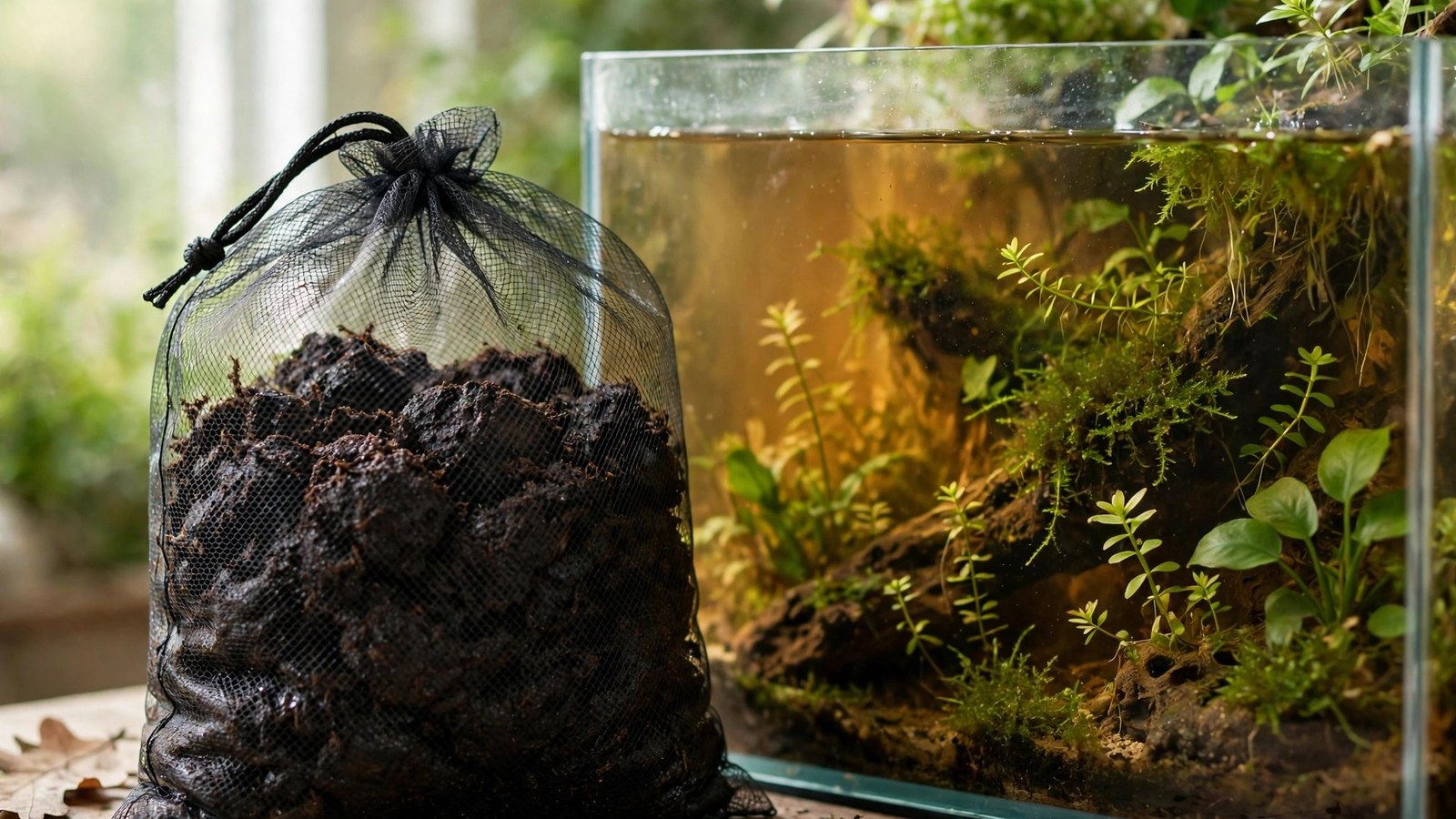
Your tap water holds the tank at pH 8, your tetras look glassy-eyed, and the bottled "pH down" you dosed this morning has already bounced back by dinner. Most people treat pH like a number to punch in — but pH is a chemistry, and peat moss pH lowering changes the chemistry underneath it. Here is the dose, placement, timeline, and when to skip peat entirely.
Yes, peat moss reliably lowers aquarium pH: Sphagnum peat releases humic and fulvic acids that neutralize carbonate hardness, dropping pH 0.5–1.0 points at roughly 1–2 oz of rinsed peat per 10 gallons, bagged in the filter. The effect peaks in 3–7 days and fades after 2–4 weeks. Amber tinting is normal; clear water means the peat is spent.
How peat moss pH lowering actually works
Peat is partially decomposed Sphagnum moss, loaded with weak organic acids — mostly humic and fulvic acids. As water flows through it, those acids react with your water's carbonate hardness (KH), the buffer that pins pH up. Consume the buffer, and pH falls. It is the same chemistry behind the soft, acidic water freshwater aquarium plants evolved in across blackwater river basins.
Weak acids mean pH falls over days, not minutes — no shock, no rebound cycle the way bottled pH-down causes. Hard water needs more peat, soft water much less, and peat's finite acid store always runs out (raw Sphagnum peat tests at pH 3.0–4.0, and extension sources note its acidifying effect fades as it breaks down: UGA Extension).
Where to put the peat: filter bag vs. substrate
For pH lowering, use the filter bag. Rinsed peat goes in a fine mesh bag tucked into the filter after the sponge, before the biomedia. It is fully controllable: add more bags, pull the bag out, or swap in fresh peat on schedule — and nothing ever needs fishing out of the gravel.
Mixing peat into the substrate is a different project: a permanent, slow-release construction decision, not something you tune week to week. If you want to build with peat, see the counterpart guide to the peat base layer planted tank build. This guide covers the filter-bag method — the answer to "how do I lower the pH of the tank I already own?"
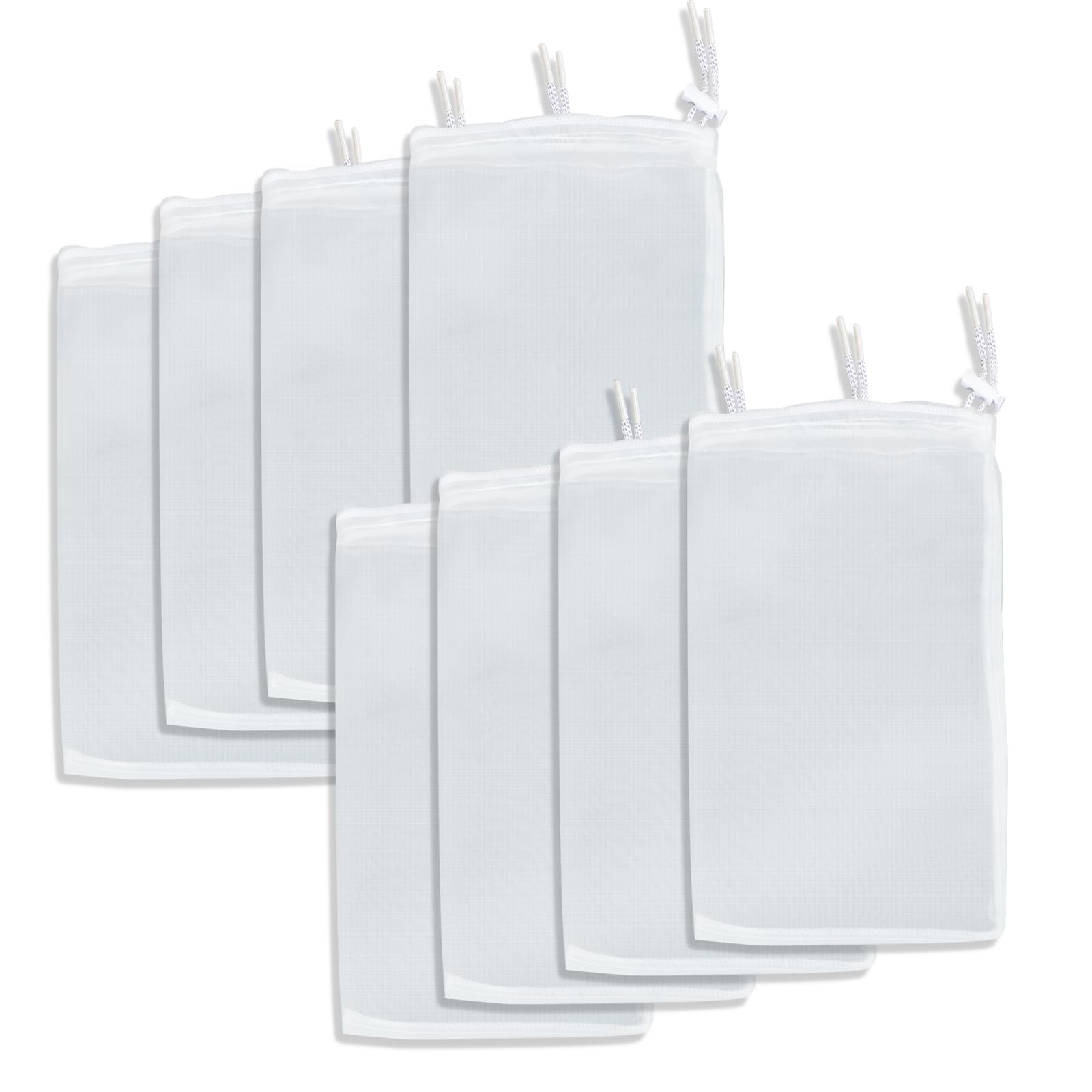 ★4.8
Pawfly Filter Media Bags
Check Price on Amazon ★4.8Dosing: how much peat and how to prepare it
For average tap water (KH 3–6 dKH), 2–4 oz (55–115 g) of dry Sphagnum peat per 20 gallons, rinsed and bagged, is the standard dose. In soft water (KH 0–2 dKH), halve it — with almost no buffer, the same peat drops pH much further. In very hard water (KH 8+), peat alone barely dents pH; pair it with RO dilution.
- Buy plain Sphagnum peat moss — 100% peat, no fertilizers, lime, or "pH-adjusted" labels.
- Rinse it twice. Knead under tap water, dump the cloudy runoff, repeat — this removes dust and the harshest initial acid flush.
- Bag it wet. Fill a mesh bag half full (peat swells), tie it off, seat it in the filter's flow.
- Record baseline pH and KH first. Without before-numbers you can't tell whether the peat worked — or worked too well.
- Test at day 3, day 7, then weekly. Expect a gradual drop that holds 2–4 weeks.
What the water will look like
Expect amber, tea-colored water within 24–72 hours. That tint is tannins — dissolved humic compounds — and it is literally the active ingredient in solution. Dark tint means the peat is working; clear water means it is spent. The color peaks around day 5 and fades over the following week. Don't strip it with fresh carbon — carbon pulls out exactly the acids you paid for. Weekly water changes dilute the color without killing the method.
Monitoring and maintenance
- Weekly: test pH and KH with liquid reagents. KH is the number that matters — if it reads zero, you have no buffer left and pH can free-fall.
- Every 2–4 weeks: replace the peat bag on a calendar schedule. Spent peat looks identical to fresh peat.
- At each water change: fresh tap water brings new KH, which temporarily slows the effect. Normal, not a failure.
- Watch the livestock: rapid gill movement or hovering at the surface in the first days means pH fell too fast — pull the bag for 24 hours and re-test.
When NOT to use peat for pH
- Hard-water species: African cichlids, guppies, platies, mollies, and swordtails want pH 7.2–8.5. Lowering it stresses them and wastes peat against massive KH.
- Aquasoil tanks: aquasoils acidify by design; stacking peat on top drives pH under 5.5 and exhausts the soil's buffer. Pick one method.
- CO2-injected tanks: pressurized CO2 already drops pH a point or more during the photoperiod. Peat makes the swing harder to manage — track pH precisely with a quality pH pen instead of adding variables.
- You need precision: for exact pH targets in breeding, peat's drift-and-fade cycle is too imprecise — RO water remineralized to a target is the right tool.
- Clear-water photography tanks: tint is a feature of peat, but still tint. For a whisper of tannin instead, botanicals for planted aquariums cover lighter options like alder cones.
Peat vs. the alternatives
| Method | pH drop | Speed | Stability | Downsides |
|---|---|---|---|---|
| Peat moss | 0.5–1.0 | Days | Good 2–4 weeks | Tannin tint; needs refreshing |
| RO water dilution | Any | Immediate | Excellent | Equipment cost; must remineralize |
| pH-down chemicals | Any | Minutes | Poor — rebound cycle | Repeated acid shocks |
| Alder cones / leaves | 0.2–0.5 | Days | Modest | Too weak for hard water |
Peat sits in the sweet spot: stronger than botanicals, gentler than bottled acids, cheaper than an RO unit — a natural fit for a low-tech planted tank setup, where slow chemistry beats high-tech control.
Frequently Asked Questions
How fast does peat moss lower aquarium pH?
Measurable change within 48–72 hours, peaking at 3–7 days. Peat releases weak organic acids gradually, so the curve is a gentle slope, not a cliff. No movement after a week means the peat is spent, the water is too hard for the dose, or the bag sits outside the filter's flow.
Will peat moss crash my pH?
Only in near-zero-KH water, where no buffer slows the acids. At KH 3+ dKH, peat bottoms out around a 0.5–1.0 point drop and stalls. Watch KH more closely than pH: KH falling toward zero is your early warning, days before pH follows.
How long does peat last in the filter?
Two to four weeks of meaningful acid output — harder water exhausts peat faster. Refresh on a calendar schedule. Spent peat looks exactly like fresh peat, so "it still looks fine" is how tanks quietly drift back up.
Does the amber tint mean something is wrong?
No — peat adds tannins, and the tint is dissolved humic acids, the active ingredient. Carbon can strip the color but also strips the acids, defeating the purpose. If the tint is unacceptable, use RO dilution instead of peat.
Is peat moss safe for shrimp and snails?
For soft-water Caridina shrimp it is excellent — it mimics their native conditions. For Neocaridina and most snails, use caution: acidification can thin snail shells and stress Neos. Keep KH above 2 dKH in snail tanks and watch shell edges.
Can I use peat with an aquasoil substrate?
Usually not. Aquasoils already acidify by design, and stacking peat on top routinely drives pH under 5.5 while exhausting the soil's buffer faster. Choose one acidification strategy per tank.
Peat moss pH lowering is not glamorous — a soggy bag of decomposed moss in a filter. But for soft-water planted tanks it is the closest thing to set-and-forget natural chemistry: gradual, forgiving, cheap. Dose conservatively, respect the KH, and refresh on schedule.