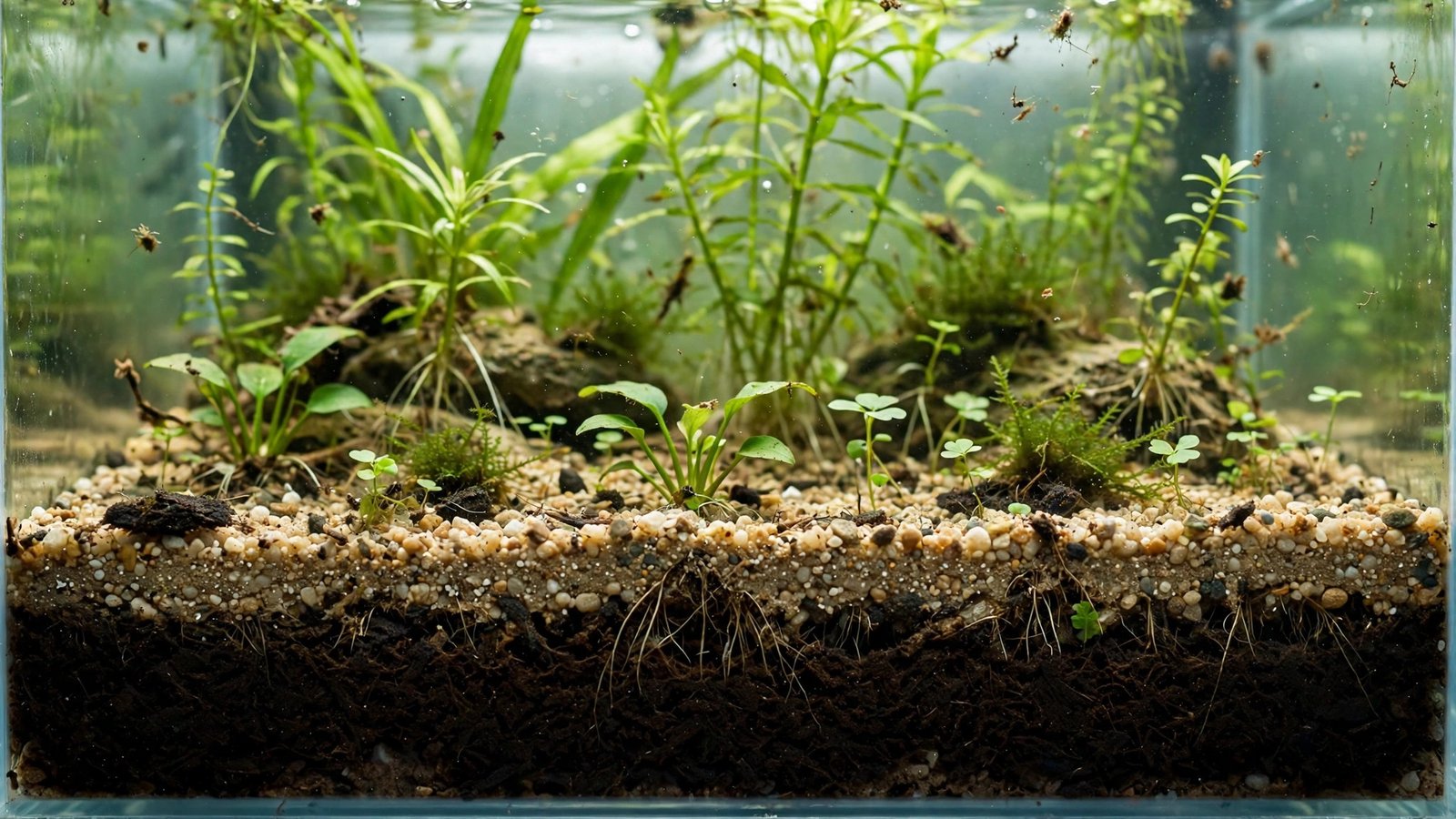
There is a smell I will never forget from my first attempt at a peat layer: I pried up a corner of substrate during a rescape, six months after setup, and the tank exhaled a puff of tea-coloured water and a faint, earthy, bog-like scent. The crypts underneath were glowing. Their roots had woven straight through the dark layer I had almost talked myself out of using. That is the short version of what peat under aquarium substrate does when it is done right: it feeds roots with gentle humic acids, softens hard water a touch, and makes the whole bottom of the tank behave a little more like the leaf-litter streams that aquarium plants evolved in.
Peat plates and loose peat as a base layer are an old Nature-Aquarium heritage method, revived from Takashi Amano's original playbook (ADA's early substrates leaned on peat under their soils) and now back on shop shelves. The idea is simple — a thin organic layer under your main substrate — but the chemistry and the construction matter. Done well, it is one of the cheapest upgrades you can give a planted tank. Done carelessly, you get tea-stained water, pH swings, and an anaerobic mess. This guide covers when peat beats aquasoil alone, how to lay and cap it properly, how to manage the side effects, and which plants genuinely benefit.
What Peat Actually Does Under the Substrate
Peat — sphagnum moss peat, the compressed stuff sold as plates, granules, or loose bags — is basically partially decomposed organic matter. Under a substrate cap it does three jobs at once, and they matter for different reasons:
- It feeds roots with humic and fulvic acids. These mild organic acids chelate minerals, keeping iron and trace elements available at the root surface — the same mechanism Tropica describes in its guidance on substrate nutrition — and they encourage the microbial activity that keeps natural riverbeds fertile.
- It softens and acidifies gently. Peat releases tannins and humic acids that nudge pH down and lower carbonate hardness over time. The effect is slow and steady rather than dramatic — a whisper, not a shove.
- It darkens the water with tannins. That tea-colour tint is dissolved humic compounds. It is the same chemistry as tannins leaching from driftwood, and it does the same useful work: shading algae-prone light, and — importantly — slightly reducing water transparency in a way many South American and Southeast Asian species prefer.
Compare that to standard aquarium soil or gravel: aquasoil feeds plants with pre-loaded nutrients and buffers pH through its own chemistry; inert gravel feeds them nothing. Peat is neither — it is an organic modifier that makes the layers around it work better and the water a little more "alive."
When Peat Beats Aquasoil Alone
Active aquasoils already do a lot — they buffer pH, release nutrients, and give roots a friendly texture. So why add peat? Four setups where it pulls ahead of aquasoil alone:
1. Hard, alkaline tap water
If your tap water comes out at pH 8 with high GH and KH, aquasoil alone burns through its buffering capacity fighting that water and can exhaust in a year or two. A peat base layer adds a second, longer-lasting line of acidification — a pattern you will recognise from how buffering substrates behave over time.
2. Long-lived, low-maintenance tanks
Aquasoil's nutrient charge depletes after 18–36 months; a peat layer works through slow organic decay and humic acid release rather than a fixed nutrient charge, so it keeps contributing root-zone chemistry far longer. It pairs beautifully with the philosophy behind long-lived dirted tank setups.
3. Crypts, swords, and other heavy root feeders
Plants with big, hungry root systems — Cryptocoryne, Echinodorus, aponogetons — respond to humic-rich substrate the way a tomato responds to compost. The chelating effect of humic acids keeps iron available at the root surface, which is often the limiting factor when swords go pale despite water-column dosing.
4. Blackwater-inspired biotopes
If you are scaping for cardinals, discus, apistogrammas, or rasboras, the gentle tannin release from a peat layer is a feature, not a side effect. The tinted water plus the soft-water chemistry is the closest a standard planted tank gets to the chemistry of those fish's home rivers.
When does peat not beat aquasoil? In high-energy CO₂ tanks where you want maximum control and predictable buffering, aquasoil alone — capped and depth-correct per substrate depth guidelines for planted aquariums — is cleaner and easier to reason about.
If you'd rather skip the DIY layer, a proven aquasoil does the job out of the bag: an aquasoil like Fluval Stratum.
Forms of Peat: Plates, Loose, or Fibre?
Peat arrives in three common forms, and each suits a different build:
| Form | Best for | Watch out for |
|---|---|---|
| Pressed peat plates | Even coverage; the classic Nature-Aquarium method. Sit flat, easy to measure. | Can wick fine dust upward if not capped well; buy aquarium-specific plates (garden peat may contain fertiliser). |
| Loose sphagnum peat | Custom shapes, deep pockets around heavy root feeders, large tanks. | Floats and drifts if a gap opens in the cap; soak it thoroughly before placing. |
| Peat fibre / granules | Mixing into soil blends or filter media; filter peat for tint-only setups. | Granules can be too dense for pure base layers; better as a mixed-in component. |
Whatever you buy, check the label: it must be unfertilised, untreated sphagnum peat — no added nitrogen, no pH-adjusted "garden" blends, no wetting agents. Aquarium-branded peat plates are the safest option.
Laying Peat Under Aquarium Substrate: The Step-by-Step Method
Peat goes under the main substrate, never on top, and the cap is what makes or breaks the build. Here is the method that has worked reliably:
- Plan 1–2 cm of peat, no more. This is a seasoning layer, not a soil replacement. Anything thicker decays unevenly and multiplies anaerobic risk. Mark your depth with a ruler or a strip of tape on the glass.
- Soak loose peat first. Put it in a bucket of dechlorinated water, squeeze out air bubbles, and let it saturate for at least an hour (overnight is better). Skipping this step is how you get floating peat during the fill.
- Place peat plates or the soaked loose layer directly on the bare tank bottom. Press plates down flat; leave no big air pockets. Keep the layer at least 2–3 cm away from the front glass so the dark band does not show through the viewing pane.
- Optional nutrient step: sprinkle a thin dusting of root tabs or powdered iron-rich clay over the peat in the planting zones where swords and crypts will go. The peat's humic acids help keep these available.
- Cap with 4–6 cm of your main substrate. Aquasoil over peat is the classic combination; a sand cap over aquasoil (see how to cap aquarium soil with sand or the detailed sand-capping technique) keeps the peat locked down while letting roots pass through. The cap must be heavy and continuous — this is not a place for a thin decorative dusting.
- Fill slowly. Place a plate or plastic bag over the substrate and pour onto it. Rushing the fill is the number-one way a perfect peat layer turns into a cloudy brown snow globe.
- Run activated carbon for the first week. The first tannin flush is the strongest; carbon plus a couple of extra water changes clears the initial tea tint without removing the peat's long-term chemistry.
That cap depth matters more than anything else. A peat layer under a 2 cm skim of sand will leach, stain, and drift. Under a proper 4–6 cm cap it behaves itself for years.
Tannin Staining: Feature, Flaw, or Phase?
Expect tinted water for the first one to three weeks. Expect some tint long-term if you run a peat layer — that is the point for a blackwater-style tank, but it can annoy an aquarist chasing crystal-clear water. Manage it with:
- Activated carbon or Seachem Purigen in the filter, replaced on schedule during the first month.
- Generous water changes in month one (30–40% twice weekly), then your normal routine.
- Accepting the tint if you keep blackwater fish — for cardinals and apistos, that tea colour is environmental enrichment, and many aquarists find it dramatically improves fish colouration and behaviour.
One human detail worth sharing: I keep my peat-tank's water just faintly golden — my partner calls it "the whisky tank" — because the cardinal tetras in it colour up deeper and bolder than the same fish in my crystal-clear CO₂ tank. That is not a controlled experiment, but it is consistent, and it is why the tint stopped bothering me.
pH, GH, and KH: The Chemistry Shift, Honestly Quantified
Peat's effect on water chemistry is real but modest. A reasonable expectation for a 1–2 cm peat base layer under a full cap in a medium-hard tank:
- pH: down 0.3–0.8 units over several weeks, then stable.
- KH: slow, slight decline over months.
- GH: minimal direct effect — peat is not a true softener the way RO or resin is.
This is a softening of the water's character, not a desalination. If your tap water is liquid rock, peat alone will not make it blackwater — but it will take the edge off, extend your aquasoil's buffering life, and keep the substrate root-friendly longer.
Which Plants Benefit Most — and Which Don't Care
Big winners
- Cryptocoryne species — the classic peat-layer success story; humic-rich substrate and crypts are old friends.
- Echinodorus (swords) — heavy root feeders that use the chelated iron effect.
- Aponogeton and Nymphaea — bulb and tuber plants that feed aggressively through roots.
- Vallisneria and Sagittaria — runners spread through the layer and drink from it.
Indifferent
Most stem plants and epiphytes (Anubias, Java fern, Bucephalandra, mosses) feed primarily from the water column or from hardscape, so a peat base layer changes little for them. If your scape is stem-heavy with CO₂, peat is optional seasoning rather than a game-changer.
Caution
Delicate carpeting plants like Hemianthus callitrichoides grow such shallow root systems that they may never reach the peat — and the slight acidity at the substrate surface during month one can slow their melt-recovery. Plant carpets after the initial tannin flush has passed.
Anaerobic Risk: The Fear, and the Honest Answer
At 1–2 cm under a proper cap, risk is low. The layer is thin enough that root penetration and microfauna keep it partially oxygenated, especially in planted zones.
- Roots are your ventilation system. Plant densely in peat zones; living roots pump oxygen into the substrate. Bare, unplanted peat zones are where compaction starts.
- Poke it gently. During water changes, push a chopstick or skewer into the substrate in a few spots and watch for large bubble streams. A few small bubbles are normal; a geyser of foul-smelling gas means you have compaction — thin the peat there and plant it heavily.
- Never disturb the whole layer at once. A full-teardown rescape of a peat tank releases a pulse of nutrients and humic compounds — the "tea exhale" I described in the intro. Replant quickly, do a big water change, and run fresh carbon.
Peat is genuinely lower-risk than raw soil here: it is already partially decomposed, so its oxygen demand curve is gentler than fresh organic matter like the layers discussed in mineralized topsoil builds or potting-mix comparisons. Still, respect the layer — thin, capped, planted.
Peat vs. Pumice: The One-Sentence Contrast
Where the pumice base-layer method is an inorganic, porous-stone drainage approach that keeps the substrate aerated and chemistry-neutral, peat is the organic, humic-acid route — it acidifies, tints, and feeds roots chemically rather than structuring them physically.
Maintenance Routine for a Peat-Layer Tank
Once established, a peat tank asks little:
- Months 1–2: carbon or Purigen in the filter, weekly parameter tests, 30–40% water changes. Crypts may melt, then rebound harder than before.
- Months 3–12: normal maintenance. Root tabs in heavy-feeder zones every 3–4 months. The peat itself needs no replacement.
- Year 2+: tannin release is largely spent, but humic chemistry and microbial habitat persist. If the aquasoil above is also exhausted, treat the tank as mature-low-tech: water-column dosing carries the load, roots still get the humic bonus.
- Rescapes: move plants, not the peat. Keep the layer buried; patch the cap where roots pulled it up.
Frequently Asked Questions
Can I put peat under gravel or sand without aquasoil?
Yes — peat under inert substrates like sand or gravel works, and it is the cheapest way to make an inert substrate setup root-fertile. You lose the buffering and nutrient charge of aquasoil, so supplement with root tabs from day one and expect a stronger initial tannin flush, since there is no aquasoil layer absorbing part of it.
Will peat crash my pH overnight?
No. Peat acidifies slowly over weeks, not hours — that is precisely its advantage over chemical pH adjusters. A sudden crash points to something else, like exhausted KH, a CO₂ malfunction, or a contaminated peat product. Buy unfertilised, aquarium-safe peat and test weekly in the first month to confirm your tank's actual curve.
Is peat safe for shrimp and sensitive fish?
Generally yes, and soft-water shrimp like Caridina and many tetras thrive in the gently acidified, tannin-tinted water. The risk is the change, not the peat: add livestock after the first-month chemistry has stabilised, and avoid peat layers in tanks holding hard-water specialists like African cichlids or livebearers that prefer alkaline conditions.
How long does a peat base layer last?
The strong tannin release fades over 2–6 months; the humic-acid and chelating benefits persist for years as the peat continues its slow decay. Think of it as a front-loaded effect with a long tail — the opposite of aquasoil's nutrient charge, which is strong at first and then essentially gone.
Can I add a peat layer to an already-running tank?
Not under the existing substrate without a full teardown — and tearing down a mature tank to bury peat is rarely worth it. Better options for established tanks: peat granules in a filter bag in the filter (tint and mild chemistry only), or peat under substrate in a new section if you are extending the scape. The base-layer method is a setup-time decision.
Does peat cause algae?
Not directly — the tannins actually shade light slightly, which can mildly suppress algae. Algae outbreaks blamed on peat are usually from the setup-time disturbance: disturbed peat releases a nutrient pulse, and combined with fresh-tank instability that feeds algae. Heavy planting from day one, good flow, and the first-month carbon/water-change routine prevent this almost entirely.
The Bottom Line
Peat under the substrate is the oldest trick in the Nature-Aquarium book, and it survived for a reason: a thin, well-capped layer of humic-rich organic matter makes hard water gentler, roots hungrier, and crypts happier — for years, at a fraction of the cost of premium substrates. Respect the three rules — thin layer, heavy cap, plant it densely — and the only surprise will be that bog-scented exhale on rescape day, telling you the peat was working all along.