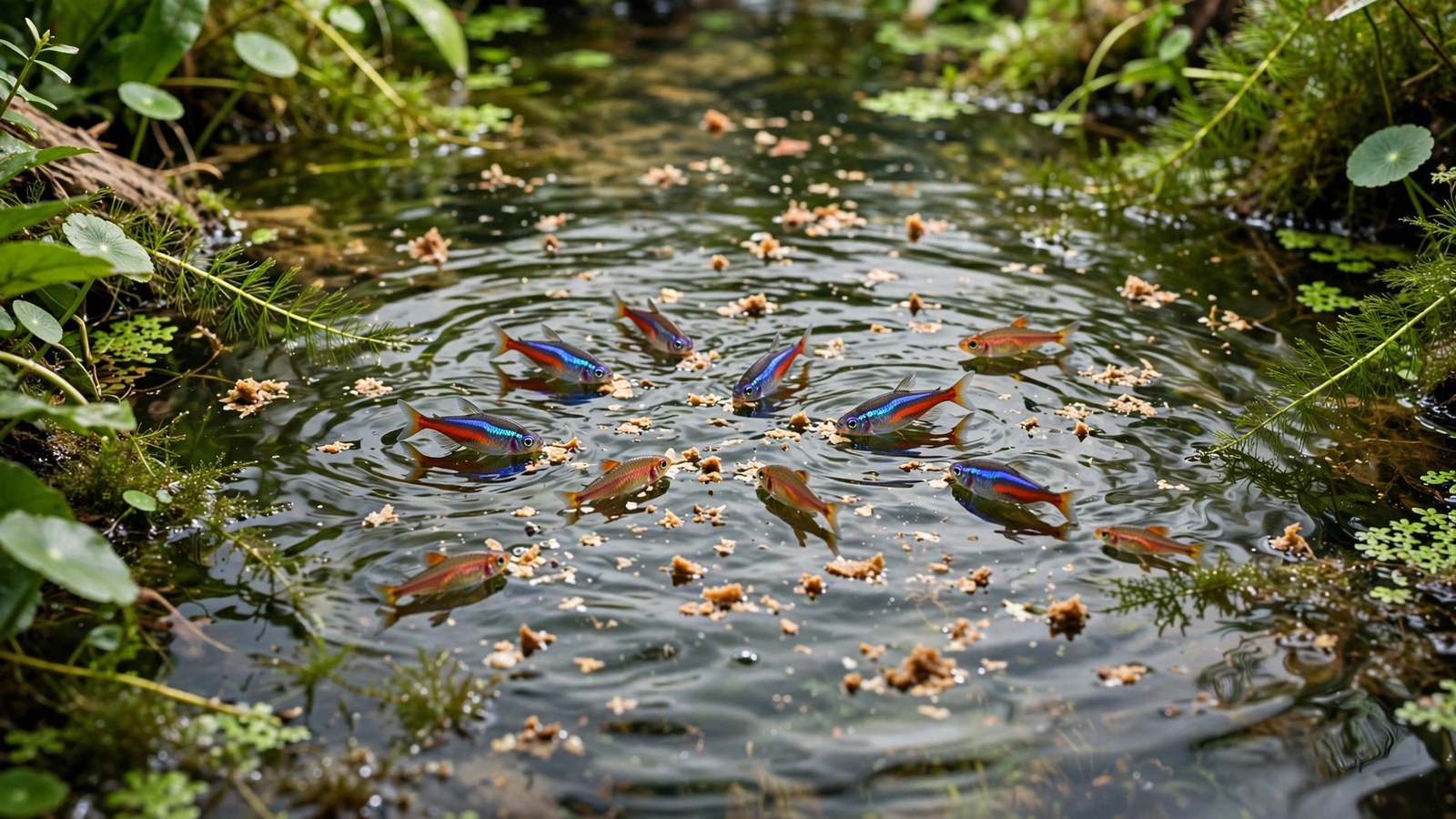
Most experienced hobbyists agree that overfeeding is the single biggest killer of aquarium fish. Most beginners dump in a generous pinch "to be safe," then watch uneaten flakes dissolve into ammonia. The fix is not buying better food — it is following a fish feeding schedule that matches each fish's life stage. Fry need constant tiny meals; adults thrive on once-daily feeding with a fast day each week. This guide gives you the exact routine, portion rules, and species exceptions, so you feed with confidence instead of guilt. It matters in planted setups too: decaying food pollutes the same substrate where your aquarium plants for fish tank community feeds.
A healthy adult aquarium fish needs only about 2–3% of its body weight in food per day — roughly one small pinch of flakes for a school of ten tetras. Feed fry 4–6 times daily in tiny portions, juveniles 2–3 times daily, and adults 1–2 times daily, skipping one day per week. Anything uneaten after three minutes should be netted out.
Fish Feeding Schedule by Life Stage
A newborn guppy fry and a full-grown guppy have almost nothing in common at mealtime. Fry have tiny stomachs and burn energy growing, so they need food almost constantly. Adults grow slowly, and extra meals mostly become waste. The table below is your baseline — adjust portions by species size and appetite.
| Life stage | Feedings per day | Portion per feeding | Best foods |
|---|---|---|---|
| Fry (0–4 weeks) | 4–6 | A dusting, eaten in under a minute | Infusoria, baby brine shrimp, crushed flakes |
| Juveniles (1–6 months) | 2–3 | A small pinch, gone in about a minute | Micro pellets, frozen daphnia and brine shrimp |
| Adults | 1–2 | A small pinch per fish, gone in 60 seconds | Quality flakes, pellets sized to mouth |
| Conditioning breeders | 2–3 | Generous protein portions | Frozen bloodworms, live foods |
Consistency matters more than variety. Feed at roughly the same times each day, about an hour after lights-on, and skip the late-night meal — a fish's metabolism slows in the dark, so food dropped in at midnight mostly rots by morning.
How Much to Feed: The 2-Minute Rule, Honestly
You have probably heard the "as much as they eat in two minutes" rule. Here is the honest problem: most community fish will stuff themselves for two full minutes and then bloat. Two minutes is an overfeeding recipe disguised as wisdom.
Use the 30–60 second rule instead. Add a small pinch, watch, and stop the moment fish slow down or food drifts past them. A fish that is mildly eager at every meal is a healthy fish; a fish with a distended belly after feeding is being overfed.
Match food size to mouths. When half your food sinks untouched, the issue is usually particle size, not appetite.
Fasting Days and Vacation Rules
Skipping one day of feeding per week is one of the healthiest things you can do for your tank. Wild fish do not eat daily, and a weekly fast lets the digestive tract clear, reduces waste, and noticeably slows algae growth. Fry under four weeks old are the only ones that should never fast.
Vacation fears cause more overfeeding damage than hunger ever does. A healthy adult community tank survives 7–10 days without food with zero harm — fish simply graze on algae, biofilm, and leftover microfauna. If a friend feeds while you are away, pre-portion each day's food into labeled pill-organizer compartments so there is nothing to guess.
Species Exceptions: Bettas, Plecos, and Shrimp
The general schedule covers most tetras, rasboras, guppies, and barbs. Three common groups need their own rules.
Bettas have stomachs roughly the size of their eyeball. Feed 2–4 small pellets or a pinch of flakes once or twice daily — that is genuinely enough. Hikari's official betta care sheet recommends small measured portions for the same reason: bettas beg relentlessly and will eat themselves bloated. Soak pellets for a few seconds first if you feed larger ones.
Plecos and bottom feeders are nocturnal grazers, not midday surface feeders. Drop in a sinking wafer or sinking pellets for bottom dwellers after lights-out, when the pleco actually emerges. Bristlenoses and most common plecos also need real vegetable matter — offer blanched zucchini or cucumber slices a few times a week, removed after 6–8 hours before they foul the water. For a full rundown, see our guide to blanched vegetables as fish food.
Shrimp barely count as "fed" animals in a mature tank. Cherry and amano shrimp graze on biofilm and algae all day — a tiny wafer twice a week is plenty, and more just feeds the snail population.
In a mixed community, feed in zones. Surface flakes for top feeders first, mid-water pellets a minute later, sinking food for the bottom crew after lights dim. In a tank stocked with the easiest aquarium plants for a beginner community tank, zoned feeding also keeps uneaten food from settling into the substrate and rotting among the roots.
Overfeeding Signs and Ammonia Consequences
Every uneaten flake begins decomposing within hours, and decomposition produces ammonia — the most toxic common pollutant in a fish tank. Chronic overfeeding shows up as cloudy water, algae blooms, and ammonia readings that never quite hit zero; fish get lethargic and develop fin rot or bloat long before a test kit screams.
Watch for the classic signs: food still visible on the substrate five minutes after feeding, distended bellies, stringy white waste, and sudden algae explosions. Any one of these means cut portions by a third immediately — do not "upgrade" to a better food first. Fish rebound quickly once the waste load drops.
Frequently Asked Questions
Should I feed my fish once or twice a day?
For healthy adult community fish, once a day is genuinely enough; twice a day with small portions is fine too. Frequency matters far less than portion size. Choose whichever fits your routine and stick to it — fish thrive on consistency.
How long can aquarium fish go without food?
Healthy adults comfortably go 7–10 days without food by slowing their metabolism and grazing on algae and biofilm. Fry under four weeks old are the exception — never fast them. For absences beyond ten days, use a tested automatic feeder rather than vacation blocks, which pollute the water.
Is it better to underfeed or overfeed fish?
Underfeed, every time. A slightly underfed fish stays active, healthy, and eager at mealtimes. An overfed fish suffers bloating and constipation, while the leftover food decays into ammonia that poisons the whole tank. If you are ever unsure whether you fed enough, you fed enough — err on the lighter side.
Why is my fish tank cloudy after feeding?
Cloudiness after feeding almost always means too much food or pieces too large to eat quickly. Uneaten particles dissolve and feed a bacterial bloom. Cut portions to what disappears in 60 seconds and the cloudiness usually clears within a day or two.
Do bottom feeders need a separate feeding schedule?
Not a separate schedule, just a separate delivery: most bottom feeders are nocturnal, so drop sinking food after lights-out when they actually forage, rather than letting surface fish steal it. Two to three targeted bottom-feeder meals per week is plenty for adult corydoras, loaches, and small plecos.
Your Routine, Simplified
Tape this to the tank stand: adults once or twice daily, juveniles two to three times, fry four to six times — every meal gone in sixty seconds, one fast day per week. Feed the bettas sparingly, the plecos after dark, and stop trusting the begging.