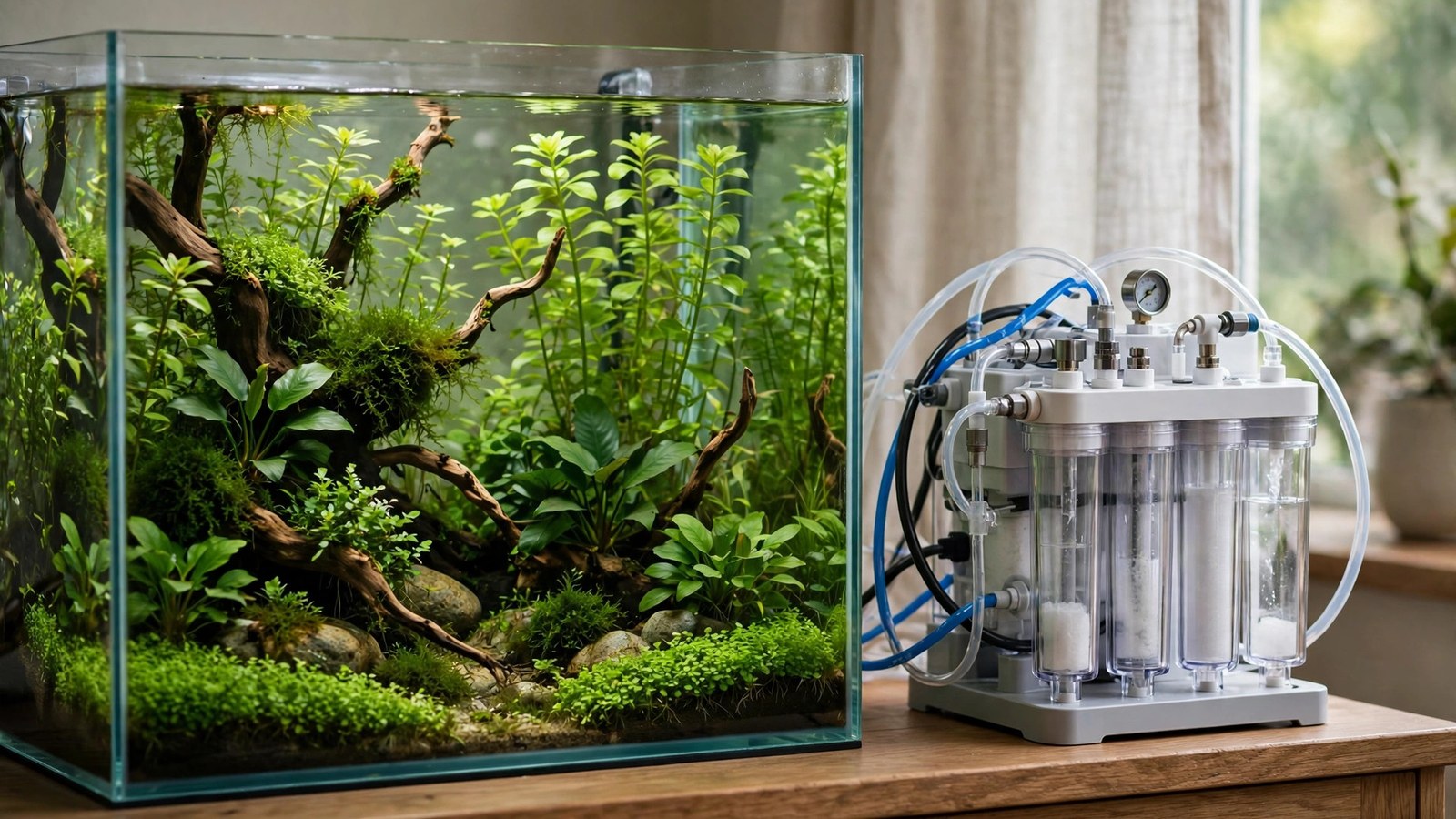
If your tap water leaves white crust on the glass and your "sensitive" plants keep melting anyway, the problem is rarely your fertilizer schedule — it's the water itself. Tap water at 300+ ppm of dissolved minerals can push hardness and pH beyond what finicky species tolerate, and no amount of trimming fixes that. This guide matches the best rodi unit for aquarium water to your tank in five real-world scenarios.
Why planted tanks benefit from RO/DI water
Most planted tank water parameters — GH, KH, pH — are inherited from your tap. When the tap is hard or varies seasonally, soft-water plants like Tonina and Eriocaulon stall while algae exploits the instability. An RO/DI unit strips nearly everything out: the RO membrane rejects the bulk of dissolved solids, and the DI resin polishes what remains to 0 TDS. You then rebuild it with a remineralizer to a stable GH and KH.
The payoff is predictability: dosing stops fighting unknown tap minerals, and water changes stop being a chemistry lottery. The tradeoffs — most units waste 2–4 gallons per gallon produced, cartridges are a recurring cost, and pure RO water must always be remineralized — are real but manageable.
How to choose the best rodi unit for aquarium water
Start with the four stages. A sediment filter catches rust and particles; a carbon block removes chlorine that would destroy the membrane; the RO membrane does the heavy lifting, rejecting up to 98% of dissolved solids; and DI resin polishes the last ions to zero TDS. If your city uses chloramines, add a fifth stage — a second carbon block — because chloramines break through single carbon stages fast.
Size output against your water-change habit, not just tank size. A 50 GPD unit makes roughly 2 gallons an hour under good conditions — fine for one nano tank, painfully slow for a 75-gallon tank's weekly change. Then check the supporting gear: an inline TDS meter in a planted tank setup tells you when membrane or DI resin is spent (output above 0–1 TDS means cartridges are due). If mains pressure sits below about 60 psi, add a booster pump — low pressure tanks both output and rejection rates.
5 RO/DI units worth buying
Every pick below is genuinely suitable with real tradeoffs. Match the scenario to your situation — there is no perfect unit here.
| Unit | Best for | Stages | Output | Strength / tradeoff |
|---|---|---|---|---|
| AquaticLife RO Buddie 4-Stage | Nano tanks, apartments | 4 | 50 GPD | Tiny, runs on tap pressure / slow; small DI cartridge exhausts fast on hard tap water |
| Bulk Reef Supply 4 Stage Value | Most hobbyists | 4 | 75 GPD | NSF-certified filters, Dow Filmtec membrane, lifetime warranty / base model lacks TDS meter and gauge |
| SpectraPure CSPDI 90 | Shrimp breeders | 4 | 90 GPD | Individually tested 98%+ rejection membrane, 3-probe TDS meter / premium price |
| LiquaGen 5 Stage Elementary | Feature value | 5 | 75 / 150 GPD | Pre-assembled, versions bundle gauge and TDS meter / reef branding confuses freshwater buyers |
| Bulk Reef Supply 4 Stage Value 100 | Large or multiple tanks | 4 | 100 GPD | Same solid build, faster fills / high-GPD membranes can trade rejection for speed |
AquaticLife RO Buddie 4-Stage (50 GPD) — best compact. The unit for people with no space: it fits under a sink, runs on water pressure with no electricity, and color-changing DI resin shows when it's spent. Expect about 2 gallons an hour — right for nano tanks. On hard tap water the small DI cartridge exhausts quickly, making resin a regular running cost.
Bulk Reef Supply 4 Stage Value (75 GPD) — best for most hobbyists. Bulk Reef Supply's 4-stage system pairs a Dow Filmtec membrane with NSF-certified filters and tool-free push-connect fittings on one bracket, backed by a lifetime warranty. It suits chlorinated city water and clean well water — most planted-tank keepers. The honest gap: the base Value model ships without a TDS meter or pressure gauge.
SpectraPure CSPDI 90 (4-stage, 90 GPD) — best high-purity pick. SpectraPure individually tests each SpectraSelect Plus membrane for rejection (98%+), includes a 3-probe TDS meter monitoring feed, membrane, and DI output, plus a membrane flush valve that extends membrane life. That's why caridina shrimp breeders swear by it — stable 0 TDS batch after batch. Premium price, and overkill for a hardy community tank.
LiquaGen 5 Stage Elementary (75 or 150 GPD) — best feature value. LiquaGen's 5-stage units come pre-assembled with an auto shut-off and check valve, and versions bundle a pressure gauge and dual TDS meter — features competitors charge extra for. The extra carbon stage gives chloramine-prone city water more headroom. It's marketed to reef keepers, but the output is just 0 TDS water — suited to planted tanks once remineralized.
Bulk Reef Supply 4 Stage Value 100 (100 GPD) — best for large tanks. Same proven build as the 75 GPD Value unit with a faster membrane, so weekly changes on big or multiple tanks take noticeably less time. Honest note: higher-GPD membranes sometimes trade rejection for speed, making the DI resin work harder — verify the rated rejection before assuming it's a pure upgrade.
Dosing gets simpler on RO water, not harder: with tap minerals out of the picture, every dose lands exactly as calculated. If you run a high-tech tank, pair your RO routine with a structured schedule like the one in our EI dosing beginners guide and adjust from a clean baseline.
The article's compact-pick scenario is the RO Buddie 4-Stage 50 GPD; genuine buying-intent slot in the pick list: the AquaticLife RO Buddie 4-Stage ★4.3.
Frequently Asked Questions
Do planted tanks really need an RO/DI unit?
No — most hardy plants and community fish do fine on dechlorinated tap water. RO/DI earns its place when tap water is very hard, highly variable, or loaded with nitrates and phosphates that fuel algae. Shrimp breeders and keepers of soft-water species benefit most; check the freshwater aquarium plants complete guide to see whether your species need soft water before spending money.
How much water does an RO/DI unit waste?
Typically 2–4 gallons of waste per gallon of pure water, depending on the unit, mains pressure, and membrane. Higher pressure and flush-valve equipped units waste less. Route the waste line to a garden or houseplants rather than the drain — it's just concentrated tap water, fine for plants that tolerate minerals.
What GPD rating should I buy for a planted tank?
Match GPD to your weekly water-change volume with a comfort margin. A 50 GPD unit makes about 2 gallons an hour — fine for tanks under 20 gallons. For 40–75 gallon tanks, 75–100 GPD fills buckets in a reasonable evening. Multiple large tanks justify 150 GPD. Going one size up costs little extra and saves hours over the unit's lifetime.
Can I use RO water from the grocery store instead?
Yes, for small tanks — store-bought RO or distilled water works exactly like unit-made water, and you still must remineralize it. The math breaks down fast on larger tanks: hauling jugs weekly gets expensive and tedious. If you're buying more than a few gallons a week, a unit pays for itself in convenience within months.
Start with your tap water report
Before buying anything, pull your municipal water report or test tap TDS, GH, and KH. If TDS sits under ~150 ppm and stays stable, your money is better spent on plants and CO2 — browse the aquarium plants for fish tanks guide and grow on tap. If it's hard, spiky, or algae-fueling, pick the scenario above that matches your tanks, budget for the meter and remineralizer, and keep it consistent.