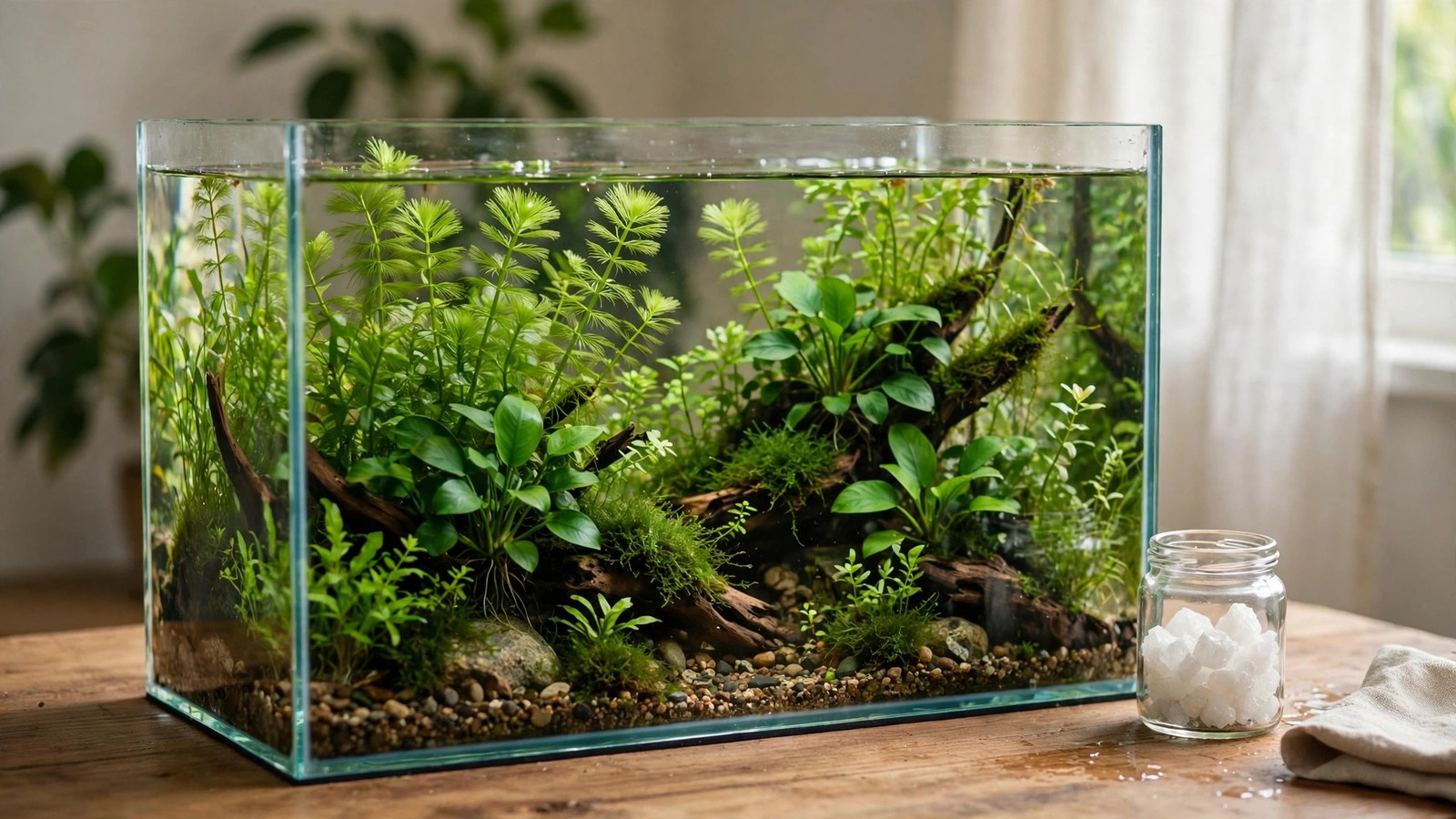
A forum thread swears by Epsom salt for aquarium plants at 1/2 tsp per 10 gallons, your old leaves are yellowing between the veins, and nobody mentioned that Epsom salt is magnesium sulfate — not aquarium salt. It is a legit, dirt-cheap magnesium fix for planted tanks, but only when magnesium is actually the problem. Here's how to confirm a deficiency, the dose protocols that work (including RO water math), and when to leave the bag on the pharmacy shelf.
What "Epsom Salt for Aquarium Plants" Actually Is (and What It Isn't)
Epsom salt is magnesium sulfate heptahydrate (MgSO4·7H2O) — about 10% magnesium by weight, the rest sulfate, which plants use as a sulfur source in tiny amounts. Buy the plain, unscented, additive-free bag; fragrances and dyes are never livestock-safe. The confusion that trips up most beginners: Epsom salt is not aquarium salt. Aquarium salt is sodium chloride, used for freshwater dips and certain diseases. Sodium chloride won't fix yellow leaves and can stress plants and shrimp. And remember that magnesium is one piece of a plant's nutrition, never the whole picture — a solid all-in-one fertilizer dosing guide keeps single minerals like this one in context.How to Spot a Real Magnesium Deficiency
Magnesium sits at the heart of every chlorophyll molecule, so a shortage shows up in photosynthesis first. Because magnesium is mobile in the plant, it relocates from old tissue to new growth — deficiency always strikes the oldest, lowest leaves first. That single trait separates it from iron deficiency, which hits new leaves.| Sign | What it looks like | Commonly confused with |
|---|---|---|
| Interveinal chlorosis | Yellowing between veins while veins stay green — marbled pattern on lower leaves | Iron deficiency (hits new leaves first) |
| Marginal necrosis | Edges of old leaves brown and crisp in advanced stages | Potassium deficiency (pinholes plus yellow edges) |
| Stunted growth | New leaves small and pale despite good light and CO2 | General starvation — check your fertilizer schedule first |
Dose Protocols That Work (Start Low)
One level teaspoon of Epsom salt weighs roughly 5 g and is ~10% magnesium, so it adds about 13 ppm of magnesium per 10 gallons. Half that for 1/2 tsp (~6 ppm), half again for 1/4 tsp (~3 ppm). Planted tanks typically want just 2–5 ppm of magnesium — which is why the conservative doses below are plenty.| Tank size | Weekly dose (after water change) | Correction dose (confirmed deficiency) | Mg added |
|---|---|---|---|
| 10 gal | 1/4 tsp | 1/2 tsp | ~3 / ~6 ppm |
| 20 gal | 1/2 tsp | 1 tsp | ~3 / ~6 ppm |
| 40 gal | 1 tsp | 2 tsp | ~3 / ~6 ppm |
Remineralizing RO and Distilled Water
RO water has essentially zero minerals, and it's the one scenario where Epsom salt earns a permanent place. But magnesium is only half the job — you also need calcium, which Epsom salt can't supply. For soft-water planted tanks, target roughly 3–5 ppm magnesium and 8–15 ppm calcium (a Ca:Mg ratio around 3:1), landing near 3–5 dGH. Epsom salt at 1/2 tsp per 10 gallons delivers ~6 ppm magnesium; pair it with a calcium source (calcium sulfate or a commercial GH booster containing calcium and magnesium salts) in the same water-change bucket. Mix salts into the water-change water before it touches the tank and verify with a GH test. Skip any one mineral and you'll breed a lopsided deficiency down the road.Shrimp, Snail, and Fish Safety
At 3–6 ppm Mg, Epsom salt is safe for fish, shrimp, and snails — it's the same magnesium already in hard tap water. It doesn't spike pH, since sulfates aren't carbonates. The only livestock risk is sloppy practice: dumping dry granules straight into the tank, where a concentrated pocket can irritate gills. Always dissolve first. Still, "start low, observe livestock" is the rule on this site for every additive. Dose after your water change, watch for an hour — shrimp grazing, snails active, fish breathing evenly — and only then settle into the routine. If anything looks off, a partial water change rinses it out. And if you're adding new livestock or plants around dosing time, our guide on how to acclimate new aquarium plants covers why stressed plants mislead every diagnosis.When NOT to Reach for the Bag
First: your tap water already has decent GH (6+ dGH is mostly calcium and magnesium already) — adding more skews the Ca:Mg ratio and can lock out calcium or potassium uptake. Second: you run a complete EI regimen — EI recipes include MgSO4 as standard, so you'd be doubling up. Check your current mix with our EI dosing guide for beginners before adding anything. Third: the deficiency isn't magnesium. Yellow new leaves (iron), pinholes with yellow edges (potassium), or stunted pale growth with everything dosed (nitrogen or CO2) won't respond to Epsom salt — and chasing the wrong fix for a month costs a full growth cycle.Frequently Asked Questions
How much Epsom salt per gallon should I add?
Start with about 1/40 tsp per gallon (1/4 tsp per 10 gallons), which adds roughly 3 ppm of magnesium — the low end of the planted-tank range. Only increase to 1/20 tsp per gallon if old-leaf yellowing and low GH confirm a deficiency. Always dissolve it in tank water first.
Is Epsom salt safe for shrimp and snails?
Yes, at normal doses (3–6 ppm Mg). Magnesium is already present in hard tap water, and magnesium sulfate doesn't alter pH or harm invertebrates. The one risk is undissolved granules dumped directly into the tank — dissolve your dose in a cup of tank water first.
What's the difference between Epsom salt and aquarium salt?
Epsom salt is magnesium sulfate, a plant nutrient that fixes magnesium deficiency. Aquarium salt is sodium chloride, used for disease dips and fish stress. They're not interchangeable — sodium chloride does nothing for plants and can harm them, while Epsom salt does nothing for ich.
Can I use Epsom salt instead of a complete fertilizer?
No. Epsom salt supplies only magnesium and sulfate; plants also need nitrogen, phosphorus, potassium, and micronutrients. Treat it as one missing ingredient in a complete routine — a good all-in-one or EI regimen with magnesium covered makes Epsom salt unnecessary.
Will Epsom salt raise my GH or pH?
It raises GH (general hardness) — 1 tsp per 10 gallons adds roughly 1.5–2 dGH, since magnesium counts toward hardness. It does not raise pH or KH, because sulfates aren't carbonates. Useful for RO remineralization without buffering, but it can't stabilize pH.