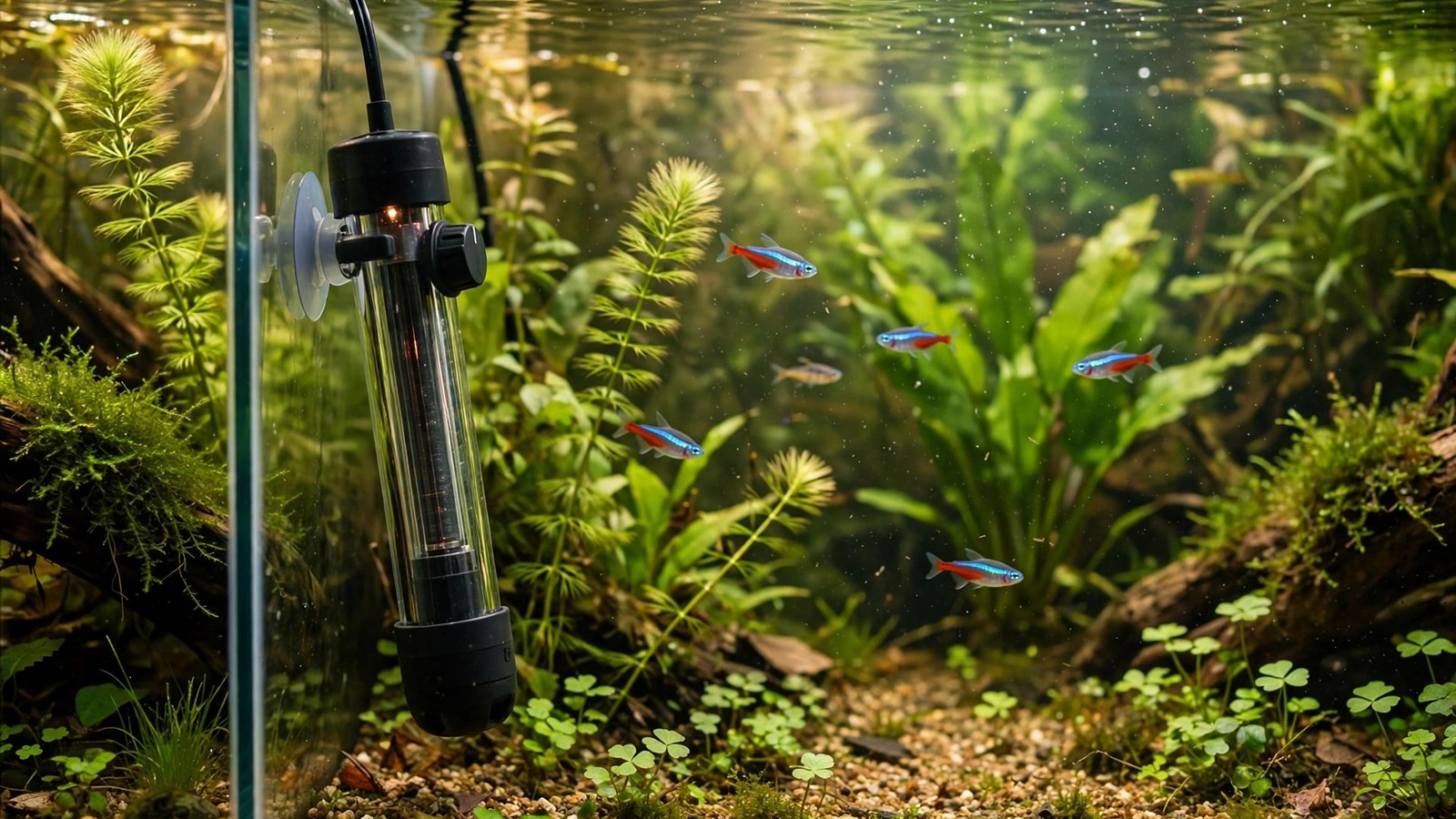
The best aquarium heater for planted tank keepers isn't the one with the flashiest display — it's the one you forget exists. Temperature sets the pace for everything in the tank: enzyme activity, CO₂ solubility, beneficial bacteria, and the growth rate of every stem. A cheap heater with a sloppy thermostat can swing the water several degrees between cycles, stressing livestock and stalling plants.
No fake "we lab-tested 47 heaters" here — six models the planted-tank hobby keeps buying and recommending, with their genuine tradeoffs, plus how to size and place any heater for the stable warmth plants need.
Choosing the best aquarium heater for planted tank stability
Before sizing anything, settle whether your planted tank even needs a heater — a room that holds 72°F year-round can sometimes skip one.
Wattage. Use 3–5 watts per gallon, but the real variable is the gap between room and target temperature: a 20-gallon tank in a 68°F room does fine on 100 watts, while the same tank in a 60°F basement may need 150. Oversizing has a real downside — a huge heater heats so fast that a stuck thermostat can cook a small tank before you notice. For 55 gallons and up, two smaller heaters beat one big one: if one fails off, the other holds the line; if one fails on, it can't overpower the tank alone.
Adjustable vs. preset. Preset heaters lock in at 78°F and drift with age. Adjustable models let you target 74°F for caridina shrimp or 78°F for a tropical community, and let you compensate when the dial lies. Assume every dial is off a few degrees out of the box.
Safety. The thermostat is the weak link in every heater — its quality is what separates a heater you trust from one you check nervously each morning. An external controller (a separate unit that cuts power at your set point) is the best money in the hobby: even if the heater's own thermostat sticks closed, the controller saves the tank.
The 6 picks, compared
Six models with long track records, each framed by the scenario it suits — the right heater depends on your tank.
| Heater | Best for | Type | Standout | Tradeoff |
|---|---|---|---|---|
| Eheim Jager TruTemp | Adjustable workhorse | Glass, adjustable | Recalibratable dial, ±0.5°C accuracy | Long body; glass needs a guard |
| Fluval E Series | Display / high-tech tanks | Glass, digital | Dual sensor + LCD readout | Bulky; premium price |
| Aqueon Pro | Shatterproof peace of mind | Aluminum, adjustable | Nearly indestructible, LED indicator | Wider accuracy tolerance |
| Hygger titanium + controller | Large tanks, budget | Titanium, external controller | Remote controller with memory | Probe placement is finicky |
| Cobalt Neo-Therm | Low-profile aquascapes | Flat electronic | Slim, hides behind hardscape | Premium price per watt |
| Finnex HMO titanium | Simple and durable | Titanium, dial | No glass to break | Coarse dial — add a controller |
1. Eheim Jager TruTemp — best adjustable workhorse
The heater old-school hobbyists measure everything else against. Its TruTemp ring lets you recalibrate the dial against a thermometer, and Eheim's official specs claim ±0.5°C control accuracy with dry-run shutoff, in sizes from 25 to 300W. Downsides: it's long (the 300W is 20 inches), it's still glass so budget for a guard, and you must calibrate it against a thermometer.
2. Fluval E Series — best for display and high-tech tanks
Wraps the element in a fish-safe guard and adds an LCD readout of actual water temperature plus a dual-sensor system watching for big swings. In a high-tech tank, spotting drift at a glance is genuinely useful. Tradeoffs: it's bulky, the display faces one direction (mount it thoughtfully), and you pay a premium over simpler models with equal heating power.
3. Aqueon Pro — best shatterproof pick
Aluminum casing, fully submersible, shrugs off bumps during maintenance, and the LED glows while heating so you can see it working. That durability matters with kids or large boisterous fish sharing the tank. The tradeoff is precision: accuracy tolerance is wider than the Jager's or a digital model's, and the notched dial offers no digital readout. Pair it with a thermometer or an external controller and it's a heater you can forget about.
4. Hygger titanium with external controller — best for large tanks
Hygger's higher-wattage titanium heaters ship with a separate controller: set the temperature on the controller, the probe reads the water, and the unit remembers settings through outages. For 75-gallon-plus tanks, you get the external-controller safety net built in. Caveats: the build feels budget next to Eheim or Fluval, and the probe must sit in representative water — tuck it in dead flow and the controller chases the wrong number.
5. Cobalt Aquatics Neo-Therm — best low-profile heater
Flat and slim, the easiest heater here to disappear behind driftwood or a dense stem background in an aquascape-first tank. The electronic thermostat holds temperature tightly. The tradeoff is price — a clear premium per watt over a Jager or Aqueon. Buy it for the form factor, not for extra heating power.
6. Finnex HMO titanium — best simple and durable
A titanium tube with a basic controller: no glass, no fragile parts, corrosion-proof, available in the high wattages big tanks need. The "install and ignore" option for fish rooms and sumps. Its honest limitation is the coarse dial — pair it with an external controller for a planted display tank, and it's rugged and precise.
Frequently Asked Questions
What size heater do I need for a planted tank?
Start with 3–5 watts per gallon, then adjust for your room. A 20-gallon tank in a normal home needs about 100 watts; a 55-gallon needs 200–250 watts, ideally split across two heaters. Cold rooms below 65°F warrant sizing up. Undersized heaters run constantly and wear out; oversized ones risk overheating if the thermostat sticks.
Are preset heaters okay for planted tanks?
They work for standard tropical communities at 78°F, but adjustable heaters are the better buy. Caridina shrimp prefer the low 70s, discus the low 80s, and preset thermostats drift with age with no way to compensate. Verify a preset heater monthly with a thermometer and replace it at the first sign of drift.
Where should I place the heater in a planted tank?
Where water moves: near the filter outflow or intake, mounted horizontally low so it stays submerged during water changes. Strong flow prevents hot pockets. Never bury it in substrate, and hide it behind hardscape once positioned.
Does a heater affect CO₂ or plant growth?
Temperature sets the metabolic pace: at 74–78°F plants photosynthesize efficiently and bacteria process waste quickly, while a tank at 68°F grows visibly slower than one at 76°F. The heater doesn't change CO₂ dosing directly, though warmer water holds slightly less dissolved gas. Stability matters more than the exact number; if growth still lags, here's how to grow aquarium plants faster through light and nutrients.
How long do aquarium heaters last?
Plan on 3–5 years for a quality heater. Replace it sooner if temperatures swing, condensation appears inside a glass tube, or the dial no longer matches your thermometer. Heaters usually fail in the "on" position — which is why an external controller is cheap insurance — and measuring dissolved solids with a TDS meter monthly catches aging equipment early.
The bottom line
Match the pick to your scenario: Eheim Jager for adjustable precision, Aqueon Pro or Finnex titanium if breakage worries you, Fluval E for display tanks, Hygger for big tanks on a budget, Neo-Therm when the aquascape comes first. Verify with a thermometer and consider the external controller. The lightly planted aquarium setup guide walks through stocking a new scape on stable parameters, and the low-tech planted tank setup shows how far consistency alone goes without CO₂.