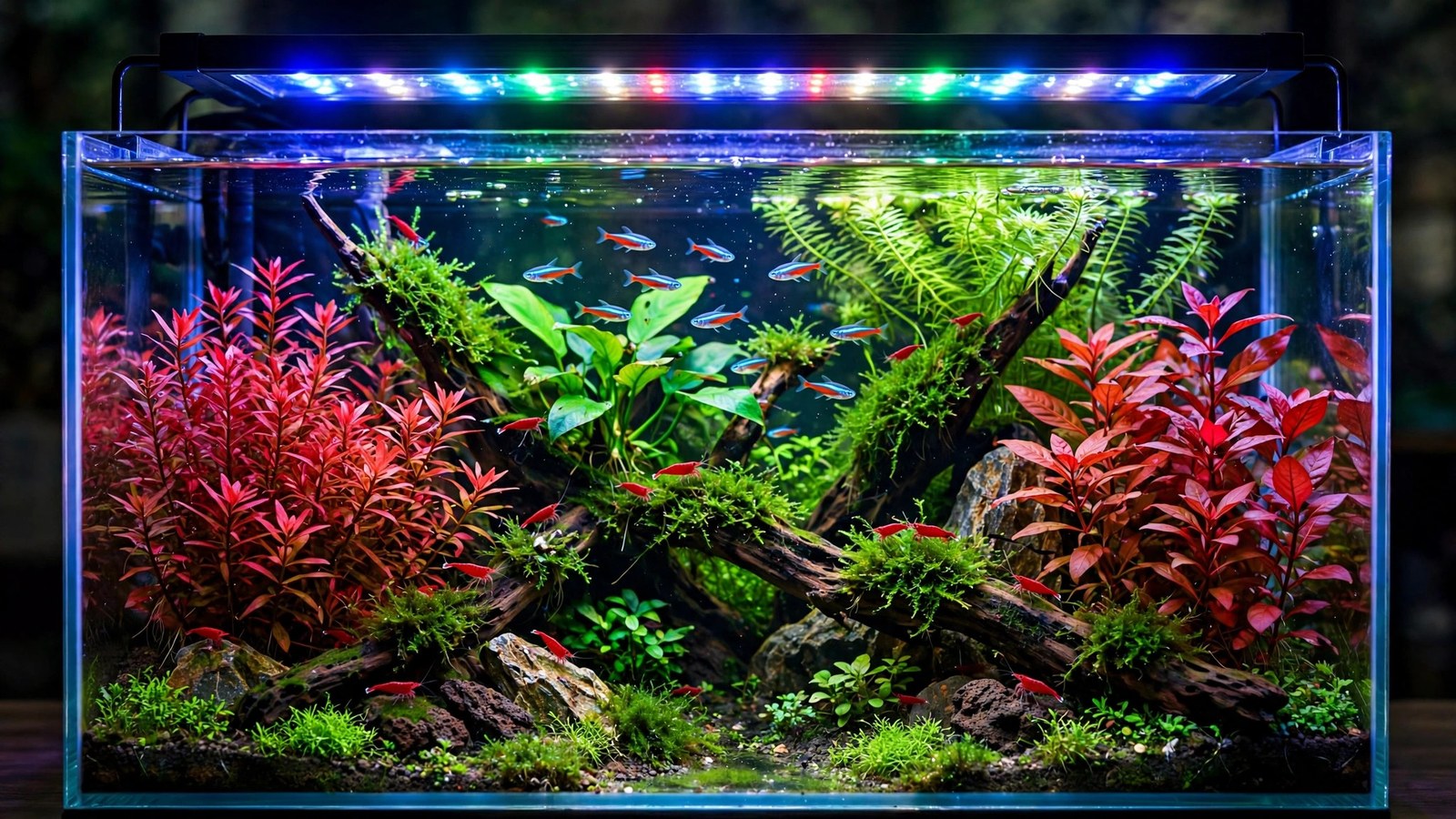
You finally get your Rotala to grow thick and healthy, then stare at the tank and wonder why it still looks washed-out pink instead of that deep crimson you see in contest photos. Nine times out of ten, the plants are fine — it's the light that's lying to you. That's the real wrgb vs white led aquarium light debate: not which one grows plants faster, but which one shows you what you're actually growing. Once you understand that, the buying decision gets simple.
What "WRGB" Actually Means (and What a White LED Is)
A plain white LED fixture builds its "white" from cool-white diodes (usually 7,000–8,000 K) with fixed phosphors. Every diode emits the same light, so what you see is what you get — the manufacturer baked the color temperature in at the factory. Turn it down and it just dims; you can't shift it warmer or cooler.
WRGB fixtures add separate red (R), green (G), and blue (B) diode channels on top of the white ones. In the app you control each channel from 0 to 100 independently. Want a warmer, golden midday look? Dial red and green up. Want the crisp cool-water look? Push white and blue. That control is the entire point — you're mixing your own white instead of accepting the factory's.
Most quality WRGB units also spread the colors through a diffuser so the reds, greens, and blues blend evenly at the substrate instead of casting separate color shadows. Cheap "RGB" bars without white diodes are a different, weaker thing — they can't produce a clean full spectrum, which is why serious aquascapers specify WRGB (white + RGB) rather than plain RGB.
Why Your Red Plants Look Dull Under White LEDs
This is where WRGB earns its price. A fixed white LED typically peaks in blue and broad-spectrum yellow-green, with a thin red tail. Your Rotala rotundifolia reflects red wavelengths — but if the light barely emits any red, there's nothing to reflect, so the plant renders as salmon-pink instead of crimson. Add an independent red channel at 60–70% and the same plant suddenly looks like a different species.
The same physics applies to livestock. Cardinal tetras' neon stripes, the scarlet of cherry shrimp, a betta's fins — all of these get a visible richness boost under tunable red because the fixture is actually delivering photons in those wavelengths. Professional aquascaping photographers almost never shoot contest tanks under fixed white LEDs for exactly this reason.
For the full picture on how spectrum influences both plants and problem organisms, see our guide on how light spectrum affects aquarium plants.
WRGB vs White LED Aquarium Light: Which Grows Plants Faster?
Short answer: no. This is the industry's most common misunderstanding, and it's worth killing cleanly. Plant growth rate is driven by PAR — photosynthetically active radiation — the total number of photons landing on leaves per second, measured in µmol/m²/s. Give a Cryptocoryne 60 µmol/m²/s from a white LED or 60 µmol/m²/s from a WRGB fixture and it grows at the same speed. Chlorophyll's absorption peaks in red and blue, and both fixture types deliver plenty of both — the white LED's phosphor-converted blue spike covers the blue peak, and its broad output covers enough red for photosynthesis.
Where spectrum does matter for growth is at the margins: extra red can deepen red pigmentation (anthocyanin production is a stress response plants use as sunscreen) and slightly improve internodal compactness, but those are cosmetic effects, not biomass gains. No credible test has shown a spectrum mix outperforming another at equal PAR for total plant growth.
So if a store tells you WRGB "supercharges growth," translate that to what it really means: at equal PAR, a WRGB fixture and a white LED grow plants identically — WRGB just looks dramatically better doing it. To verify you're actually comparing equal output rather than equal-looking brightness, read our PAR rating guide for aquarium lights before you buy.
Five Popular Fixtures, Compared Side by Side
Here are the fixtures that dominate the 60 cm (24-inch) planted-tank conversation, with the numbers that matter. PAR figures are manufacturer- or retailer-reported values at roughly 30 cm (12 in) of depth — take them as order-of-magnitude comparisons, not lab measurements, and note prices drift with region and sales.
| Fixture | Type | Wattage (60 cm model) | Typical price (USD) | Claimed PAR @ ~30 cm | Standout trait |
|---|---|---|---|---|---|
| Chihiros WRGB II Slim 60 | WRGB | ~45 W | $130–$150 | ~170 µmol/m²/s | Best PAR-per-dollar; "My Chihiros" app with sunrise–sunset ramps |
| Week Aqua M450 Pro 60 | WRGB | ~60 W | $90–$120 | ~180 µmol/m²/s | Aggressive value pick; strong reds, decent app |
| Twinstar 600S (60 cm) | WRGB-style RGB + white | ~55 W | $180–$220 | ~150 µmol/m²/s | Aquascaping-contest pedigree; superb color rendering, pricier |
| Fluval Plant 3.0 (61–85 cm) | Tunable white + RGB | 32 W | $180–$220 | 107 µmol/m²/s (official spec) | FluvalSmart app, 5 preset light cycles, publishes per-depth PAR data |
| Hygger HG-957 (24–30 in) | White LED | ~28 W | $35–$45 | ~50–70 µmol/m²/s | Budget king; 7-color modes but no true per-channel tuning |
Notice the pattern: the three dedicated WRGB units deliver roughly triple the PAR of the budget white LED, and that gap — not the RGB channels — is what would make plants grow faster. Compare any fixture on PAR first, color control second.
For dedicated deep-dives on two of these brands, see our Twinstar LED guide and our Week Aqua LED guide. For raw numbers straight from the manufacturers, check Chihiros' official WRGB II Slim specifications and Fluval's official Plant 3.0 specifications — Fluval is one of the few brands that publishes measured PAR at multiple depths.
App Control and Sunrise–Sunset: The Real Reason to Upgrade
Ask WRGB owners what they'd miss most, and the surprising consensus isn't the red channel — it's the 15-minute sunrise ramp. Plants and algae both respond to how light intensity changes, not just its peak. A fixture that slams from 0 to 100% at 8:00 AM dumps maximum photons onto algae that hasn't "woken up" yet while shocking fish that were resting in the dark. A gradual ramp lets photosynthetic machinery spin up in step with the light.
This is programmable only on fixtures with real app or timer control: you set 0% at 7:45, peak at 10:00, dim through the afternoon, and fade to moonlight by 21:30. Fluval's Plant 3.0 ships five preset cycles for this; Chihiros' app lets you draw a fully custom curve; Week Aqua offers simpler but effective timed ramps. A basic white LED on a wall timer gives you one brutal on/off switch — fine for hardy low-tech tanks, noticeably worse for anything delicate. For the mechanics of why ramps matter, read our guide to sunrise–sunset ramping for aquarium plants.
The WRGB Algae Playbook: Tame the Red Channel
The red channel is the most algae-sensitive part of any WRGB fixture. Cyanobacteria and many green algae species are efficient red-light users, and new aquascapers routinely push red to 90–100% chasing crimson stems, then watch a brown dust coat everything within two weeks. The fix is boring and effective: cap red at 60–70%, keep total intensity matched to your CO₂ and fertilizer levels, and hold the photoperiod to 6–8 hours in new tanks.
Think of it as a three-way seesaw — light, CO₂, and nutrients must stay balanced. Raising red without raising the other two hands algae the advantage. If you're troubleshooting an existing bloom, our breakdown of the light spectrum and algae connection walks through which wavelengths feed which algae types.
Who Should Buy WRGB — and Who Should Save the Money
| Your situation | Buy this | Why |
|---|---|---|
| Aquascaper chasing contest-grade reds and photography | WRGB (Chihiros, Twinstar, Week Aqua) | Per-channel control is non-negotiable for red rendering and shots |
| High-tech tank with injected CO₂ and demanding stems | WRGB | You need 120+ µmol/m²/s at substrate, which budget white LEDs rarely deliver |
| You want sunrise–sunset automation and phone control | WRGB or Fluval Plant 3.0 | Ramping and presets are built into these; wall-timer whites can't do it |
| Low-tech tank, Java fern / Anubias / Crypts | Good white LED | 30–50 µmol/m²/s is plenty and growth is identical; save $100+ |
| Tight budget, first planted tank | Budget white LED | Spend the difference on substrate and fertilizer — they matter more for growth |
If you land in the white-LED camp, our best LED lights for low-tech planted tanks ranks the value picks. Either way, if money is tight, the budget light upgrade guide shows how to squeeze the most out of a cheap fixture.
Frequently Asked Questions
Does WRGB actually grow aquarium plants faster than white LEDs?
No. Growth rate follows PAR — total photon output — not spectrum. At equal PAR (say 80 µmol/m²/s at the substrate), a WRGB fixture and a white LED grow the same plants at the same speed in every test we've seen. Chlorophyll absorbs red and blue efficiently from both light types. What WRGB changes is appearance: redder reds, richer fish coloration, and tunable color temperature. Buy WRGB for how your tank looks, and verify intensity with a PAR meter for how it grows.
What should I set each WRGB channel to for a planted tank?
A safe starting point for most tanks: white 70–80%, red 60–70%, green 60–70%, blue 60%. That gives roughly 6,500–7,500 K with enough red for color pop without feeding algae. New tanks should run total intensity around 50–60% for the first month, then step up 10% biweekly if growth stalls. Keep the photoperiod at 6–8 hours while the tank matures, and never raise the red channel alone — increase all channels proportionally.
Is the red channel bad for algae?
Not bad — just the most tempting to misuse. Many algae species use red light very efficiently, so a red channel pinned at 90–100% with unbalanced CO₂ or nutrients reliably triggers dust and thread algae. Capped at 60–70% with proper fertilization and a 6–8 hour photoperiod, red causes no more algae than any other wavelength. If algae appears after you boost reds, dial red back first before changing anything else.
Can a plain white LED grow red plants like Rotala?
Yes — red plants grow fine under white LEDs as long as PAR is high enough (80–120 µmol/m²/s for demanding reds) with CO₂ and lean dosing. The catch is appearance: without an independent red channel, reds render as washed-out pink or salmon rather than deep crimson. Growers chasing the contest look either add a WRGB or supplement with a small red-heavy strip light. The plant's health is about photons; the plant's color on camera is about spectrum.
Do I need sunrise–sunset ramping, or is a timer enough?
A timer is enough for hardy low-tech tanks, but ramping is genuinely useful for high-energy setups. The 15–30 minute sunrise fade prevents the light-shock stress that can trigger algae blooms in new tanks and startle fish awake. It's also the feature WRGB owners report missing most when they switch back. If your fixture lacks it, you can approximate it with a dimmer plug on a smart timer — not as smooth, but noticeably better than a hard on/off.
The Bottom Line
The wrgb vs white led aquarium light question resolves to this: photons grow plants, spectrum sells the view. Match your fixture's PAR to your plants' needs first — that's the part that actually determines growth — and treat WRGB's channels as a color-rendering and automation upgrade, not a growth cheat code. If you're aquascaping for reds, photography, or just love watching a proper sunrise sweep across your tank, WRGB earns its premium every single day. If you're growing a healthy low-tech jungle on a budget, a good white LED leaves you $100 richer with plants that grow just as fast.