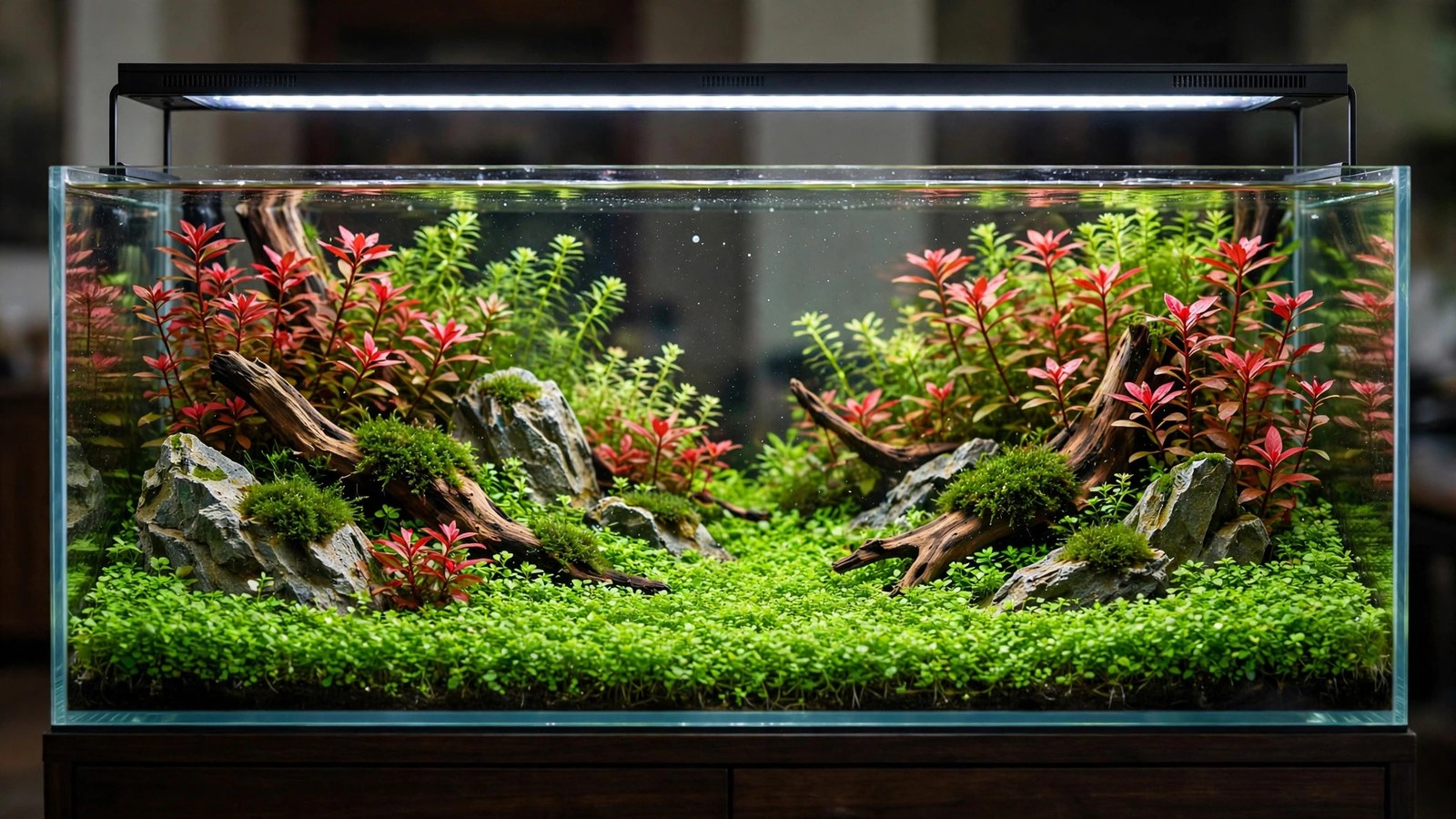
Twinstar has become one of the most respected names in planted aquarium lighting, and choosing a twinstar planted tank light comes down to matching the right model line — and the right size — to your tank, your plant goals, and whether you run CO2. This guide compares Twinstar's main planted-tank LED lines (S, E, B, and the older EA series), gives you a model-by-tank-size cheat sheet, and walks through mounting, photoperiod, and intensity setup so your new light grows plants instead of algae.
The Twinstar Planted Tank Light Lines, Explained
Twinstar names its lights by tank length: a 600-series light fits 60 cm / 24-inch tanks, a 900 fits 90 cm / 36-inch tanks, and so on, with 200, 300, 450, and 1200 models rounding out the range. The letters after the number are what matter — they tell you which performance tier you're buying. Get the letters wrong and you'll either under-light a high-tech setup or blast a low-tech one into an algae farm.
S Line — the flagship for high-tech tanks
The S Line is Twinstar's brightest, highest-output series, aimed squarely at CO2-injected planted tanks with demanding plants. The latest generation (Ver. 5.0) uses a 6-color LED mix plus dedicated plant-growth LEDs covering roughly 400–780 nm, with strengthened blue (~450 nm) and red (~660 nm) peaks that drive photosynthesis. For reference, the 600S Ver. 5.0 draws about 67W and outputs roughly 4100 lm, while the 900S is around 100W / 6200 lm. Optional Bluetooth controllers (LightControl Standard or Pro) add dimming and scheduling. The older S Ver. 3 pushed the RGB-vs-white ratio even harder (the 600S had 126 RGB vs 14 white LEDs) for extra-red color pop.
Choose the S Line if you run pressurized CO2 and want carpets like Hemianthus callitrichoides, dense red stem gardens, or contest-style aquascapes. Skip it if your tank is low-tech with no CO2 — you will spend your life fighting algae at full output.
E Line — the balanced mid-range
The E Line shares the same advanced full-color spectrum as the S Line but runs roughly 20% lower output, in a more compact body, at a friendlier price. The 600E Ver. 5.0 is about 49W / 3000 lm, vs 67W / 4100 lm for the 600S. Same Bluetooth control options, same plant-growth-oriented spectrum, no white-LED washout. This is the sweet spot for low-to-medium-tech setups with moderate light plants, and for high-tech owners who prefer to run their light slightly underdriven rather than fighting excess power.
Choose the E Line if you want premium Twinstar color rendering and solid growth without the intensity headaches of the S Line — the best default pick for most hobbyists upgrading from budget LEDs. If you're comparing options, see our roundup of the best aquarium lighting for planted tanks for how Twinstar stacks against other brands.
B Line — the budget entry point
The B Line (currently Ver. 3.0) is Twinstar's value tier: WRGB full-spectrum LEDs tuned for healthy growth and vivid color, with Bluetooth LightControl Standard included. The 60B runs about 29W / 2300 lm — plenty for a standard 60 cm low-tech tank. If your plants are easy species (Anubias, Java fern, Crypts, Bucephalandra) and you run no CO2, the B Line gives you the Twinstar look and reliability without paying for output you'll never use.
Choose the B Line as a first serious upgrade from a kit hood light, or as a secondary-tank light. For budget-hunting strategies generally, read our guide to upgrading your aquarium light on a budget.
EA series — the older value line
The EA series (IV generation) was Twinstar's earlier accessible line: slim aluminum bodies with adjustable legs, a built-in timer (6–10 hours), 7 brightness levels, and sunrise/sunset ramping. The 600EA was around 40W / 2100 lm; the 900EA about 58W / 2900 lm. You'll still find these new from some retailers and used everywhere. They're fine lights for low-tech tanks, but lack the Bluetooth scheduling and the refined spectrum of the current B/E/S lines.
Choose a used or discounted EA only if the price is clearly below the B Line — otherwise the B Line's WRGB spectrum and Bluetooth control make it the better buy.
Model-by-Tank-Size Cheat Sheet
Measure your tank's actual length (and rim width) before ordering — model numbers track nominal tank sizes. The table below covers the most common sizes using current-generation output figures.
| Tank length | Typical volume | Low-tech pick | CO2 / high-tech pick |
|---|---|---|---|
| 20–30 cm (nano) | 3–10 gal | 200B or 300B | 200S / 300S (dimmed at start) |
| 45 cm | ~10 gal | 450B or 450E | 450S |
| 60 cm (24") | ~20 gal | 60B or 600E | 600S |
| 90 cm (36") | ~50 gal | 900E | 900S |
| 120 cm (48") | ~65+ gal | 1200E | 1200S |
Two notes: on the 60 cm size, the 600E is arguably the perfect "one light forever" purchase for anyone who might add CO2 later — it bridges both worlds. On larger tanks (90 cm and up), plan for two units or the hanging pendant versions (SP models) if your aquascape has a strong center peak; one bar leaves the ends dim.
Mounting: Legs vs. Hanging
Most Twinstar units come with metal mounting legs that sit the light on the rim of the tank. This is simplest and works perfectly for standard rims — just confirm your glass thickness against the model's spec, since legs for the 600S, for example, are sized for roughly 6 mm glass.
The SP (pendant) variants hang from the ceiling or a stand. Hanging buys you two things: a cleaner look above rimless aquascapes, and adjustable height. Raising a light a few centimeters is the easiest way to soften intensity on a low-tech tank running an S Line — see our hanging light height guide for starting heights by tank depth. If you go the hanging route, make sure your mount is secure before water goes in.
Setting Photoperiod and Intensity: Start Conservative
The number one mistake with a new Twinstar is running full power for 10 hours on day one. Plants don't benefit from it, and algae absolutely does. Use these conservative starting points, then adjust over 2–3 weeks based on what you observe.
- Photoperiod: start at 6 hours for a new tank or any tank without CO2. Add 30 minutes per week up to 7–8 hours if plants are growing and algae is absent. Learn the reasoning in our photoperiod duration guide.
- Intensity: on a dimmable model (Bluetooth models, or EA with its 7 levels), start at 60–70% of max. On a fixed-output S Line without a dimmer, either run a shorter photoperiod or add an inline dimmer — Twinstar's own inline dimmer is the cleanest option.
- Sunrise/sunset ramping: use it. A 10–30 minute ramp spares fish and shrimp the shock of instant full brightness, and many Bluetooth apps schedule it automatically.
- Timers: a consistent on/off schedule matters more than the exact hours. Use the light's built-in timer or an external one — our aquarium light timer guide covers the options.
When you do increase intensity, do it slowly — no more than ~10% per week — and watch for the first signs of too much light in a planted tank (green dust on glass, hair algae on slow growers). Our guide to raising light intensity safely details the full playbook.
Light, CO2, and Algae: the Balancing Act
An S Line at full output without matching CO2 and fertilization is the classic recipe for a green tank. Light drives photosynthesis, but it also drives algae — algae just needs less light to get going than your plants do. That's why the standard advice is: balance light to the lowest available resource. If you're running lean ferts or no CO2, keep light moderate; if you inject CO2 and dose consistently, you can exploit the full output.
If you're unsure how much light your plants actually need, start with how much light aquarium plants need, and read up on CO2 for planted tanks before buying a light sized for a high-tech dream you haven't built yet. Also worth knowing: how light spectrum connects to algae — a full-spectrum light like Twinstar's doesn't cause algae on its own, but excess red-heavy output on an unbalanced tank absolutely invites it.
Twinstar vs. the Usual Suspects
How does Twinstar compare to the other brands you'll cross-shop?
- vs. Fluval Plant 3.0/4.0: Fluval offers app control, scheduling, and solid growth at a mid-range price, but Twinstar's spectrum renders reds and greens more vividly to the eye. Build quality favors Twinstar. See our Fluval Plant 3.0 vs 4.0 comparison for that family.
- vs. budget white LEDs: a $30 generic bar keeps plants alive; it won't color them. Twinstar's RGB-weighted spectrum is the difference between "green plants" and "plants that look like the contest photos."
- vs. Chihiros/ADA Solar: Chihiros competes on price-to-performance with app control; ADA Solar sets the luxury benchmark. Twinstar sits between — premium spectrum and build without ADA pricing.
For a deep dive on spectra, see our guide to light spectrum for aquarium plants.
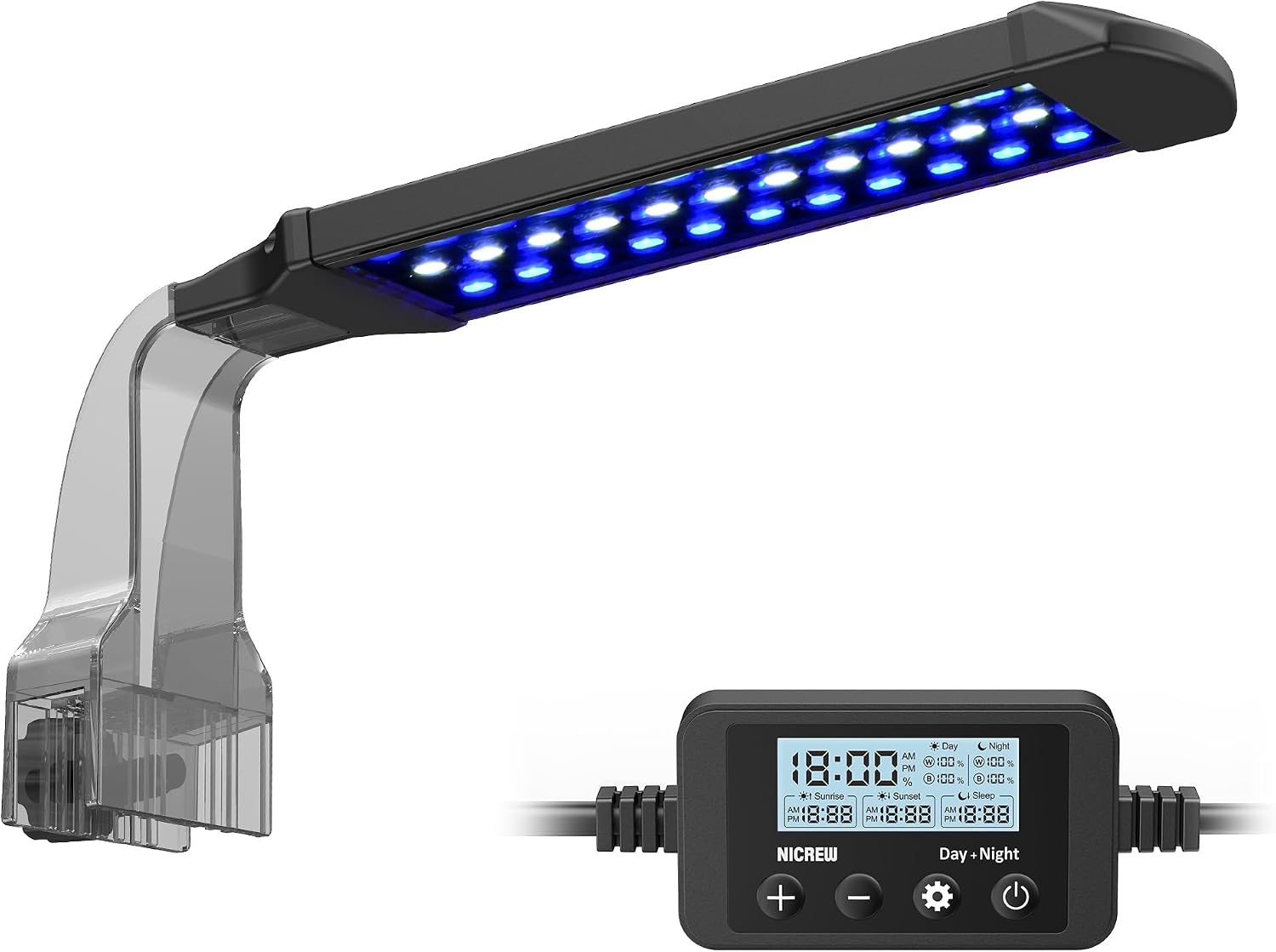
The value rival most buyers cross-shop against Twinstar: NICREW ClassicLED Plus.
 ★4.6
NICREW ClassicLED Plus planted aquarium light
Check Price on Amazon ★4.6When to Replace or Upgrade
LEDs dim gradually rather than burning out suddenly — after roughly 20,000–30,000 hours, a Twinstar will still light your room but may deliver noticeably less PAR to the substrate. That's about 7–9 years at 8 hours a day, so this is rarely urgent. Upgrade triggers are real: you added CO2 and your B Line can't keep up, your tank depth beats the light's spread, or your app-controlled model predates Bluetooth. When the time comes, revisit our best LED lights for low-tech planted tanks and the replacement-timing advice in when to replace your aquarium light.
To confirm specs for the latest generation before buying, check Twinstar's official store page for the S Line — output figures and controller options change between revisions.
Frequently Asked Questions
Is a Twinstar S Line too much light for a tank without CO2?
Usually, yes. The S Line is designed for CO2-injected tanks, and at full output over a low-tech setup it will almost certainly grow algae faster than plants. You can make it work by starting at reduced intensity or a shorter 6-hour photoperiod, hanging the light higher, and adding an inline dimmer — but if you're committed to low-tech, the E or B Line is a far less frustrating purchase at a lower price.
What size Twinstar do I need for a 60 cm tank?
The 600-series models (600B, 600E, 600S, or older 600EA) fit 60 cm / 24-inch tanks, each in the leg or pendant (SP) variant. Choose the letter by tech level: B or E for low-tech, S for CO2-injected. The 600E is the most versatile single purchase since it serves both worlds. Always measure your actual tank length and glass thickness against the model's spec before ordering.
Do Twinstar lights have a built-in timer and dimmer?
It depends on the model. The newer B, E, and S lines use optional Bluetooth LightControl controllers (Standard or Pro) for dimming and scheduling; the B Line Ver. 3.0 includes the Standard controller. The older EA series has a built-in timer with 6–10 hour settings, 7 brightness levels, and sunrise/sunset ramping. Base S and E models without a controller run at fixed full output, so budget for a controller or inline dimmer if you want dimming.
How long should I run my Twinstar each day?
Start with 6 hours daily, then add 30 minutes per week up to 7–8 hours once plants are growing and algae is under control. New tanks and low-tech tanks should stay at 6 hours for the first month. Consistency matters more than the exact number — use a timer or the app scheduler so the photoperiod never drifts. Avoid the temptation of 10–12 hour days; they benefit algae far more than plants.
Can I use a Twinstar light for red plants?
Yes — Twinstar's RGB-weighted spectrum is one of its strengths, rendering reds vividly and pushing the red and blue peaks plants use most. But remember that intense red coloration in plants mostly comes from high light plus CO2 and nutrient balance, not from the light alone. An S Line with CO2 will color red stems far better than the same light on a low-tech tank, regardless of spectrum.
Are Twinstar lights worth the price over budget LEDs?
For a display planted tank, yes: the spectrum, color rendering, build quality, and controller ecosystem are a clear step above generic white LED bars. For a utility grow-out tank or a first low-tech setup, a budget light grows plants fine — spend the difference on substrate and fertilizer. The best value in the lineup is usually the E Line or the B Line, which deliver most of the flagship's spectrum for noticeably less money.
The Bottom Line
Match the letter to your tech level — S for CO2-driven high-tech, E for the versatile middle ground, B for low-tech and budget builds — then match the number to your tank length. Start dimmer and shorter than you think, raise both gradually, and let the plants (not the algae) tell you when to stop. Do that, and a Twinstar planted tank light will do exactly what it's famous for: make your plants look better than you expected.