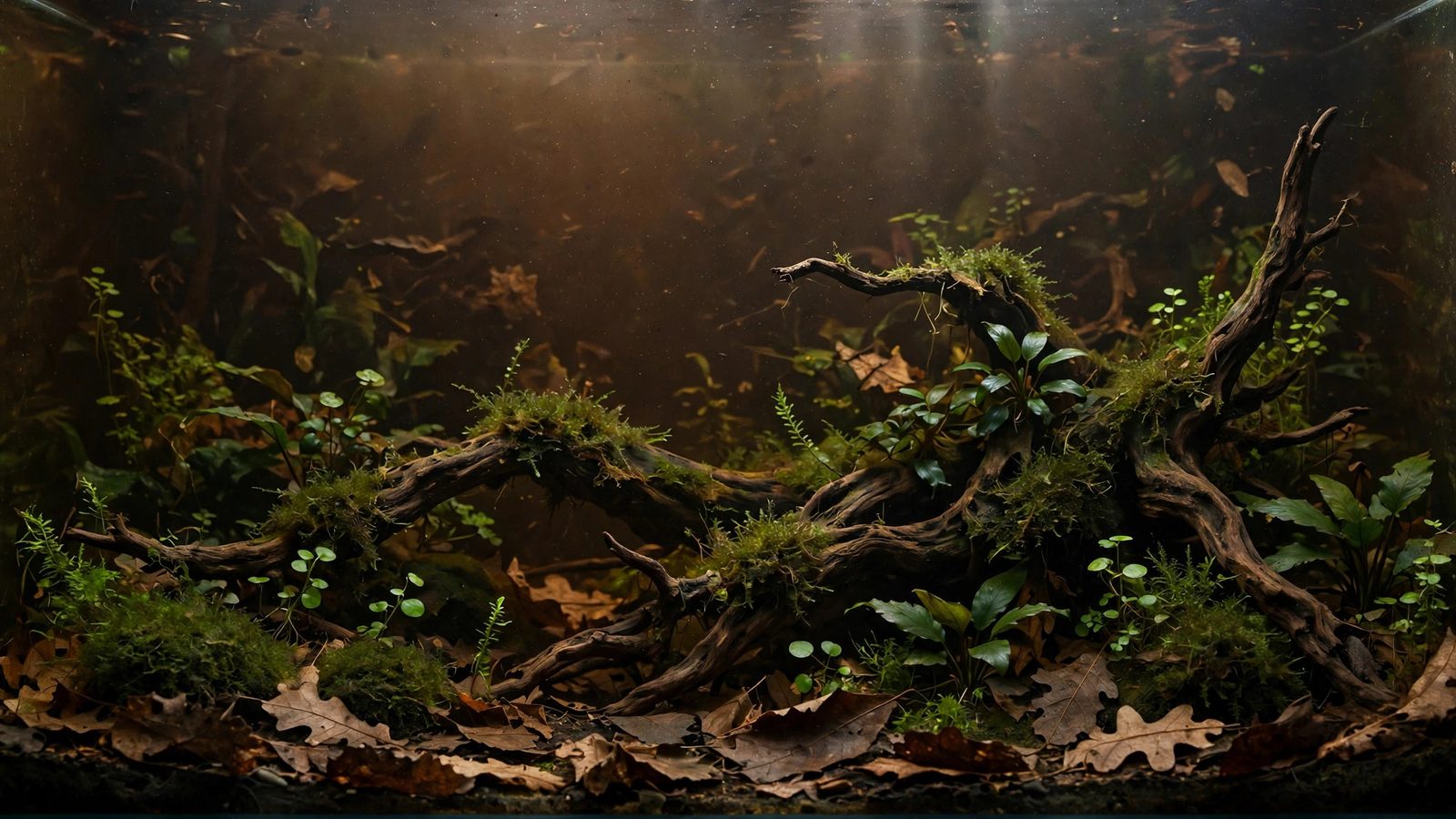
A blackwater aquascape setup trades the bright, manicured look of conventional planted tanks for something older and moodier: tea-stained water, drifting leaves, shafts of dim light, and fish glowing like embers in the gloom. Done right, it's the most atmospheric style in the hobby — a slice of flooded Amazon forest floor that makes neon tetras look like they were designed for it (they were). Done wrong, it's murky water hiding a mess. This guide covers the tannins, botanicals, plants, and water chemistry that separate the two.
What Blackwater Actually Is
Blackwater rivers — the Rio Negro is the famous example, but they occur across the Amazon, Congo, and Southeast Asia — get their color from tannins and humic substances leaching out of decomposing leaves, wood, and peat in the surrounding forest. The water is stained brown like tea, acidic (pH 4.0–6.0), extremely soft (near-zero KH/GH), and low in dissolved minerals but rich in dissolved organic carbon. Visibility is low, light penetration is poor, and the whole ecosystem runs on leaf litter.
For the aquascaper, this means three things: the water itself is a design element (the tint is the look), the hardscape should be wood and leaves rather than stone, and plant selection must favor species that tolerate — or genuinely come from — dim, acidic, soft water. Many classic "aquascaping" plants will struggle; the ones that thrive will look more at home than they ever could in a bright Dutch tank.
Tannins: The Color Engine
The brown tint comes from botanicals, and you have several sources, each with different character:
- Indian almond leaves (catappa): the standard. Release strong tannins for 2–4 weeks, tint water amber-brown, and provide grazing surfaces and shelter as they break down. Use 1–2 large leaves per 10 gallons to start; add more for darker water.
- Oak and beech leaves: milder tint, slower breakdown, excellent long-lasting leaf litter. Collect from pesticide-free areas, dried and brown — never green.
- Alder cones: potent tannin bombs; a handful tints a nano tank significantly. Also prized for mild antifungal properties.
- Driftwood: mopani and Malaysian driftwood leach tannins for months. Boiling reduces (but doesn't eliminate) leaching — decide whether you want the wood to contribute color or not.
- Peat moss / peat granules: in a filter media bag, peat softens water and adds humic tint steadily. The most controllable long-term tannin source.
- Commercial blackwater extracts: concentrated tannin liquids for precise tint control. Useful for topping up color after water changes without adding more leaves.
Preparation matters: rinse or briefly boil leaves and cones to remove dust and hitchhikers, but don't over-boil — you'll extract the very tannins you want. Leaves will float for a day or two before waterlogging and sinking; weigh them down or just wait. As leaves decompose over 4–8 weeks, push new ones in on top — the layered, multi-stage litter bed is both authentic and functional, sheltering fry and feeding biofilm.
Water Chemistry: Soft, Acidic, Stable
Blackwater chemistry is the technical heart of the setup. Target parameters for an Amazonian blackwater tank:
| Parameter | Target range | Notes |
|---|---|---|
| pH | 5.0–6.5 | Tannins + low KH drive this down naturally |
| KH | 0–3 dKH | Low KH lets botanicals acidify the water |
| GH | 1–6 dGH | Soft water; most blackwater fish are soft-water species |
| Temperature | 76–82°F (24–28°C) | Match your specific fish |
| TDS | 30–120 ppm | Very low dissolved solids is the signature |
Most tap water is too hard and alkaline for genuine blackwater. The reliable approach: RO (reverse osmosis) water remineralized lightly, or RO cut with tap to hit your targets. With near-zero KH, tannins from your botanicals will pull pH down on their own — this is why KH control comes first. Trying to acidify hard, high-KH tap water with leaves is futile; the buffer wins.
Stability warning: near-zero KH means near-zero buffering, so pH can crash if organic load spikes. Prevent this with sensible stocking, regular small water changes (10–15% weekly with matching RO-based water, pre-tinted if you want consistent color), and not overloading botanicals all at once. A pH controller isn't necessary, but a liquid test kit used weekly in the first two months is.
A reliable pick here is API Freshwater Master Test Kit.
Hardscape: Wood, Leaves, and Restraint
Blackwater hardscape is almost entirely driftwood and botanicals. Think submerged tree roots, fallen branches, and the forest floor — not rock gardens. A single dramatic root structure or a tangle of branches (see our single-driftwood layout guide for composition) over a sand bed scattered with leaves is the entire formula. Stone, if used at all, should be minimal and dark — a few smooth river stones half-buried, never a bright Seiryu centerpiece that screams "different continent."
Substrate is fine sand — white, tan, or dark depending on the specific habitat. Rio Negro biotopes use pale sand that glows amber through the tinted water; many hobbyists prefer dark sand for contrast with fish colors. Either is defensible; pick one and commit. Depth: 3–5 cm, flat or gently sloped — blackwater rivers don't have dramatic aquasoil hills. Our substrate sloping guide still applies for gentle depth cues, but keep it subtle here.
Leaf litter placement is an art: scatter leaves naturally (toss, don't arrange), concentrate them in drifts where "current" would deposit them, and let some land on wood. The litter bed should look accumulated, not decorated.
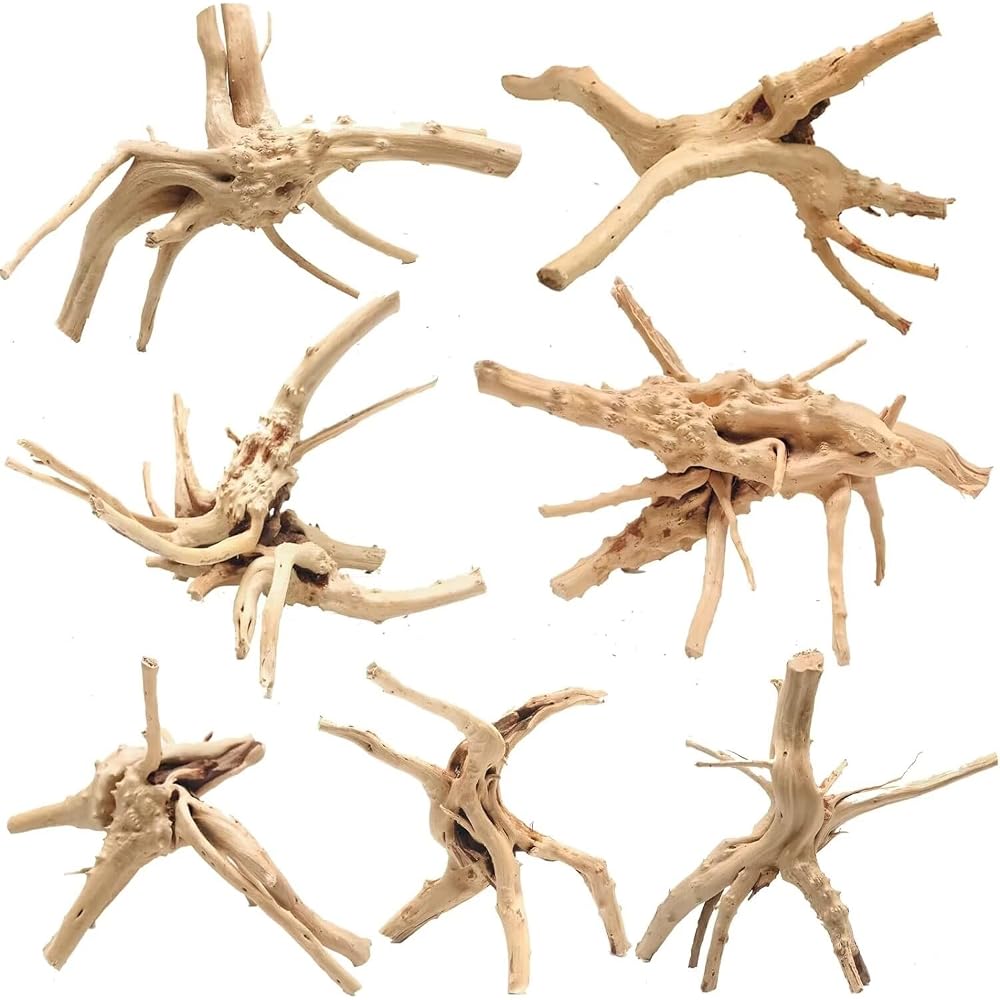
A reliable pick here is spider wood driftwood.
 ★4.2
Hamiledyi Natural Spider Wood Driftwood
Check Price on Amazon ★4.2Plants for Blackwater: What Actually Thrives
Forget the high-light carpet species. Blackwater plants are low-light, acid-tolerant species, many of them slow growers:
- Anubias (barteri, nana, 'Petite'): the blackwater workhorse. Attach to wood, tolerates deep shade and pH 5, nearly indestructible. Our driftwood attachment guide covers the technique.
- Java fern and Bolbitis: epiphytes for wood, thriving in dim acidic water where they'd be algae magnets in bright tanks.
- Bucephalandra: slow, shade-loving, and the deep greens look spectacular against tannin-tinted water.
- Cryptocoryne wendtii, beckettii, spiralis: root in the sand, tolerate soft acidic water beautifully, and form the "understory" colonies.
- Echinodorus (Amazon swords): the authentic Amazon centerpiece. E. bleheri and E. amazonicus in a blackwater tank is biotope-correct and dramatic.
- Floating plants (frogbit, Salvinia, red root floaters): essential — they complete the dim canopy effect, and their roots dangle into the water column like the real thing. Keep a clear feeding/corner area so they don't cover 100% of the surface.
- Mosses: Taxiphyllum species on wood for the aged, soft look.
Lighting should be dim to moderate — 20–30 PAR at substrate is plenty. Bright light in a blackwater tank grows algae on every leaf and destroys the mood. A dimmable LED run at 50–60%, possibly with a warmer color temperature (6000–7000K still fine; avoid harsh 8000K+ daylight), plus floating plants diffusing it further. The goal is "light filtering through forest canopy," not "operating theatre."
CO2 is optional and often skipped — these plants don't need it, and the low-energy aesthetic doesn't demand fast growth. If you do inject, keep it modest; pH is already low, so monitor with a drop checker and go by livestock behavior.
Fish: The Glowing School Effect
Blackwater is where small characins become spectacular. Against dark water and dim light, their colors fluoresce:
- Cardinal and neon tetras: the iconic choice — their red/blue iridescence evolved for exactly this water.
- Rummy-nose tetras: tight schoolers whose red faces glow in tannin water; also excellent "canary" fish for water quality.
- Ember tetras, green neon tetras: smaller options for nano blackwater builds.
- Dwarf cichlids (Apistogramma cacatuoides, borellii): leaf-litter territory holders — the behavioral centerpiece.
- Hatchetfish: surface dwellers for the open top zone under floaters.
- Corydoras (sterbai, duplicareus): sand-sifters that belong on the litter bed.
Stock lightly and in real schools (12–20+ of each schooling species). A blackwater tank with six neons looks empty; with twenty-five, it looks like the river. If you're building a strict habitat replica, our biotope aquascaping guide covers species-fidelity discipline.
Filtration and Maintenance
Use gentle filtration — a sponge filter or a canister with the outflow baffled. Blackwater habitats are slow-moving; strong current stresses the fish and scatters your leaf litter. Filter media can include peat granules or catappa leaves in a media bag for steady tannin release.
Maintenance rhythm:
- Weekly 10–15% water changes with pre-matched, pre-tinted water (mix your blackwater extract into the change water so the tint doesn't yo-yo).
- Replenish leaf litter monthly — add new leaves as old ones disintegrate; siphon only the fully-mulched sludge, never the intact leaves.
- Glass cleaning as needed — tannin water still grows biofilm on glass; magnetic cleaners handle it.
- Trim sparingly — these are slow growers; see our trimming maintenance guide and apply it with a light hand.
- Top off evaporation with RO water only — minerals don't evaporate, and topping with hard tap water creeps your GH/KH upward over time.
Frequently Asked Questions
Will tannins harm my fish or plants?
No — tannins and humic substances are beneficial. They have mild antibacterial and antifungal properties, reduce stress in soft-water fish, and many blackwater species show better color and breeding behavior in tinted water. The plants listed above evolved in these conditions. Problems only arise if pH crashes from zero buffering combined with heavy organic load — preventable with sensible stocking and water changes.
How dark should the water be?
Aim for the color of weak to medium tea — you should clearly see the back of the tank, just tinted. If you can't see your fish at the back glass, it's too dark. Start with fewer botanicals than you think; you can always add more. Remember that the tint deepens over the first week as leaves release their initial load, then stabilizes.
Can I do blackwater with hard tap water?
Not genuinely. Tannins can't overcome high KH — the buffer neutralizes the acids as fast as leaves release them, so you get stained water that stays alkaline, which suits neither the aesthetic's fish nor its chemistry. Use RO water (or RO/tap blend) to get KH near zero first, then let botanicals do their work. An RO unit is the single best investment for this style.
Do I need to replace leaves, or can I leave them forever?
Replace on rotation. Leaves release most tannins in the first 2–4 weeks, then become primarily shelter and grazing surface as they slowly decompose over 2–3 months. Add a few new leaves monthly and remove only fully disintegrated mush. Never swap the entire litter bed at once — that spikes organics and strips the biofilm your livestock grazes on.
Will blackwater stain my silicone and equipment?
Tannins can lightly stain silicone over months, but it's cosmetic and largely reversible if you ever tear the tank down. Filter housings and heaters may discolor slightly. It won't damage anything functionally. If resale pristine-silicone matters to you, blackwater isn't your style — embrace the patina.
Can shrimp live in blackwater tanks?
Neocaridina (cherry shrimp) prefer harder, alkaline water and will struggle to molt in true blackwater parameters — skip them. Caridina species (crystal shrimp, Taiwan bees) love soft acidic water and are the correct choice, though they're pricier and more sensitive. Our shrimp tank aquascaping guide covers Caridina-focused setups that pair beautifully with blackwater aesthetics.
The Mood Is the Point
A blackwater aquascape succeeds when someone walks past and stops — not because it's colorful, but because it's atmospheric. The dim light, the drifting leaves, the school of cardinals igniting in the gloom: it's the closest most of us get to diving the Rio Negro. Keep the water genuinely soft and acidic, the botanicals rotating, the planting shade-tolerant, and the fish in real schools, and the style practically maintains its own magic. When it's mature and you want to show it off, our aquascape photography guide has specific tips for shooting tinted water without it looking muddy.