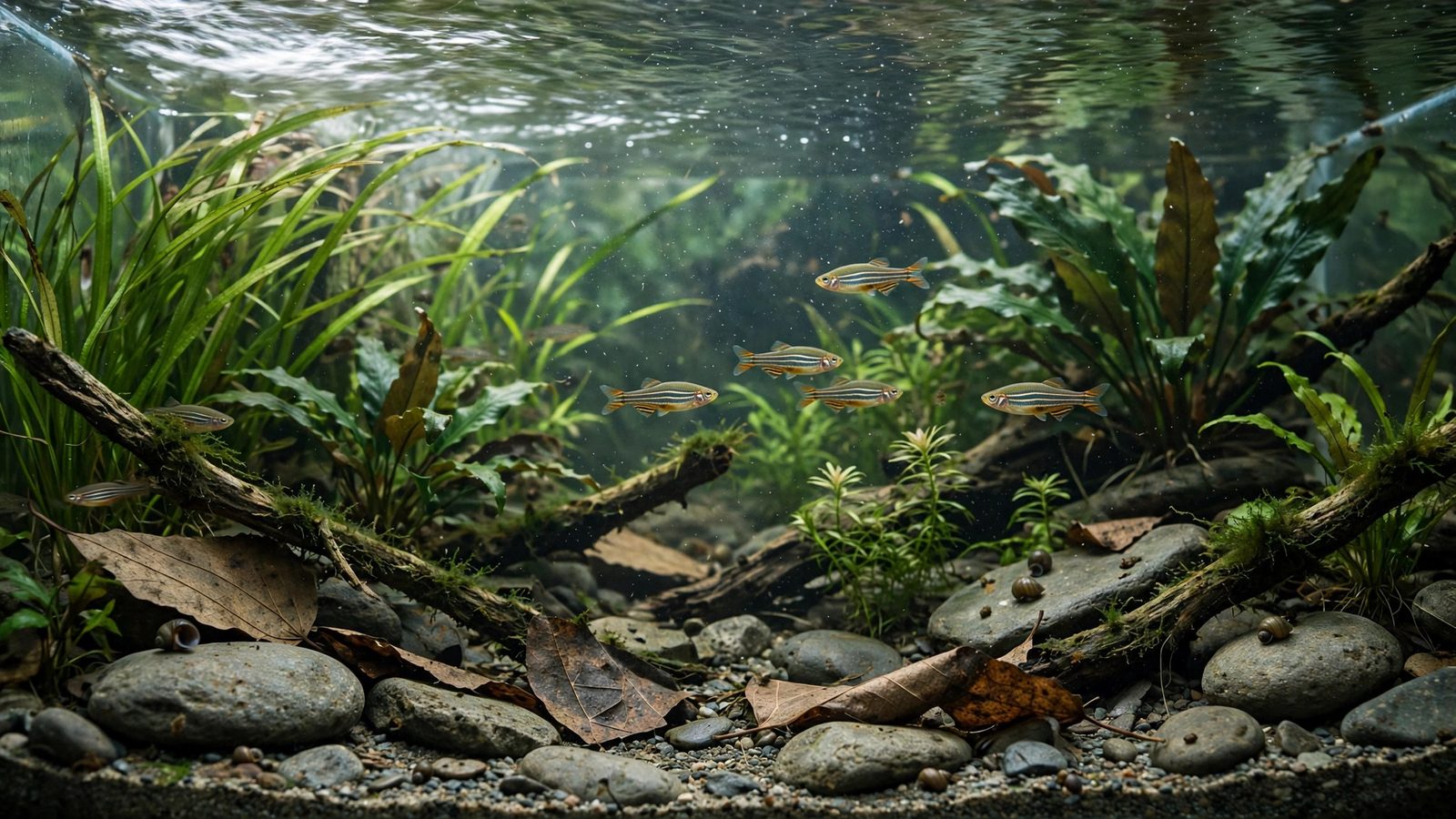
Most india river biotope aquarium setup guides make the same mistake: they darken the water with peat and leaf litter and call it India. But the Ganges, Brahmaputra, and Western Ghats streams are sunlit, neutral-pH monsoon rivers — fast, oxygen-rich, and swept clear of tannins by seasonal floods. Build the real thing and you get one of the liveliest tanks possible: danios ripping across the current while rosy barbs flash crimson in the shallows. Here is how to do it, zone by zone.
An India river biotope aquarium setup recreates the sunlit monsoon rivers of the Ganges, Brahmaputra, or Western Ghats at neutral pH 6.8–7.4 and 22–26 °C, with smooth river stones, fine gravel, Rotala and Aponogeton planting, and stocking centered on danios, rosy barbs, loaches, and glass catfish. Unlike the peat-swamp biotope of Southeast Asia, it needs no blackwater chemistry — the monsoon does the filtration work for you.
India River Biotope Aquarium Setup: The Monsoon-River Build
A true biotope starts with a choice. The biotope aquascape approach demands geographic honesty: one habitat, one set of species. For India, commit to one of three river personalities before buying a single stone.
The Ganges lowland offers wide, calm, sandy runs with drifting current — the classic rosy barb and glass catfish habitat. The Brahmaputra is a powerhouse: braided channels, smooth boulders, and giant danio schools riding the current. The Western Ghats hill streams are the aquascaper's dream: clear, cool, shallow water pouring over rounded granite, home to the trade's most striking loaches.
Choose your river and commit. A Western Ghats stream stone arrangement looks nothing like a Ganges sandbank, and the stocking differs too. For contrast, the rice paddy biotope guide shows how another Asian habitat handles shallow, sunlit water.
Water: Neutral, Oxygenated, and Seasonal
This is where most India biotopes fail. Keepers add driftwood, almond leaves, and peat because they read "tropical Asia" and reached for the blackwater toolkit. India's great rivers are flushed by the monsoon every year — tannins never accumulate. Your water should be crystal clear, neutral, and highly oxygenated.
Aim for pH 6.8–7.4, GH 6–12, KH 4–8, and 22–26 °C. Most tap water already lands in this window. Skip RO unless your water is extreme. Mimic monsoon seasonality: do your weekly 20% water change with slightly cooler water. This reliably triggers spawning behavior in danios and barbs, just as the first monsoon rains do.
Flow Is the Design Element
Position your filter outflow and a circulation pump on one end to create a single, gentle gyre, and arrange everything along the visible current line. The Rio Xingu biotope uses the same unidirectional-flow technique — the layout principles transfer directly.
Hardscape: River Stones, Sand, and Space
Indian riverbeds are swept clean. Use one stone type only — smooth river cobbles, granite, or unpolished grey pebbles — half-buried in fine sand, clustered in two or three groups rather than scattered.
Use an inert substrate: fine natural gravel or coarse sand, 3–5 cm deep, sloping toward the back. The best substrate guide for planted tanks covers grain-size choices — for this biotope, lean toward its inert river-sand options rather than nutrient-rich aquasoils, because the plants here feed heavily from the water column anyway. Skip heavy driftwood entirely; a single weathered branch is acceptable in a Ganges build, but never in Brahmaputra or Ghats layouts.
Plants: Rotala Lines and Aponogeton Meadows
Two plant groups carry the whole biotope. Rotala (R. rotundifolia and R. indica) grows in flowing, current-swept stems along the banks of Indian rivers, and its pink-green tips under bright light are this tank's signature color. Aponogeton — A. crispus and A. rigidifolius, both native to Sri Lanka and peninsular India — forms the lush ruffled rosettes that anchor the midground.
Plant Rotala in diagonal lines following the flow, Aponogeton in loose groups of 3–5 in the midground, and leave the front third open as a sand river channel where the fish school. The complete freshwater plants guide lists the Rotala and Aponogeton species with their care parameters if you want to compare varieties before planting.
| Plant | Zone | Light | Placement |
|---|---|---|---|
| Rotala rotundifolia | Midground–background | Medium–high | Lines following the current |
| Rotala indica | Background | Medium | Tall bank-side stands |
| Aponogeton crispus | Midground | Medium | Groups of 3–5 rosettes |
| Aponogeton rigidifolius | Midground | Low–medium | Accent beside stones |
| Hygrophila polysperma | Background | Low–medium | Back corners (Indian native) |
Weekly liquid fertilizer and moderate light suffice; CO₂ helps Rotala color but is optional.
Fish: The Monsoon Schooling Cast
Every species below comes from the Ganges–Brahmaputra basin or the Western Ghats, and each shows its best behavior in a proper group with current to play against.
| Species | Group size | Temp | Role in the tank |
|---|---|---|---|
| Zebra danio (Danio rerio) | 8–10 | 22–26 °C | Top-water current riders |
| Giant danio (Devario aequipinnatus) | 6–8 | 22–26 °C | Midwater showpiece school |
| Rosy barb (Pethia conchonius) | 8+ | 22–26 °C | Color: males turn crimson when courting |
| Glass catfish (Kryptopterus minor) | 6+ | 22–26 °C | Sheltered midwater drift school |
| Yoyo loach (Botia almorhae) | 5–6 | 22–26 °C | Bottom foragers, snail control |
| Hillstream loach (Sewellia spp.) | 4–6 | 20–24 °C | Ghats builds: algae grazers on stones |
A 150-litre Ganges build might run 10 zebra danios, 8 rosy barbs, 6 glass catfish, and 5 yoyo loaches. For a Ghats hill stream, swap barbs for giant danios and add hillstream loaches (keep at 20–24 °C). Feed flakes and pellets, plus frozen daphnia or bloodworm twice weekly.
Equipment and Weekly Rhythm
A filter rated for 1.5× your tank volume plus a circulation pump handles flow; moderate LED for 6–8 hours daily grows Rotala color without algae. A heater at 24 °C is a safety net, but many Indian river species do fine unheated in temperate rooms.
The weekly routine is simple and mirrors the monsoon cycle:
- 20% water change with slightly cooler, dechlorinated water.
- Trim Rotala stems and replant the tops to thicken the lines.
- Wipe viewing glass; leave algae on the back glass for loaches to graze.
- Dose liquid fertilizer after the water change.
- Check flow direction — stems will show you if the pump shifted.
Frequently Asked Questions
Can I mix species from different Indian rivers in one biotope?
Strictly, no — a biotope recreates one habitat. In practice, Ganges-basin species (rosy barbs, glass catfish, yoyo loaches) overlap enough to mix safely. But hillstream loaches belong to cooler Ghats streams and should not share a tank with warm-water Ganges fish.
Is this a blackwater setup?
No — that is the defining difference. India river biotopes are clear-water monsoon systems at neutral pH 6.8–7.4. Blackwater biotopes use peat and tannins to drop pH below 6.0, suiting Southeast Asian peat swamps and parts of the Amazon. Mixing the two chemistries satisfies neither habitat's species.
What tank size works for a proper India river biotope?
A 75-litre (20-gallon) tank is the minimum for one school of danios or barbs with loaches. A 150-litre tank lets you run two full schools plus bottom dwellers, which is where the biotope truly comes alive. Longer tanks always beat taller ones for river layouts.
Do I need CO₂ for Rotala and Aponogeton?
No. Both genera grow well low-tech with moderate light and weekly liquid fertilizer. CO₂ makes Rotala redder and faster, but it is optional — these plants evolved in bright, shallow, fast-flushed water where nutrients arrive with the current. Aponogeton especially appreciates being left undisturbed once planted.
Why do my rosy barbs look pale?
Pale rosy barbs usually mean too-small groups or stagnant water. Males develop their crimson breeding color only in schools of 8 or more with current to display in and regular cooler water changes. Feed frozen foods twice weekly and they should color up within two to three weeks.
Bringing the Monsoon Home
An India river biotope's beauty is not in a manicured composition but in motion — water moving, plants swaying in unison, danios banking through the current like birds. Build it honestly: one zone, clear neutral water, proper schools, and a weekly rhythm that echoes the monsoon.