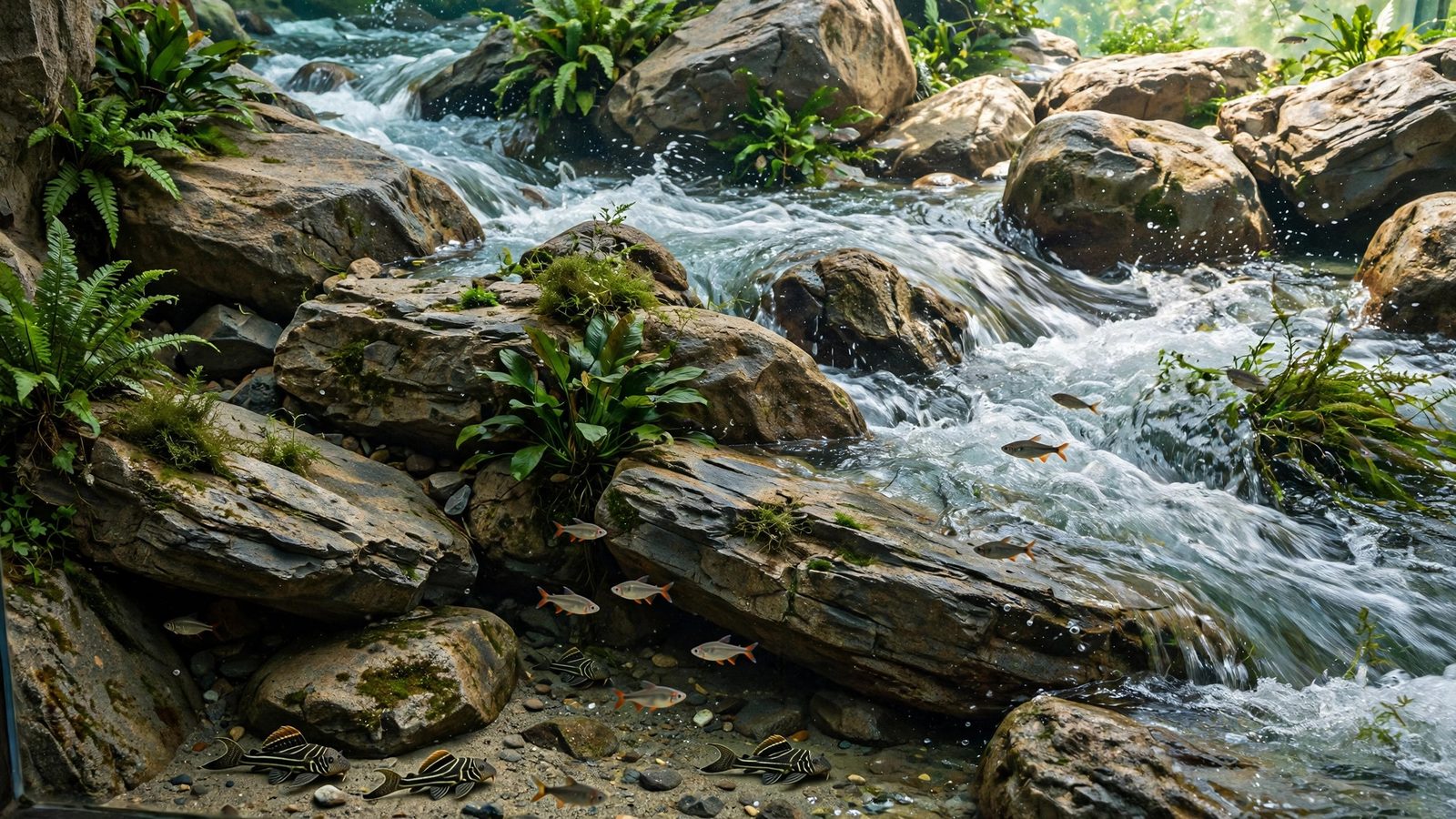
Picture a river you can see straight through: sun-lit water racing over granite boulders, striped plecos gripping rock in the current. That is the Rio Xingu, a clearwater Amazon tributary in Brazil's Pará state. A rio xingu biotope recreates fast, rocky rapids rather than the slow, tea-colored blackwater most people picture as an "Amazon tank" — and that distinction shapes every choice from hardscape to stocking.
A Rio Xingu biotope is a clearwater, high-flow aquarium of granite boulders, sandy gravel, and strong current, stocked with Xingu endemics such as the zebra pleco (L046). Hold 27–30 °C and pH 6.5–7.5, with high oxygen from a powerhead driving an open swimming lane. Citable fact: the Xingu's Volta Grande rapids — the zebra pleco's home — are among Earth's most distinctive rapids, permanently altered by the Belo Monte dam.
Designing your rio xingu biotope layout
In a Xingu tank the rock is the aquascape, so start with hardscape. Choose smooth granite or basalt boulders in several sizes plus river pebbles, and build two rock piles in the back corners, leaving a wide open lane down the middle for the current. Stack the boulders into real caves — plecos will claim them within hours, and a pile with no hideouts leaves shy fish stressed. New to region-faithful scapes? Review the biotope aquascaping basics linked further down before buying rock.
Spread 3–5 cm of sandy gravel across the open areas — Xingu rapids are floored with coarse sand and gravel washed clean of silt. Skip fine sand that compacts and aquasoil the current would strip; our rocky-river substrate picks cover grain sizes that stay put. Tuck pebbles against the boulder bases and keep the central lane bare: that corridor is where the river feel lives.
Creating strong current and high oxygen
Flow is this biotope's heartbeat — plan it before planting or stocking. Mount a powerhead low in a rear corner, aimed along the back glass so water sweeps the tank's full length in a gyre and returns along the front. Pair it with a canister filter and set the spray bar to break the surface: rapids are oxygen-saturated, and zebra plecos evolved in water that never sits still. Aim for visible plant sway without pinning fish to the glass.
Test the flow with a pinch of flake food: it should circle the tank and settle only behind rocks. Food piling in one corner marks a dead spot — nudge the powerhead until it clears.
Water parameters that suit a clearwater river
Clearwater rivers carry almost no tannins but real mineral content: target clean, neutral, well-buffered water — the opposite of a blackwater setup. Weekly 30–40% water changes are essential, because rapids are constantly renewed by the river.
| Parameter | Target range | Notes |
|---|---|---|
| Temperature | 27–30 °C (80–86 °F) | Warm and stable |
| pH | 6.5–7.5 | Neutral to slightly alkaline |
| General hardness | 4–12 dGH | Moderate is fine |
| Ammonia / nitrite | 0 ppm | Non-negotiable |
| Nitrate | Below 20 ppm | Water changes + modest feeding |
| Dissolved oxygen | High | Surface agitation + powerhead |
Hardy river plants that survive the current
Forget delicate stems — in this flow they shred within a week. Xingu planting means epiphytes that grip rock with rhizomes, like the vegetation clinging to boulders in the rapids. Tie Anubias barteri, Bolbitis heudelotii, and Java fern to boulders with cotton thread or gel superglue, tucking them into crevices just above the substrate. Add Vallisneria in the calmer pockets behind rocks, where its ribbon leaves can stream without tearing. Check how much light a shallow clearwater tank needs and run moderate light 7–8 hours — enough for epiphytes, not enough to beard bare rock with algae.
| Plant | Placement | Why it works here |
|---|---|---|
| Anubias barteri | Tied to boulder faces | Tough leaves resist current and rasping |
| Bolbitis heudelotii | Crevices in rock piles | Thrives in moving water |
| Java fern | Rock edges, mid-tank | Grips rock in strong flow |
| Vallisneria spiralis | Sheltered pockets behind rock | Streams where current softens |
Skip CO2: epiphytes grow slowly, and high flow vents dissolved CO2 fast. A lean liquid fertilizer after water changes is plenty.
Stocking with Xingu endemics
This is where the biotope earns its name: the Xingu holds dozens of species found nowhere else, and its rapids catfish are aquarium-trade stars. Build around bottom dwellers and keep the bioload modest — rapids are not crowded places.
| Species | Adult size | Role in the tank |
|---|---|---|
| Zebra pleco, Hypancistrus zebra (L046) | 8–10 cm | Xingu icon; claims and guards a cave |
| Medusa pleco, Ancistrus ranunculus (L034) | 12–15 cm | Grazes rock and glass |
| Gold nugget pleco, Baryancistrus xanthellus (L018) | 15–20 cm | Needs a 55-gallon tank |
| Xingu cory, Corydoras xinguensis | 4–5 cm | Schools along the sandy lane |
The zebra pleco is the fish everyone pictures here: give it a cave barely wider than its body, strong oxygenation, and meaty sinking foods — bloodworm and carnivore pellets, not algae wafers. Our zebra pleco care guide covers feeding and breeding, and the medusa pleco profile details a hardier L-number for the same rocks. School six-plus Xingu corys on the sandy lane and add current-loving tetras mid-water — never soft-water blackwater species.
Why this is not a blackwater tank
The most common Amazon-biotope mistake is treating all Amazon water as one thing. Blackwater rivers like the Rio Negro run acidic, tannin-stained, and slow, with driftwood tangles, cardinal tetras, and discus. The Xingu is the photographic negative: crystal-clear, mineral-rich, fast, and rocky. Hence granite instead of driftwood, powerheads instead of gentle sponge filters, and neutral-alkaline water instead of peat-filtered acidity. Our biotope aquascape guide explains the research-first approach that keeps a biotope honest, and the Rio Tapajós biotope is this build's closest cousin — another clearwater Amazon river, slower and sandier than the Xingu's rapids. For independent habitat documentation, browse the Biotope Aquarium Project.
Frequently Asked Questions
Can I keep a zebra pleco in a Rio Xingu biotope?
Yes — L046 comes from the Xingu's fast, oxygen-rich rapids. Give each adult a snug cave, keep water at 27–30 °C with strong current, and feed meaty sinking foods like bloodworm and carnivore pellets. Buy only captive-bred stock from a reputable breeder: wild zebra plecos are protected in Brazil, where export is banned, so nearly every legitimate fish in the trade is tank-raised. They are shy and nocturnal: value them for authenticity, not daytime display.
Do I need CO2 injection for Xingu biotope plants?
No. Anubias, Bolbitis, and Java fern are slow-growing epiphytes that do fine without injected CO2, and surface agitation strips dissolved CO2 from the water anyway. Moderate light, clean water, and a light fertilizer dose after each water change keeps them healthy and steadily growing.
What tank size works for a Rio Xingu biotope?
A 40-gallon breeder is the practical minimum, fitting rock piles plus an open current lane. For zebra plecos long-term or a gold nugget pleco, step up to a 48-inch 55-gallon so each cave-dweller holds a territory. Longer footprints beat taller ones for river biotopes.
Can I add cardinal tetras to a Xingu tank?
They would survive, but they belong in a different river. Cardinals are Rio Negro blackwater fish built for soft, acidic, slow water — a hard, alkaline rapids tank breaks the biotope's premise. Choose current-tolerant tetras instead, and save cardinals for a blackwater build.
Is driftwood okay in a Xingu biotope?
Barely, if at all. The Xingu's rapids are granite, not submerged forest, and driftwood leaches tannins that tint and soften the water — exactly what a clearwater biotope avoids. Use one small, well-soaked accent piece at most, and let the boulders dominate.
Bringing the rapids home
A Rio Xingu biotope rewards restraint: fewer plants, bolder rock, honest current, fish truly from those rapids. Build the river first — granite, lane, flow — and the stocking nearly chooses itself. Keep the water moving, clean, and warm.