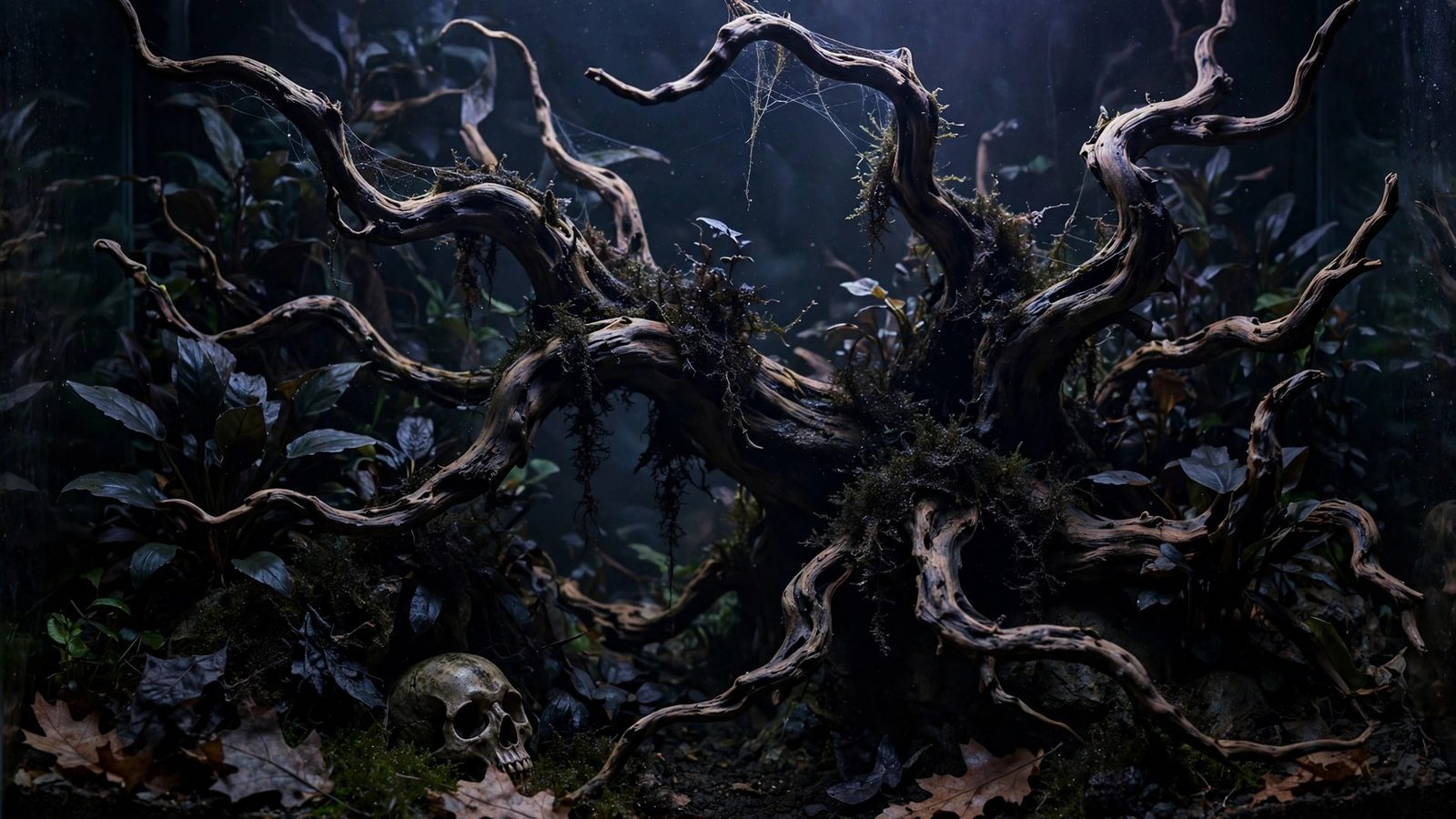
You have four weeks until the doorbell starts ringing on Halloween night, and that is exactly enough time. A proper Halloween aquascape does not come from a plastic haunted-house ornament dropped into your tank on October 30 — it comes from a living planted scape designed to look like a drowned haunted forest. Black substrate, gnarled spider wood, curtains of weeping moss, blood-red Ludwigia — all under cold moonlight-blue lighting. This is a build plan, not a shopping list: a week-by-week schedule, a plant and material matrix, livestock-safe decor rules, and a teardown plan for November 1.
Why Four Weeks Is the Right Window
Most themed-tank attempts fail for one reason: they are decorated instead of grown. A skeleton bubbler bought on October 30 in an otherwise unchanged community tank is a joke, not an aquascape. The haunted-forest look lives or dies on living plants — moss curtains thick enough to drape, red stems tall enough to read as autumn underbrush — and those need time. Four weeks is the sweet spot: long enough for fast stems and mosses to establish, short enough that you do not burn out on a theme with an expiry date.
Start with a mature, cycled tank: you are doing a partial rescape — new hardscape and planting while filter and livestock stay in place — never a full restart racing a Halloween deadline against a nitrogen cycle. The timing lines up with the market too: retailers launched their 2026 Halloween aquarium lines in mid-September, so seasonal demand is climbing now and peaks the week before the 31st. You are building at exactly the right moment.
The halloween aquascape formula: four elements of a spooky scape
Every convincing Halloween aquascape is built from the same four ingredients. Get all four right and almost any arrangement reads as haunted; miss one and the theme collapses into "tank with a plastic pumpkin."
1. The black floor
Dark substrate does two jobs: it reads as midnight ground, and it makes red plants and pale wood glow by contrast. This is straight aquascaping color theory — dark ground pushes bright plants forward. Use black aquasoil in the planted zones and edge it with fine black sand in the foreground for clean contrast. Bank it into a gentle back-to-front slope — the standard sloped substrate technique — so the forest floor has depth instead of reading flat.
2. The twisted wood
Spider wood and manzanita branches are the scape's skeleton: their tangled, reaching shapes are what your brain reads as dead haunted trees. Lay your hardscape first — the hardscape-first method — with one dominant piece at roughly one-third or two-thirds of the tank width (classic focal point placement) and two or three smaller branches echoing its angles. Soak or boil the wood for a week before it goes in so it sinks and stops leaching tannins — you want dark, clear water, not tea-colored murk.
3. The weeping canopy
Weeping moss (Vesicularia ferriei) tied to the upper branches creates the draped, dripping canopy that sells "haunted." Tie small tufts with cotton thread or aquarium-safe glue; gravity does the rest, cascading the fronds downward instead of outward like Christmas moss. Behind the wood, tall dark-green stems form the shadowy background wall. Leave deliberate empty space in the foreground — negative space keeps a spooky scape eerie rather than cluttered.
4. The blood-red underbrush
Red plants are the Halloween palette. Ludwigia palustris 'Super Red' and Alternanthera reineckii planted in midground drifts around the wood bases read as blood-colored underbrush against the black substrate. Red is the one element you must keep red: under medium light without CO2, Ludwigia reverts to dull green within two weeks and your haunted forest becomes an ordinary planted tank. Budget for high light and injected CO2 from day one.
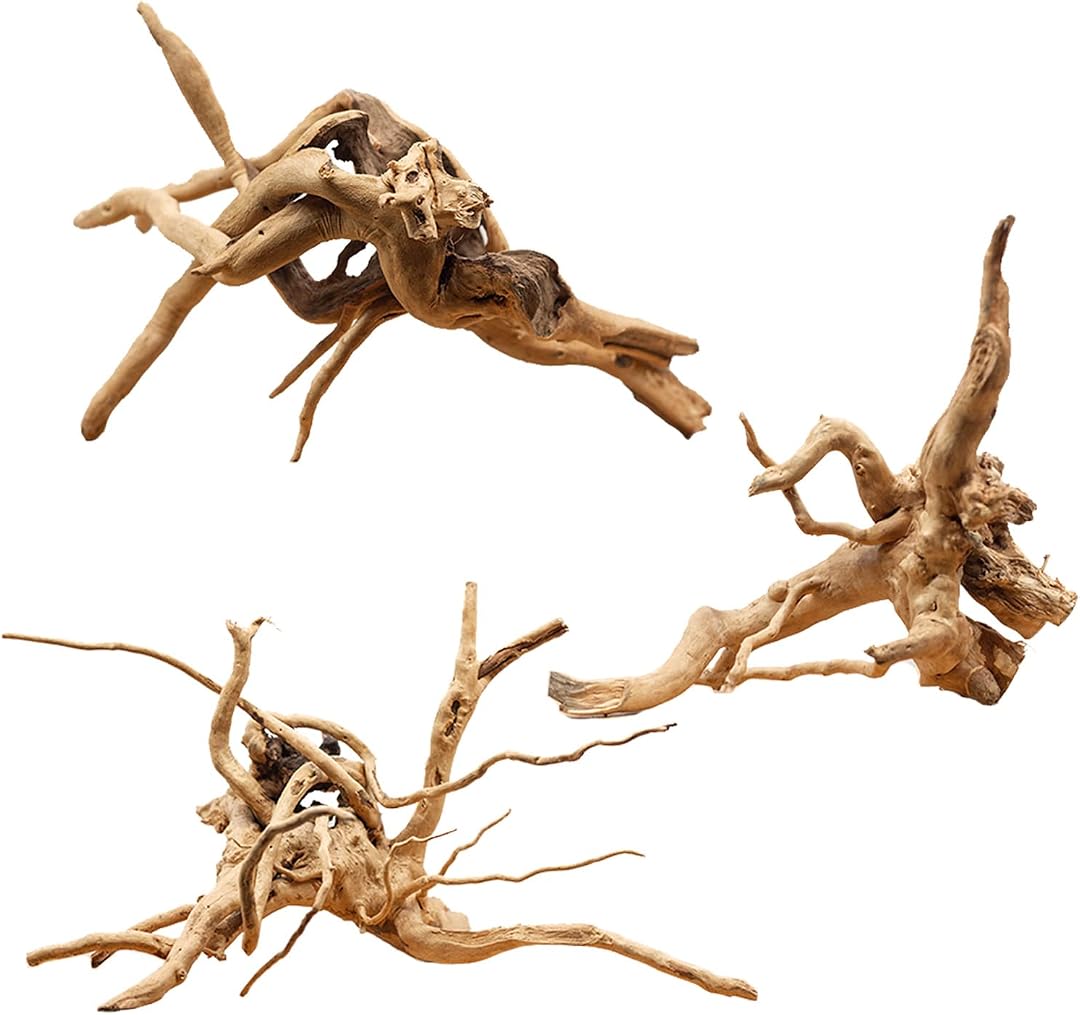 ★4.0
majoywoo Natural Spider Wood Branches
Check Price on Amazon ★4.0Plant and Material Selection Matrix
Every item below has a job in the composition. Before ordering, cross-check each plant's care requirements in the Tropica plant database — it lists exact light and CO2 needs per species, which is what keeps your reds red.
| Plant / material | Role in the scape | Care level | Growth rate | Notes |
|---|---|---|---|---|
| Ludwigia palustris 'Super Red' | Blood-red midground underbrush | Medium–hard | Fast | Needs high light + CO2 to stay red; trim weekly from week 2 |
| Alternanthera reineckii | Deep crimson accent clumps | Medium | Medium | Plant in groups of 5–7 stems around wood bases |
| Weeping moss (Vesicularia ferriei) | Draping canopy on branches | Easy | Slow–medium | Tie to upper wood only; it cascades downward |
| Spider wood / manzanita | Haunted-tree hardscape skeleton | N/A | N/A | One hero piece + 2–3 satellites; soak 7 days first |
| Black aquasoil + black sand | Midnight substrate floor | N/A | N/A | Aquasoil in planting zones, sand in the foreground |
| Dark background stems (Rotala, Hygrophila) | Shadowy rear backdrop | Easy–medium | Fast | Creates the "forest goes on forever" effect |
| Moonlight-blue LED fixture | The Halloween atmosphere itself | N/A | N/A | Run 2–3 hours after the main photoperiod |
| Skeleton bubbler / painted props | Temporary seasonal props | N/A | N/A | Decoration only — never permanent scape elements |
The 4-Week Build Timeline
Four weekly phases, each with a clear done-state. Print this section and tape it to the tank stand.
Week 1 (October 3–9): Foundation
Hardscape and substrate only — no plants yet. Clear the planting zones (fish and filter keep running). Lay aquasoil in a 3–4 inch back-to-1-inch front slope, edge the foreground with black sand, and set your hero spider-wood piece per your focal-point plan. Bought wood soaks in a bucket this week, not in the tank. Done-state: substrate sloped, hero wood placed, plants ordered.
Week 2 (October 10–16): Planting
Plant everything. Sink the soaked wood, space the red stems 3–5 inches apart in midground drifts, tie weeping moss to the upper branches, and fill the background with dark-green stems. Start CO2 (~1 bubble/sec per 10 gal, drop checker green by lights-on), run the main light 8 hours daily, and dose all-in-one fertilizer per the bottle. Done-state: everything planted, CO2 running, first trim done to push bushier side shoots.
Week 3 (October 17–23): Growing in
The tank looks messy this week and that is fine. Trim the Ludwigia and background stems again to force branching; re-tie any drifted moss. Add the moonlight-blue fixture and start the evening "Halloween shift" so livestock acclimate gradually. Introduce temporary props one at a time — skeleton bubbler first — and watch fish for stress for 24 hours after each addition. Done-state: moss visibly draping, red stems at two-thirds height, blue phase running smoothly.
Week 4 (October 24–31): Polish and performance
Final grooming week. Third trim on the reds for the dense underbrush look, wipe any diatoms off the glass, keep up water changes, and do a 40% change the day before Halloween for maximum clarity. On October 31, run the white light until evening, then switch to moonlight-blue only — the tank becomes a glowing haunted forest while trick-or-treaters walk past. Done-state: dense red underbrush, draped canopy, crystal water, props in place.
Moonlight-Blue Lighting: The Actual Effect
The blue light is not a gimmick — it is a second photoperiod at a different color temperature, and it is what makes the scape read as "Halloween" rather than "nice planted tank with a pumpkin." Run your main full-spectrum light as normal: 7–8 hours of white at 30–50 PAR at the substrate for the reds. Then run a blue-spectrum LED bar — or a dimmable RGB light set to 100% blue — for 2–3 hours after the main light shuts off, at low intensity (roughly 5–10 PAR). Blue penetrates water beautifully: the black substrate turns into a dark mirror while the red plants go nearly black-violet.
Two rules. First, keep the blue phase short — total photoperiod past 10–11 hours invites algae, and blue light still grows algae. Second, never run blue-only all day; red plants need their white-spectrum hours to photosynthesize, or they stall right when you need them growing. If you are shopping for a fixture, pick a main light with a controllable blue channel, so you do not need a second fixture at all.
Livestock-Safe Rules for Temporary Decor
Seasonal props are decorations, not scape elements — and most cheap Halloween decor was never painted to be submerged. These rules are non-negotiable.
- Soak-test everything. Every painted ornament, skeleton, or haunted-house hide gets a 24–48 hour soak in dechlorinated water first. If the water smells chemical, changes color, or paint feels soft or flaky afterward, the prop does not go in. Full stop.
- No glow-in-the-dark coatings. The phosphorescent coatings on cheap glow skulls and pebbles can contain compounds that leach in water. They look great on a shelf — they stay on the shelf.
- Bubblers are fine, with a check. A skeleton air-stone bubbler is safe if its coating passes the soak test and you run it on an adjustable valve: a gentle stream of bubbles, not a storm.
- Secure everything. Props in the current get zip-tied or weighed down. A drifting skeleton that lands on the moss canopy crushes it and startles the fish — the seasonal version of the unstable-decor mistake beginners make.
- Keep props out of the substrate. Never bury painted ornaments in aquasoil — it creates anaerobic pockets and traps paint chips where bottom-feeders graze. Sit them on the sand instead.
- Stocking stays calm. The dark, high-contrast blue phase can unsettle skittish species; keep it to 1–2 hours if yours are shy. Species that suit aquascaped tanks — tetras, rasboras, small catfish — handle the theme far better than jumpy, bright-colored fish that fight the palette.
The Teardown Plan: Back to Normal by November 1
A Halloween aquascape is a costume, and costumes come off. Plan one session the first weekend of November — about 90 minutes.
- Pull the props. Remove every ornament, bubbler, and prop. Rinse, dry, and store them in a labeled box — most resin props are reusable for years.
- Restore the light schedule. Drop the blue phase and return to 7–8 hours of white. The plants visibly relax within days.
- Decide the scape's future. The Halloween layout — black substrate, dramatic wood, red stems, moss canopy — is a legitimate year-round dark-style scape. Trim the reds hard one last time, rebalance the composition, and you have a moody forest tank for winter.
- Water change and reset. A 30–40% water change, filter maintenance, glass wipe. Your tank is a normal planted tank with a story again.
Frequently Asked Questions
Can I do a Halloween aquascape in a nano tank?
Yes — 5–10 gallons is actually ideal, since you need fewer plants and less wood to fill the frame. Scale down the hardscape: one small spider-wood piece, one weeping-moss clump, and a single drift of Ludwigia. Keep the blue phase to 1–2 hours in a nano, where parameters shift faster. The full four-week timeline works unchanged; you just buy less of everything.
What if my red plants turn green?
They are telling you the light and CO2 are insufficient — the most common Halloween-scape failure. Red pigmentation (anthocyanin) is expensive for plants to maintain; they only produce it under high light. Confirm your main light delivers at least 30 PAR at the substrate, get the drop checker green by lights-on, and trim off the green growth so new red shoots take over. Recovery takes 2–3 weeks, so catch it in Week 2, not Week 4.
Is the moonlight-blue light safe for fish?
Yes — at 5–10 PAR for 2–3 hours it mimics natural moonlight and does not stress healthy fish. Introduce it gradually during Week 3 so livestock acclimate, and skip the blue phase if you keep nocturnal or highly light-sensitive species. Never leave any aquarium light on around the clock; fish need a true dark period for their sleep cycles.
How do I stop algae from ruining the look?
The new-plant phase is the highest algae-risk window, and a green dusting kills the haunted-forest illusion fast. Keep the main photoperiod at 7–8 hours and the blue phase at 2–3 hours, dose fertilizer consistently (starved plants invite algae), and do 30% water changes twice a week during the build. Week-2 diatoms on the black sand are normal — vacuum them lightly and they clear as the tank matures.
Can I keep the scape up past October?
Absolutely — the bones of this scape are a legitimate dark-style planted layout. The only things that must go are the temporary props (not designed for permanent submersion) and the extended blue phase. Trim the red stems into a balanced composition, rebalance to a white-spectrum schedule, and the "haunted forest" becomes an elegant moody tank that happens to have been built in October.
Your Haunted Forest Is Four Weeks Away
The hardest part of a Halloween aquascape is not the technique — it is starting early enough. This weekend, order the spider wood and the red stems. Next weekend, plant them. By October 31 your living room holds a glowing blue haunted forest no plastic ornament could match — and on November 1 it is a beautiful planted tank again. Set your Week 1 reminder: the clock is ticking.