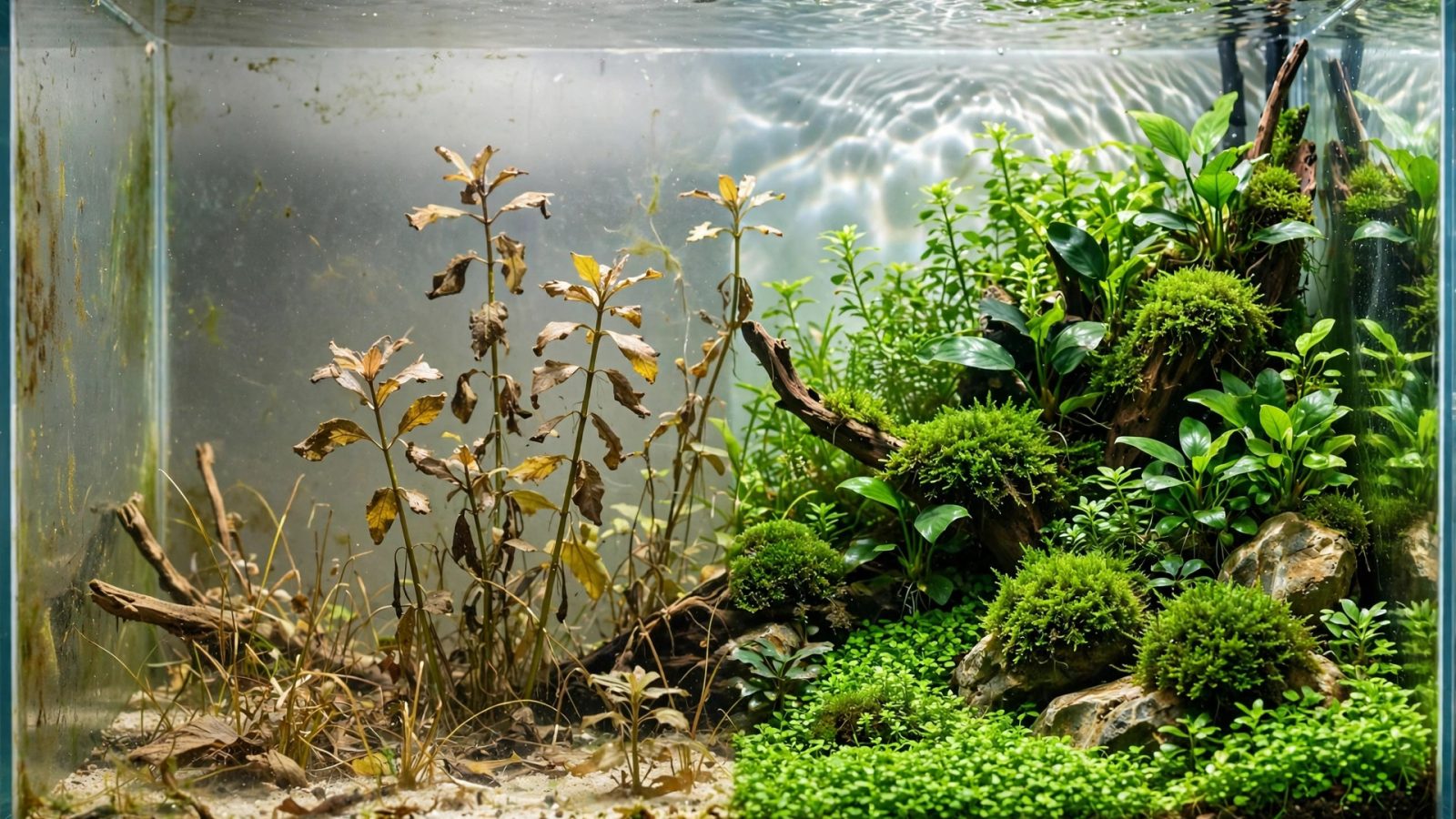
Every aquascaper makes these mistakes — the difference between a beginner and an experienced scaper is just how fast they stop making them. These are the 11 aquascaping mistakes beginners make most often, why each one ruins layouts, and exactly how to fix it. Run through this list before your next rescape and you’ll skip about a year of trial and error.
1. Centering the Focal Point
The mistake: placing the main stone or wood dead-center in the tank.
Why it fails: centered compositions feel static — the eye arrives and stops moving. The layout looks “posed” rather than natural.
The fix: use the rule of thirds — place the focal element at the one-third or two-thirds mark. Off-center placement creates visual tension that makes the whole tank feel larger and more dynamic.
2. Flat Substrate
The mistake: pouring in substrate level, front to back.
Why it fails: flat substrate = flat-looking tank. Background plants sit at the same visual level as foreground ones, and the back-glass bottom edge shows — an instant depth-killer.
The fix: slope 2–3 cm at the front up to 8–15 cm at the back, with supports underneath so it holds. See 9 depth techniques for the full playbook.
3. Too Few Plants at Setup
The mistake: planting sparsely to “save money,” planning to let plants fill in.
Why it fails: bare substrate under aquarium lighting is an algae farm. Plants outcompete algae only when they’re already established in numbers; a sparse planting gives algae months of uncontested real estate.
The fix: plant densely on day one — budget for it. Tissue-culture cups, stem bundles planted 3 cm apart, full carpet grids. The plant bill is the cheapest algae prevention you can buy.
4. Mixing Styles Randomly
The mistake: iwagumi stones + Dutch stem streets + a big driftwood centerpiece + a carpet + floaters, all in one tank.
Why it fails: each style has internal logic; mixing them breaks all of it. The result reads as clutter, not creativity.
The fix: pick one style per tank and commit — iwagumi, Dutch, jungle, triangle, or island. Learn its rules, then bend them deliberately once you understand them.
5. Ignoring the Hardscape Dry Layout
The mistake: placing stones and wood directly into a filled, planted tank and hoping it works.
Why it fails: underwater, everything looks closer to fine than it is. Stones that seemed well-placed look random once plants grow in.
The fix: arrange hardscape in the dry tank first. Photograph it from the front, sides, and above. Live with the photos for a day. Adjust until the composition works from every angle before substrate and water commit you.
6. Burying Rhizomes (Anubias, Java Fern, Buce)
The mistake: planting epiphytes like terrestrial plants, rhizome underground.
Why it fails: buried rhizomes rot. The plant slowly dies over weeks while you wonder what’s wrong with your water.
The fix: rhizome always above the substrate — tie or glue to hardscape instead. See attaching plants to driftwood and attaching plants to rocks.
7. No Maintenance Schedule
The mistake: treating the scape as finished once planted.
Why it fails: aquascapes are gardens, not paintings. Untrimmed stems shade themselves and rot; uncleaned stones grow algae; unthinned carpets lift in mats.
The fix: calendar it — weekly water changes and glass cleaning, stem trims every 1–3 weeks depending on style, monthly thinning and filter maintenance. The style you chose determines the workload; Dutch demands the most, jungle the least.
8. Too Much Light, Too Soon
The mistake: running full-intensity light 10+ hours from day one “to help plants grow.”
Why it fails: new plantings can’t use that much light yet — but algae can. The classic new-tank algae bloom is almost always a light overdose.
The fix: start at 6 hours with moderate intensity; ramp to 7–8 hours over 2–3 weeks as plants establish. A timer is non-negotiable — inconsistent photoperiods stress plants and invite algae.
9. Stocking Algae-Eaters as a Cleanup Plan
The mistake: “I’ll just get some otos/shrimp to handle the algae.”
Why it fails: cleanup crews manage residual algae; they can’t fix the imbalance causing it. And they’re livestock with their own needs — not tools.
The fix: fix the cause (light, CO2, nutrients, maintenance), then add Amano shrimp and otocinclus as the finishing crew they are. See our plant problem guides for diagnosing the actual cause.
10. Rescaping Too Often
The mistake: tearing down and rearranging every few weeks when the tank doesn’t look like the inspiration photo yet.
Why it fails: aquascapes need 2–3 months to mature. Constant rescaping resets plant establishment to zero — you never see what the layout would have become. (And each teardown stirs up a nutrient spike.)
The fix: commit to 3 months. Photograph monthly and compare — the time-lapse shows progress invisible day to day. For realistic timelines, see how long an aquascape takes to fill in.
11. Copying Without Understanding
The mistake: replicating a contest-winning scape plant-for-plant without knowing why each choice works.
Why it fails: the original used specific light, CO2, water, and maintenance you don’t have. The copy grows differently and disappoints.
The fix: study the principles — focal placement, depth, contrast, plant roles — then build your own layout with plants suited to your setup. Imitate the thinking, not the shopping list.
The Beginner’s Pre-Scape Checklist
- One style chosen and its rules understood
- Hardscape dry-laid, photographed, and approved
- Focal point on a thirds-line, not centered
- Substrate sloped with supports
- Plant list finalized — enough for dense day-one planting
- Rhizome plants assigned to hardscape, not substrate
- Light timer set: 6 hours to start
- Maintenance schedule on the calendar
- Commitment: no rescape for 3 months
Frequently Asked Questions
What is the hardest part of aquascaping for beginners?
Patience — both planting densely enough at the start (instead of economizing) and leaving the layout alone for 2–3 months to mature. Most beginner failures are impatience, not technique.
Why does my aquascape look flat?
Almost always flat substrate, centered hardscape, or single-height planting. Fix with a front-to-back slope, off-center focal point, and three plant height layers — see creating depth.
How long before an aquascape looks good?
2–3 months minimum for most styles; carpets and Dutch streets need the full window. Judge at month three, not week three.
Why Beginners Make These Mistakes (It’s Not Ignorance)
Every mistake above has a reason beginners make it — usually a reasonable-sounding instinct that happens to be wrong underwater:
- Centering feels “balanced” because we’re taught symmetry = beauty. Underwater, asymmetry reads as natural.
- Flat substrate feels tidy. But aquariums are viewed through glass at an angle — flat reads as a shelf, sloped reads as a landscape.
- Sparse planting feels economical. The algae bill always exceeds the plant savings.
- Style mixing feels creative. Constraints are what make styles readable — creativity comes after fluency.
- Skipping the dry layout feels efficient. It’s the most expensive shortcut in the hobby, paid in rescapes.
- Burying rhizomes feels like “planting.” Epiphytes aren’t terrestrial plants — different biology, different rules.
- No maintenance schedule feels like freedom. Gardens need gardeners; the schedule is the hobby.
- Max light feels like helping. Plants need enough light, not maximum light.
- Cleanup-crew-as-plan feels like a shortcut. Biology doesn’t shortcut; fix causes.
- Frequent rescapes feel like progress. They’re resets disguised as progress.
- Copying feels safe. Understanding is safer.
The First-Year Learning Path
If you’re starting from zero, here’s the sequence that builds skill fastest:
- Tank 1 — Jungle or low-tech natural. Forgiving, cheap, teaches plant basics. Make every mistake here; the style absorbs them. (Jungle guide)
- Tank 2 — Triangle composition. Your first designed layout. Learn focal placement, depth, and height graduation. (Triangle guide)
- Tank 3 — Iwagumi or island. Minimalism or negative space — the disciplines of restraint. (Iwagumi guide, Island guide)
- Tank 4 — Dutch or high-tech nature. Full CO2, full commitment. By now the maintenance discipline is habit, not burden. (Dutch guide)
Each tank teaches what the next one requires. Skipping straight to Dutch is possible — but the failure rate is high, and a failed first tank discourages more beginners than any other hobby factor. There’s no shame in the progression; every great scaper started with a jungle tank (or wishes they had).
Where to Learn More (Without the Noise)
- Do: study competition tanks (IAPLC, AGA) for composition — analyze why winners work, using the rules in our focal-point guide and depth guide.
- Do: keep a tank journal — photos monthly, notes on trims, dosing, and changes. Your own data beats any forum advice.
- Don’t: chase every new product. Substrate, light, CO2, fertilizer, patience — the fundamentals haven’t changed in decades.
- Don’t: compare your month-two tank to someone’s year-three tank. The timelines in our fill-in guide are the honest benchmark.
Mistake Recovery Guide: Fixing What’s Already Wrong
Made the mistakes already? Most are fixable without a full teardown:
- Centered focal point: shift the main stone/wood 10–15 cm toward a thirds-line and rebalance the other side. Often a 20-minute fix with dramatic results.
- Flat substrate: during the next water change, push substrate from the front toward the back with your hand — you can build a slope in an established tank, gently, over two or three sessions.
- Sparse planting: buy more plants now. There’s no penalty for supplementing late — only for leaving it bare.
- Buried rhizomes: unearth them today. Rinse off rot, trim mush, tie to hardscape. Most recover if the rhizome is still firm.
- Algae from too much light: cut the photoperiod to 6 hours immediately, then ramp back up over three weeks as balance returns.
- Style soup: pick the style the tank mostly is, remove the elements that belong to other styles. Subtraction beats addition.
- Impulse rescape urge: photograph the tank, put the photos away for two weeks, then look again. The urge usually passes; the growth doesn’t lie.
The Mindset Shift: From Decorator to Gardener
The deepest beginner mistake isn’t on the list above — it’s the mental model. Beginners think of aquascaping as decorating: arrange objects, done. Experienced scapers think of it as gardening: plant systems, tend them, guide their growth.
The decorator asks “where should this go?” The gardener asks “what will this become in three months, and what will it need from me?” Every technique in our aquascaping guides — depth, focal points, trimming, fertilizing — serves the gardener’s question. Make the shift and the mistakes above stop happening naturally, because you’re designing for the future tank, not the present one.
Quick-Fire Mistake Fixes
My tank is 3 weeks old and covered in algae — did I fail?
No — you have a new tank. Diatoms (brown dust) in weeks 2–4 are nearly universal and fade on their own. Cut light to 6 hours, keep up water changes, add a cleanup crew, and reassess at week 6. Most “disasters” at week 3 are just the ugly phase of a normal grow-in — see realistic timelines.
I planted everything and it all melted — start over?
Not yet. Check: are the roots firm and white? Is any new growth appearing? If yes to either, wait — melting emersed leaves with new submerged growth is adaptation. If it’s all mush after 3+ weeks, identify the cause (usually light or buried rhizomes) before replanting, or the replacements will melt too.
My scape looked great at month 2 and terrible at month 5 — what happened?
Usually one of three things: substrate nutrients depleting (add root tabs), a fast grower shading everything else (thin aggressively), or maintenance slipping (resume the schedule). Month-5 slumps are maintenance failures, not design failures — the layout was fine; the gardening lapsed.
Should beginners use aquasoil or sand?
Aquasoil for planted tanks, full stop. It buffers pH down, feeds roots for a year, and grows plants visibly faster. Sand is cheaper and suits specific styles (island negative space, corydoras tanks), but beginners grow plants better in soil. The cost difference is the cheapest insurance in the hobby.