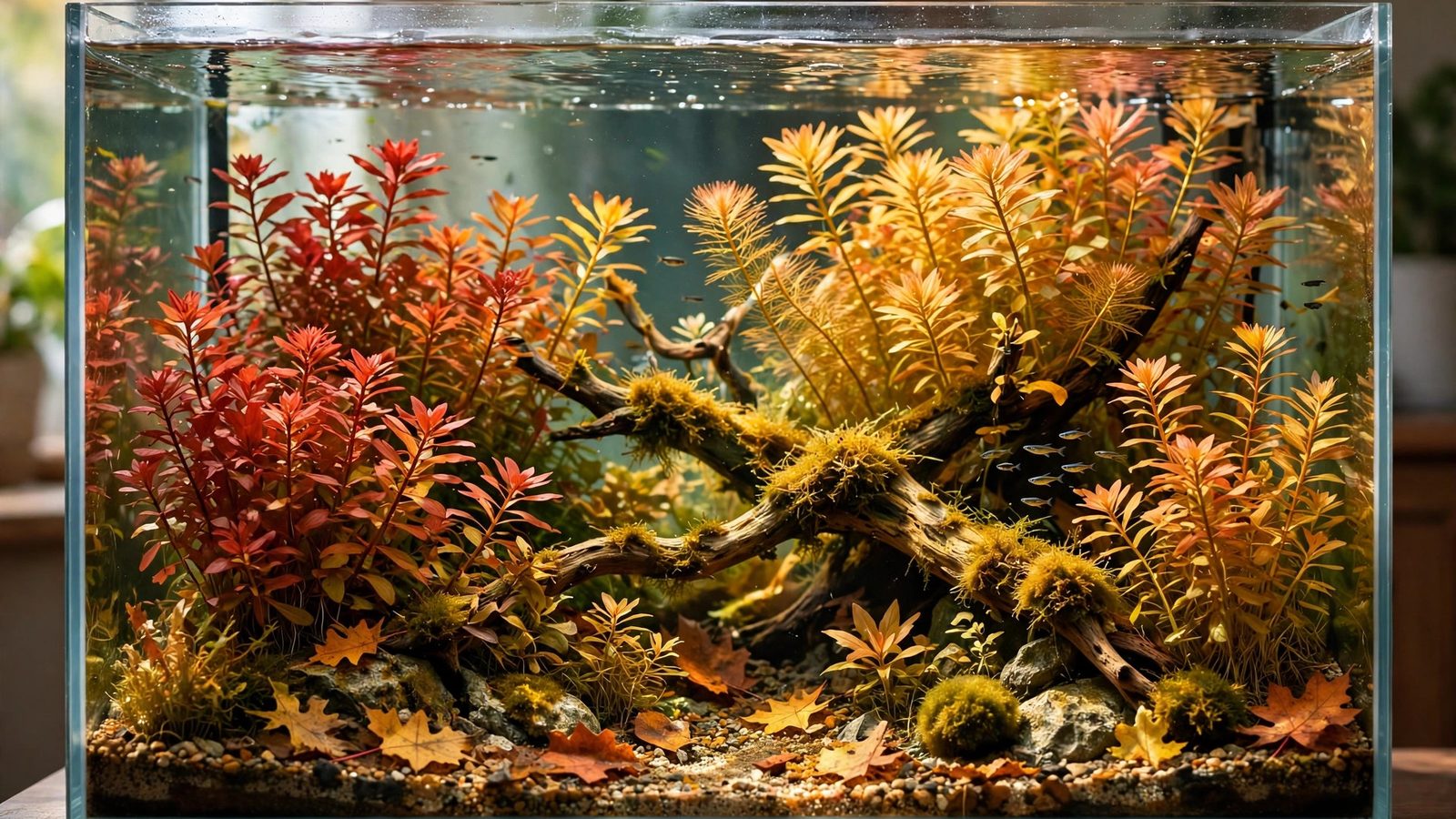
Walk past an aquarium convention any October and you'll see the same thing: tanks glowing like maple trees at sunset, while most planted tanks stay stubbornly green year-round. Red and orange underwater colors feel like a trick reserved for contest winners — they aren't. An autumn aquascape is simply a deliberate palette: red stem plants grouped where the eye lands, warm-toned hardscape, and lighting that rewards warm pigments instead of washing them out. By the end of this guide, you'll know exactly which plants turn crimson on demand, which hardscape sells the fall story, and the week-by-week planting timeline that gets you there before peak foliage season ends.
Why an Autumn Aquascape Works Underwater
On land, autumn is a countdown — pigments fade, leaves drop, and the color show lasts weeks. In a tank, you freeze the best two weeks of October and hold them indefinitely. That permanence is the whole appeal: reds that never drop, a forest floor that never rots away, warm light that never dims into winter. Contest judges have known this for years — warm palettes score disproportionately well because most competitors show up with every shade of green and nothing else. The mistake most people make is treating red as an accent. One sad Ludwigia stem floating among green bushes reads as a dying plant, not autumn. Autumn reads as a season only when warm tones dominate 60–70% of the visible mass: a red canopy, an orange midground, a gold carpet, and only then green where it frames rather than fills. Think like a painter mixing a palette, not a collector filling slots. The Dutch planting rules — species in defined groups, tallest behind, bold contrasts side by side — translate perfectly to fall themes, except your contrasts are color-temperature contrasts: scarlet against bronze, rust against moss-green. A second trap is reaching for dyed gravel, red-fluorescent gravel, or red-colored ornaments. Real autumn color is organic and uneven — leaves within a single Rotala bush range from copper to wine, and that variation is what makes it believable. Manufactured red is flat, and the eye spots the lie instantly.The Autumn Plant Palette: Reds That Actually Stay Red
Not all red plants are created equal. Some need CO2 and high light just to blush; others deliver fire-engine red in a medium-light low-tech tank. The table below ranks the autumn all-stars by reliability — start with the top rows and expand as your setup allows.| Plant | Autumn color | Placement | Difficulty | Notes |
|---|---|---|---|---|
| Ludwigia sp. 'Super Red' | Blood-red top to bottom | Midground/background bush | Easy | Stays red even without CO2; the single most reliable autumn plant |
| Rotala rotundifolia | Pink-orange at tips | Background wall | Easy–medium | Colors up fastest; trim and replant tops for density |
| Nymphaea zenkeri 'Red' (red tiger lotus) | Bronze-red pads | Midground focal point | Easy | One plant anchors the whole scene; trim floating leaves to keep it submerged |
| Ammannia gracilis | Orange-gold gradient | Background | Medium | The true "fall foliage" gradient — green bases to amber tips; needs CO2 for best color |
| Rotala wallichii | Peach-pink | Background accent | Medium–hard | Soft, feathery texture reads as autumn canopy; needs CO2 + lean nitrates |
| Cryptocoryne wendtii 'Flamingo' | Rose-pink rosette | Foreground/midground | Easy | Your pink foreground "leaf litter" base under the reds |
| Echinodorus 'Red Devil' / 'Flame' | Deep burgundy swords | Midground specimen | Easy | Root tabs mandatory; slow but dramatic |
| Alternanthera reineckii 'Mini' | Magenta-purple | Foreground bush | Medium | The dark accent that makes neighboring reds look brighter |
Hardscape That Tells the Fall Story
Hardscape carries half the autumn illusion, and wood is non-negotiable. Spider wood with its fine branching reads as bare autumn branches; a large manzanita trunk laid across the tank becomes a fallen tree. Position one or two major wood pieces before anything else — hardscape-first planning is the difference between a tank that happens to have wood and a tank built around a fallen forest. For the substrate, match the leaf-litter story: a base of dark aquasoil (it also feeds the heavy root-feeders like swords and lotus) capped or bordered with warm-tone gravel or coarse sand in the foreground. Malaysian driftwood plus bronze-toned gravel plus Ammannia gracilis is the classic combination that photographs like a New England forest floor. A winding sand path in warm tan — the technique detailed in the sand pathway guide — doubles as the trail through the woods, and it's the single most persuasive "you are standing in a forest" cue you can add. Real dried leaves are the finishing touch, but choose them carefully. Indian almond (catappa) leaves tint the water tea-colored with tannins — beautiful and authentic, but they break down in 2–4 weeks and need replacing. Oak leaves last longer and stain less. Either way, boil leaves for 10 minutes before adding them to kill hitchhikers and sink them faster. A light dusting of 5–8 leaves in the foreground, replaced monthly, sells "fall" harder than any plant.Lighting and Water Chemistry for Maximum Warmth
Here's the part most guides get backwards: red plants don't need "more light," they need the right light. Anything above 8000K color temperature shifts the spectrum toward blue and visually bleaches warm pigments — your expensive reds look pink and washed out. For autumn tones, run 5000–6500K fixtures, or better yet a programmable RGB light (Chihiros WRGB II, Twinstar 600S, or Fluval Plant 3.0) with the red channel pushed to 80–100% and blue held at 50–60%. At 80–100 µmol PAR at the substrate, most reds color fully; beyond ~150 PAR you're just feeding algae. The chemistry trick is counterintuitive: limit nitrates. When nitrogen runs rich (20+ ppm NO3), plants stay green and grow fast because they're not stressed. When nitrates run lean (5–10 ppm), plants produce anthocyanins — the red and purple pigments — as a kind of sunscreen. This is the same reason land plants turn red in autumn: chlorophyll drains away, anthocyanins remain. Dose an all-in-one fertilizer at half strength once a week, test nitrates, and hold that 5–10 ppm window. CO2 at 25–30 ppm is still recommended for the medium-difficulty species (Ammannia, Rotala wallichii), but Ludwigia super red and red tiger lotus will blush happily without it. Iron deserves a myth-busting: red plants do not turn red because you add iron to the water column. Iron deficiency causes pale new growth, which you should fix — but excess iron just feeds algae. Plant heavy root-feeders in iron-rich aquasoil with root tabs, dose a complete micro fertilizer normally, and let the light and lean nitrates do the coloring work. For the full science on lean dosing and anthocyanin production, the 2hr Aquarist planted-tank guides document the regime in detail.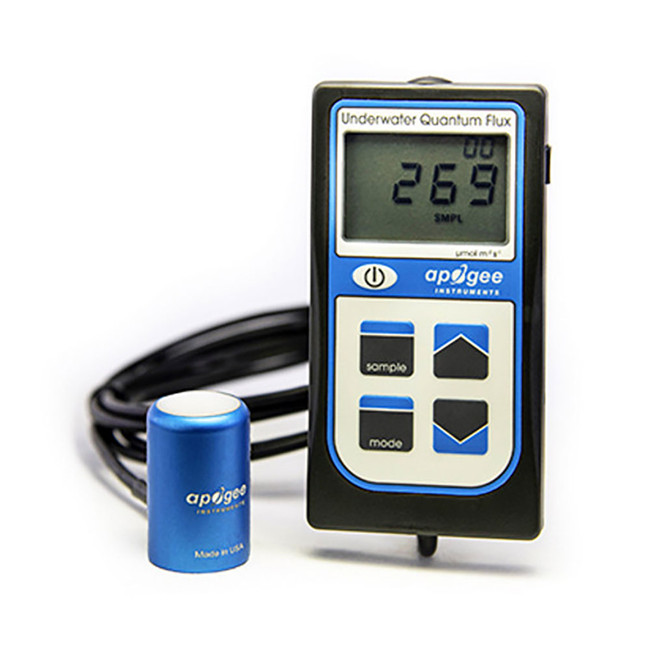 ★4.4
Apogee MQ-510 Underwater PAR Meter
Check Price on Amazon ★4.4Layout: Painting With Autumn Colors
Start with the focal point — the "hero tree." One red tiger lotus or one dense Ludwigia super red bush placed at the golden-ratio point (roughly one-third from either end) becomes the burning bush every eye finds first. Everything else is composed around it: background walls of Rotala rotundifolia and Ammannia gracilis behind it, lower orange midground (Rotala wallichii, Flamingo crypts) flanking it, and the leaf-litter foreground at its feet. Height gradient does heavy lifting here. Autumn scenes read as "canopy above, forest floor below," so slope your substrate 2–3 inches higher in the back and plant the tallest reds along a diagonal ridge sweeping from the high back corner down to the opposite front — the diagonal composition technique gives autumn canopies their sweeping, wind-blown feel. Contrast pairs matter too: place your deepest red (Alternanthera 'Mini') directly beside your brightest orange (Ammannia tips), and tuck a pocket of green moss behind the hero bush. Warm colors advance toward the viewer, cool colors recede — the same principle behind blackwater layouts, where tannin-darkened water pushes the background back and makes foreground reds glow. Leave breathing room. A common beginner failure is filling every inch — autumn forests have clearings. Two or three open sand patches where the eye rests will make the planted areas feel denser and more dramatic by comparison. If you're new to composing layouts, run through the beginner layout walkthrough first, then adapt its framework to the autumn palette.The Planting Timeline: 12 Weeks to Peak Foliage
Autumn aquascapes reward patience because red plants color on their last growth — a freshly planted Rotala stem is green; the crimson tips appear after 3–4 weeks of growth under the right conditions. Work backwards from your target date. Weeks 1–2: hardscape and cycling. Position wood and stone, slope the substrate, plant only the fast green fillers (moss, crypts) if you're doing a silent cycle with established media. Otherwise cycle fishless for 2–4 weeks. Test ammonia and nitrite to zero before adding livestock. Weeks 3–4: plant the reds. This is when the background walls of Rotala and Ludwigia go in, along with the tiger lotus bulb and sword plants with root tabs. Start CO2 now if you're using it, and begin the lean-nitrate dosing regime from day one — coloring is a process, not a switch. Weeks 5–8: grow-out and first trims. Stem plants will reach the surface and need their first trim at week 5–6. Replant the tops right next to the originals to double density — this trim-and-replant cycle is the engine of every thick red wall. The technique is covered in detail in the trimming and maintenance guide. The lotus will start throwing submerged pads by week 6–7; pinch any leaves that reach for the surface. Weeks 9–12: peak color. By now the reds have 3+ generations of growth under lean nitrates and warm light, and the color shift compounds with each trim cycle — each replanted top colors faster than its parent did. This is when you photograph it, enter a contest if the timing's right, or simply sit back and watch fish weave through your private October.Livestock That Completes the Scene
Fish are the final brushstroke. Ember tetras (orange-red, schooling) and chili rasboras (deep red) read as drifting autumn leaves when they move through the red stems — 15–20 of either in a 20-gallon tank is transformative. For contrast, a school of green neon tetras or celestial pearl danios gives the eye a cool-color anchor that makes the warm palette feel warmer. Bottom dwellers should stay subtle: a few otocinclus or cherry shrimp (which will happily graze the leaf litter) rather than anything bright enough to steal the scene. Quarantine everything for 2–3 weeks before it touches the scape. Nothing ruins a 12-week build like an ich outbreak in week 10, and medicating a planted tank risks the very plants you've spent months coloring up.Frequently Asked Questions
Can I make an autumn aquascape without CO2?
Yes — choose the forgiving reds. Ludwigia super red, red tiger lotus, Rotala rotundifolia, and Cryptocoryne 'Flamingo' all color well in low-tech tanks under decent light. Skip Ammannia gracilis and Rotala wallichii without CO2; they'll survive but stay mostly green. Lean nitrates and warm-spectrum lighting matter more than CO2 for the easy species.
Why are my red plants turning green instead?
Almost always one of three causes: nitrates too high (above ~15 ppm), lighting too cool (8000K+ or heavy blue spectrum), or the plants are simply too young — reds color on mature growth after 3–4 weeks. Check nitrates first with a liquid test kit, shift your light toward the red channel, and give new plantings a full month before judging.
Will leaf litter crash my water parameters?
A modest scattering of 5–8 boiled leaves won't. Tannins lower pH slightly and soften water, which most tetras, rasboras, and shrimp actually prefer. Replace leaves as they break down (every 3–4 weeks for catappa, 6–8 for oak) and remove mushy remnants promptly — decaying matter spikes ammonia if left to rot in the substrate.
How do I keep the red tiger lotus from taking over?
Pinch off any leaf stem that angles upward toward the surface — submerged pads stay compact, but once it sends floating leaves it shades everything below and shifts energy to surface growth. One lotus per 20 gallons is plenty; it will still produce 10–15 submerged pads, which is all the focal-point drama you need.
What's the cheapest way to get warm-spectrum lighting?
A programmable RGB/WRGB light is ideal, but on a budget, any 6500K full-spectrum LED plus a warm-white supplemental strip (3000–4000K) gets you most of the way there. Avoid the temptation of "red boost" party bulbs — uneven spectrums grow algae and make fish look unnatural. Total lighting budget for a 20-gallon autumn tank can stay under $80 with this approach.