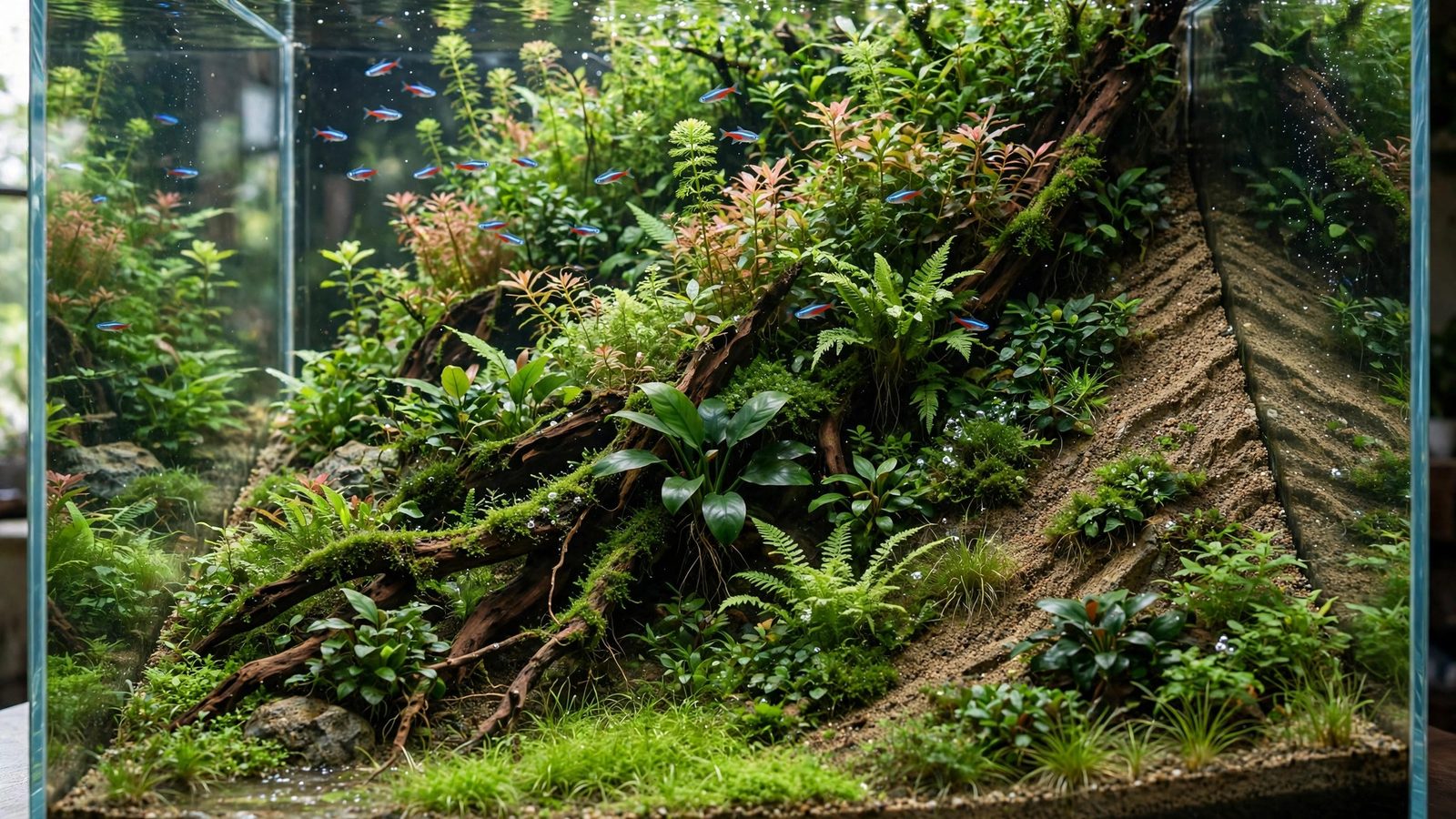
Flat substrate makes flat aquascapes. It's that simple — and it's why sloping substrate for depth is one of the highest-impact techniques a beginner can learn: raise the back, lower the front, and a glass box suddenly reads as a landscape with real distance. The slope costs nothing, takes ten minutes during setup, and transforms every layout style from Iwagumi to jungle. Here's how to build slopes that look natural, stay put, and grow plants well.
Why Slopes Create Depth
Your eye judges depth partly by vertical position: things higher in the visual field read as farther away. A flat substrate puts the back plants at the same level as the front plants, so the tank reads as a shallow stage. Raise the back by 5–8 cm and the background plants sit higher in the frame — instantly, the tank gains a horizon and a sense of receding distance.
The slope does three jobs at once:
- Perspective illusion: elevated background + low foreground mimics how real landscapes recede.
- Root depth where it matters: background stem plants are the hungriest root feeders; deep substrate at the back gives them room.
- Compositional structure: the slope itself becomes a design element — valleys, terraces, and hills are just slopes with intention.
This technique underpins our guide to creating depth in aquascapes — slope is the foundation; plant scaling and hardscape placement build on it.
How Much Slope: Rules of Thumb
| Tank depth (front to back) | Front substrate depth | Back substrate depth |
|---|---|---|
| Nano (≤30 cm deep) | 2–3 cm | 5–7 cm |
| Standard 60cm (30–36 cm deep) | 2–3 cm | 7–10 cm |
| Large (45 cm+ deep) | 3–4 cm | 10–15 cm |
The classic ratio: the back should be 2–3× as deep as the front. Less than that and the effect is invisible; much more and you risk anaerobic dead zones and an unstable hill. For dramatic concave valley layouts or Nature Aquarium hills, you'll exceed these numbers — but those builds use internal supports (see below).
Front glass rule: keep substrate at the front glass thin (2 cm) and clean. A deep substrate line visible through the front glass looks messy and wastes the depth illusion — the slope should read in the tank, not through the glass.
Building Slopes That Don't Collapse
Loose substrate slumps. Every aquascaper learns this watching a beautiful hill flatten itself over two weeks. Prevention methods, from simple to structural:
1. The simple mound (small slopes)
For gentle slopes under 5 cm of elevation change, just pile aquasoil higher at the back and plant it immediately. Plant roots are the retaining wall — a densely planted slope stabilizes itself within weeks as roots bind the soil. The danger window is the first month before roots establish; avoid strong current blasting the slope face during this period.
2. Stone terracing
For medium slopes, build retaining walls from flat stones stacked like dry-stone walling across the slope. Each terrace holds back the level above it. This looks fantastic — the stone edges read as natural rock strata — and it's the traditional method in Iwagumi layouts with elevated back sections. Bury each stone's base well; a visible gap under a retaining stone ruins the effect.
3. Hidden supports (big hills)
For dramatic elevation (10 cm+), don't use pure substrate — it's wasteful and compacts. Instead:
- Lava rock bags: mesh bags filled with lava rock form the hill's core; cap with 3–4 cm of aquasoil. Cheap, lightweight, porous (no anaerobic issues), and plants root through the mesh.
- Egg crate + rock: egg-crate platforms on PVC legs create terraces; fill around with substrate.
- Filter media bags of pumice: same principle — inert, porous volume filler.
Cap any support with enough substrate for planting (minimum 3 cm over the support), and slope the cap naturally. From the front glass, viewers see only soil and plants — the engineering stays invisible.
4. The "bank and plant" method
Shape the slope before adding water, mist it to settle, then plant densely and flood carefully (pour over a plate or plastic bag to avoid cratering). Flooding is when most slopes die — a careless pour carves gullies. The dry start method is the ultimate slope protector: grow the carpet emersed for weeks, and by flooding time the roots have locked the hill in place.
Slope Shapes for Different Layouts
- Classic back-to-front: the default. High back, low front. Works for every style; start here.
- Corner mounds: slope rising toward the back corners with a valley in the center-back — the foundation of concave layouts. Creates a natural "amphitheater" drawing the eye inward.
- Side slope: high on one side, descending across the tank — pairs with diagonal compositions for strong directional flow.
- Island mound: raised center falling away on all sides — the base of island-style aquascapes. Needs retaining support; a center mound is the least stable shape.
- Terraced: stepped levels held by stone — formal, architectural, stunning with Dutch-style ordered planting on each level.
Planting on Slopes
Slopes change planting logic:
- Plant the slope face densely. Bare slope erodes; planted slope endures. Carpeting plants are ideal slope-holders — their runners knit the surface together.
- Match plant height to elevation. Tall stems planted on top of a high back section may hit the water surface and need constant trimming. Either lower the hill or choose mid-size background plants.
- Foreground plants at the front stay short — the low front is where your carpet or open sand lives, preserving the "valley floor" that makes the back look distant.
- Stagger heights down the slope: tall at the back crest, medium mid-slope, short at the front — this gradient amplifies the depth illusion beyond what the soil alone achieves.
Root tabs pushed into deep back sections feed heavy root feeders (swords, crypts) for months — deep substrate is only useful if it's also nutritious.
Maintenance: Keeping the Slope Alive
- Siphon gently on slopes. Jamming a gravel vac into a hill undoes weeks of root binding. Hover above the surface to lift detritus.
- Replant uprooted stems promptly. Every hole left in a slope is an erosion start. Keep spare plantlets to plug gaps.
- Watch for slumping after rescapes. Any time you pull plants from a slope, expect some settling — top up soil and replant the same session. Our rescape guide covers slope-safe replanting.
- Trim the crest. Plants on the hilltop grow fastest (closest to light); trim them most often or the hill disappears under a hedge. See trimming maintenance for shaping technique.
Choosing Substrate for Slopes
Not all substrates slope equally. Aquasoils (ADA Amazonia and equivalents) are the best sloping media — their irregular, angular granules interlock and resist sliding, and they hold a sculpted shape well when misted during setup. Coarse sand and fine gravel slope acceptably for gentle grades but migrate over time on anything steep; use them for subtle back-to-front rises, not hills. Very fine, round-grained sand is the worst — it flows like sugar and flattens within weeks unless terraced with stone. A popular compromise is an aquasoil core for structure capped with a thin sand veneer for looks: you get the stability of soil with the aesthetic of sand, and plant roots punch through the cap easily.
A reliable pick here is Fluval Stratum.
Frequently Asked Questions
Will a deep substrate cause anaerobic gas pockets?
In fine sand, possibly — hydrogen sulfide pockets can form in compacted sand deeper than 7–8 cm. In porous aquasoil or over lava-rock supports, it's rarely an issue because water circulates through the granules. Mitigate with Malaysian trumpet snails (they burrow and aerate), rooted plants (roots oxygenate substrate), and avoiding ultra-fine compacted sand at depth.
How do I slope substrate in an already-filled tank?
Carefully: push substrate back with a flat tool or your hand during a water change when the level is low, building the back up gradually over several sessions. It's fiddly and clouds water — the honest answer is that slopes are a setup-stage job. For major regrades, our rescape guide walks through doing it properly.
Can I slope inert sand, or does it need aquasoil?
You can slope any substrate, but aquasoil holds slopes better (angular granules interlock; round sand grains slide). For sand slopes, keep them gentler, terrace with stones, and plant densely. A sand cap over an aquasoil slope gives you the look of sand with the stability of soil — a common pro trick.
How steep is too steep?
Beyond about 30–35 degrees, even planted aquasoil migrates downhill over time. If your design needs steeper, you need terracing or hidden retaining structures — soil alone won't hold it. When in doubt, build the support; a collapsed hill mid-cycle is heartbreaking.
Does sloping waste substrate?
A big hill in a large tank can double substrate needs — which is exactly why hidden supports (lava rock bags) exist: they provide volume without cost or compaction. Budget one extra bag of aquasoil for a 60cm sloped build versus flat, and use supports for anything dramatic.
The Cheapest Upgrade in Aquascaping
No new light, no CO2 system, no rare plant — just soil, shaped with intention. A slope is the difference between a tank that looks like a box of plants and one that looks like a place. Build it during setup, support it honestly, plant it densely, and every layout you ever make benefits. Pair it with the focal discipline in our focal point placement guide and the compositional frameworks in triangle composition, and you have the complete structural toolkit for convincing depth.