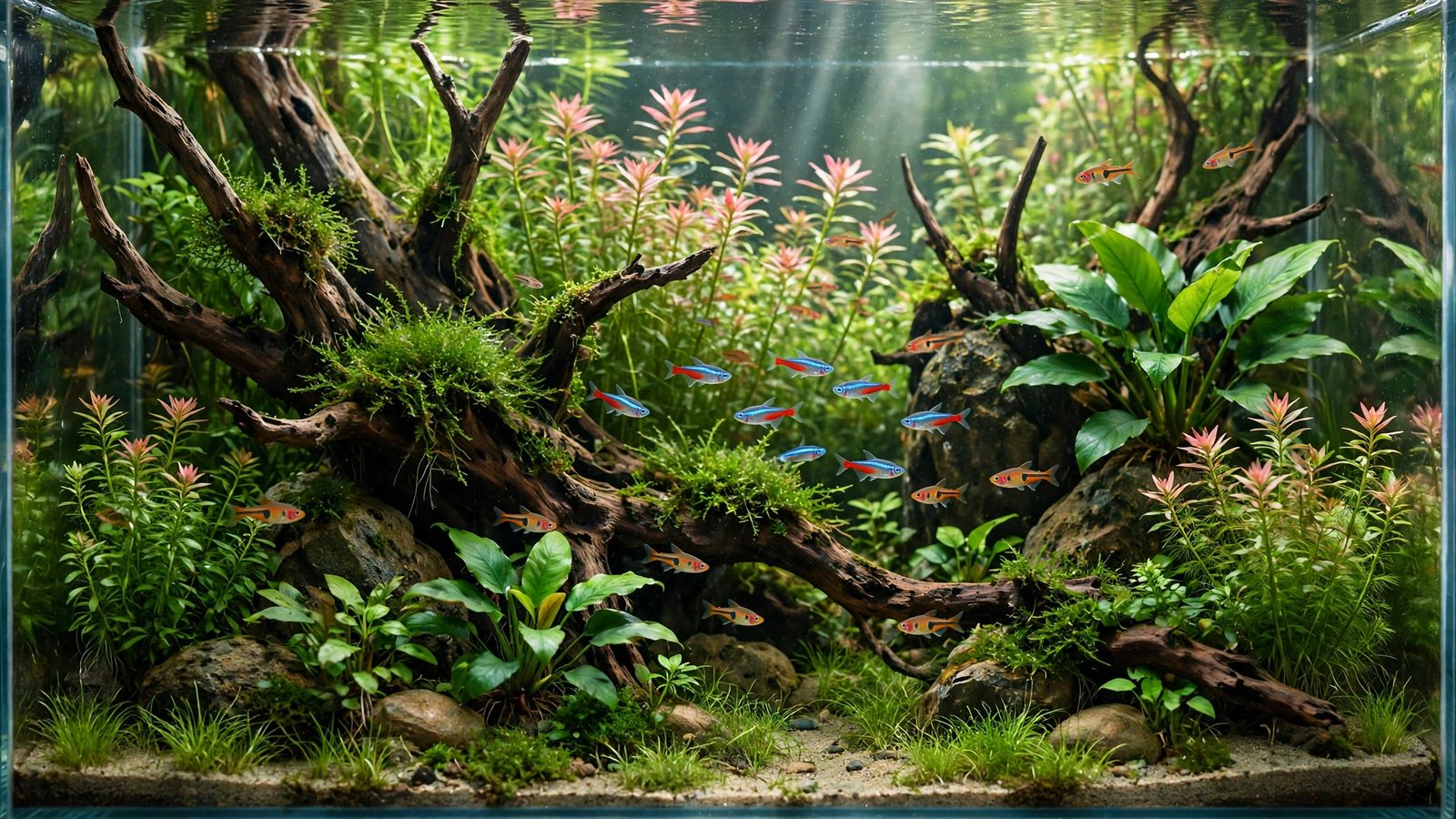
The best fish for aquascape layouts aren't just compatible with plants — they complete the composition. A school of cardinal tetras drifting through an Nature Aquarium style forest, or a tight shoal of rummy nose tetras patrolling a minimalist stone arrangement, turns a pretty planted tank into a living picture — the same philosophy on display in ADA's Nature Aquarium gallery. Choose wrong, and the same fish will shred leaves, uproot carpet, or scatter your carefully built focal points in a week. This guide treats livestock as a design decision: which species complement your layout's scale, palette, and lines — and which ones will quietly destroy it.
Why Fish Are a Design Decision, Not Just Livestock
Aquascaping inverts ordinary fishkeeping: the layout comes first, and the fish are its finishing layer. Think of a school the way a painter thinks about a moving brushstroke — its color, size, and movement pattern either reinforce your composition or fight it. One large school of a single species reads as one graceful "river" of motion; a mixed bag of colorful species reads as visual noise.
The practical stakes are just as real. Aquascaped tanks are often smaller, more densely planted, and more chemically delicate than ordinary community tanks. Boisterous, oversized, or digging fish damage the scape, spike bioload past what your filtration and plant mass can absorb, and stress in the high-light, high-flow environment carpets demand. Designing livestock around the layout is what separates a tank that photographs beautifully for years from one that unravels in a month.
Best Fish for Aquascape: The Checklist
Run every candidate species through these five filters. It earns a place only if it passes all five.
1. Truly plant-safe
It must not eat, chew, or rasp living plants — including tender new growth and mosses. Grazing algae off leaves is fine and helpful; the danger species are herbivores that mistake soft foliage for salad, like silver dollars and Buenos Aires tetras.
2. Non-digging and non-uprooting
Carpets anchor shallowly for months. Fish that dig, sift substrate, or barrel through the foreground rip up runners faster than they spread. This rules out most cichlids, large loaches, and goldfish by default.
3. Right-sized for the layout's scale
A 12 cm angelfish turns a 60 cm nano scape into a crowded bathtub; a 2 cm chili rasbora vanishes in a 120 cm showcase. Bonus: small fish make the hardscape look larger — tiny livestock exaggerates perceived scale.
4. Calm temperament
Fin-nippers, relentless chasers, and hyperactive dashers stress tankmates and shred the tranquil mood a good scape creates — plus they slam through delicate stems during panic bursts.
5. Compatible with your water
CO2-injected scapes run slightly acidic, soft water — ideal for most schoolers. Hard-water, high-pH rock layouts suit different species. Match the fish to the chemistry your scape creates.
Schooling Fish: The Moving Focal Point
One species schooling in numbers is the signature livestock move in aquascaping. Here are the strongest candidates and the layouts each suits best.
Cardinal tetra (Paracheirodon axelrodi)
The aquascaper's classic: iridescent blue over a deep red belly, larger and richer than the neon tetra. A school of 20–30 above a green carpet in a 90 cm+ tank is the single most reliable "wow" in the hobby. They want soft, slightly acidic water and 24–27°C — confirm exact parameters in detailed species profiles on Seriously Fish. Never keep fewer than 10, or the schooling effect dies.
Neon tetra (Paracheirodon innesi)
Smaller, hardier, and more water-tolerant than cardinals — the workhorse for beginner scapes and 10-gallon layouts. Cheaper in the numbers that make schooling spectacular. Don't mix neons and cardinals in one tank; the similarity reads as messy.
Green neon tetra (Paracheirodon simulans)
A centimeter smaller than neons, with an intense teal stripe that glows under planted-tank lighting. Built for nano scapes and dark layouts where larger tetras would overpower the scale.
Ember tetra (Hyphessobrycon amandae)
Warm ember-orange, barely 2 cm, igniting against green plants. A group of 15–25 produces a glowing amber cloud at modest cost. Exceptionally peaceful — safe with shrimplets and delicate moss.
Rummy nose tetra (Hemigrammus rhodostomus)
The tightest schooler on this list: silver bodies flashing in unison, red noses echoing red stem-plant tips for a subtle color rhyme with your planting. They demand clean, stable water and groups of 12+, but nothing moves quite like them in a 60 cm+ tank.
Harlequin rasbora (Trigonostigma heteromorpha)
Copper-orange with a black wedge marking — the classic Nature Aquarium fish. Slightly larger and bolder than ember tetras, they suit 90 cm+ layouts without dominating them.
Chili rasbora (Boraras brigittae)
At barely 2 cm, the deep-red chili rasbora delivers the highest color-impact-per-liter of any freshwater fish. A school of 15–20 belongs in 5–10 gallon scapes; they need calm water and dense cover, which a planted scape provides naturally. Pair them with the palettes in our guide to aquascaping plants for nano tanks.
Black neon tetra (Hyphessobrycon herbertaxelrodi)
For monochrome or blackwater aquascape layouts where red fish would clash: a sleek black-silver-white stripe reading like a pencil line through the composition. Hardy, schooling, dramatically underused.
Celestial pearl danio (Danio margaritatus)
Spotted like a tiny galaxy, these nano danios hover and dart rather than cruise — ideal for densely planted, layered layouts where constant cruising would look wrong. Give them cover and 8+ companions and their patterning shows fully.
Color Theory: Match Fish to Your Palette
Fish color should rhyme with the layout's palette, not compete with it. First: reds and oranges against green. Green dominates most aquascapes, and red sits opposite green on the color wheel — maximum contrast, minimum clash. Embers, chilis, and cardinals glow against a green backdrop; this pairing powers most famous Nature Aquarium photographs. The principles are covered in our aquascaping color theory guide. Second: one species, one statement. A single large school reads as a unified element; three species in small groups read as confetti. If you mix, separate them by water level — a midwater school plus a bottom shoal — so each reads as its own layer. Third: let the layout lead. Minimalist Iwagumi layouts beg for one elegant school; dense jungle-style layouts can carry bolder fish; dark hardscape makes pale or iridescent fish pop.
Bottom Dwellers and Cleanup Crews That Respect the Scape
Otocinclus catfish
The indispensable algae crew: 2–3 cm, soft-mouthed, utterly uninterested in uprooting anything. Six to ten keep leaf surfaces and glass clean. Buy them plump, supplement with blanched vegetables, and never rely on tank algae alone.
Pygmy corydoras (Corydoras pygmaeus / hastatus)
Unlike larger cories, pygmies shoal in midwater and tiptoe across the substrate without plowing it. Ten to fifteen add a second layer of motion above the carpet. Skip bigger Corydoras in carpeted tanks — they bulldoze.
Amano shrimp (Caridina multidentata)
The heavyweight algae-eating shrimp: hardy, plant-safe, and unable to breed in freshwater (no population explosions). Six to ten patrol a mid-size scape like lawnmowers, cleaning moss and hardscape without disturbing it. For shrimp-first designs, see our guide to aquascaping shrimp tanks.
Nerite snails
Relentless glass and rock cleaners that never eat healthy plants. One design caveat: females lay small white eggs on hardscape that won't hatch in freshwater but stay visible. Accept some eggs as the price of clean glass.
Centerpiece Fish for Larger Layouts
In tanks 75 cm and up, a single striking fish can anchor the composition the way a focal stone anchors the hardscape. Rules: one centerpiece per tank, peaceful, and too slow or small-mouthed to eat your schoolers or shrimplets.
- Honey gourami (Trichogaster chuna): warm amber, 5–7 cm, gentle and deliberate. One of the few gouramis genuinely trustworthy with shrimp.
- Pearl gourami (Trichogaster leerii): elegant spotted patterning up to 10 cm; best in 100 cm+ tanks where its unhurried cruising reads as stately.
- Betta (Betta splendens): a single male is a legitimate centerpiece in a planted 10–20 gallon scape — flowing fins against structured planting is a striking contrast. Keep tankmates minimal and avoid fin-nippers. Our aquascaping betta tanks guide covers compatible layouts.
- German blue ram (Mikrogeophagus ramirezi): a jewel-toned dwarf cichlid, 5–7 cm, that holds a small territory without digging craters. Needs warmth (27–29°C); a bonded pair over a carpeted foreground is a classic contest-tank move.
Species to Avoid in Aquascaped Tanks
Some fish are incompatible with aquascaping no matter how beautiful they are.
- Goldfish and koi: eat soft plants, uproot the rest, and produce bioload no planted filter budget survives.
- Silver dollars: will strip a planted tank to bare stems overnight.
- Buenos Aires tetras: look like big hardy tetras; chew plants like they were hired to do it.
- Most African cichlids: relentless diggers and rock-movers — a planted scape becomes a construction site within days.
- Common plecos and large loaches: grow to 30 cm+, rasp leaves, and shove hardscape.
- Tiger barbs: fin-nipping menaces in small groups, hyperactive missiles in large ones.
- Livebearer colonies: guppies and platies are plant-safe, but unchecked breeding floods the tank with fry and wrecks both water quality and the minimalist aesthetic. Keep single-sex groups if you must.
Schooling Numbers That Actually Look Good
"Six of each" is pet-store advice, not design advice. Schooling behavior and visual impact scale with group size — and small fish in big schools read as one organism.
| Tank size | Nano schoolers (chili rasbora, ember tetra) | Mid schoolers (neon, harlequin) | Large schoolers (cardinal, rummy nose) |
|---|---|---|---|
| 5–10 gal | 12–20 | 8–12 | — |
| 20 gal | 20–30 | 12–20 | 10–15 |
| 40 gal | 30–40 | 20–30 | 15–25 |
| 75 gal+ | 40+ | 30+ | 25–40 |
Below 8 fish, most "schooling" species just loiter; above 12, the choreography starts. And resist splitting your budget across species — 30 cardinals in a 40-gallon scape stops visitors in their tracks; 10 cardinals, 10 neons, and 10 glowlights do not. Small tetras and rasboras also carry a light waste load per fish, which is exactly why dense schools work in planted tanks where heavy filtration would disturb the layout.
Introducing Fish Without Wrecking the Scape
- Cycle first, always. Add livestock only after the tank is fully cycled and plants are growing — many aquascapers run a fishless dark start to establish biology before a single fish arrives.
- Plant densely before stocking. Fish feel secure in cover: tighter schooling, better color, less frantic darting through stems.
- Dim the lights for the first hours. Release the school with lights low and feed a tiny amount. First-day panic bursts are what uproot fresh carpet.
- Drip-acclimate soft-water species. Cardinals and rummy noses are sensitive to parameter swings — a 45–60 minute drip prevents losses.
- Quarantine new arrivals. One sick fish in a densely planted tank is a treatment nightmare. Two weeks in a bare quarantine tank is cheap insurance.
Once stocked, keep swimming lanes open with consistent trimming schedules so schools move without tangling in overgrown stems, and keep nitrates low with regular water changes so algae never outruns your cleanup crew.
Frequently Asked Questions
How many fish can I keep in an aquascaped 10-gallon tank?
One nano school plus a small cleanup crew: 12–15 chili rasboras or ember tetras, 4–6 otocinclus or pygmy cories, and a few Amano shrimp. That fills the water column without overwhelming filtration. Skip a centerpiece fish at this size — the school is the centerpiece, and negative space matters in livestock as much as in hardscape.
Will tetras eat my aquarium plants?
The tetras and rasboras on this list — neons, cardinals, embers, rummy noses, harlequins, chilis — do not eat healthy plants. They may pick algae or biofilm off leaf surfaces, which helps the plants. The plant-eating reputation belongs to specific herbivores like Buenos Aires tetras and silver dollars, which have no place in an aquascape regardless of how tetra-like they look.
What's the best schooling fish for an Iwagumi aquascape?
Iwagumi's minimalist stone-and-carpet aesthetic calls for one elegant, restrained school: green neon tetras or a small rummy nose group in tanks 60 cm and up, ember tetras in nano Iwagumi. Avoid red-heavy species if your stone has warm tones — the goal is harmony, not a fireworks show. Let the school be the single moving element against all that stillness.
Can I keep a betta in an aquascaped tank?
Yes — a single male betta makes a stunning centerpiece in a planted 10–20 gallon scape. Choose calm tankmates only (nerite snails, Amano shrimp with dense cover), avoid fin-nippers like tiger barbs or serpae tetras, and skip strong current since long fins fight flow. Heavily planted layouts suit bettas well because they break sightlines and offer surface resting spots.
Should I add fish before or after the aquascape fills in?
After. Stock once the tank is cycled and plants are established — typically 3–6 weeks in. Early on, carpets haven't rooted and stems pull out easily; a startled school can undo planting work in minutes. The wait also confirms your CO2 and dosing are stable, so livestock enters a finished ecosystem rather than a construction zone.
Stock for the Scape You Built
The best fish for aquascaped tanks share a simple profile: small, peaceful, plant-safe, and kept in numbers large enough to move as one. Start with a single generous school of one species matched to your layout's palette and scale, add a quiet cleanup crew for the substrate, and — only in larger tanks — consider one calm centerpiece. Treat livestock as the final brushstroke of your composition, and your aquascape won't just look alive. It will look intentional, from the first stone to the last tetra.