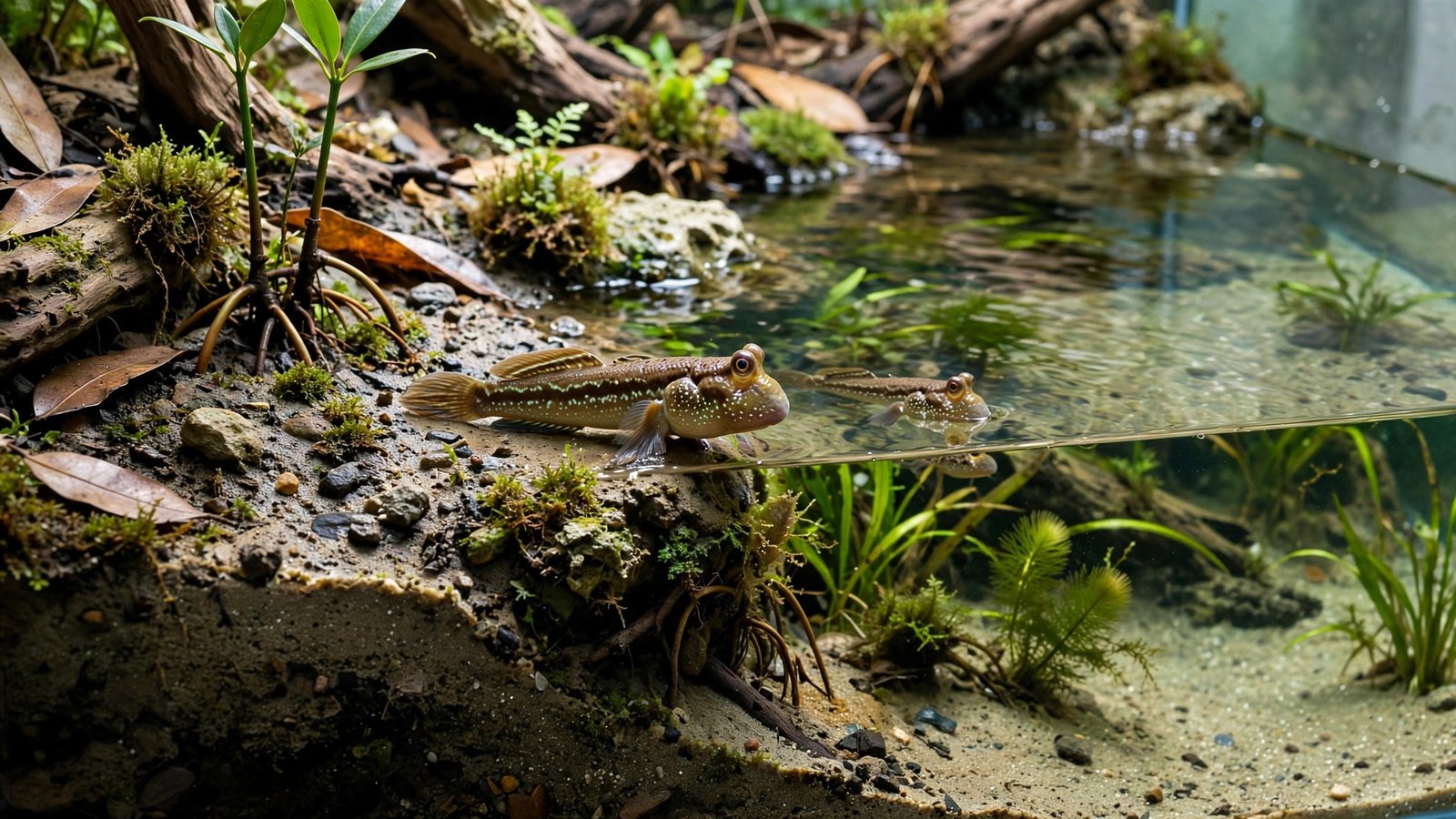
Most mudskippers fail in home aquariums for the same reason: a fully flooded tank. These fish live mostly out of water on mangrove mud banks, so a glass box of salt water is not a habitat — it is a problem with a filter. A proper mudskipper tank setup is closer to building a tiny estuary: exposed land, burrowable sand, humid air, shallow water to dip into.
How do you set up a mudskipper tank? Fill a wide tank one-third to half full with brackish water at SG 1.005–1.015 (marine salt, never tonic salt), then build sloped banks of fine sand or mud so 50–60% of the footprint is exposed land. Add raised shelves, a sealed escape-proof lid, gentle filtration, and only salt-tolerant decor — one male per small tank.
Why a mudskipper tank setup breaks the planted-tank rules
If you have scaped freshwater planted tanks, almost every instinct you bring here is wrong — starting with the substrate. The comparison of the best substrates for planted tanks shows why aquasoil wins for submerged plants; a mudskipper bank is the opposite job. The substrate must hold a burrow in open air and stay soft on bellies — so fine sand or estuary mud — never aquasoil (it crumbles and leaches nutrients into shallow water) and never gravel (coarse grains collapse into tunnels and trap diggers). The tunnel test settles any candidate: pack it damp, push a finger through — if the channel holds, it works. A guide to Seachem Onyx Sand is worth a skim; darker sand also shows off the fish better.
Tank size, shape, and the land-water math
Footprint beats volume. A 20-gallon long suits dwarf Indian mudskippers (~6.5 cm); the larger Atlantic mudskipper (up to 15 cm) wants at least a 120 × 30 cm footprint. Plan zones, not decor: a sloped beach, dry perches, and a deeper pocket (≥10 cm) for submersion, heater, and filter intake.
| Species | Minimum tank | Water depth | Land target |
|---|---|---|---|
| Dwarf Indian mudskipper | 20-gallon long | 10–15 cm | ≥50% bank + shelf |
| Atlantic mudskipper | 40-gallon breeder | 12–18 cm | ~60% bank + terraces |
| Multi-fish colony | 75-gallon+, long | 15–20 cm | 60%+ with multiple perches |
Building the land side: sand banks and raised terraces
The bank is the load-bearing structure of the build. Pile rinsed sand against one end, sloping from the waterline to 10–15 cm above it, and pack it firmly while damp — dry, loose sand slumps the first time a mudskipper digs. A hidden egg-crate skeleton under the slope keeps the bank from creeping into the water. Raised shelves multiply usable land: acrylic platforms fixed above the waterline give dry perches without stealing floor space, using the same aquarium-safe silicone techniques used for hardscape — cure 48 hours minimum before adding salt water. For rock terraces, use dense inert stone like slate or basalt; a guide to elephant skin stone shows how to stack stable steps. Press and twist every stone by hand: if it wobbles for you, a leaping mudskipper will move it.
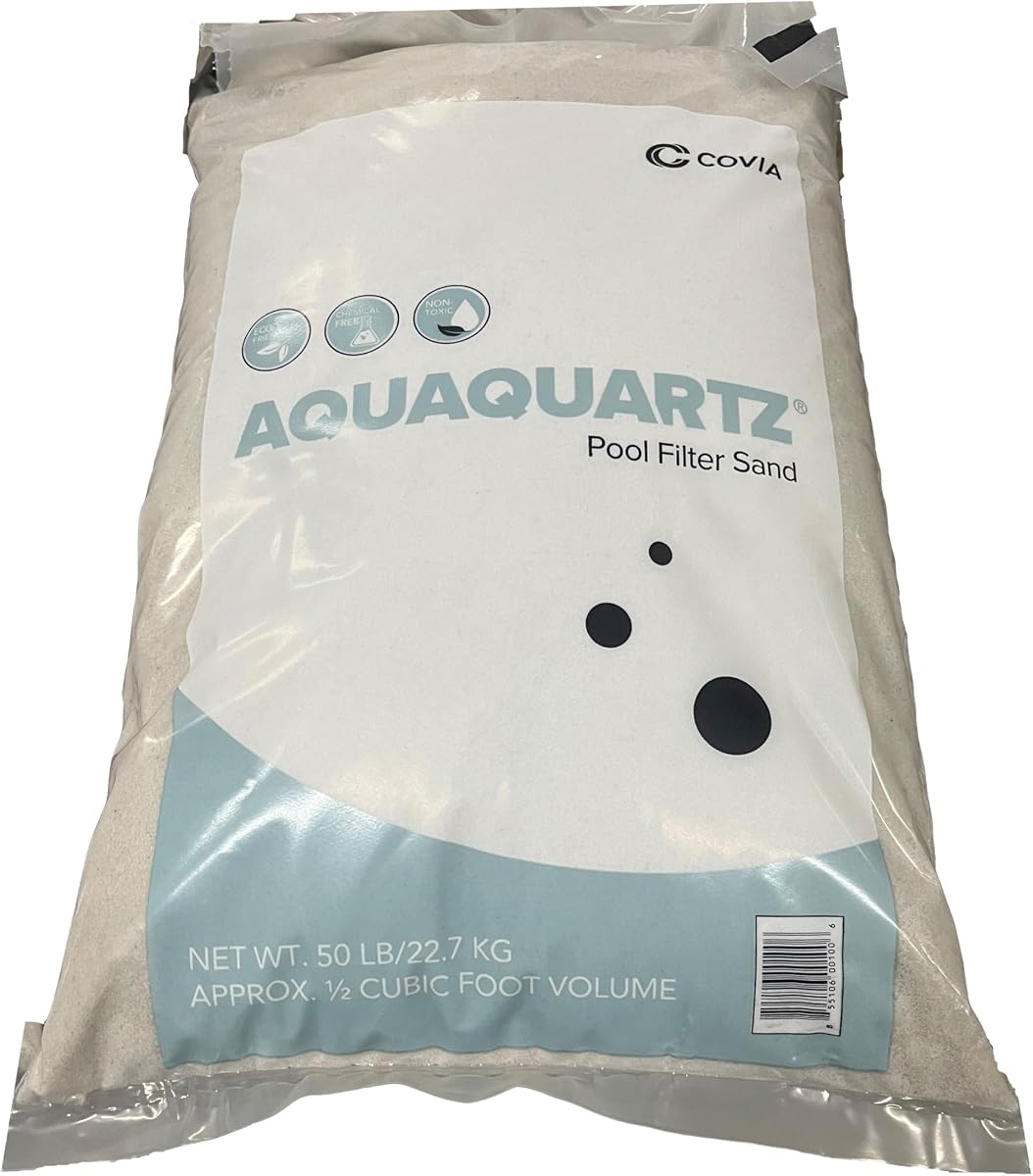
Covia AquaQuartz Pool Filter Sand
Check Price on AmazonBrackish water, mixed honestly
This is the most faked part of amateur mudskipper advice. You need a marine salt mix — the reef-aquarium kind, carrying seawater's full mineral profile. Tonic salt is not a substitute: it lacks the buffering minerals. Practical Fishkeeping's guide to brackish water makes the same distinction, and the long-running Mudskipper FAQ on WetWebMedia converges on SG 1.005–1.015; aim for 1.008–1.012, measured with a hydrometer or refractometer, never guessed from scoops. Premix in a bucket, aerate, verify, then add. Shift salinity gradually — filter bacteria dislike sudden swings. Evaporation concentrates salt, so top up with fresh water only, and run 25% weekly changes with pre-matched SG.
Hardscape in salt: what rots and what lasts
The honesty most brackish guides gloss over: driftwood rots in brackish water. Wood that survives years in freshwater softens and fouls shallow water far faster in salt. A comparison of mopani and Malaysian driftwood helps you understand wood density and tannins, but neither type gets a longevity exemption — dense woods rot slower, not never. Better: rock terraces, high-fired ceramic, or resin mangrove roots (hollow, light, made for reptile and brackish setups). Resin wood is the sleeper pick — the root silhouette without the rot. One rule for everything: no sharp edges, since mudskippers launch onto perches constantly.
Salt-tolerant plants that actually survive
Salt kills almost every freshwater plant; the survivors worth naming are java fern, anubias, and red mangrove propagules — the short list hobby sources repeat because these have survived real brackish builds. The fish-first guide to aquarium plants for fish tanks covers how java fern and anubias work as epiphytes: tie them to rock or resin wood, never bury the rhizome, or they rot regardless of salinity. Red mangrove is the statement plant — a propagule with its base in water throws out arching roots and a leafy crown. Know the cost: a thriving mangrove can outgrow a 20-long in a year. For the rest, resin or silk plants on the land side give greenery the salt cannot kill.
Stocking rules: one male per small tank
Mudskippers are territorial in a way that surprises first-time keepers: males claim perches and burrow entrances and defend them with open-mouth displays that escalate into real fights. The conservative rule: one male per small tank — one male with two or three females fits a 20-long; larger colonies need 75 gallons or more with sight-line breaks. Keep tankmates minimal; anything that fits in a mudskipper's mouth eventually will. Feed on the bank — bloodworm, brine shrimp, crickets, or chopped earthworm on a flat rock at the same time daily. They learn the routine fast, and most keepers are hand-feeding within weeks.
Frequently Asked Questions
What salinity should a mudskipper tank be?
Aim for SG 1.005–1.015 (1.008–1.012 is the sweet spot). Mix with true marine salt, never tonic salt, and measure with a hydrometer or refractometer — never guess. Change salinity gradually to protect filter bacteria, and top up evaporation with fresh dechlorinated water only, since evaporation leaves the salt behind.
Can I use aquasoil or gravel instead of sand?
No — a classic mistake. Aquasoil softens and crumbles above the waterline and leaches nutrients into shallow water, fueling algae. Gravel collapses into burrow tunnels and can trap digging fish. Fine sand or estuary mud, packed damp to 5–8 cm deep, holds tunnels and matches what mudskippers dig in the wild.
Do mudskippers really need dry land?
Yes — a lot of it. Wild mudskippers spend most of their time out of water on mud flats, feeding, displaying, and breathing humid air. A single log is no substitute. Build 50–60% of the footprint as exposed land: sloped sand banks plus raised shelves or terraces they can haul out onto.
How many mudskippers can I keep together?
One male per small tank — males are fiercely territorial and fight over perches and burrows. A 20-gallon long holds one male with two or three females; larger groups need 75 gallons or more with multiple shelves and rock piles per territory. Constant chasing or torn fins means the group is too big for the tank.
Can mudskippers live in full freshwater or seawater?
They tolerate both briefly — wild fish handle tidal swings daily — but long-term freshwater weakens immunity and invites fungal issues, while full seawater is harsher than their estuary habitat. Brackish water at SG 1.005–1.015 is where they thrive, and it keeps salt-tolerant plants viable.
A mudskipper tank setup asks for carpentry more than aquascaping: sand packed like mortar, shelves siliconed like shelving, a lid engineered like a lock. Do it honestly and you get a fish that greets you at the glass. Build the beach, seal the lid, enjoy the show.