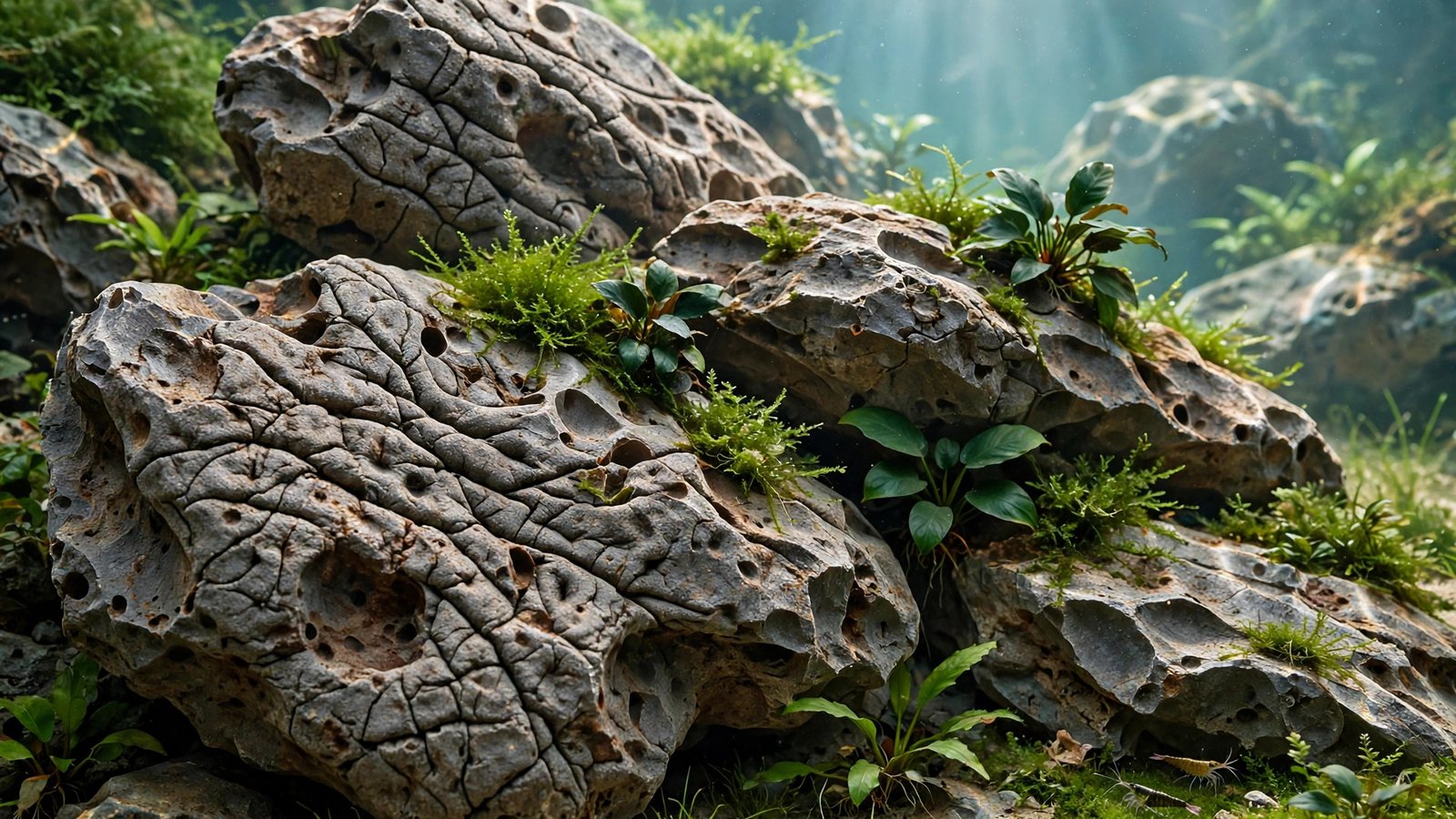
Run your fingers over a piece of elephant skin stone and the name makes instant sense — wrinkles, folds, and dimples, like the hide of an old pachyderm rendered in rock. Here is the homework to do before it goes in your tank.
Elephant skin stone is a naturally weathered dolomitic limestone whose wrinkled, leathery surface comes from years of water and wind erosion. Sold in gray and white varieties, it anchors mosses and epiphytes in its dimpled surfaces and has edges smooth enough for long-finned fish. It can slightly alter water parameters, so soak-and-test each batch for 3–5 days before adding it to sensitive setups. Dolomite's density averages around 2.85 g/cm³, so a fist-sized piece feels noticeably weightier than dragon stone of the same size.
The wrinkled look: how to identify it
No other common aquarium stone looks like this, and that is the identification test. Elephant skin stone's defining feature is its all-over wrinkled texture — undulating folds, shallow grooves, and round natural dimples that read exactly like elephant skin. The larger the piece, the more weathering and texture it carries, so the biggest rocks are usually the most dramatic.
Color tells you the variety, not the authenticity: gray ranges from charcoal to medium gray, white is an off-white with the same grooves, and some batches carry reddish-brown tints from oxidized iron. Against seiryu's sharp layered plates and dragon stone's golden-brown holes, it is denser, smoother, and wrinkled rather than veined or pocked. Our seiryu stone guide and the dragon stone profile make good comparison reading.
Elephant skin stone vs the classics
| Feature | Elephant skin stone | Seiryu stone | Dragon stone (ohko) |
|---|---|---|---|
| Texture | Wrinkled, leathery, dimpled | Sharp, layered, ridged | Pocked with holes |
| Color | Gray or off-white | Blue-gray with white veining | Golden-brown |
| Edge safety | Smooth; safe for long-finned fish | Sharp; handle with care | Rough but rounded |
| Water chemistry | May raise pH, GH, KH slightly | Raises pH, GH, KH | Inert |
| Weight | Heavy (dolomite ~2.85 g/cm³) | Heavy | Light |
| Best for | Weathered iwagumi, moss pockets | Crisp iwagumi mountainscapes | Jungle layouts, epiphytes |
Testing this stone for pH and hardness
Honest answer first: this stone is not guaranteed pH-inert. As a dolomitic limestone — calcium magnesium carbonate — it can nudge pH, GH, or KH upward, especially in soft, low-buffered water. Retailers flag exactly this: it has "the potential to alter water parameters slightly." Never treat a stranger's test result as a promise about your rock.
The quick screen is the vinegar test: drip plain white vinegar on the surface and watch for a full minute. Vigorous fizzing means the piece will raise hardness and pH; no fizz is the best outcome. Then soak-and-test — submerge the stone in your tank water for 3–5 days and compare pH, GH, and KH against a control bucket.
Pairing matters too. If your test shows a mild hardness lift, aquasoils that pair well with stone hardscapes can buffer the water column back down — see the best substrate for planted tanks to plan rock and substrate as a system.
Iwagumi contrast: how it differs from seiryu
Seiryu is the default iwagumi rock — sharp, layered, blue-gray plates that read as crisp mountain ridges. Elephant skin stone plays the opposite role: ancient and rounded, more boulder than cliff face, creating drama through texture rather than edges.
A single large gray piece as the odaishi (main stone) with smaller wrinkled fukuseki reads as an eroded rock outcrop, and the white variety brightens a dark aquasoil bed in a way seiryu's blue-gray cannot. See how dragon stone and seiryu compare; frodo stone sits closer to the seiryu end of the texture spectrum.
One practical note: this stone is heavy and rounded, so it settles firmly into substrate rather than balancing on sharp feet. Slope your soil toward the back and nest each stone a third of its height into the bed — it will hold position even under a strong water-change pour.
Planting into the crevices
This is where elephant skin stone earns its place. The dimples dotting its surface hold planting naturally — moss tufts, Anubias rhizomes, and Bucephalandra crowns wedge in so securely that a dab of cyanoacrylate gel or a loop of cotton thread is all the attachment you need.
Keep rhizome plants above the stone: tuck the rhizome into a shallow groove with only the roots touching, so it never rots. Shrimp will graze these planted pockets constantly, and the smooth edges mean even long-finned bettas can weave through without torn fins.
Cleaning and long-term maintenance
Rinse every piece thoroughly before first use to strip quarry dust and loose sediment — dolomite dust is alkaline and you do not want it clouding your tank. Follow with a 24-hour soak, which doubles as your pH screening.
In an established tank, algae treats the wrinkles like shelter. A soft brush follows the folds well for weekly spot-cleaning; avoid metal scrapers, which gouge the surface and expose fresher, more reactive rock. Never boil the stone, and never rest a heavy piece on the bare tank bottom or lean it against the glass — set every stone on at least an inch of substrate.
Frequently Asked Questions
Is elephant skin stone safe for aquariums?
Yes, with one check. It is a natural weathered dolomite with smooth edges safe for delicate fish and shrimp. Its one caveat is chemistry: it can slightly raise pH, GH, or KH, so soak-and-test for 3–5 days before adding it to sensitive setups like caridina shrimp tanks.
Will elephant skin stone raise my pH?
It can, but results vary by piece and batch. As a dolomitic limestone, it may leach carbonate and nudge pH, GH, or KH upward in soft, poorly buffered water. A vinegar fizz test gives a quick read, and a soak-and-test measures the real effect before livestock is at risk.
What is the difference between gray and white elephant skin stone?
Mainly color, not composition. Gray is the classic variety — often larger, with heavier weathering. White elephant skin stone is an off-white, slightly smoother variety that brightens a dark aquasoil bed and contrasts with green plants. Both share the dimpled texture and the same chemistry caveats.
How do I attach plants to elephant skin stone?
Use the stone's natural dimples as planting pockets. Tuck moss tufts into dimples and secure with cotton thread or a small dab of cyanoacrylate gel. For rhizome plants like Anubias, rest the rhizome in a shallow groove with only roots touching, keeping it ventilated so it never rots.
Is it suitable for betta or shrimp tanks?
Yes. It has no sharp edges, so long-finned bettas will not tear fins exploring it, and the dimples give shrimp endless grazing surfaces. Just complete the water-chemistry test first — a reactive piece can push pH beyond what soft-water shrimp tolerate.
How should I clean elephant skin stone?
Rinse thoroughly before first use to remove quarry dust. In an established tank, scrub the wrinkles with a soft brush during water changes. Avoid metal tools that gouge the surface, and never boil the stone — temperature shock can crack dense rock. Lift the piece out to treat stubborn algae in dimples.
Where to buy and what to look for
Elephant skin stone is sold by weight at specialist hardscape retailers. Browse Buce Plant's elephant skin stone listing for the gray variety and their white elephant skin stone page for the paler option; prices typically run about $25 for a 5 lb bag up to about $150 for 30 lb. Wet each piece before judging its color, and pick pieces whose wrinkles run in a consistent direction.