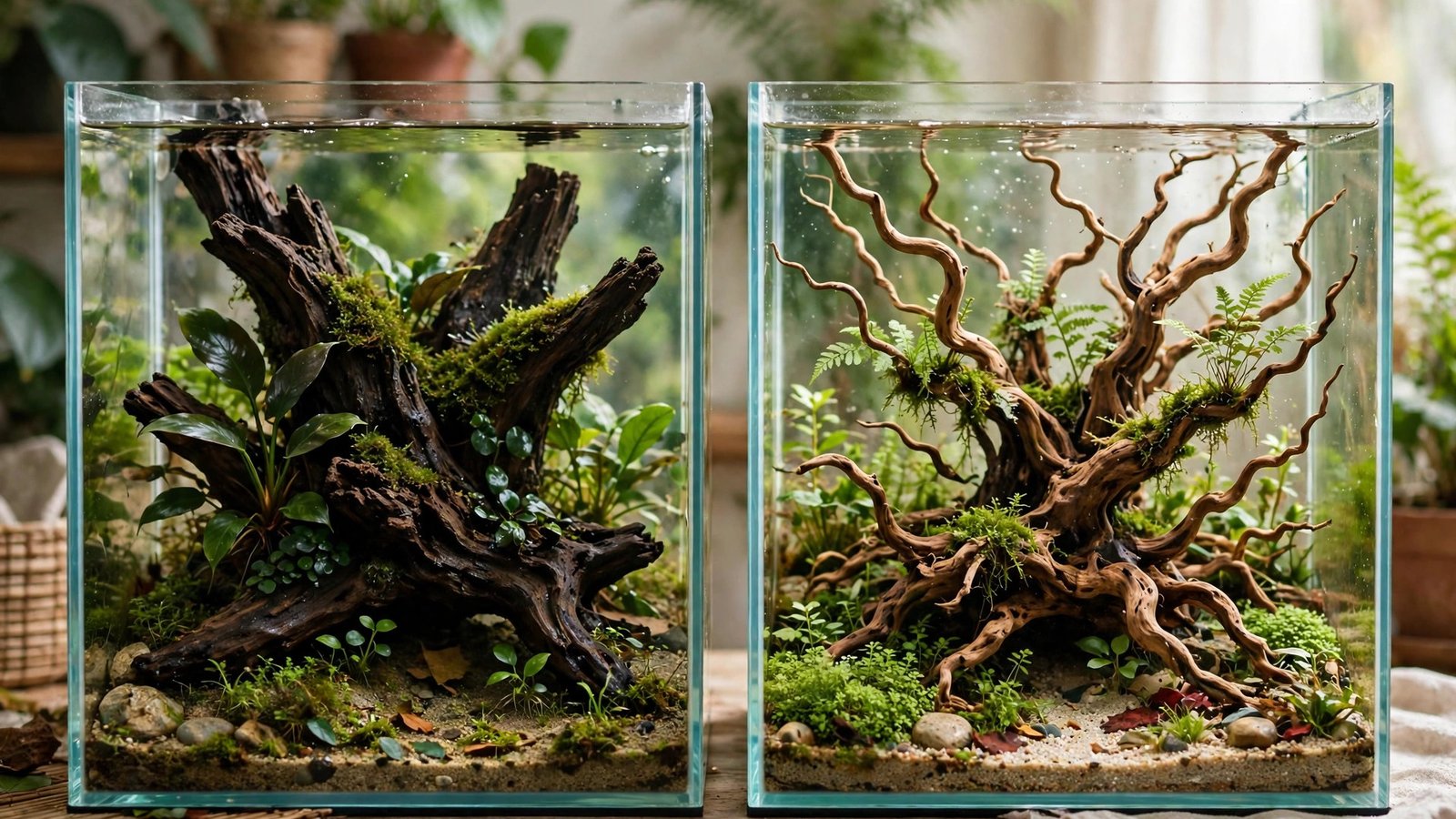
Walk into any aquascaping shop and you'll find two woods dominating the shelves: the knotted, two-tone blocks of mopani and the pale, branchy sticks of Malaysian driftwood. Ask five hobbyists which is better for a planted tank and you'll get seven opinions — usually about mopani vs malaysian driftwood tannin stains and sinking problems. This head-to-head settles it: after comparing tannin load, sinking speed, prep time, longevity, look, and price, there's a clear winner for most planted tanks — and a clear case for the other in blackwater biotopes. If you're building a planted layout, read our freshwater aquarium plants complete guide to match your hardscape to the right species.
Mopani vs Malaysian Driftwood: The Head-to-Head Comparison
Before the details, here's the quick verdict table. Pick your row, then read the section that matters most to your tank.
| Factor | Mopani driftwood | Malaysian driftwood | Winner |
|---|---|---|---|
| Tannin load & duration | Heavy — deep tea color for 2–6 months | Light — mild tint for 1–3 weeks | Malaysian (for clear water) |
| Sinking speed | Sinks immediately in most cases | Sinks immediately; thin ends may need 2–5 days | Tie |
| Prep time | 2–4 weeks soaking + multiple water changes | 3–7 days soaking, boil if it fits | Malaysian |
| Appearance | Dramatic two-tone knots, chunky blocks | Natural branchy fingers, weathered gray-brown | Style-dependent |
| Longevity | Extremely hard; 7–10+ years, essentially rot-proof | Very hard; 5–8+ years | Mopani |
| pH effect | Moderate softening (0.2–0.5) while leaching | Mild softening (0.1–0.3) while leaching | Malaysian (more neutral) |
| Price (typical) | $12–25 per piece | $10–20 per piece | Malaysian (slightly) |
| White fungus risk | Moderate — common on fresh pieces | Low — less surface biofilm | Malaysian |
Where Each Wood Comes From (and Why It Matters)
Mopani driftwood is cut from the mopane tree (Colophospermum mopane), a legume-family hardwood of southern African savannas — one of the continent's hardest timbers, which you can confirm on Wikipedia's mopane entry. That extreme density is why mopani sinks instantly and why it resists decay for a decade underwater. The two-tone cream-and-dark-brown grain is the wood's signature — no other aquarium wood looks quite like it.
Malaysian driftwood, by contrast, is a dense tropical hardwood harvested in Malaysian forests, sold in its natural branchy shapes: long fingers, Y-forks, and twisting roots. It's slightly less dense than mopani and holds less pigment, which is exactly why it's the friendlier option for planted tanks — less tannin means less work before the water stays clear.
Our deep dive on the single-species details lives at Mopani Wood: Tannins, Sinking & Prep if you want the full mopani-only rundown.
Tannins: The Biggest Real Difference
Here's the honest truth most product listings skip: mopani is a tannin factory. A single medium piece can stain a 20-gallon tank the color of strong tea for months, even after boiling. Malaysian driftwood tints the water too, but it's a fraction of the load — usually gone within a couple of water changes.
Are tannins bad? Not at all — they're actually beneficial for many fish, softening water slightly and adding antifungal properties. Read Driftwood Tannins: Benefits, Removal & Timeline for the full chemistry. But in a planted display tank where you want to admire your Rotala reds, mopani's months-long brown haze is a genuine frustration. If you're running a low-tech planted tank, tannins are easy to live with — see low-tech planted tank setup for a forgiving build that pairs well with either wood — but for ADA-style clarity, Malaysian wins outright.
Sinking Speed and Prep: What Each Demands of You
Both woods are famously sinkable — they're among the fastest-sinking driftwood types you can buy. Mopani's density means it almost never floats; you can place it straight into a scape and anchor your plants the same day. Malaysian is nearly as reliable, though paper-thin branch tips can bob for a few days until waterlogged.
Prep is where they diverge sharply. A proper driftwood prep routine for Malaysian takes 3–7 days of soaking (boil it for an hour or two if it fits your pot and you'll halve that). Mopani needs a real commitment: 2–4 weeks of soaking with water changes every couple of days, and even then it may still leach. Buy mopani a month before your build if you want a clean start.
Look, Longevity, and Which Tank Each Suits
Aesthetically they're opposites. Mopani is sculpture wood: massive knotted blocks with dramatic two-tone grain that anchors a layout like a rock formation. It suits biotope and cichlid tanks, jungle val layouts, and any scape where the wood is the centerpiece. Malaysian is branch wood: delicate fingers that reach into the water column, perfect for attaching mosses and Anubias, for spider-web scapes, and for that weathered riverbed look. For the full range of options, compare both against the 8 best driftwood types for aquascaping.
On longevity, both are excellent — but mopani is the tank wood. Its ironwood-grade density means a mopani centerpiece will outlast the aquasoil under it, easily 7–10 years. Malaysian runs 5–8 years before softening, still superb. At $10–25 per piece, either is one of the cheapest long-term hardscape investments you can make — grab a few mopani blocks or a bundle of Malaysian branches from your LFS or a reputable online retailer and dry-test your layout before the water goes in.
If you're choosing between two branchy woods instead, our spider wood vs manzanita comparison covers the other classic matchup.
Frequently Asked Questions
Does mopani or Malaysian driftwood sink faster?
Mopani wins by a hair — its higher density means it sinks immediately in nearly all cases. Malaysian sinks immediately too, though thin branch tips can float for 2–5 days until fully waterlogged. Compared to spider wood or manzanita (which can take weeks), both are excellent.
Which leaches more tannins, mopani or Malaysian?
Mopani leaches dramatically more — expect visible tea-colored water for 2–6 months even after boiling. Malaysian driftwood's tannin load is light and typically clears within 1–3 weeks of water changes. If crystal-clear water matters to you, Malaysian is the clear choice.
Can I use mopani driftwood in a planted tank?
Yes — mopani is completely plant-safe and its slow pH softening suits most plants. The only real issue is the heavy tannin leaching, which dims light penetration for a few months. Soak it 2–4 weeks before planting, and consider Purigen in the filter to keep the water clear while the wood seasons.
Is Malaysian driftwood safe for shrimp and bettas?
Yes, with a short soak first. Malaysian's mild tannin release causes only small, gradual pH shifts that shrimp and bettas tolerate well. Avoid dropping it fresh into a tank with sensitive caridina shrimp — a 3–7 day soak with a couple of water changes is enough prep.
Which lasts longer underwater?
Mopani lasts longer — its ironwood-grade density resists decay for 7–10+ years submerged. Malaysian is also very durable at 5–8+ years. Both far outlast softwoods, so either is a solid long-term hardscape investment for a planted tank.
The bottom line: choose Malaysian driftwood for most planted tanks — faster prep, milder tannins, natural branchy shapes that show off epiphytes. Choose mopani when you want a sculptural centerpiece, maximum longevity, or a genuine blackwater look where the tannins are the point, not the problem. Whichever you pick, prep it properly, and your scape will look better on day one and stay beautiful for years.