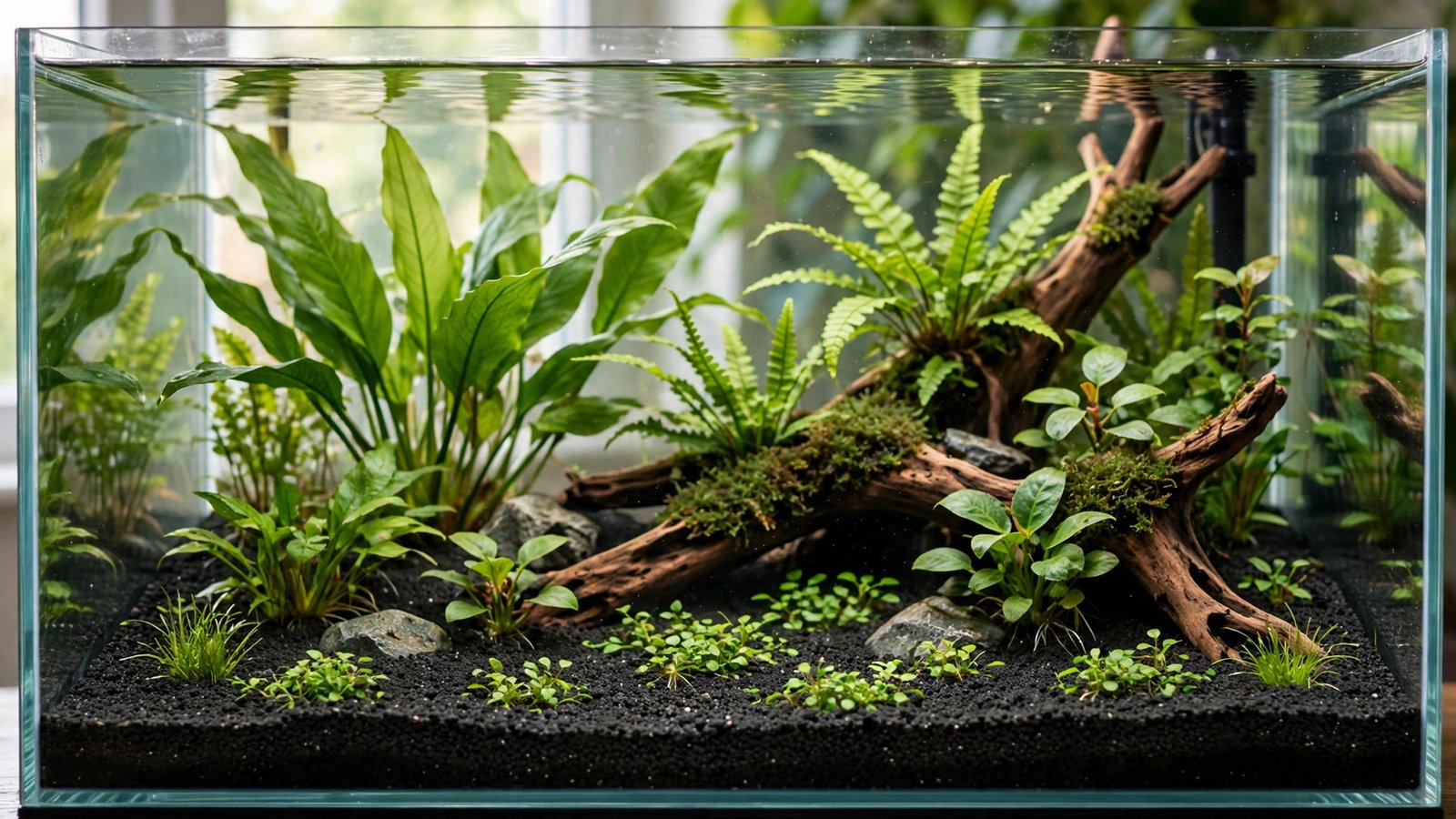
The most expensive substrate mistake is not buying the wrong bag — it is buying the right brand and assuming it does nothing to your water. If you are considering Seachem Onyx Sand for a planted tank, know this first: it is carbonate-rich, so it buffers your water upward — the single fact that decides whether it becomes your best substrate or the reason your shrimp stop breeding.
What Seachem Onyx Sand Actually Is
Onyx Sand is Seachem's dark, fine-grain mineral sand for planted freshwater aquariums. It is not a soil and not a coated gravel: it is a natural, untreated sand Seachem describes as carbonate-rich. Its published mineral analysis lists calcium and magnesium as the dominant minerals — which is why it supports carbonate hardness (KH) instead of depleting it like buffering aquasoils.
Seachem states on the official Onyx Sand product page that its slight buffering capacity may raise pH by 0.1 to 0.5 units depending on source water; it never needs replacing and needs no laterite or modifiers. The independent UKAPS guide to substrates confirms the same picture, noting the pH shift and a rise in general hardness (GH) alongside KH.
The pH Surprise Nobody Warns You About
A substrate that raises pH is not a flaw — it is a feature for a specific audience — but it rules out certain tanks. With hard, alkaline tap water, a 0.1–0.5 unit lift is a footnote, and the extra buffering can steady water against CO₂-driven pH swings. With a blackwater biotope, Caridina shrimp needing soft acidic water, or discus at low pH, Onyx Sand works against you from day one.
Carbonates dissolve slowly into the water, raising KH, and higher KH holds pH higher. The rise is mild — nowhere near limestone territory — but it is the single most important buying criterion for this product.
Onyx Sand vs Seachem Flourite: the Honest Comparison
Between Seachem's two classic planted substrates, the decision is one word: carbonates. Seachem Flourite is an iron-rich porous clay gravel that is effectively pH-neutral. Onyx Sand is carbonate-rich and nudges pH and KH upward. Everything else follows from that.
| Onyx Sand | Flourite | |
|---|---|---|
| Texture | Fine natural sand | Coarse clay gravel (~2–5 mm) |
| Chemistry | Carbonate-rich; may raise pH 0.1–0.5 | Iron-rich; pH-neutral |
| KH effect | Supports/raises KH | None |
| Look | Dark gray, smooth | Brown-red, rougher |
| Lifespan | Permanent | Permanent |
Pick Onyx Sand for dark contrast when your water can take the pH lift; pick Flourite when your substrate must stay chemically invisible. Both are permanent structural substrates, not nutrient bombs.
Who Onyx Sand Is Actually For
Three scenarios: hard-water planted setups, where mild carbonate buffering is a feature and you never fight the substrate; African cichlid tanks with plants, where the dark bed and high-pH support match the Rift Lake look; and aquascapers chasing dark contrast, since a near-black bed makes green foliage look greener.
If you want the whole field of sand options side by side rather than this deep dive, our roundup of the best sand for planted aquariums covers the alternatives in one place.
Setting It Up Without the Cloudy Mess
Seachem ships Onyx Sand pre-washed but says plainly it can get dusty in transit and needs rinsing — follow that, because skipping the rinse is the top cause of cloudy tanks. Rinse in a bucket in small batches, swirling and pouring off milky water until it runs mostly clear.
Then use Seachem's fill method: lay 5–8 cm of sand, place a bowl on the bed, and pour water into the bowl so it overflows softly onto the sand. Initial cloudiness is normal; run filter floss as mechanical filtration and expect clear water within a day or so.
Cost honesty: bags come in 3.5 kg and 7 kg, and a 3.5 kg bag covers roughly a 2 cm layer in a standard 10-gallon (40 L) tank. A typical 20-gallon at 5–6 cm needs about three 3.5 kg bags or two 7 kg bags — a one-time cost, since it never depletes.
Planting in Fine Sand: Technique Matters
The fine grain demands better technique than gravel. Using long tweezers, push each stem 3–5 cm deep, angling as you withdraw so sand falls back around it. Plant densely from day one — bare sand invites algae.
One honest quirk: detritus sits on top of fine sand instead of falling between grains — convenient, since hovering your vacuum just above the surface lifts waste without disturbing the bed. Some aquarists use Onyx Sand as a cap over nutrient-rich soil; our guide to capping aquarium soil with sand covers the technique. And because Onyx is a mineral substrate, not a fertilizer, heavy root feeders like swords and crypts appreciate a root tab at their crown.
Long-Term Care: What a Permanent Substrate Asks of You
Once established, Onyx Sand asks little: no breakdown and the dark color hides algae and detritus. The routine is ordinary — surface-vacuum during water changes, refresh root tabs every few months, replant as stems grow.
One realistic expectation: the carbonate buffering does not run out like an aquasoil's buffering does. For hard-water keepers that is the appeal: stable, permanent. Converting to a soft-water setup later means removing the substrate entirely. Decide your water strategy before you buy.
Frequently Asked Questions
Does Seachem Onyx Sand raise pH?
Yes. It is carbonate-rich, and Seachem states it can raise pH by 0.1–0.5 units depending on source water, while supporting KH. The effect is mild but real — good for hard-water setups, a genuine drawback for blackwater systems or Caridina shrimp colonies.
Do I need to rinse Onyx Sand before using it?
Yes. Seachem ships it pre-washed but explicitly advises rinsing, since a natural product picks up dust in transit. Rinse in small batches until the water runs mostly clear. Skipping this is the most common cause of cloudiness at fill time.
Can you cap aquasoil with Onyx Sand?
You can — the aquasoil feeds roots while the sand gives a dark finish and holds everything down. Note the clash: buffering aquasoils pull pH down while Onyx pushes it up, so skip this pairing in very-low-pH tanks or shrimp setups demanding stability.
Is Onyx Sand safe for corydoras?
Yes. The grain is fine and smooth, far gentler on barbels than sharp gravels like Flourite. Corydoras and loaches do well on it, though the dark bed shows uneaten food clearly — feed carefully and surface-vacuum regularly to keep waste from rotting in the bed.
How much Onyx Sand do I need?
A 3.5 kg bag covers roughly a 2 cm layer in a 10-gallon (38 L) tank. For a typical 5–6 cm planted bed, plan about three 3.5 kg bags for a 20-gallon, or use the 7 kg bags for larger tanks. Slope deeper at the back.
The Verdict
Onyx Sand is one of the most honest products in the hobby: Seachem tells you exactly what it does to your water, and whether that suits the tank you are building. For hard-water planted tanks or African cichlid aquascapes it is genuinely excellent — see also our guide to the best substrate for planted tanks. If your dream tank is soft and acidic, buy something else. For another branded substrate with very different chemistry, see our guide to JBL Manado substrate.