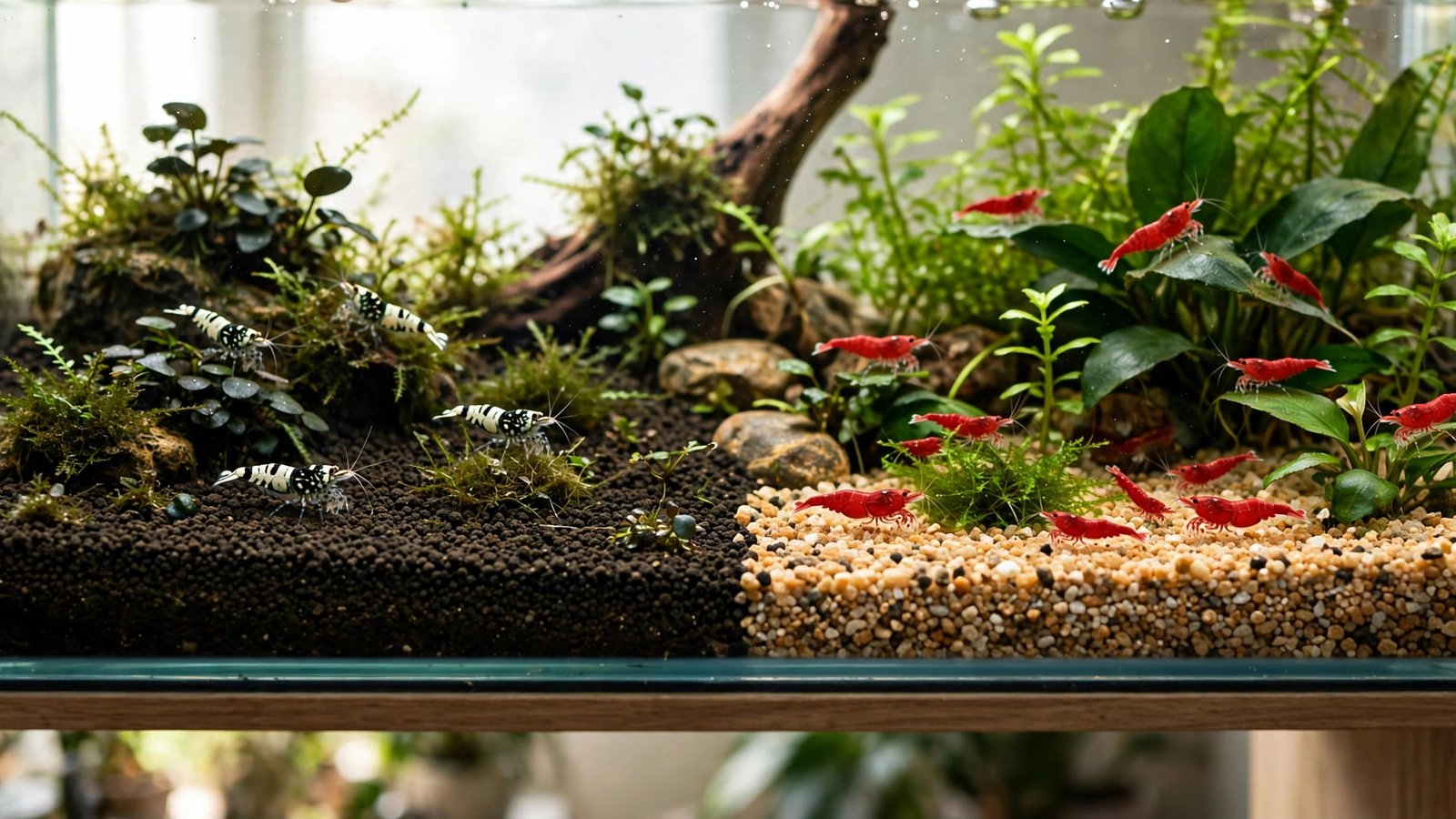
If you are setting up a tank for cherry shrimp or crystal shrimp, the substrate you pick does far more than look nice — it actively shapes your water chemistry. Finding the best substrate for shrimp tank setups comes down to one big decision: a buffering (active) substrate that pulls your pH and hardness down into the soft, acidic range, or an inert substrate that leaves your tap-water parameters untouched. Choose wrong and you will fight your water chemistry for months; choose right and the tank practically maintains itself. This guide breaks down both options, matches them to Caridina and Neocaridina species, and names the products shrimp keepers actually swear by.
Buffering vs Inert: The Core Decision
Every substrate falls into one of two camps. Buffering substrates (also called active soils) are made from baked and granulated volcanic or mineral-rich soil. They release humic acids, consume carbonate hardness (KH), and hold pH in the 5.5–6.8 range for months or years. Inert substrates — pool filter sand, fine gravel, crushed lava rock — change nothing about your water. Your parameters stay exactly what your tap or remineralized RO water provides.
Neither type is universally better. The right pick depends entirely on which shrimp you keep and what comes out of your faucet. If you want the full technical picture of how these soils work, read our guide to buffering substrates before you shop.
| Feature | Buffering (active) substrate | Inert substrate |
|---|---|---|
| Effect on pH/KH | Lowers pH, strips KH | No effect |
| Cycling | Leaches ammonia for 2–6 weeks | Ready once biofilter matures |
| Lifespan | 12–24 months of buffering, then exhausts | Indefinite |
| Best for | Caridina (crystal, Taiwan bee) | Neocaridina (cherry shrimp), cull tanks |
| Cost | $$–$$$ per bag | $–$$ |
Caridina vs Neocaridina: Different Shrimp, Different Needs
The shrimp hobby is dominated by two genera with genuinely different chemistry needs, and this is where most beginners go wrong.
Caridina (crystal shrimp, Taiwan bee)
Caridina cantonensis species — crystal reds, crystal blacks, Taiwan bees like blue bolts and king kongs — are the fussy ones. The widely used target range among experienced keepers is soft, acidic water: pH around 6.0–6.5, GH 4–6, KH 0–1. Almost nobody's tap water comes out like that, which is why Caridina tanks and buffering substrates go together like filters and water changes. The soil does the chemistry work that your tap water won't, holding pH low and KH near zero. Trying to keep Caridina on inert substrate means remineralizing reverse-osmosis water with a GH-only product and fighting pH drift manually — doable, but needlessly hard.
Neocaridina (cherry shrimp)
Neocaridina davidi — the cherry shrimp family — is famously forgiving. The standard target is neutral to slightly alkaline water: pH around 7.0–7.5, GH 6–10, moderate KH. Most tap water already falls in this range, so an inert substrate is usually the simplest choice: you keep your water as it is and the shrimp thrive. You can keep Neocaridina on active soil — many breeders do — but the soil will drag your pH down toward 6.2–6.8, which is at the low end of their comfort zone and can slow breeding.
What Makes the Best Substrate for Shrimp Tanks?
Beyond the buffering question, a shrimp-specific substrate has to satisfy a few practical demands:
- Fine grain size: Shrimp graze on biofilm that grows on substrate surfaces. Fine granules (1–3 mm) give far more surface area per liter than coarse gravel, and they keep baby shrimplets — barely 2 mm long at birth — from falling into gaps and getting trapped.
- Gentle on grazers: Sharp crushed rock can damage the delicate feeding appendages of shrimp over time. Rounded or smooth granules are safer.
- No sharp pH swings: A good substrate settles parameters and holds them steady. Stability matters more to shrimp than hitting a magic number — most shrimp deaths in new tanks trace back to fluctuating water, not slightly-off water.
- Plant compatibility: Many shrimp tanks are planted (plants harbor biofilm and absorb nitrates), so a substrate that also feeds roots is a bonus — but it's optional. Moss and epiphytes don't care what sits on the bottom.
The Best Buffering Substrates for Shrimp Tanks
These are the active soils shrimp keepers reach for again and again. They all lower pH and KH; they differ in how hard they pull, how much ammonia they leach at startup, and price.
ADA Aqua Soil Amazonia
The benchmark product — the soil every other aquasoil is compared against. Amazonia buffers strongly and reliably, and it leaches a heavy dose of ammonia for the first 3–6 weeks, which means a disciplined fishless cycle before any shrimp goes in. It also breaks down the fastest of the premium soils, typically exhausting in 12–18 months in a shrimp tank. Expensive, but the results are proven at every level of the hobby.
Fluval Stratum
The beginner-friendliest active soil. It buffers more gently than Amazonia (expect pH settling around 6.5–6.8 rather than 5.8–6.2), leaches noticeably less ammonia, and is easier to find and gentler on the wallet. Many shrimp keepers run crystal shrimp successfully on Stratum. For a side-by-side of the two big names, see our Fluval Stratum vs ADA Amazonia comparison.
Dennerle Scaper's Soil
A European favorite that sits between Amazonia and Stratum in buffering strength. Granules are durable, it leaches a moderate amount of ammonia, and it holds its structure well over time. If you want the full technical rundown, the Dennerle Scaper's Soil product page lists its composition and buffering behavior.
Brightwell Aquatics FlorinBase and UP Aqua Shrimp Sand
Worth naming because they were formulated for shrimp keepers, not adapted from planted-tank soils. Brightwell's FlorinBase lines target specific water chemistries (including a Caridina-oriented variant), and UP Aqua's Shrimp Sand comes in very fine grain that shrimplets love. Both buffer moderately and cycle in more gently than Amazonia.
Buy link for the buffering pick: UNS Controsoil.
The Best Inert Substrates for Shrimp Tanks
If you keep Neocaridina or you prefer to control chemistry entirely through your water source, inert is the way. The best choices:
- Pool filter sand: Cheap, smooth, and naturally fine-grained. Its light color makes dark shrimp (and shrimplets) easy to spot, and it vacuums cleanly. See our full breakdown in the pool filter sand guide.
- Fine aquarium sand: Slightly pricier than pool filter sand but often more uniform in grain and pre-washed.
- Small rounded gravel (2–3 mm): Heavier than sand, so it stays put under filters, and it traps less waste at the surface. Keep grains small — pea gravel is too coarse for shrimplet safety. Our complete guide to inert substrates compares every common option.
If you want rooted plants in an inert setup, that's no problem — just add root tabs under the plants and skip the active soil entirely.
Buy link for the inert pick: CaribSea Eco-Complete.
Grain Size and Depth: Details That Matter
Grain size is one of the most underrated shrimp-substrate specs. For shrimp-only or shrimp-first tanks, 1–3 mm granules are the sweet spot: fine enough that shrimplets can't get trapped, coarse enough not to compact into anaerobic mush. Powder-type soils (under 1 mm) look beautiful and grow gorgeous carpets, but they compact more easily — read our powder vs normal aquasoil guide before committing a whole tank to powder.
Depth matters less for shrimp than for planted tanks — shrimp don't root — but 3–5 cm (roughly 1.5–2 inches) gives you enough soil for stable buffering and a good biofilm farm. Deeper than 7 cm, active soil can develop anaerobic pockets; shallower than 2 cm, buffering capacity runs out faster.
Cycling a Shrimp Tank on Active Soil
This is the step that kills most beginner shrimp. Active soils release ammonia for the first few weeks — that ammonia is actually useful (it feeds your biofilter), but shrimp must not be in the tank while it happens. The safe process:
- Fill the tank and run the filter for 24 hours to settle the soil dust.
- Test ammonia and nitrite weekly. Expect ammonia to spike in weeks 1–3.
- Do 30–50% water changes weekly during the leach period to keep ammonia from stalling the cycle.
- Add shrimp only when ammonia and nitrite read zero for a full week and nitrates are present and manageable. For most active soils, that means waiting 4–6 weeks.
The aquasoil ammonia leach and cycling guide walks through the timeline soil by soil. Resist the urge to rush: shrimp are far more ammonia-sensitive than fish, and "close enough" cycling is how colonies get wiped out in week two.
Cost and Lifespan: Budgeting Honestly
A 9-liter bag of premium aquasoil typically covers a 40–60 liter (10–15 gallon) tank at 4–5 cm depth, and costs roughly two to four times what an equivalent bag of sand or gravel costs. Use our substrate calculator guide to size your purchase before you order.
The hidden cost of active soil is exhaustion. After 12–24 months, a buffering substrate loses its ability to hold pH down — your water slowly drifts back toward your source water, and Caridina breeding slows or stops. This is normal, not a defect. Some keepers refresh the soil bed with a thin top-up layer of fresh aquasoil; others rescape entirely. Read the aquasoil exhaustion guide so you recognize the signs (creeping pH, stalled breeding) before they become a crisis.
Frequently Asked Questions
Can I keep cherry shrimp on aquasoil?
Yes. Neocaridina tolerate the pH range that active soils create (roughly 6.2–6.8), and many breeders keep colonies on aquasoil with no issues. The trade-off is that you pay for buffering you don't strictly need, and breeding can be slightly slower at the low end of their pH comfort zone. If your tap water is already neutral, an inert substrate is simpler and cheaper.
Can I keep crystal shrimp on sand or gravel?
It is possible but difficult. Without a buffering substrate, you must create soft, acidic water entirely from your source — usually remineralized reverse-osmosis water dosed to very low KH — and keep pH stable at 6.0–6.5 through water changes alone. Most keepers find it far easier to let an active soil do that chemistry work.
How long does buffering substrate last in a shrimp tank?
Most aquasoils buffer effectively for 12–24 months in a typical shrimp tank, depending on the product, your source water's KH (high-KH water exhausts soil faster), and water-change volume. Watch for a slow pH climb over several weeks — that's the classic sign the buffering capacity is spent and it's time to refresh or rescape.
Do I need to cycle a tank with inert substrate?
Yes — every tank needs a cycled filter before livestock, but inert substrate doesn't add its own ammonia. Your cycle runs on a dosed ammonia source or fish food, usually completing in 2–4 weeks. The big advantage: no ammonia-leach waiting period on top of the normal cycle, so shrimp can go in sooner.
Is Fluval Stratum or ADA Amazonia better for beginners with shrimp?
Fluval Stratum is the easier beginner pick: it buffers more gently, leaches less ammonia, and cycles faster, making it forgiving for a first Caridina tank. ADA Amazonia buffers harder and grows plants better, but its heavy ammonia leach and higher price demand more patience and experience. Start with Stratum; graduate to Amazonia when you want to push breeding harder.
The Bottom Line
The best substrate for a shrimp tank is the one that matches your shrimp, not the one with the best marketing. Keep Caridina on a buffering substrate — Fluval Stratum for beginners, ADA Amazonia or Dennerle Scaper's Soil for experienced keepers — and give it a full 4–6 week cycle before adding stock. Keep Neocaridina on a simple inert substrate like pool filter sand or fine gravel, and let your tap water do the work. Either way, prioritize fine grains, stable parameters, and patience over brand names, and your colony will reward you with shrimplets.