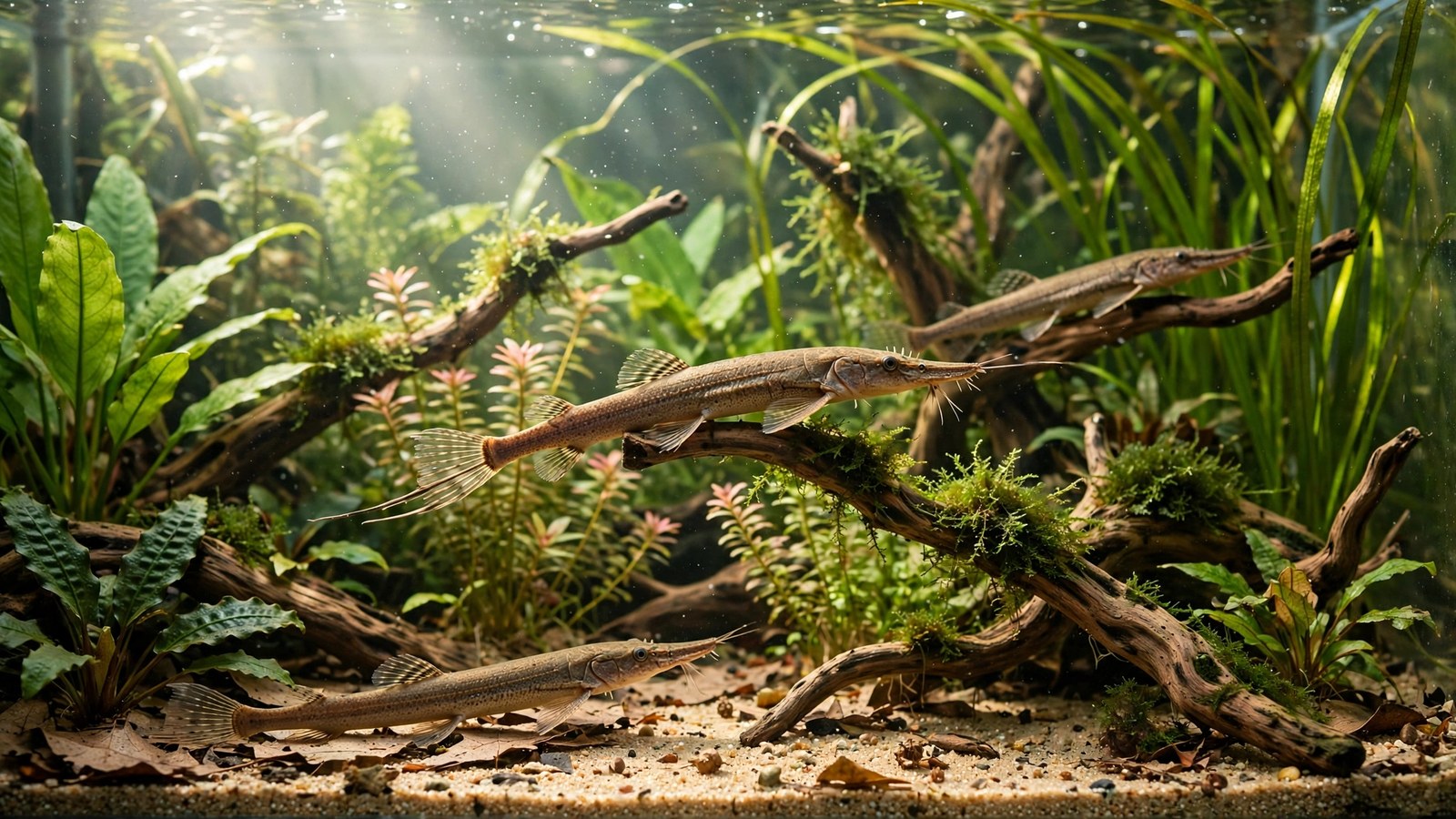
A catfish that grazes algae off your sword plants' leaves and never uproots a single stem — that is the promise of the sturisoma, the royal whiptail catfish (Sturisoma panamense), a ~20 cm South American loricariid that spends its days frozen mid-aquascape, camouflaged as a drifting twig. This guide shows you exactly how to build a planted tank around it.
First, untangle the names, because the trade uses them loosely. Sturisoma is its own genus — not the common whiptail catfish (Rineloricaria) and not the twig catfish (Farlowella), despite being sold as "royal farlowella" and "Panama sturisoma." This article is about Sturisoma specifically, and it is one of the most genuinely plant-friendly suckermouths in the hobby: it will not eat, move, or dig up your plants. Pair it with the best plants for a planted aquarium and you get a fish that polishes them while posing on them.
Why a sturisoma fits the planted tank like no other grazer
Most algae-eating catfish carry a hidden tax on your aquascape. Common plecos rasp driftwood and bulldoze stems. Even small loricariids can rasp delicate leaf margins or uproot fresh carpet plantings. The sturisoma charges no such tax. Its narrow, twig-like body and underslung sucker mouth are built for one job: grazing flat surfaces. In your tank it works bogwood and broad plant leaves like the submerged branches it evolved to hide on — especially as a juvenile, when its appetite for soft algae is strongest.
The camouflage is half the entertainment. Give a sturisoma a bundle of twiggy branches and it will vanish against them in daylight, holding perfectly still, then cruise the tank after lights-out. Confident adults hold their perches even while you work in the tank.
Build the habitat: twigs, wood, sand, and flow
Decorate for the camouflage instinct. Several twiggy branches at different angles, one or two solid bogwood pieces for perching, and sand or fine gravel underfoot — coarse gravel abrades its belly. This is a fast-water fish, so filtration should be strong and aeration generous: a surface-breaking outflow or an airstone keeps oxygen high. Moderate light suits both the fish and a low-tech planted setup; under strong light a shy sturisoma retreats to the shade.
| Parameter | Target | Notes |
|---|---|---|
| Temperature | 73–82°F (23–28°C) | Avoid sustained heat above 82°F |
| pH | 6.5–7.5 | Slightly acidic to neutral |
| Hardness | 5–15 dGH | Soft to moderately hard |
| Tank size | 30 gal+ (115 L) | Trios do best in 65+ gal |
| Substrate | Sand or fine gravel | Protects the belly and fins |
| Flow and aeration | Moderate–high, well oxygenated | Fast-water species; do not keep in stagnant tanks |
| Lighting | Moderate | Heavy planting gives shaded resting spots |
Cycle the tank fully before adding a sturisoma — like all loricariids, it is ammonia-sensitive — and hold nitrates under ~20 ppm with weekly 30% water changes.
Plant choices for a royal whiptail
Plant for grazing and perching — the plants chosen for the fish here are broad leaves it can clamp to: Amazon swords, Anubias, and Java fern. Tall stems and Vallisneria give the vertical lines the twig camouflage works best against, and the foreground carpet is safe since this catfish never digs. Leave open sandy lanes between thickets as grazing routes, and plant densely enough that the fish always has shaded daytime cover.
Feeding: the algae grazer that needs more than algae
The classic beginner mistake is assuming the tank's algae is the whole diet. Algae is the appetizer. The staple should be vegetable-heavy sinking food: algae wafers, spirulina-based pellets, and blanched vegetables — zucchini, spinach, cucumber, shelled peas — two to three times a week. Add only occasional protein: a small portion of frozen bloodworm or daphnia once a week at most. Too much animal protein causes unhealthy weight gain and extra waste in a fish that eats constantly.
Feed after lights-out or late in the day, placing food near its favorite perch — shy individuals get outcompeted by bold tank mates. The driftwood doubles as a dietary bonus: the fish rasps biofilm off it all day. Like its relative the bristlenose pleco, the routine will feel familiar — but the sturisoma is the shyer feeder, so confirm it is actually eating during the first weeks.
Sexing and breeding: spawning is achievable, raising fry is the hard part
Sexing adults is straightforward once you know the signs. Males grow much longer first dorsal fins and, at maturity, develop odontodes — bristle-like "whiskers" on the cheeks and snout — that females lack. A conditioned pair will spawn on glass or broad plant leaves, where the female lays 80–100 eggs; the male then guards the clutch for roughly 8 days until they hatch.
Spawning is the achievable half. Raising the fry is the honest difficulty: they need microscopic food such as infusoria, then powdered fry food and soft blanched vegetables, in a dedicated fry tank with seasoned sponge filtration and stable, well-oxygenated water. Expect to lose early batches — breeders consider the fry stage the real skill of this species.
Tank mates that respect the long fins
Peaceful community fish only — the long dorsal and trailing tail filaments are fin-nipper magnets.
| Good companions | Why they work |
|---|---|
| Cardinal and neon tetras, rasboras | Peaceful mid-water schoolers; no competition for bottom food |
| Corydoras | Share the bottom without aggression or fin-nipping |
| Dwarf cichlids (e.g. Apistogramma) | Calm, occupy different zones, leave the catfish alone |
| Otocinclus, small peaceful plecos | Parallel algae grazers with zero conflict |
Frequently Asked Questions
Is a sturisoma really safe for planted tanks?
Yes — it is one of the safest algae grazers for aquascapes. Sturisoma rasp algae and biofilm off leaves, glass, and wood but do not eat living tissue, dig substrate, or uproot stems. Juveniles are especially effective at polishing broad leaves. Give it driftwood perches and it polishes your scape instead of dismantling it.
What is the difference between Sturisoma, whiptail catfish, and Farlowella?
Three different genera that the trade lumps together. Sturisoma (royal whiptail) is the larger, ~20 cm genus covered here. Rineloricaria is the common whiptail catfish, smaller and stockier. Farlowella is the true twig catfish, extremely slender. Always buy by the species name — Sturisoma panamense — not by the common name on the tank.
How many sturisoma can I keep together?
They do well singly, in pairs, or in small groups. A trio in 65 gallons or more shows the most natural behavior, perching together and becoming noticeably bolder. In a 30-gallon tank, one or two is the comfortable limit — each fish wants its own perch.
Can I breed sturisoma in a home aquarium?
Spawning is achievable: a conditioned pair lays 80–100 eggs on glass or broad leaves, and the male guards them for about 8 days. Raising the fry is the genuinely hard part — they need infusoria, then powdered food and soft vegetables, in a dedicated fry tank with gentle sponge filtration. Expect losses in early batches.
A royal addition worth planning for
The sturisoma asks for specific things — twiggy branches, clean fast water, vegetable-heavy feeding — and repays planning like few catfish can: a living twig that keeps your plants polished while never threatening them. Start with the hardscape it was born to vanish into. For species-level reference, the Sturisoma panamense species database entry and a detailed royal whiptail care spotlight confirm the parameters and breeding notes above.