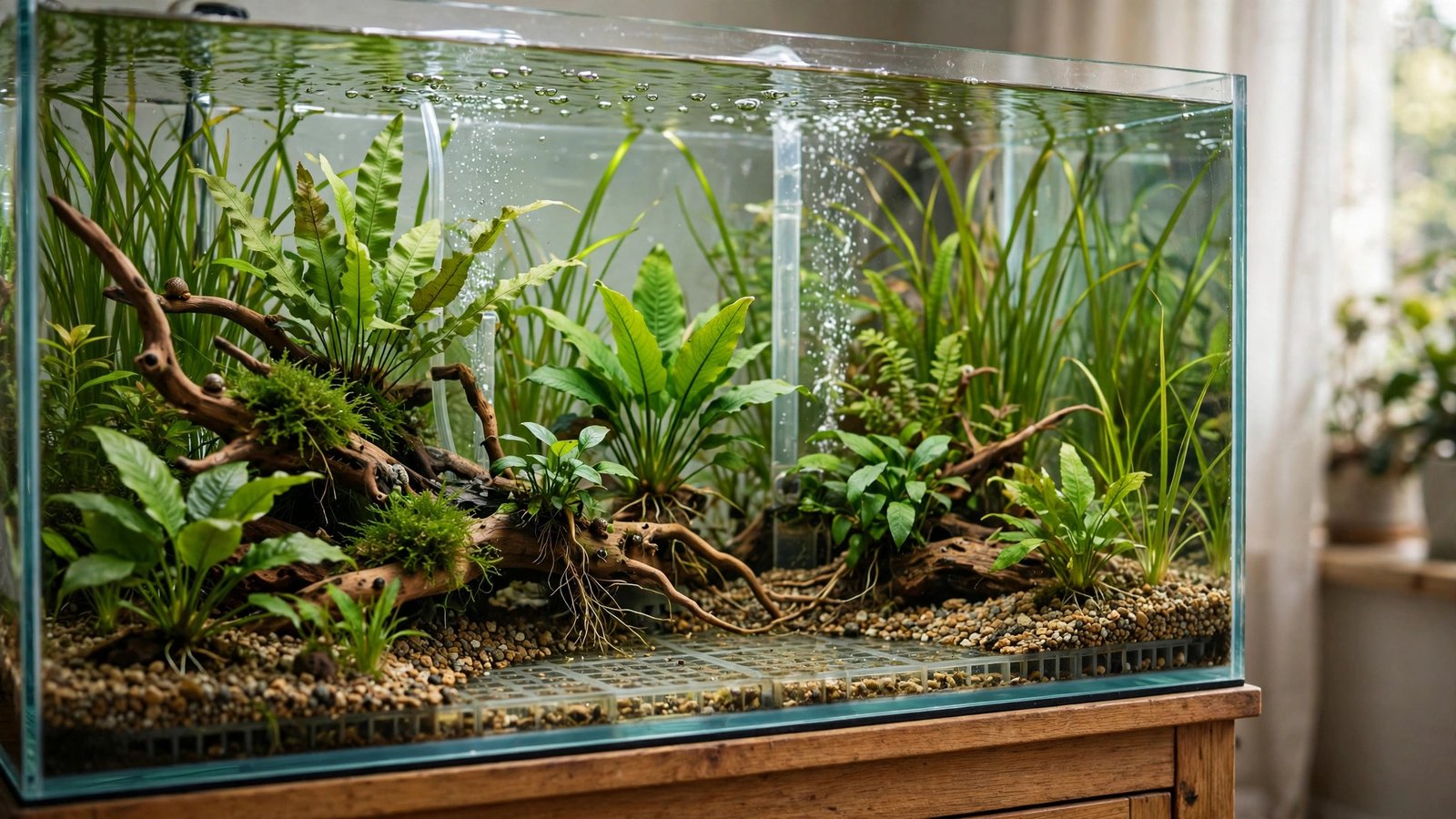
Ask any planted-tank forum about the undergravel filter planted tank debate and you will get two opposite answers, both delivered with total confidence. One hobbyist ran a UGF tank for a decade with lush growth; another tore theirs out after the plates choked on roots. You find out which one you are by month six.
How an Undergravel Filter Works in 60 Seconds
A slotted plastic plate sits on the tank floor under 2–3 inches of coarse gravel. An air pump or powerhead pushes water up the lift tubes, pulling water down through the gravel bed and under the plate.
That downward pull is the entire trick: every grain of gravel hosts nitrifying bacteria, so the whole substrate becomes one giant biofilter. It dominated the hobby for decades, costs $20–40, and has no intake to endanger fry or shrimp. The trouble starts when roots enter the picture.
Why an undergravel filter planted tank fights your roots
Three mechanical conflicts explain almost every UGF failure in planted tanks:
1. Roots choke the plates
Plant roots grow down and weave straight through the plate slots. Heavy root feeders like swords, vallisneria, and crypts can form a dense mat underneath within 6–12 months, stalling circulation and creating anaerobic dead spots. One UKAPS member ran UGF on a low-tech tank fine, but switched to a canister for fear the roots would choke the bed.
2. Flow steals nutrients from the gravel
Root tabs you place in the gravel get pulled up and out by the constant downward flow, flushing them into the water column where algae claims them first. Liquid fertilizers dosed into the water get dragged down into the substrate instead. The UGF does the opposite of what a planted substrate should do.
3. UGF demands gravel; plants want soil
Undergravel filters need coarse, porous substrate (2–4 mm gravel). But most planted tanks run on aquasoil, which breaks down into fines over 12–24 months that migrate under the plate and clog it. For a nutrient-rich soil bed, a dirted tank setup with no forced flow works far better.
The Reverse-Flow Workaround
The old-school fix is reverse-flow UGF: a powerhead pushes pre-filtered water up through the plates, and the three problems mostly invert:
- Roots stay manageable. Upward flow pushes detritus to the surface where your powerhead's pre-filter sponge catches it.
- Nutrients stay put. Root tabs dissolve into the bed instead of flushing away.
- The bed stays aerobic. Rising oxygenated water prevents the dead spots standard UGF beds develop.
The trade-offs: a powerhead rated roughly 100–150 GPH per 10 gallons, a pre-filter cleaned every 2–4 weeks (a clog kills plate flow), more visible plumbing, and weekly gravel vacuuming. Still gravel-only.
Which Plants Tolerate UGF — and Which Hate It
If the plant barely touches the substrate, UGF is fine:
| Plant group | Examples | UGF verdict |
|---|---|---|
| Epiphytes (attach to wood/rock) | Anubias, java fern, bucephalandra | Excellent — roots never reach the plates |
| Floaters | Frogbit, water lettuce, salvinia | Excellent — no substrate contact |
| Water-column feeders | Hornwort, anacharis, guppy grass | Good — shallow roots |
| Light stem plants | Rotala, ludwigia | Fair — thin roots; prune before they mat |
| Heavy root feeders | Amazon swords, crypts, vallisneria | Poor — thick mats choke plates in months |
| Carpeting plants | Dwarf hairgrass, monte carlo | Poor — need fine substrate; mats smother flow |
UGF planted tanks work best as low-tech jungle tanks: gravel, driftwood with anubias and java fern, floaters on top, guppies below. See best plants for guppy tanks for stocking that suits this setup.
UGF vs Sponge vs HOB for Planted Tanks
| Factor | Undergravel filter | Sponge filter | Hang-on-back (HOB) |
|---|---|---|---|
| Biological capacity | Very high (whole substrate) | High | Medium–high |
| Root interference | Severe / minor (reverse-flow) | None | None |
| Substrate freedom | Coarse gravel only | Any substrate | Any substrate |
| CO2 off-gassing | Low | Low–medium | High (drives off CO2) |
| Fry/shrimp safety | Excellent | Excellent | Poor (needs intake sponge) |
| Maintenance | Weekly gravel vac; plate teardown yearly | Rinse sponge monthly | Rinse media monthly |
| Cost (20-gal setup) | $20–40 | $10–25 | $30–60 |
For CO2-injected aquascapes, sponge or canister filters win on every axis — see the high-tech planted tank setup guide. For a low-tech breeding tank, UGF's fry safety and bio capacity are genuinely hard to beat.
Verdict: When UGF Is Fine, and When to Pick Another Filter
| Scenario | Verdict |
|---|---|
| Fish-only or fry grow-out tank, coarse gravel | Great — what UGF was built for |
| Low-tech tank: epiphytes + floaters on gravel | Good — standard or reverse-flow |
| Reverse-flow + powerhead, root-tab feeding | Good — viable for moderate root feeders |
| Aquasoil or dirted substrate | Avoid — fines clog the plates |
| Heavy root feeders as the centerpiece | Avoid — mats choke flow within a year |
| Carpeted aquascape | Avoid — wrong substrate, wrong flow |
| High-tech CO2 tank | Avoid — use canister or sponge |
Buying a UGF for a Planted Tank
If you land in one of the "fine" rows, here is what to check before buying a UGF plate kit:
- Plate coverage. Plates should cover the full tank footprint — buy a kit sized to your exact tank rating. Undersized plates leave dead corners where detritus rots.
- Airlift vs powerhead. Airlifts are cheaper and gentler. For reverse-flow you need a powerhead that locks onto the lift tube — check tube diameter compatibility before buying.
- Gravel size. Pair plates with 2–4 mm coarse gravel, 2–3 inches deep. Sand falls through the slots; large pebbles let detritus sink under the plate.
UGF kits are commodity items — buy on plate coverage and tube compatibility, not brand promises. Pair them with our first planted tank shopping list, then cycle the tank before stocking.
Uplift tubes are the core UGF component the buying section covers: replacement uplift tubes like Lee's ★4.4.
Frequently Asked Questions
Can you use an undergravel filter with aquasoil?
Not recommended. Aquasoil breaks down into fines over 12–24 months, and those fines migrate under the plates and clog the slots. Downward flow also strips the soil's nutrients into the water column, fueling algae. With aquasoil, use a sponge, HOB, or canister instead and skip the UGF.
Will plant roots really clog an undergravel filter?
Yes — it is the most documented UGF complaint in hobby forums. Heavy root feeders like amazon swords send thick roots through the plate slots within 6–12 months, forming mats that block circulation. Shallow-rooted stems and epiphytes rarely cause trouble, which is why UGF works for some planted tanks and fails for others.
Is reverse-flow UGF actually better for planted tanks?
Yes, meaningfully. Pushing pre-filtered water up through the plates keeps detritus suspended, lets root tabs stay in the gravel where plants use them, and keeps the bed oxygenated. You still need coarse gravel, a powerhead around 100–150 GPH per 10 gallons, and regular pre-filter cleaning.
Does an undergravel filter remove CO2 from the water?
Very little compared to HOB filters. UGF circulation happens below the gravel surface, so there is minimal surface agitation to off-gas CO2 — a genuine advantage for low-tech tanks. Reverse-flow powerheads create slightly more surface movement, but still far less than an HOB outflow.
How often do you clean an undergravel filter in a planted tank?
Vacuum the gravel surface weekly — more often than a non-UGF tank, since downward flow pulls waste into the bed. Expect a full plate teardown every 12–18 months to clear root mats; there is no way around this with root feeders. Reverse-flow setups stretch the interval but still need the yearly teardown.
Are undergravel filters outdated?
For planted aquascaping, largely yes — aquasoil, root tabs, and carpets all conflict with how UGF works. But they are not obsolete: breeders still use them for unbeatable fry safety and massive biological capacity at low cost. Outdated for the aquascaper; still excellent for the breeder's low-tech planted holding tank.
The Bottom Line
An undergravel filter is neither miracle nor menace — it is a specialized tool. Pair it with coarse gravel, epiphytes, floaters, and reverse-flow plumbing, and it quietly powers a thriving low-tech tank. Force it under aquasoil with a carpet, and you will rip it out within a year. Skim the UKAPS discussion and the Aquarium Co-Op UGF thread before committing.