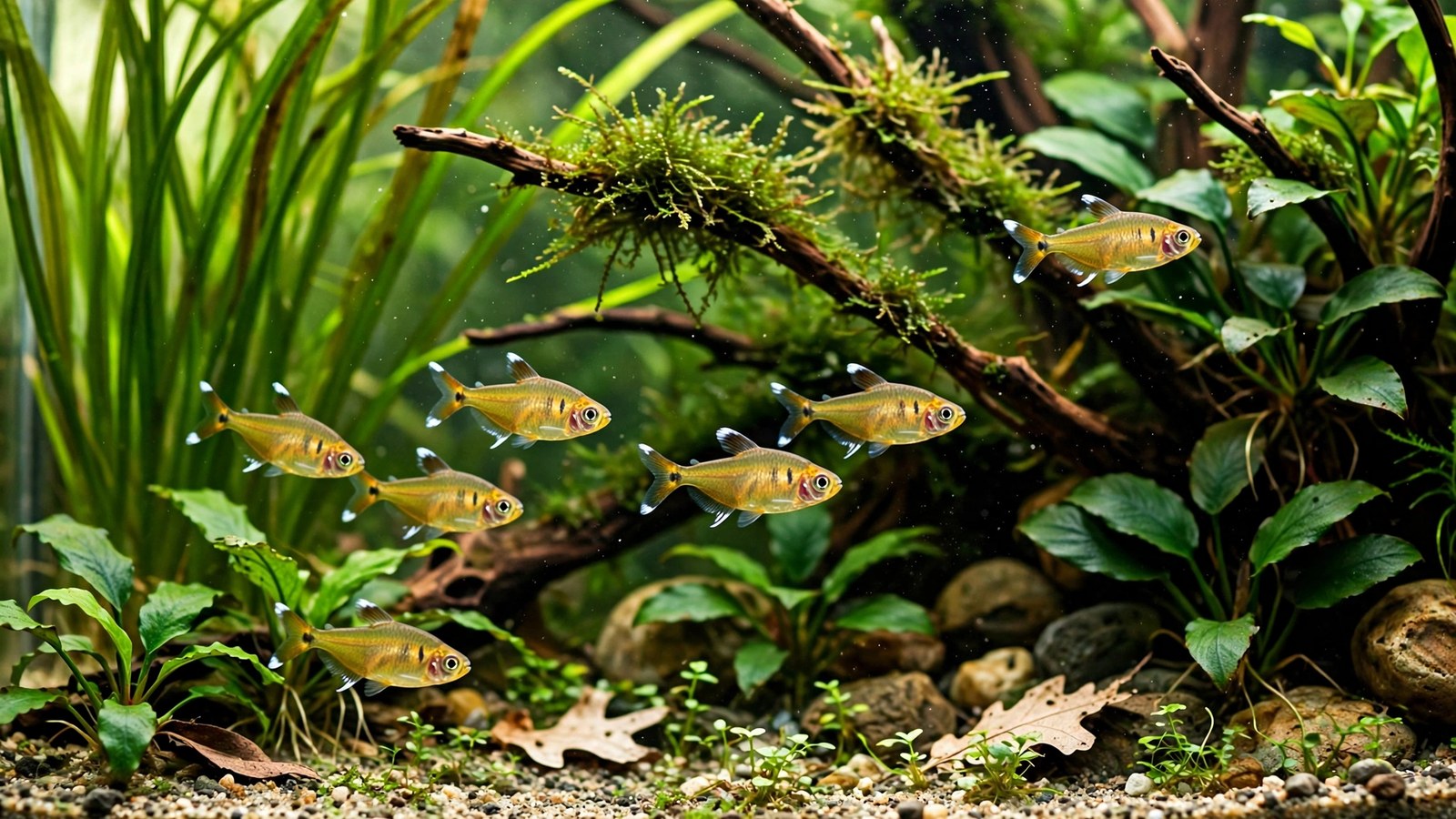
Most tetras ask you to rebuild your water around them. The silver-tip tetra never got that memo — it thrives in plain tap water from pH 6.0 to 8.0, schools tightly, and never stops moving over a green planted backdrop. If you're planning a silver tip tetra planted tank, this is the schooler that forgives beginner mistakes while still looking like an expert chose it. Fish-first guide to aquarium plants first — then this page for the full silver-tip setup.
Is the silver-tip tetra good for a planted tank? Yes — it's one of the best schoolers for a planted tank: extremely hardy, constantly active in mid-water, and completely plant-safe. Here is the one citable fact to check at the shop: unlike most tetras, Hasemania nana has no adipose fin. Keep a school of 8–10 or more in 18–20 gallons with planted edges and an open swimming lane, and they color up within days.
How to Set Up a Silver Tip Tetra Planted Tank
A 20-gallon long is the sweet spot: the extra footprint gives a fast school room to run, and the height suits mid-water fish better than a tall narrow tank. Choose a filter rated for the tank with steady, moderate flow — silver-tips come from moving streams and look their best with gentle current from a small powerhead or a well-placed HOB outflow. They are not jumpers like danios, but a lid is still wise.
Use a dark substrate to make their bronze bodies and silver fin tips glow, and add a full-spectrum LED on a timer (8 hours daily). For the planting plan itself — which species, where they go, how many — the complete guide to freshwater aquarium plants covers beginner-friendly choices in detail. The layout below is tuned specifically for this fish.
The Tank Layout: Planted Edges, Open Middle
Silver-tips are display swimmers, not shy hiders. Plant densely around the back and sides — Java fern and Anubias tied to driftwood are ideal: tough, low-light, no aquasoil needed — and keep the center open. Floating frogbit or water lettuce dims the light, deepening their copper tones and helping new fish settle.
This "planted arena" layout suits any mid-water schooler. The kubotai rasbora planted tank uses the same edges-open-middle geometry, so they make excellent tankmates for a mixed-school display.
Water That Barely Matters (Almost)
This is the hardiest tetra commonly sold: it tolerates a pH range most tetras wouldn't survive and handles summer temperature drift in an unheated room. But "hardy" doesn't mean immune to ammonia — cycle the tank fully first, then keep up 25–30% weekly water changes.
| Parameter | Comfortable range | Notes |
|---|---|---|
| Temperature | 23–28°C (73–82°F) | 24–26°C is the sweet spot for color |
| pH | 6.0–8.0 | Adapts to most tap water; avoid sudden swings |
| Hardness | 5–20 °dGH | Soft to moderately hard is fine |
| Ammonia / nitrite | 0 ppm | Non-negotiable, even for hardy fish |
| Nitrate | Under 20 ppm | Fast-growing stem plants help hold this down |
For comparison, the blue tetra is another adaptable tetra in the same forgiving class — both are far easier water-wise than cardinals or rummy-noses.
Feeding a Hungry Little School
Silver-tips are unfussy omnivores with fast metabolisms. A quality micro-flake or fine granule (TetraMin-style tropical flakes are the classic staple) forms the base: two small meals a day, only what the school finishes in two minutes. Rotate in frozen daphnia, baby brine shrimp, or finely chopped bloodworm two or three times a week to keep their bronze color vivid.
Skip the giant once-a-day dump. Small frequent meals match how they feed in the wild, and your plants will quietly absorb the steady trickle of nutrients. Manufacturer care notes, like Tetra's own silvertip species page, echo the same routine: varied micro-foods, small portions, consistency over quantity.
School Size Is Everything
This is the one rule you cannot bend. Eight to ten or more is where silver-tips transform: the chasing stops, the school moves as one flashing unit, and the nipping that gives this species a bad reputation never starts. In small groups or alone, they redirect their energy onto tankmates' fins — especially slow, long-finned fish.
At the shop, confirm the ID with the missing adipose fin (see the intro) and pick active fish with bright silver-white fin tips. Males run slimmer and more coppery; females are rounder and paler. Another hardy schooler with the same "buy a big group" logic is the kerri tetra — the purple emperor of planted tanks. Detailed species data for silver-tips, including the fin trait, is documented in the aqua-fish.net silver-tipped tetra profile.
Breeding Silver-Tips Among the Plants
Silver-tips are egg-scatterers, and a planted tank is halfway to a breeding setup. Condition a pair or trio on live and frozen foods for two weeks, then move them to a separate tank with fine-leaved plants or spawning mops and slightly soft, acidic water. Remove the adults right after spawning — they will eat their own eggs.
Eggs hatch in roughly 24–36 hours. The fry are tiny: start on infusoria or liquid fry food, then graduate to newly hatched baby brine shrimp. A densely planted grow-out tank shelters the fry and grows the microfauna they graze on between feedings.
Frequently Asked Questions
Is the silver-tip tetra good for beginners?
Yes — it's one of the most forgiving tetras you can buy. It accepts a wide pH and temperature range, eats anything, and resists the beginner mistakes that kill cardinals and neons. The only beginner trap is buying too few: get at least eight, or the nipping starts.
How many silver-tip tetras should I keep together?
Aim for 8–10 as a practical minimum, more if the tank allows. At that number they school properly, males display to each other instead of harassing tankmates, and fin-nipping drops to near zero. Six is survivable but visibly less settled; below six, expect trouble.
Are silver-tip tetras nippy?
Only when under-grouped or bored. A proper school of 8–10+ in a tank with swimming space and plants keeps their energy directed inward. Problems almost always trace back to three or four fish in a bare tank — fix the group size and layout, and the nipping stops.
What plants go well with silver-tip tetras?
Hardy, low-demand plants suit them best: Java fern and Anubias on driftwood for the borders, Vallisneria or Amazon swords for background height, and floating frogbit to dim the light. They never eat plants, so even soft-leaved species are safe — pick plants for your light and substrate, not for the fish.
How big a tank do silver-tip tetras need?
An 18–20 gallon tank with a 60 cm (24-inch) footprint is the minimum for a proper school. They're active swimmers, so horizontal length matters more than height. A 20-gallon long is ideal; anything smaller cramps the schooling behavior that makes this fish worth keeping.
A Schooler That Earns Its Keep
Few fish give you this much motion, color, and forgiveness per dollar. Plant the edges, add your school of eight or more, feed them well, and silver-tips will reward you with a tank that always looks alive. If you want an even livelier open-water display to compare, the scissortail rasbora is the bigger, bolder cousin in the same planted-arena style.