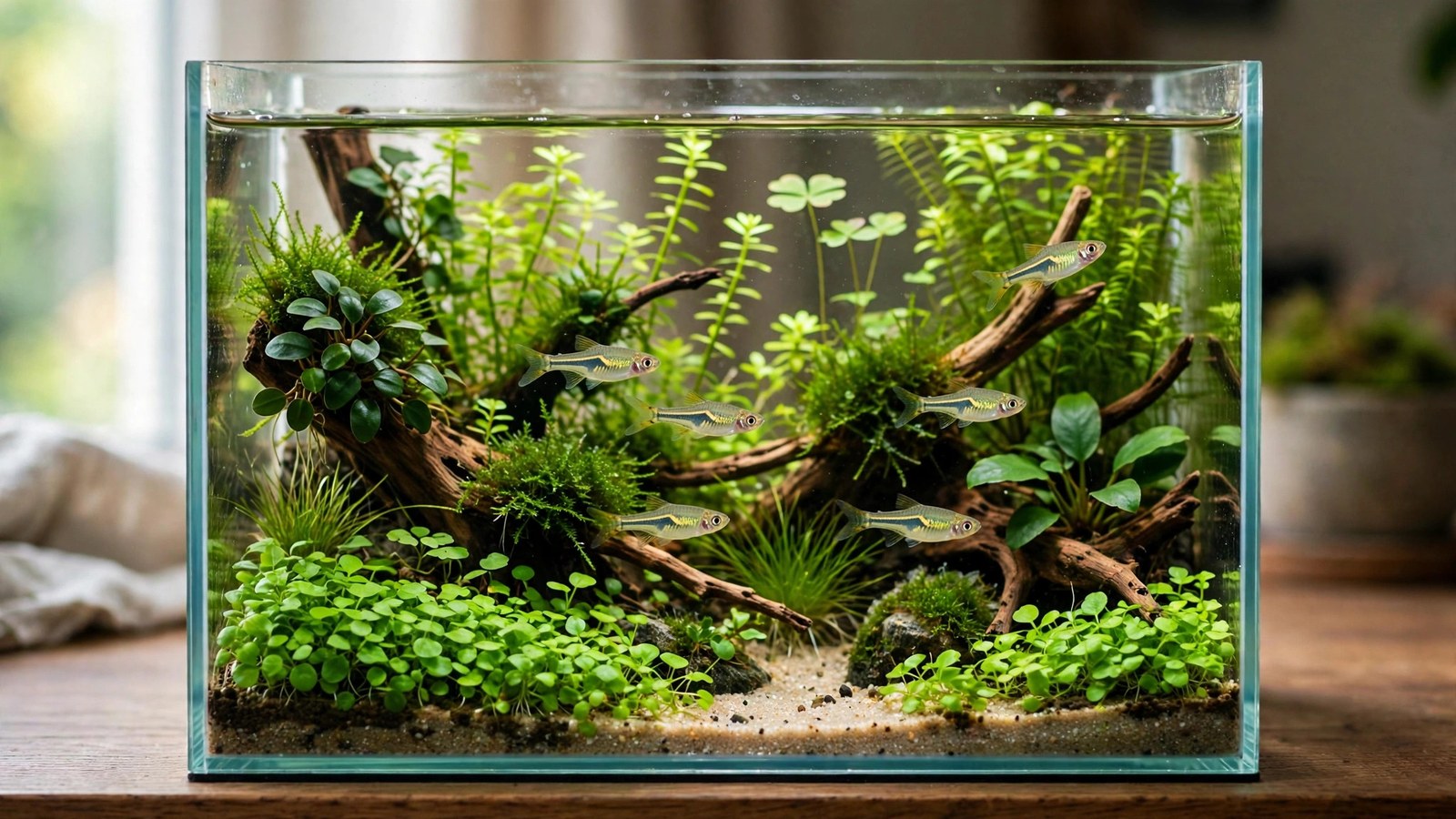
Most nano fish make you compromise: tiny fish, tiny color payoff. The kubotai rasbora breaks that rule — a two-centimeter fish that glows neon lime-green from across the room. Building a kubotai rasbora planted tank is one of the most rewarding nano projects you can take on: these fish school tightly, ignore shrimp completely, and look like living sparks against the right plants. This guide gives you the exact tank size, water targets, plant list, and stocking plan for a thriving green-on-green nano.
Setting Up Your Kubotai Rasbora Planted Tank
Start with a 10-gallon standard or, better, a 60 × 30 cm long-style nano. A longer footprint matters because kubotai rasboras are horizontal swimmers — they patrol the mid-water in a shimmering pack, and five extra centimeters of length show off that behavior better than five extra of height. A sponge filter or a small hang-on-back with a prefilter sponge covers filtration; keep the current gentle, since these fish come from slow-moving forest streams in Thailand.
Use an aquasoil-based substrate. It does double duty: feeding root-feeders and buffering pH down into the soft, acidic range kubotai rasboras prefer. Cap it with a thin sand strip along the front for shrimp foraging. Add hardscape before planting — one or two branchy spider-wood pieces and a few small dark stones — and let the wood's tannins subtly soften the water. Then cycle the tank. Live plants absorb ammonia directly, so a planted tank cycles faster; hold until ammonia and nitrite read zero for three consecutive days before adding the full school of 10–12 at once.
For livestock-matched planting advice, keep a solid aquarium plants for fish tanks guide bookmarked. If this is your first nano scape, the lightly planted aquarium setup guide covers the low-tech foundations this tank relies on, and this guide to cycling a planted tank faster walks through the planted-cycle method.
Water Parameters: Soft, Warm, and Stable
Kubotai rasboras forgive beginner mistakes, but not swinging chemistry. Their native streams are soft and warm year-round, and your tank should mimic that stability.
| Parameter | Target range | Why it matters |
|---|---|---|
| pH | 6.0–7.0 | Soft acidity keeps colors vivid |
| GH | 3–6 dGH | Low minerals match native streams |
| KH | 1–4 dKH | Low buffer lets aquasoil hold pH steady |
| Temperature | 72–80 °F (22–27 °C) | Warm water speeds schooling activity |
| Nitrates | Under 20 ppm | 25–30% weekly water changes hold this |
| Light | Low–medium, 6–8 hours | Too much light washes out the fish |
Test weekly for the first two months. If your tap water is hard, cut it 50/50 with RO water — a swing of more than 0.5 pH or 2 dGH in one change stresses the school. The planted tank water parameters guide breaks down what each reading means.
Plants That Flatter a Lime-Green Fish
Green fish in a green tank is the design challenge — and the fun. The trick is contrast of texture and tone, not of color. Dark, fine-leaved foliage behind a shimmering lime school reads beautifully; broad bright-green leaves make the fish vanish.
| Plant | Placement | Why it works here |
|---|---|---|
| Rotala rotundifolia | Background | Fine red-tinged leaves give the strongest contrast to neon green |
| Cryptocoryne wendtii 'Brown' | Midground | Dark bronze leaves make the fish glow against them |
| Java moss / Christmas moss | On wood | Shelters shrimplets and fry; low light tolerant |
| Staurogyne repens | Foreground | Compact carpet that stays low and doesn't steal the scene |
| Bucephalandra (dark cultivar) | On hardscape | Near-black leaves are a perfect backdrop for a lime school |
| Limnophila sessiliflora | Background corner | Feathery density gives the school a thicket to dart through |
Arrange with intention: group the Rotala and Limnophila along the back in two uneven clusters, never one flat wall. Put the Cryptocoryne and Bucephalandra mid-tank where the school cruises, so the fish constantly cross the dark backdrop. Leave the front third open above the Staurogyne — that empty stage is where you will actually watch them. All six thrive without CO2 under low–medium light.
Feeding, Shrimp-Safe Tank Mates, and Breeding Basics
Feed small, feed varied, feed twice. Crush flake food between your fingers for their tiny mouths, and rotate in micro pellets, frozen daphnia, and baby brine shrimp twice a week. Frozen foods push their green from "nice" to "glowing" — top condition shows in brightness. Skip one day a week; it keeps water clean and digestion healthy.
This species' standout trait is how thoroughly shrimp-safe it is: unlike most nano fish, kubotai rasboras ignore adult shrimp and even shrimplets, so a thriving planted shrimp tank colony can share this water. Want more fish? Keep them small and peaceful: ember tetras, chili rasboras, or pygmy corydoras. The best schooling fish for planted tanks rundown compares twelve candidates if you want options. Avoid anything nippy or large enough to swallow a two-centimeter fish.
Breeding is very doable. Condition a group with baby brine shrimp for two weeks, then move one male-heavy trio into a moss-filled container 1–2 °F warmer than the main tank. They scatter eggs into the moss at dawn; pull the adults out next morning and eggs hatch in 24–48 hours. Feed infusoria or vinegar eels for the first week, then newly hatched brine shrimp. SeriouslyFish's kubotai rasbora species profile lists native habitat and breeding notes for cross-checking, and Tropica's aquarium plant database has verified care data for every plant mentioned here.
Frequently Asked Questions
How many kubotai rasboras should I keep in a 10-gallon planted tank?
Keep 10–12. Kubotai rasboras are obligate schoolers — groups under 8 stay pale, hide, and never show the ribbon-like schooling that makes them special. Ten fish fit comfortably in a 10-gallon with weekly 25–30% water changes, and a bigger school behaves better, not worse, in a nano.
Are kubotai rasboras really shrimp-safe?
Yes, genuinely. Unlike most nano fish, which hunt newborn shrimplets, kubotai rasboras have tiny mouths and calm temperaments, and keepers consistently report them ignoring cherry shrimp babies. Provide moss and plant cover anyway so shrimplets have refuge; a shrimp colony can thrive in this tank without losses.
Why did my kubotai rasboras lose their green color?
Fading is stress or environment, not diet — their green is structural. Check three things: school size (under 8 fish fades them), light (harsh bright light washes them out — add floaters), and water stability (ammonia spikes or hard alkaline water dulls them). A settled school in soft, shaded water colors back up within one to two weeks.
Do kubotai rasboras need CO2 or high light?
No. The fish prefer dimmer light, and every plant in this guide grows fine without injected CO2. Run low–medium LED lighting for 6–8 hours daily. CO2 will speed plant growth if you want it, but it's optional — this is one of the easiest species tanks to run low-tech.
Can kubotai rasboras live with bettas?
Risky, and not recommended. At 2 cm they read as food or a target to many bettas, and bettas prefer calmer, warmer water than the gentle current schoolers like. Give kubotai rasboras their own species or community nano — a 10-gallon species setup shows them off far better anyway.
A Living Emerald Worth the Weekend It Takes to Build
Soft water, ten-plus fish, dark fine-leaved plants, a dimmed surface — that is the whole formula. Set it up this weekend, let the plants settle for two weeks, and you will have the only tank in the house people notice from the doorway. The green will do the rest.