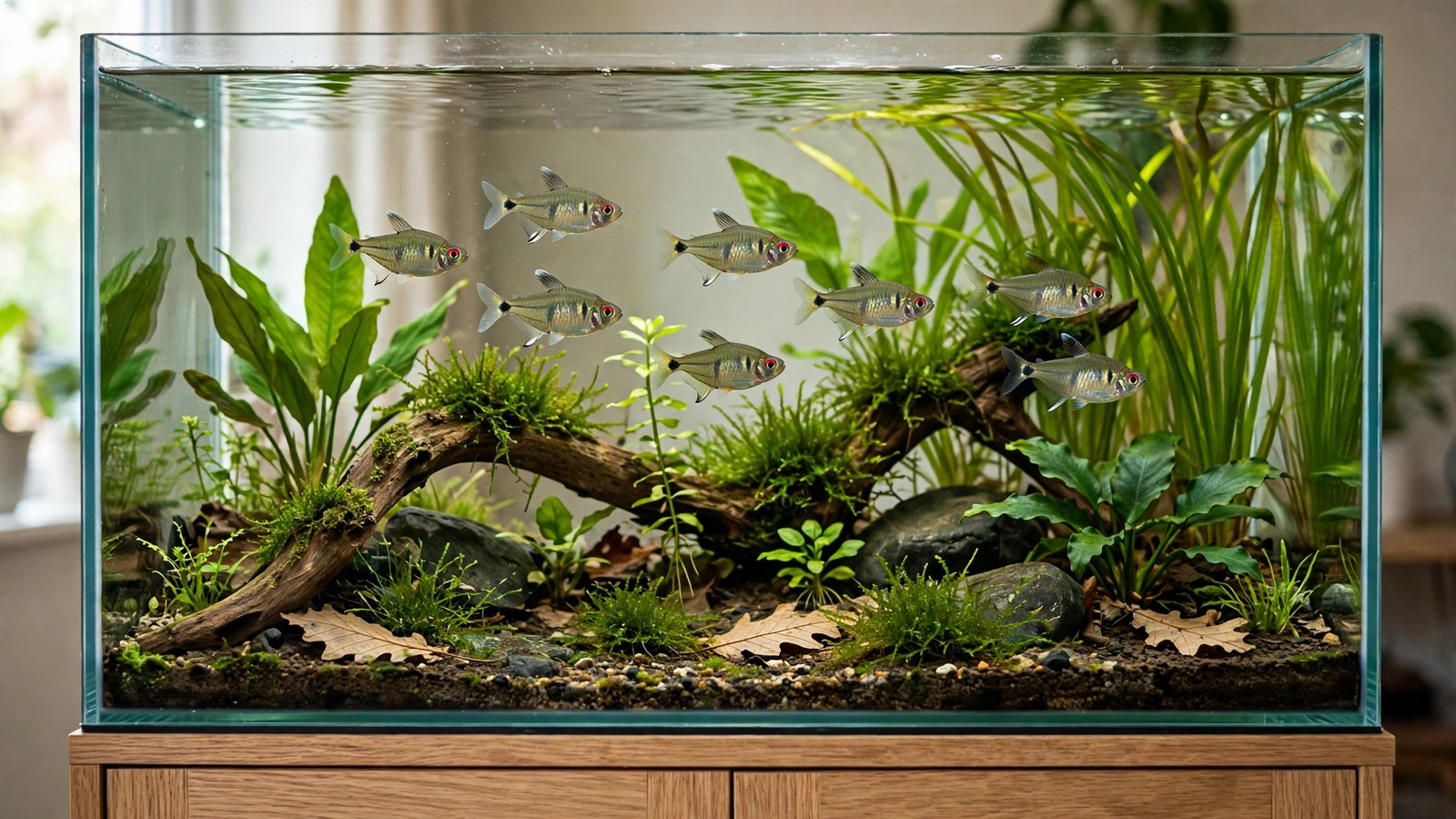
The fish that needs your tank the least might deserve it the most. While beginners watch delicate neons melt down in a fresh setup, the red eye tetra — Moenkhausia sanctaefilomenae — shrugs off water that would level its flashier cousins and never touches your plants. A well-planned red eye tetra planted tank pairs this cheap, bulletproof 2.75-inch schooler with dark substrate, open swimming lanes, and floating-plant shade — the combination that makes the red crescent above each eye glow.
Why the Red Eye Tetra Gets Overlooked (and Shouldn't)
Walk the tetra wall at any fish store and the red eye tetra loses the beauty contest: a deep-bodied silver fish, roughly 2.75 inches (7 cm) grown, with a black-edged tail and a bright red crescent over each eye. Most shoppers walk past it — which is exactly why it ends up being the smart buy.
It repays the plain looks with durability. Moenkhausia sanctaefilomenae has been captive-bred in huge numbers for decades, and tank-raised stock tolerates pH 5.5 to 8.5, hardness swings, and beginner tanks where a cardinal tetra would give up. Universally stocked, usually cheap, and — the point that matters — it does not eat plants (see Seriously Fish's species profile).
The honest caveat is temperament. These are active, boisterous fish, and small or cramped schools turn confidence into fin-nipping toward slow, long-finned tank mates. Nearly every problem this species causes traces back to too few fish in too little water.
Tank Size and School Size: The Honest Numbers
Most retailer blurbs say 20 gallons and six fish. That is the floor, not the formula. A 20-gallon long works because its footprint gives a 2.75-inch schooler a straight swimming lane, but 30 gallons genuinely changes the group's behavior: room to cruise, a buffer against the roughhousing that sparks nipping, and space for proper planting. If you are buying the tank for this fish, buy the 30.
Keep eight to twelve. Six is the quoted minimum, but at eight-plus the tetras' social energy stays internal — chasing each other, flashing crescents, leaving tank mates alone. Drop to four or five and the group gets bored and bossy, and fins start going missing.
| Tank option | School it supports | Verdict |
|---|---|---|
| 20-gallon long | 6–8 | Honest minimum; keep the school at 8 and the center open |
| 29–30 gallon | 8–12 | The sweet spot — full school plus real aquascaping |
| 40-gallon breeder | 12–15+ | Showpiece; behavior at its calmest and most natural |
Your Red Eye Tetra Planted Tank: The Build Plan
The scape follows one rule: frame the swimming, don't fill it. Think of a lightly planted aquarium setup with open swimming space and floating-plant cover — planted edges, a busy background, a clean open lane down the middle, and a floating-plant ceiling diffusing the light. They come from dappled, leaf-stained South American waters and color up best under similar conditions.
Start with dark substrate — dark aquasoil or sand makes the silver bodies and red crescents pop and echoes the tannin-tinted riverbed they evolved over. Plant the rear and sides densely, leave the front-center third open, and add driftwood for broken sightlines and the gentle tannins that deepen the red-eye color. Catappa leaves are an optional finishing touch.
Lighting can stay moderate: a medium LED, 7–8 hours daily, no CO2 required. The floating-plant canopy (frogbit, water lettuce, or red root floaters) softens the light the tetras prefer and gives them a shaded ceiling to cruise under — which is when the crescents show best.
Plants That Suit Active Schoolers
Because the fish ignore greenery entirely, plant choice is about what survives boisterous tank mates and flatters the scape. Anchor the layout with sturdy, fast-establishing plants: Amazon swords and vals for the background, Anubias and Java fern on the driftwood, floaters up top. Keep robust stems like Hygrophila or Ludwigia repens in the back corners, away from the school's traffic.
The principle is aquarium plants for a fish tank chosen for active schoolers: pick plants around the fish's behavior. The easiest aquarium plants for a beginner community tank overlap almost exactly with what works here — undemanding epiphytes, swords, and floaters.
Water Parameters and Feeding
Parameters are the easy part — hardy means forgiving, not immune to neglect. Cycle the tank fully before the school goes in, and hold nitrates down with the weekly routine.
| Parameter | Target range |
|---|---|
| Temperature | 73–82°F (23–28°C) |
| pH | 5.5–8.5 (stable beats exact) |
| Hardness | Soft to moderately hard, up to ~20 dGH |
| Ammonia / nitrite | 0 ppm, always |
| Nitrate | Under 40 ppm; under 20 ppm better |
| Water changes | 30% weekly |
Feeding is equally straightforward. These eager omnivores take food from the surface and midwater: a quality flake or micro-pellet as the daily staple, plus frozen daphnia, bloodworm, or brine shrimp two to three times a week for deeper color. Feed what the school finishes in two minutes, once or twice daily — their enthusiasm makes overfeeding the main risk.
Staple flake diet for the feeding section; balanced daily food for active tetras: TetraMin Tropical Flakes ★4.8.
Tank Mates and the Nipping Question
With a proper school in 30 gallons, red eye tetras are model community citizens. Good company includes other hardy, similar-sized schoolers — a black neon tetra planted tank is a natural companion theme, and lemon tetra planted tank builds share the same easygoing, plant-safe brief. Corydoras and bristlenose plecos are ignored entirely.
Avoid slow and fancy fish: bettas, long-finned angelfish, and fancy guppies draw attention from a bored or under-schooled group. Tiny shrimp juveniles may get hunted, so don't expect a breeding colony to thrive. When in doubt, check a schooling fish roundup for planted tanks before you buy.
Frequently Asked Questions
Are red eye tetras plant-safe?
Yes — fully. They feed in the water column and never graze leaves, stems, or mosses, unlike plant-eating tetras such as the Buenos Aires tetra. The only risk is mechanical: a boisterous school can uproot fresh stems, so let new plants root first.
How many red eye tetras should I keep together?
Eight to twelve, with six as the absolute minimum. Below eight, their social energy turns outward and fin-nipping starts — especially toward slower tank mates. Larger schools spread the roughhousing internally for calmer, better-colored fish. Never keep a trio or pair; small groups are where nearly every behavioral complaint comes from.
What tank size do red eye tetras need?
A 20-gallon long is the honest minimum, but 30 gallons is the better call. The extra footprint gives these fast swimmers a real swimming lane plus room for planted edges and an open center. Anything under 20 gallons crowds the school and amplifies nipping.
Will red eye tetras nip other fish?
They can, but the cause is almost always fixable: too few tetras, too small a tank, or tempting slow, long-finned tank mates. In a school of 8+ in 30 gallons, nipping is rare. Avoid bettas, fancy guppies, and long-finned angelfish unless the tank is large and the school full-sized.
Do red eye tetras need soft, acidic water?
No. Captive-bred stock tolerates pH 5.5 to 8.5 and a wide hardness range — a big part of their beginner appeal. Stability matters far more than any specific number, so avoid chasing pH with chemicals. Tannins from driftwood or catappa leaves flatter their colors with a gentle tea-stain.
For a fish that costs little and asks for almost nothing, the red eye tetra returns a tight, confident school, real personality, and a planted tank it will never redecorate. Build the honest 30 gallons with eight or more fish, shade the water, darken the floor.