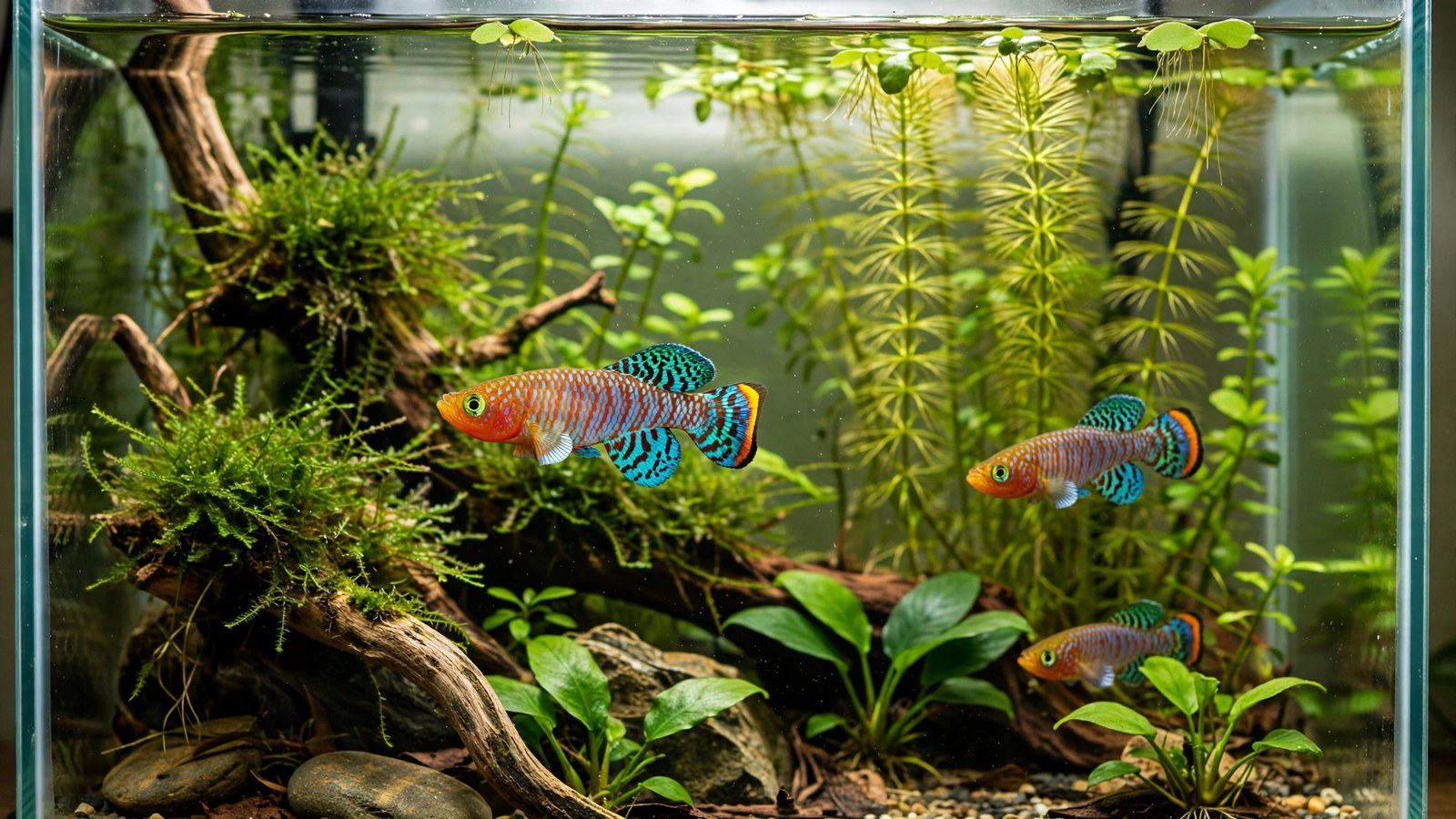
Most aquarium fish give you years to get the setup right. Nothobranchius rachovii gives you about twelve months: hatch, breed, and die. A well-built rachovii killifish planted tank is how you witness the full cycle — peat spawning, live-foods-only feeding, eggs stored dry for months, then a new generation hatching in a day. This guide covers the annual rhythm that generic killifish advice misses.
Why rachovii are a completely different project
Sibling non-annual killifish are fish you buy, grow, and keep indefinitely. Nothobranchius rachovii comes from seasonal pools in Mozambique that dry up every year, and it evolved to match: hatch, grow, breed, die — all in one rainy season. In the aquarium you are not keeping pets, you are running generations. Adults reach full color in roughly 8 weeks, breed daily, and decline around month 10. That single fact shapes every decision, from tank size to why peat sits in labeled bags on your shelf for four months.
Your rachovii killifish planted tank: the full build
Start with a 40–60 L tank with a tight lid — killifish jump. If you want nano planted tank inspiration for smaller footprints, scale the equipment below rather than the stocking. A sponge filter or baffled hang-on-back keeps flow gentle; these still-water pool fish hate current.
Substrate breaks the planted-tank norm here. Spread 2–3 cm of boiled, damp peat moss across a third of the tank — or set a shallow glass bowl of peat into a sand bed. Peat stains the water tea-colored and holds pH at 6.0–6.5, the blackwater conditions rachovii spawn in. Plant the rest in fine sand with Cryptocoryne and fine-leaved stems. Keep the aquascape low-tech: this species thrives in low-tech planted tank conditions where fertilizers will not spike the water they spawn in.
Floating plants are the second half of the formula. Cover 50–70% of the surface with frogbit, red root floaters, or salvinia — the biggest lever for male aggression and color. The cornerstone guide to floating aquarium plants for beginners covers species-by-species care, and the easiest aquarium plants for beginners guide rounds out the background greenery. Roots trailing from floaters double as refuge for females between spawning bouts.
| Parameter | Target | Notes |
|---|---|---|
| Temperature | 22–25°C | Cooler water slows aging; warmer accelerates the annual clock |
| pH | 6.0–6.8 | Peat naturally holds this range; avoid phosphate buffers |
| Hardness | 4–8 dGH | Soft water triggers spawning; hard water reduces egg viability |
| Ammonia / nitrite | 0 ppm | Cycle fully before stocking — see our guide to planted tank water parameters |
| Light | Low–medium, 6–8 h/day | Floater shade dims the tank; no high-light or CO₂ needed |
| Water changes | 25% weekly | Match temperature within 1°C; a cold shock can stall spawning |
Peat spawning: collecting, storing, and hatching eggs
Rachovii spawn by diving into peat as a pair: the male wraps the female, she pushes eggs a centimeter into the peat, and they repeat this daily. Every 7–14 days, lift the peat bowl or section out, squeeze it gently until damp but not dripping, and seal it in a labeled zip bag with the collection date. Then replace with fresh boiled peat so spawning continues uninterrupted.
Stored peat goes into a cupboard at 20–24°C for 4 months minimum — this dry diapause is mandatory, wet it early and the embryos die. If you are setting up your first breeding project, the breeding tank plants setup guide covers plant choices that complement egg collectors.
To hatch, float the peat in a shallow container of soft, cool water (22°C, pH ~6.5), about 1–2 cm deep. Fry begin hatching within 12–18 hours, most out by 48 hours. Move fry to a grow-out tank and start feeding immediately — yolk sacs last barely a day.
Feeding: live foods only, no exceptions
This is where rachovii keepers fail. These fish usually refuse dry food entirely, weakening in a tank full of uneaten flakes. Budget for live-food culture before you buy the fish: baby brine shrimp, microworms, and vinegar eels for fry; adult brine shrimp, daphnia, and grindal worms for adults. Feed twice daily, only what they eat in 2–3 minutes.
Fry protocol is the make-or-break week. Newly hatched fry take baby brine shrimp nauplii immediately — hatch a fresh batch daily for the first month, graduate to adult brine shrimp and small daphnia by week 3, and expect sex colors by week 6–8. If a culture crashes, decapsulated brine shrimp eggs are your emergency backup, never flake.
Stocking, aggression, and the generation cycle
Stock one trio (one male, two females) or two pairs per 40 L. Males display constantly and spar; two males in a small tank stress each other into faded color and stopped spawning, even without visible injury. Tankmates either eat fry or eat the eggs out of the peat — keep rachovii species-only.
Plan the calendar in generations. Month 0: wet eggs, raise fry. Month 2: breeding begins — start collecting peat. Month 6: second peat bag in storage, adults at peak. Month 10–12: adults decline; your next generation should already be bagged and dated. One healthy trio supplies enough eggs per year to sustain the line indefinitely.
Frequently Asked Questions
Can rachovii killifish live in a community planted tank?
Not well. Tankmates eat the eggs hidden in the peat and pick off fry, which defeats the annual breeding cycle, and live-foods-only feeding complicates community routines. Keep rachovii species-only in a dedicated 40–60 L tank.
What happens if I never collect the peat?
Some eggs hatch unpredictably after water changes, but fry rarely survive in the adult tank — they get eaten. Worse, you lose the generation record and the controlled 4-month diapause. Collect every 1–2 weeks; it takes ten minutes and it is the whole hobby.
How long do stored eggs stay viable?
Best hatch rates come at 4–6 months of storage; bags stay viable 6–12 months at 20–24°C in damp (not wet) peat. Squeeze peat thoroughly before bagging — excess moisture grows fungus that kills embryos. If a bag molds, spread the peat thin to air for a day and rebag. Dried-out bags can be re-dampened lightly.
Can I use coconut fiber instead of peat moss?
Peat moss is the standard for a reason: its acidity and fine texture match rachovii's natural spawning substrate, and decades of killifish literature document hatch rates in it. Coir works in a pinch but needs more careful dampness management in storage. For your first generation, use sphagnum peat moss and remove the variable.
Why are my adult rachovii fading and dying at 10 months?
That is the annual lifecycle working as designed, not a water-quality failure — wild rachovii live one rainy season. Fading color, a bent spine, and reduced appetite at 9–12 months are normal senescence. If your peat bags are dated and stored, the next generation replaces them.
For species background and natural-history detail, see the authoritative Nothobranchius rachovii profile at Seriously Fish.
Start the cycle
In a rachovii tank the calendar matters more than the aquascape. Set your live cultures running, date your first peat bag, and let the annual rhythm do what no filter or fertilizer can: turn one small tank into a self-renewing line of fish, year after year.