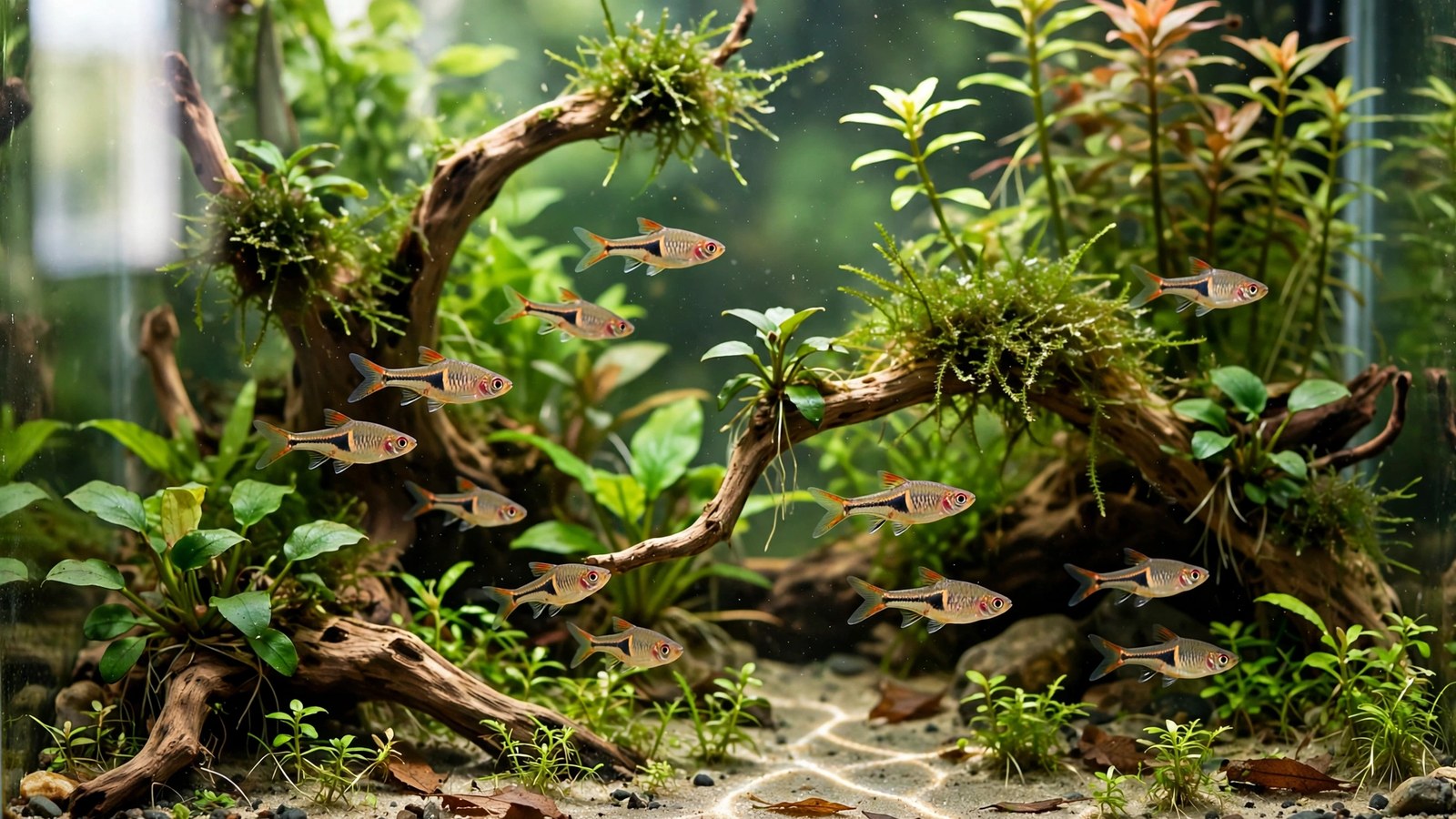
Most nano fish disappear into a planted tank. Phoenix rasboras do the opposite — fifteen males glowing ember-orange against tannin-stained water is one of the nano hobby's great sights. But Boraras merah is a timid peat-swamp specialist, and the standard playbook — bright light, strong flow, small groups — turns them into permanent hiders. This phoenix rasbora planted tank guide builds the blackwater nano they were made for.
The short answer: Set up a phoenix rasbora planted tank as a 5-to-10-gallon blackwater nano: dark substrate, gentle sponge-filter flow, stable pH from 4.0 to 6.5, and at least 15 Boraras merah. Dense planting plus catappa leaf litter gives this timid peat-swamp schooler the cover it needs to stay colored and schooling. Notable fact: adult males reach only about 2 cm, so a mature planted 5-gallon tank handles the whole school's bioload with weekly 30% water changes.
Phoenix Rasbora vs Chili Rasbora: Know Which Fish You Have
Mislabeled Boraras are the biggest source of phoenix rasbora disappointment. The trade mixes up two species and one unrelated plant:
| Phoenix rasbora (B. merah) | Chili rasbora (B. brigittae) | |
|---|---|---|
| Color | Warm red-orange, paler belly | Intense red, bold black stripe edged red |
| Stripe | None, or a faint dark blotch | Continuous black lateral stripe |
| Temperament | Timid; needs 15+ and heavy cover | Bolder; settles in smaller groups |
| Origin | Peat-swamp forests of Borneo | Blackwater streams of Borneo and Sumatra |
Buy the wrong one and your expectations will be off: the chili rasbora (Boraras brigittae), the red-and-black-striped cousin, has its own article and its own bolder setup. ("Phoenix moss" is Fissidens fontanus — a fine moss, wrong organism.) Once you have confirmed merah, read the complete planted species-tank build for rasboras, then come back here for the species-specific details.
Building Your Phoenix Rasbora Planted Tank: Layout and Hardscape
Think peat-swamp shallows: still, tea-colored water under forest canopy, leaf litter underfoot. A 5-gallon is the sweet spot for a school of 15; a 10-gallon lets you add shrimp. Filtration is one sponge filter on a gentle air pump — canisters and hang-on-backs create current these fish hate, and their tiny bodies get pinned to intakes.
Go dark: black or dark-brown aquasoil or fine sand, which makes orange fish look dramatically more colorful and reads as safety to a timid schooler. Then add the highest-impact ingredient in this setup: 4–6 catappa leaves scattered on the substrate. They tint the water gold, grow grazing biofilm the rasboras pick at, and mimic the forest floor as they break down over 3–4 weeks. Replace them monthly.
Keep light dim, 6–8 hours daily. Bright light sends merah into the plants; low light plus tannins makes males glow.
Blackwater, Your Way: Water Parameters
Do not let "blackwater" scare you. In practice it means soft, warm, still, and tinted — and the trade consensus is that merah is easy once the tank is cycled and stable. Chase stability, not perfect numbers.
| Parameter | Target | Notes |
|---|---|---|
| Temperature | 73–79°F (23–26°C) | Aim for 75–77°F |
| pH | 4.0–6.5 | Any stable value in range works |
| GH / KH | 1–5 dGH, 0–3 dKH | Soft water; soft tap or remineralized RO |
| Ammonia / nitrite | 0 ppm | Cycle fully first — non-negotiable |
| Nitrate | Under 20 ppm | Weekly 25–30% water changes keep it there |
| Flow | Nearly still | One sponge filter; baffle anything else |
Cycle 3–4 weeks, then add the whole school at once. Match temperature and pH at every water change — a 2-point pH swing in soft water is far more dangerous than a "wrong" but steady pH.
Planting for Security: What to Grow With Them
Planting is behavior management — every stem is courage for the school. Use hardy, low-light plants that tolerate tannins; the forgiving species in the easiest aquarium plants for beginner tanks are almost all phoenix-compatible.
- Background: Cryptocoryne wendtii — broad hiding walls that love soft acidic water.
- Midground: Java fern tied to a small piece of driftwood to anchor the forest-stream look.
- Foreground: Anubias nana petite on stones — keep it low so the front clearing stays visible.
- Surface: Frogbit or red root floaters over 30–50% of the surface — the best single cure for shyness.
Plant densely from day one — a sparse new tank terrifies a timid schooler. If the budget forces a choice, spend it on plants before hardscape.
Feeding a Two-Centimeter Predator
Boraras merah has a pinhead-sized mouth — most feeding mistakes are portion-size mistakes. Feed newly hatched baby brine shrimp (live food triggers red coloration), frozen daphnia, vinegar eels, and 0.3–0.5 mm micro pellets. Standard flakes, even "crushed," are ignored.
Feed two to three tiny meals daily — only what the school finishes in about 60 seconds — and skip one day a week. In a planted 5-gallon, uneaten food decays fast and the ammonia spike hits soft-water fish hard.
CO2 and Fertilizer: Start Low, Watch the Fish
You do not need CO2 here — every plant above thrives without it in low light. If you already run it, stay conservative: a drop checker at pale-to-medium green (roughly 10–20 ppm), and never let livestock gasp at the surface. In a 5-gallon, a small miscalculation swings CO2 fast.
Dose a comprehensive liquid fertilizer at half the label rate once or twice a week, increasing only if plants show deficiency. Heavy dosing in soft, low-KH water invites algae faster than it grows plants. For fish-first planting decisions, our aquarium plants for fish tanks guide keeps the focus where it belongs: on what the animals need.
Frequently Asked Questions
Can phoenix rasboras live in a 5-gallon tank?
Yes — a 5-gallon is the ideal minimum for 12 to 15 fish. At 2 cm each they produce little waste, so a cycled, planted 5-gallon handles the whole school with weekly 30% water changes. Below 5 gallons, parameter swings happen too fast.
How many phoenix rasboras should I keep together?
Fifteen or more. Groups under 12 stay pale and hidden; at 15+ the school acts as one confident unit, schooling openly in full, glowing male coloration. Short on budget? Buy fewer plants and more fish — school size beats aquascape.
Do phoenix rasboras need blackwater?
They do not need a chemistry project, but they prefer tannin-tinted, soft, acidic water like their Borneo peat-swamp home. A few catappa leaves and dark substrate get most of the benefit. Tank-bred fish tolerate stable neutral pH — but bolder coloration shows up in proper blackwater.
What is the difference between phoenix and chili rasboras?
Phoenix rasboras (Boraras merah) are warm red-orange with no stripe and are noticeably shyer. Chili rasboras (Boraras brigittae) are intense red with a bold black lateral stripe and settle more easily in smaller groups. Check the markings before you buy — shops mislabel them constantly.
What do phoenix rasboras eat?
Tiny foods: baby brine shrimp, frozen daphnia, vinegar eels, and 0.3–0.5 mm micro pellets. Feed two to three small meals daily, only what they finish in a minute, and fast one day a week. Live baby brine shrimp is the best color enhancer — males glow brighter within two weeks.
Are phoenix rasboras good for beginners?
Yes, if the tank is fully cycled and stable first. The care is simple — sponge filter, dim light, tannins, tiny food, big school. Add them to a brand-new tank and ammonia kills them; wait out the 3–4-week cycle and they are among the easiest nano fish to keep.
Your Ember-Orange School Awaits
Build it right — dark substrate, tannins, a gentle sponge filter, fifteen or more fish in a fully cycled tank — and the phoenix rasbora stops hiding and becomes the centerpiece it was meant to be. Still comparing? Browse the best schooling fish for planted tanks. For species-level detail, Seriously Fish's species profile of Boraras merah backs the parameters in this guide.