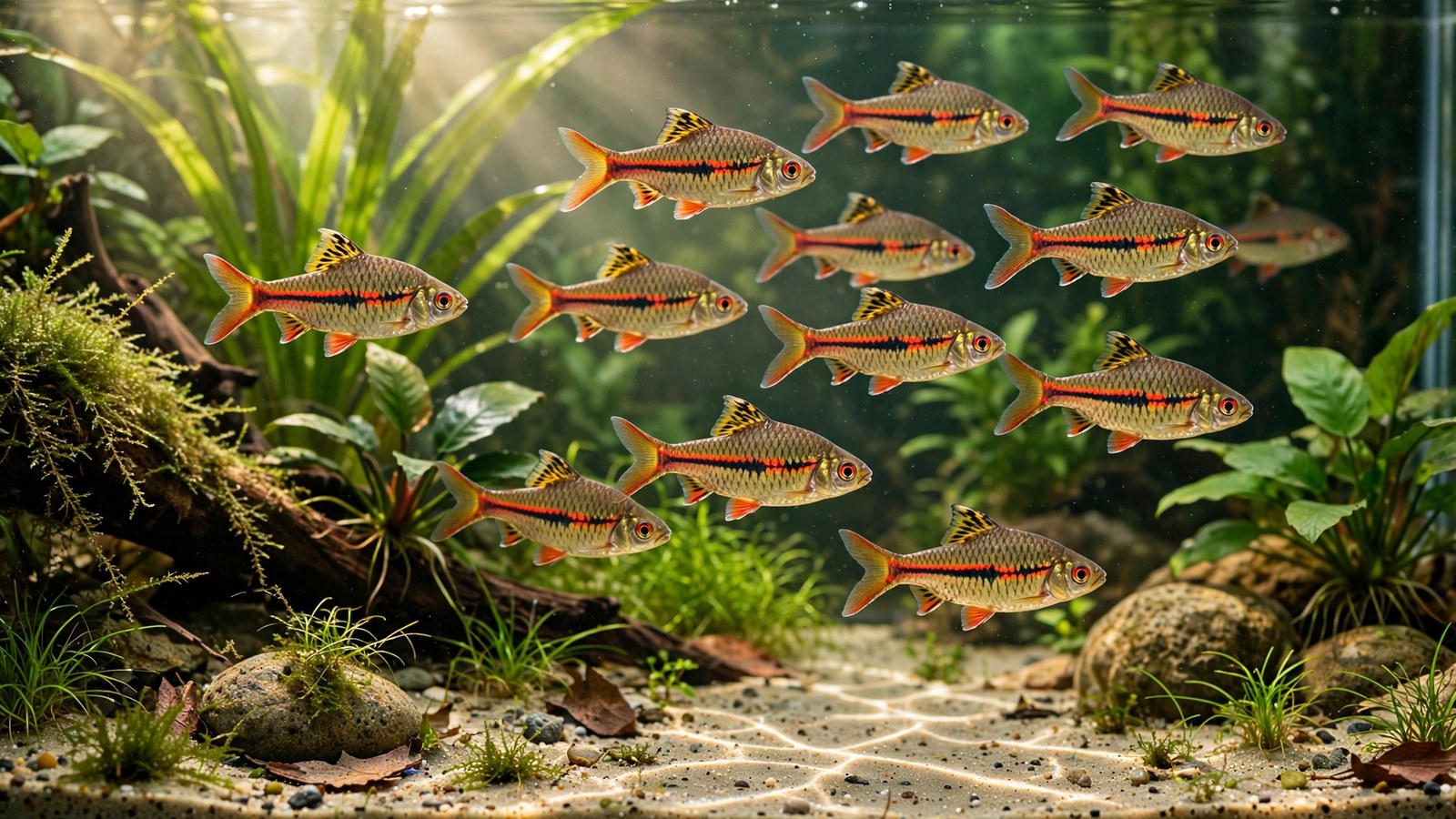
Most planted-tank fish make you choose between color and motion. Odessa barbs refuse the trade. When a school of ten Pethia padamya males ignites their blood-red flank stripes over dark gravel, the tank stops looking like decoration and starts looking alive. An odessa barb planted tank is built around that moment: dimmer light, dark substrate, an open swimming lane, and plants tough enough to survive a daily schooling hammering.
Direct answer: The ideal odessa barb planted tank is a 30–40 gallon long aquarium holding a school of 8–12 Pethia padamya at 21–25°C and pH 6.5–7.5, over a dark substrate under dimmed low-to-medium light. Males develop their red stripe only alongside rivals — retailer care data notes they "show its best colors over a dark substrate with dim lighting in a heavily planted aquarium." School size and substrate color are your two biggest color levers.
Why Odessa Barbs Deserve Their Own Planted Setup
Odessa barbs are not cherry barbs with a paint job: cherry barbs are shy slow-water fish, and tiger barbs are notorious nippers that treat delicate plants like a salad bar. Pethia padamya sits in its own lane: a fast, boisterous mid-water schooler from Central Myanmar — first recorded in an artificial pond above the Anisakan Falls and the lower Chindwin River, and scientifically described by Kullander & Britz in 2008. Males carry a vivid red lateral stripe (padamya is Burmese for "ruby") while females stay silvery-beige, and adults reach roughly 6–7 cm.
That speed is why they need a tank designed for them: an unobstructed central swimming lane flanked by dense plant walls that break sightlines. Males color up noticeably stronger in dimmed, planted tanks, and rival males push each other's red further. Build for speed, cover, and light control, and this fish rewards you like few others.
Your Odessa Barb Planted Tank: Step-by-Step Setup
Start with a 30-gallon long as the floor and a 40-gallon breeder as the sweet spot — footprint matters more than height for a horizontal schooler. Cycle the tank fully before the barbs arrive; a stable nitrogen cycle keeps the red stripe bright.
Filtration should deliver moderate, river-like flow: a canister filter sized for 4–6× tank turnover per hour with a spray bar along the back glass gives current without a whirlpool. Aim a gentle stream down the central lane and baffle any output blasting into resting areas. Keep the tank covered; startled barbs can jump.
Lay the hardscape with intention: driftwood or smooth stones along the back third and both ends, planted heavily around them, with a front-center corridor of open substrate at least 30 cm wide. This "lane flanked by jungle" geometry delivers the schooling display and the sightline breaks in one layout.
Dark Substrate: The Color-Pop Secret
The male's red stripe is a contrast display, and contrast needs a dark background. Over pale gravel males look pinkish and washed out; over black substrate under slightly dimmed light they turn ruby. This is the most repeatable observation in the hobby for this species, and it costs nothing extra to get right.
Two substrates do the job well. Seachem Flourite Black Sand is inert, never breaks down, and holds plants once you add root tabs. CaribSea Eco-Complete in black is another proven choice that reads as a rich, dark riverbed. For heavy root feeders like Amazon swords, run dark aquasoil capped with black sand. Rinse thoroughly and slope it 6–8 cm deep toward the back.
Tough Plants That Survive Barb Traffic
Odessa barbs are not dedicated plant eaters, but they are clumsy — a school playing tag through the stems snaps delicate growth and uproots anything loosely anchored. The fix is structural: rhizome plants tied or glued to wood and rock, plus deep-rooted rosette and runner plants. Skip soft fine-leafed stems; they become shredded confetti within a month.
| Plant | Placement | Why it survives barbs |
|---|---|---|
| Java fern | Tied to driftwood, mid-background | Leathery rhizome leaves barbs ignore; wood-anchored, nothing to uproot |
| Anubias barteri | Glued to rock/wood, midground | Tough, slow-growing leaves; unpalatable and firmly attached |
| Vallisneria spiralis | Back wall, in substrate | Deep runner roots; flexible straps bend instead of breaking |
| Cryptocoryne wendtii | Midground clusters | Dense waxy rosettes; established roots hold firm |
| Amazon sword | Back corners, with root tabs | Heavy root system; broad leaves give chased fish cover |
Plant densely from day one. A low-tech planted tank setup with no CO2 grows every plant on this list under low-to-medium light — exactly the dimmed light your barbs want. For species selection, the complete aquarium plants for fish tanks guide covers the full range, and the easy beginner plants for a community tank roundup overlaps heavily with what survives barb traffic.
Flow, Feeding, and Tankmates
Water management is straightforward: 21–25°C, pH 6.5–7.5, soft to moderately hard, with 30% weekly water changes. Stability beats perfection — swings dull their color within days. The Wikipedia Odessa barb entry documents the species' Myanmar origins and 2008 description, while Diszhal's Pethia padamya profile corroborates the dark-substrate color observation.
Stock 8–12 fish at roughly one male to two females so the females distribute male attention. A school under six is the classic mistake — males stay pale, and "schooling" devolves into two fish sulking in corners.
Feed small and meaty: Hikari Micro Pellets or New Life Spectrum small-fish formula twice daily, plus frozen daphnia or bloodworms two to three times weekly. Carotenoid-rich color foods — color-enhancing flakes or freeze-dried krill — genuinely deepen the stripe over a few weeks.
Choose peaceful, fast, short-finned tankmates: corydoras, larger tetras, and danios all work. Top-dwelling contrast fish round out the column — see a killifish planted setup for the surface layer. The best schooling fish for planted tanks guide and the planted community tank walkthrough both slot Odessa barbs into wider plans. Skip shrimp colonies — adult barbs hunt shrimplets.
Frequently Asked Questions
How many Odessa barbs should I keep in a planted tank?
Keep 8–12 in a 30–40 gallon tank, about one male per two females. Schools under six produce pale, nervous fish and more nipping, because the social structure that spreads male attention never forms. Buy the full school at once so a stable hierarchy forms quickly.
Will Odessa barbs eat my aquarium plants?
Not dedicated plant eaters, but they nibble soft new shoots and uproot loosely anchored stems while roughhousing. Stick to leathery rhizome plants like Java fern and Anubias plus deep-rooted Vallisneria and Cryptocoryne. Attach rhizomes with thread or gel glue rather than burying them. Delicate fine-leafed stems get shredded within weeks.
Do Odessa barbs need CO2 or high light?
No. The best plants for this tank thrive low-tech with no CO2. Dimmer light is an advantage: subdued lighting intensifies the male's red stripe and keeps algae down. Run 6–8 hours daily, and save the CO2 budget for a different scape.
Can Odessa barbs live with cherry shrimp?
Not safely. Adult barbs hunt shrimplets and harass even full-grown shrimp, and no planted refuge stops a fast mid-water predator. Large Amano shrimp stand a chance; a breeding colony of dwarf shrimp gets eaten down. Keep shrimp in a separate tank.
Why is my male Odessa barb pale?
Check school size (under eight males stay dull), substrate color (pale gravel washes the stripe out), lighting (overly bright tanks suppress it), and age (young males take months to color). Fixing school size and going dark on substrate are the two highest-impact changes.
The Payoff
An odessa barb planted tank asks less than most showpiece setups — no CO2 rig, no high-light algae wars, no fragile stems. What it asks for is judgment: a long tank, a real school, dark ground underfoot, light held in reserve. Deliver that, and one evening the school will catch the dim light all at once — ten red stripes flashing in formation — and you'll know why the species name means ruby.