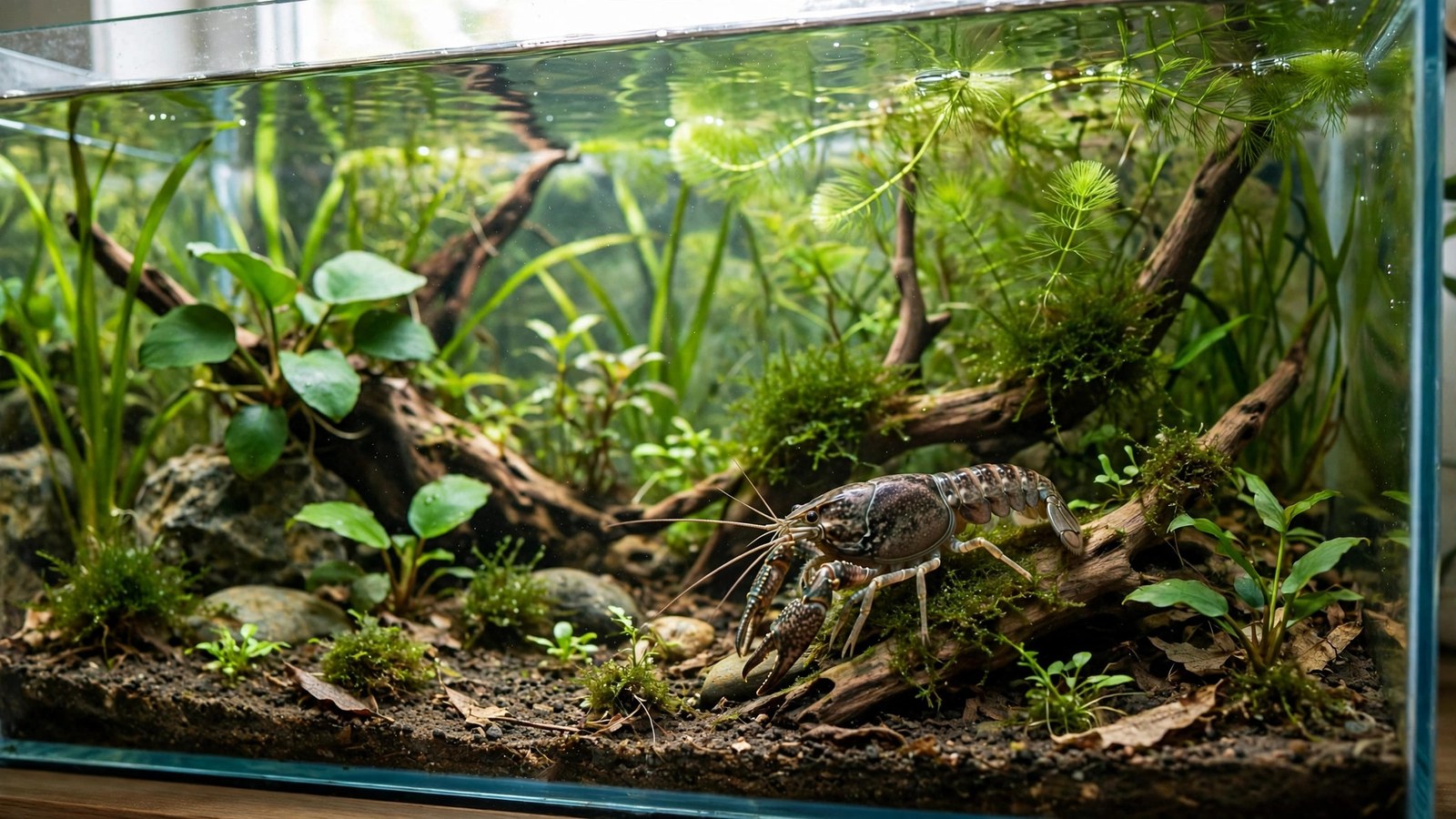
You only need one. A single female marbled crayfish — Procambarus virginalis, the Marmorkrebs — can found an entire colony without a male ever entering the tank, because every individual clones herself. That is the magic and the menace of a marbled crayfish planted tank: you are not stocking an animal, you are installing a self-replicating population in a glass box full of salad. This guide shows you how to make it thrive anyway — plants tough enough to take the claws, water that supports clean molts, and population control that keeps the colony manageable.
One Female, Endless Clones: The Population Problem
Marbled crayfish reproduce by parthenogenesis: unfertilized eggs develop into genetic copies of the mother, and the species has no males at all. A mature female carries dozens of fully formed juveniles under her tail per brood and can repeat that every couple of months in warm water. Buy one, and within a year you can have forty.
So size the tank for the colony, not the animal in the bag. A 20-gallon tank suits a single female, but a colony needs 40–55 gallons with broken sightlines so juveniles can dodge adults — cannibalism of freshly molted tank mates is real. If you want crayfish personality without the multiplication, our Mexican dwarf crayfish (CPO) planted-tank setup guide covers a species that breeds in pairs, not clones. For marbled crayfish, buy the colony-sized tank before you need it.
Setting up your marbled crayfish planted tank
Crayfish are messy: they tear food apart, produce heavy waste, and molt often, so filtration and stability matter more here than in a fish-only planted tank.
| Parameter | Target | Notes |
|---|---|---|
| Tank size | 20 gal single; 40+ gal colony | Footprint beats height |
| Temperature | 64–77°F (18–25°C) | Cooler water slows breeding |
| pH | 7.0–8.0 | Acidic water weakens shells |
| GH / KH | 6–12 dGH / 3–8 dKH | Calcium for new exoskeletons |
| Ammonia / nitrite | 0 ppm | Cycle fully before adding crayfish |
| Nitrate | Under 20 ppm | 30% weekly water changes |
Use sand or fine gravel they can dig in without collapsing burrows. Fit any filter with a sponge prefilter — our prefilter sponge guide shows the two-minute fix — to keep claws and juveniles out of the intake. Hides are non-negotiable: a crayfish is soft for 24–48 hours after molting and needs a cave or crevice it can back into. Provide at least one hide per animal, plus spares.
Plants That Survive Crayfish (and the Ones That Won't)
Marbled crayfish shred plants — they clip stems, uproot new plantings, and graze anything soft. You don't fix this by feeding more; you design around it.
| Category | Examples | Why it works |
|---|---|---|
| Rhizome plants on hardscape | Anubias, Java fern, Bucephalandra | Tied to wood/rock — nothing to uproot |
| Floating plants | Salvinia, frogbit, water lettuce | Out of reach of claws |
| Tough rooted plants | Crinum, Aponogeton, established Amazon sword | Leathery leaves; deep roots hold |
| Sacrificial fast growers | Hornwort, guppy grass, Elodea | Living food, replaced cheaply |
| Doomed choices | Carpets, soft stems, fresh tissue-culture plugs | Clipped or uprooted within days |
For selection principles, start with our aquarium plants for fish tanks guide, then cross-check the easiest aquarium plants for beginners list — the tough, undemanding species overlap heavily with what survives claws.
Feeding and Molting: Calcium Is Non-Negotiable
Feed sinking crayfish or shrimp pellets as the staple, blanched zucchini or spinach twice a week, and a little frozen bloodworms for protein. Remove uneaten fresh food after 24 hours — rotting vegetables crash water quality fast.
Molting is the critical event: juveniles shed every few weeks, and the new shell needs dissolved calcium to harden. Drop cuttlebone into the tank and leave shed shells — crayfish eat them to reclaim minerals. A crayfish stuck half-out of its shell means the water is too soft or acidic.
Tank Mates and Population Control
Marbled crayfish catch anything slow, sleeping, or small: shrimp colonies, snails, and bottom-dwellers are food. Fast mid-water swimmers like zebra danios are the only relatively safe bet, and even they lose eggs and fry. For most keepers, species-only is the right call.
For algae control, our cleanup crew guide for planted tanks helps — but apply the crayfish filter, since many "safe" crew members aren't safe from claws; manual removal stays part of your routine. For comparison, our honest electric blue crayfish setup guide covers another plant-shredding Procambarus that breeds in pairs rather than clones.
Population control is mandatory. Separate berried females into a breeder box to pause the colony, rehome juveniles through your local fish club early, and never treat a pond, stream, or toilet as an exit. Released stock has founded wild populations in several countries — every released female is a whole colony.
Check before you buy: marbled crayfish are banned under the EU's Invasive Alien Species regulation and are prohibited or require permits in several US states — check your current local list, and never release or transport them into the wild. Ontario's marbled crayfish invader fact sheet and Michigan State University Extension's overview of marbled crayfish in the pet trade explain why this animal is regulated.
Frequently Asked Questions
Do marbled crayfish eat aquarium plants?
Yes — enthusiastically. They clip stems, uproot new plantings, and graze soft leaves. Tie Anubias and Java fern to hardscape, keep floating plants out of reach, and grow sacrificial hornwort as living food. Carpets and soft stems are doomed here.
How fast do marbled crayfish multiply?
One female can produce dozens of juveniles per brood and breed repeatedly in warm water — a single animal becomes a colony of forty within a year. Cooler water (64–68°F) slows breeding but never stops it. Plan tank size and an exit strategy for the colony, not the individual.
Are marbled crayfish legal to keep?
It depends on where you live. They're banned across the EU under the Invasive Alien Species regulation, and several US states prohibit or restrict them. Check your local invasive-species list before buying, buy only from reputable sellers, and never release them — released stock has founded wild populations in multiple countries.
What size tank does a marbled crayfish colony need?
A single female does fine in 20 gallons; plan 40–55 once breeding starts. Footprint matters more than height: juveniles need broken sightlines, multiple hides, and room to avoid adults after molting. Overcrowding triggers cannibalism — upgrade before the second brood hatches, not after.
Can marbled crayfish live with fish?
Rarely well. They catch slow, sleeping, or small fish, and eat shrimp and snails. Fast mid-water swimmers like zebra danios usually survive but lose eggs and fry. Species-only is the honest recommendation — design the whole scape around crayfish behavior instead of compromising.
The Cloning Colony, Done Right
A marbled crayfish planted tank works when you stop expecting a peaceful aquascape and start running a managed colony: tough plants on hardscape, sacrificial growers, hard water with calcium, and a population plan from day one. Respect the biology — and the law — and one self-cloning female gives you the most fascinating tank in the hobby.