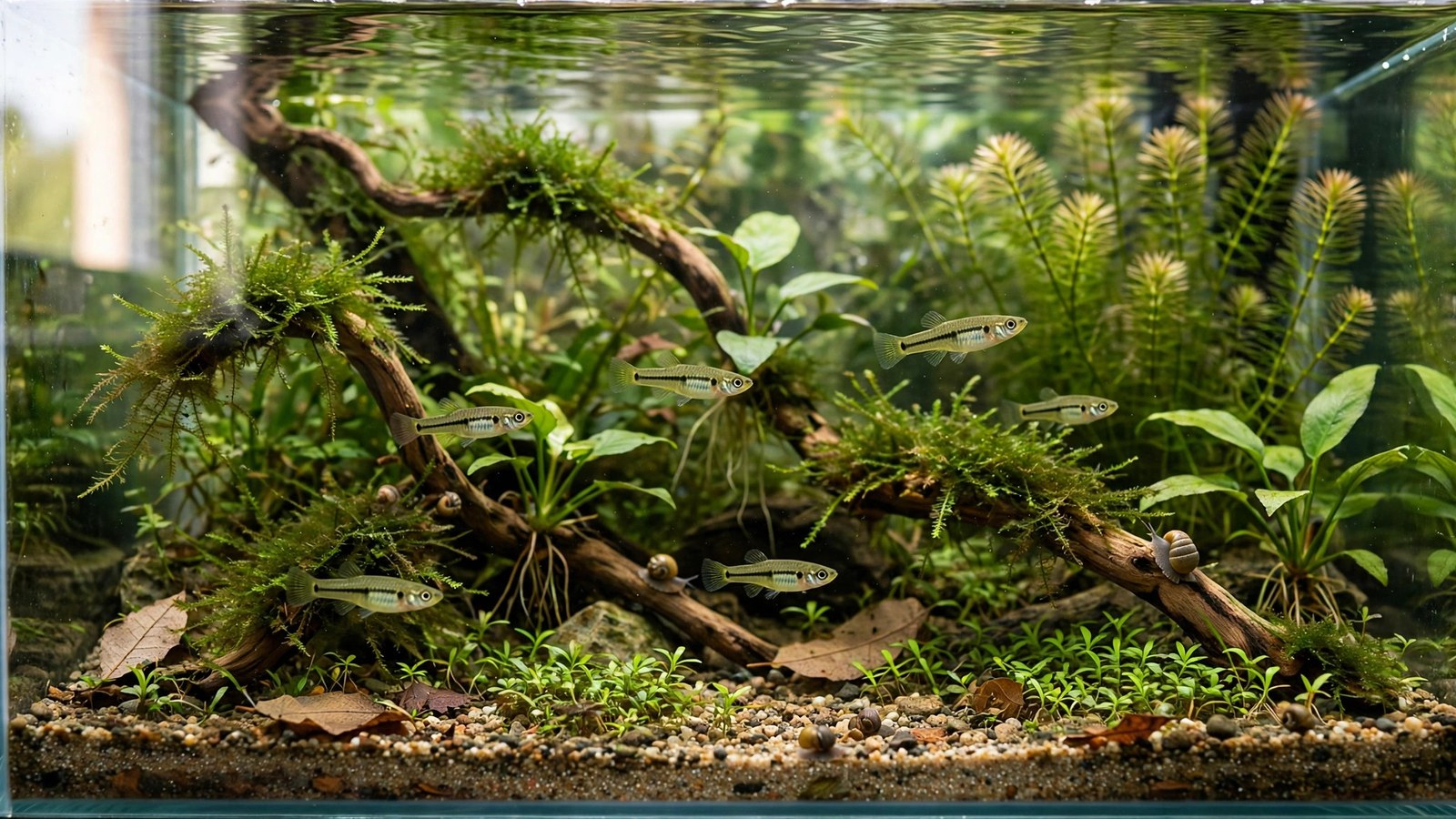
One of the world's smallest livebearing fish barely outgrows your thumbnail — and it breaks the one rule every other killifish follows. A least killifish planted tank needs no peat moss, no spawning mops, no egg-hatching rituals, because Heterandria formosa is the only livebearing "killifish" in the hobby. This guide shows you how to set up, plant, feed, and breed this dwarf livebearer in a 5–10 gallon nano tank.
The short answer: a least killifish planted tank is a 5–10 gallon densely planted nano setup at 68–78°F with a sponge filter. Unlike every egg-laying killifish, Heterandria formosa gives birth to live fry every 3–5 weeks — and females practice superfetation, carrying several broods at different developmental stages at once, so fry arrive continuously rather than in batches.
The Only Livebearing "Killifish" in the Hobby
The common name is a trap. Every other killifish — clown, golden wonder, gardneri, rachovii — is an egg-layer with spawning rituals and peat substrates. Heterandria formosa (sold as the dwarf mosquitofish) belongs to the livebearer family Poeciliidae: a tiny guppy cousin wearing a killifish's name.
This rewrites the whole setup. Where egg-layers revolve around spawning media (compare the routine in a clown killifish planted tank), least killifish revolve around one thing: permanent dense cover, because fry are always arriving.
From the slow, vegetated swamps and ditches of Florida and the coastal Southeast US, they want still-ish water, soft plant-filtered light, and thickets everywhere. The aquarium plants for a fish tank guide covers plant-selection basics; nano specifics follow below.
Your Least Killifish Planted Tank: Nano Parameters
Five to ten gallons is the sweet spot — a trio in a 5-gallon has plenty of room, and a 10-gallon absorbs a growing colony. Skip power filters entirely; even gentle hang-on-backs suck up newborn fry. One air-driven sponge filter gives you biological filtration, biofilm grazing, and zero fry hazard.
| Parameter | Target |
|---|---|
| Tank size | 5–10 gallons |
| Temperature | 68–78°F (20–26°C) |
| pH | 7.0–8.0 |
| Hardness | Moderate to hard |
| Filtration | Sponge filter only |
| Lighting | Low–medium, 6–8 hours/day |
| Water changes | 25% weekly |
| Stocking | 1 male to 2–3 females per 5 gallons |
No heater is needed if your room stays above 68°F year-round — they tolerate cool dips and breed most steadily in the low-to-mid 70s. Stock lightly: a trio becomes a dozen-plus within months. The stocking notes on nano planted tank ideas cover colony math — plan for what the tank will become.
Planting Dense: The Fry-Cover Blueprint
Forget negative space — here, plants are infrastructure. Target fine-leaved species covering 60–70% of the water column, with open lanes only along the front glass.
- Guppy grass: the MVP — fast, tangled, packed with microfauna fry graze on. Float one clump, root another in the back corner.
- Java moss: on driftwood or up the back wall. Newborn fry vanish into it within seconds of birth.
- Pearlweed: a mid-ground bush whose tiny leaves form a maze adult mouths can't navigate.
All three are forgiving low-tech plants — the easiest aquarium plants for a beginner community tank list confirms they survive neglect. Plant in zones: guppy-grass wall behind, pearlweed thickets mid-tank, moss on hardscape at the edges. If you can see more than half the substrate, you haven't planted enough — the breeding tank plant setup rule of cover over composition applies perfectly.
Breeding: No Eggs, Just a Constant Fry Drip
No breeding project exists — no spawning mops, no egg collection. Keep a mixed-sex group fed and sheltered: females drop 1–5 live fry roughly every 3–5 weeks, and because of superfetation, cycles overlap so a colony produces new fry most weeks.
Newborns are ~0.25 inches, fully formed, swimming and grazing immediately. Expect the colony to roughly double every 2–3 months until carrying capacity slows it. Have a rehoming outlet ready before you need one, and never release them outdoors.
One settling phase: newly introduced females often stress-drop fry within days of arrival, and the first batch usually gets eaten. Don't panic — once they're comfortable, the rhythm stabilizes.
Feeding Micro Foods
Tiny mouths, constant grazing habit. Feed a varied micro-diet, not one staple:
- Daily: crushed micro pellets or powdered flake, twice a day, only what they finish in 60 seconds.
- 3–4× weekly: live or frozen micro foods — baby brine shrimp, microworms, or grindal worms. The microworm culture guide for aquarium fry walks through the trivial home setup.
- Fry: biofilm and infusoria from the plant thickets for the first 48 hours, then powdered fry food and baby brine shrimp from day 3–4.
Skip large flakes — if a particle is wider than their eye, they can't manage it. A weekly fasting day is fine.
Tank Mates: Shrimp, Yes — With One Honest Caveat
Least killifish are peaceful to the point of timidity. The pairing everyone asks about:
- Adult cherry shrimp: excellent. Adults are completely ignored — too big to register as food.
- Newborn shrimplets: hunted. Least killifish are micropredators, and a shrimplet is exactly the right size to eat. Some survive in dense moss; in a sparse tank, none will.
- Other nano fish: chili rasboras, ember tetras, and sparkling gouramis work, but every added species eats some killifish fry. For maximum fry survival, go species-only.
If shrimp are your goal, plant even denser and accept a shrimplet tax — the colony grows slowly instead of exploding. The planted shrimp tank setup covers moss-density tricks that maximize shrimplet survival under micropredators.
Population Control and Common Mistakes
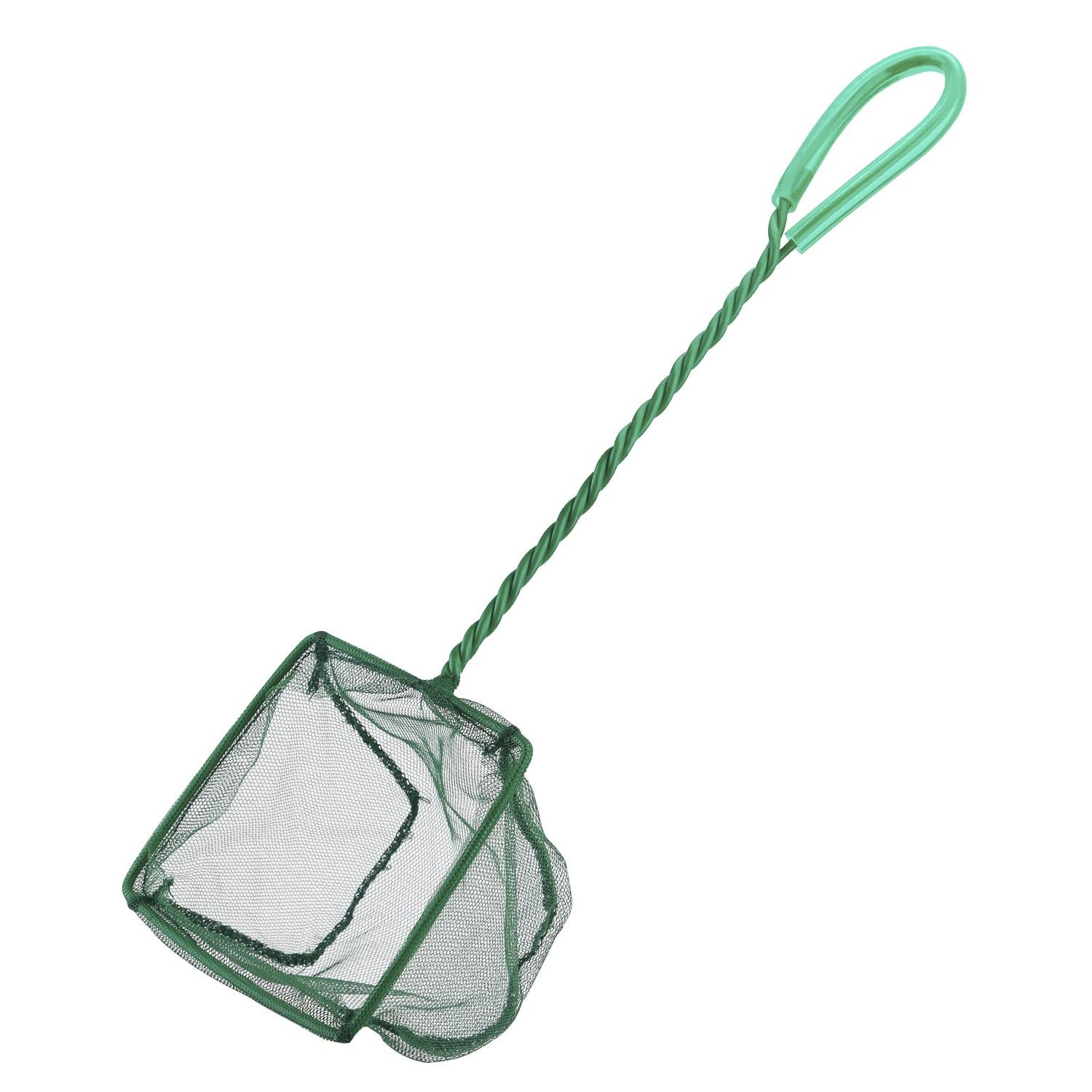
A colony is a slow-motion population boom. Resist "just add a predator" — anything big enough to eat juvenile killifish will also stress the adults and wreck the nano peace. Thin juveniles by net instead, and rehome them.
Water-change discipline beats gadgetry: 25% weekly keeps nitrates under 20 ppm as bioload creeps up. Test monthly; if nitrates climb anyway, you're overfeeding or overdue to rehome juveniles.
 ★4.6
Pawfly 4" Aquarium Shrimp Net
Check Price on Amazon ★4.6Frequently Asked Questions
Are least killifish really killifish?
Only by common name. Least killifish (Heterandria formosa) are livebearers in the family Poeciliidae — guppy and molly relatives — while true killifish are egg-layers in families like Rivulidae and Nothobranchiidae. The name stuck because they're small and share wild habitats with true killifish.
Do least killifish need a heater?
Not if your room stays above 68°F (20°C) year-round. They're subtropical fish from Florida and the coastal Southeast US and tolerate cool dips that stress tropical species. They breed most steadily in the low-to-mid 70s°F; add a small heater only if winter room temps dip below 68°F.
How fast do least killifish breed?
Females drop 1–5 live fry every 3–5 weeks, and thanks to superfetation — carrying multiple broods at different developmental stages at once — a colony produces fry nearly continuously. A starter trio can become a dozen-plus fish within a few months in a dense tank with zero intervention.
Can least killifish live with cherry shrimp?
Adult shrimp are completely safe — least killifish ignore anything too big to swallow. But they hunt newborn shrimplets relentlessly, so your shrimp colony grows slowly rather than exploding. Dense java moss and guppy grass give some shrimplets hiding cover; sparse tanks see near-total predation.
What do baby least killifish eat?
For the first 48 hours they graze biofilm and infusoria in dense plant thickets — why heavy planting is non-negotiable. From day 3–4, offer powdered fry food and newly hatched baby brine shrimp. Feed tiny amounts twice daily; uneaten powder fouls nano tanks fast.
A Tiny Fish That Rewards Dense Planting
The least killifish asks for almost nothing — a small tank, room-temperature water, a jungle of fine-leaved plants — and returns a self-sustaining colony breeding quietly in the thickets. Plant thick, feed small, let it multiply. For authoritative species data, see the Seriously Fish profile of Heterandria formosa.