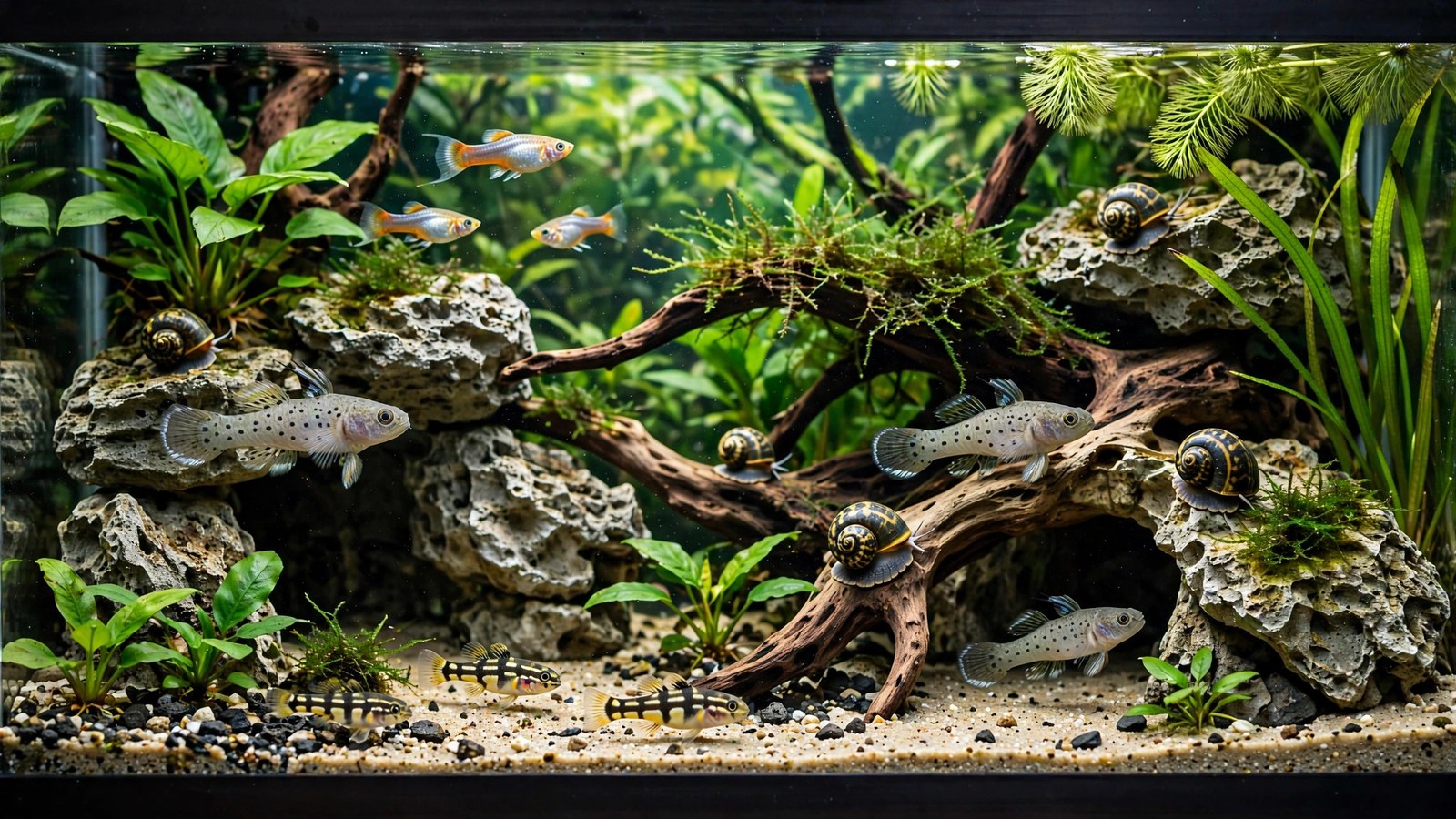
Few freshwater fish divide keepers like the knight goby. One camp insists it needs brackish water, the other keeps it in hard, alkaline tap water for years — and both have thriving, spotted, fin-fanning fish to prove it. If you want to build a knight goby planted tank, you don't have to pick a side. You need the honest middle ground, one cave per male, and plants that won't melt at the first pinch of salt.
Knight Goby Planted Tank: Settling the Brackish-vs-Freshwater Debate
The confusion is understandable: Stigmatogobius sadanundio comes from South and Southeast Asian estuaries, where water slides between fresh and brackish with the tide. Wild fish lean freshwater, yet they keep better health and color in the aquarium with a little salt — SeriouslyFish targets roughly one-quarter marine strength (SG ~1.005), while noting great success in hard, alkaline freshwater too.
Clear up the name confusion first: the knight goby is not the bumblebee goby (Brachygobius doriae), a much smaller true-brackish nano species covered in our bumblebee goby planted tank guide. Nor is it a stiphodon goby, a freshwater algae-grazing stream fish from a different niche entirely.
| Approach | Target SG | Verdict |
|---|---|---|
| Light brackish (consensus) | ~1.005 | Best all-rounder: fewer fungal issues, still planted |
| Hard alkaline freshwater | 1.000 (pH 7.5–8.5, GH 10+) | Works long-term; avoid soft acidic water |
| Heavy brackish | 1.008–1.010 | Unnecessary; shrinks your plant list for no gain |
Whichever you choose, stability beats precision: mix replacement water to match the tank and verify it with a refractometer before it goes in.
Aquascape: Caves, Sand and Salt-Tolerant Plants
Start with the floor: fine sand 5–7 cm deep, no coarse gravel for a fish that lives on its belly. Then build territory — stack slate, lava rock or ceramic caves into two or three distinct clusters, each with a clear entrance and an overhang. Plan one cluster per male; a male without his own cave becomes the tank's bully.
At SG 1.005 most true freshwater plants survive, but delicate stems and soft-water specialists melt. Build around proven salt-tolerant species:
| Plant | Placement | Why it works here |
|---|---|---|
| Java fern | Tied to cave rocks | Tolerates SG 1.005; anchors hardscape to planting |
| Anubias spp. | Wood/rock, low light | Slow, tough, unpalatable; survives light brackish water |
| Vallisneria | Background | Hard-water lover that takes mild salt |
| Water sprite | Midground or floated | Fast grower; doubles as shade |
| Floating plants | Surface | Dim the light — bright light makes gobies reclusive |
Knight gobies are dim-light fish — under bright open light they hide all day. A mat of floaters over part of the surface drops the intensity the goby feels while rooted plants below still get enough; see our floating aquarium plants for beginners for salt-tolerant options. The hardy picks in our aquarium plants for fish tanks guide overlap well, and the whole build works as a low-tech planted tank: moderate light, no CO2, weekly liquid fertilizer.
Feeding a Predator That Snubs Flakes
The knight goby is a carnivore with standards. Frozen bloodworms, mysis shrimp, chopped krill and daphnia are the staples; live blackworms or grindal worms trigger the strongest feeding response. Most also browse a little green algae — garnish, not dinner.
Flakes are the classic failure point. Some gobies eventually pick at quality pellets, but most ignore dry food entirely — a goby that "isn't eating" is usually being offered the wrong food. Feed once daily, only what disappears in two to three minutes, and deliver it near the caves with tongs or a turkey baster. Frozen mysis thawed in tank water is the most reliable first meal for new arrivals.
Tank Mates, Territory and the Jumping Habit
With other species, the knight goby is peaceful — the territorial streak is reserved for its own kind. One male per cave cluster is the rule; two males in a 20-gallon will feud until one owns every cave. One male with two or three females in a well-structured 30-gallon gives you the best shot at the famous "fan dance" courtship display.
Tank mates need two qualifications: too big to swallow, and tolerant of your chosen water. Sailfin mollies and swordtails are the classics — they handle hard alkaline or lightly brackish water and stay up top, out of the goby's way. Cherry shrimp, amano fry, or nano fish under 3 cm are live food, not tank mates. Planning the bottom crew? Read our cleanup crew for planted tanks guide and cross off anything shrimp-sized.
Finally, the lid. Knight gobies are startled, powerful jumpers — a spooked fish can clear an open-top tank. Our open top vs lid guide for planted tanks covers the trade-offs, but for this species the answer is simple: a tight-fitting lid with no gaps around filter tubing, full stop.
Frequently Asked Questions
Can knight gobies live in a fully freshwater planted tank?
Yes, if the water is hard and alkaline (pH 7.5–8.5, GH 10+) — many keepers run them this way for years. Avoid soft, acidic freshwater, which stresses them. Light brackish at SG ~1.005 remains the consensus sweet spot; hard freshwater is a proven second option.
How big a tank does a knight goby need?
A 20-gallon (roughly 75 × 30 cm footprint) is the practical minimum — you need floor space for at least two cave clusters. For one male with two to three females, step up to 30 gallons for buffer room. Footprint matters more than height for this bottom-dweller.
Are knight gobies aggressive?
Toward other species they are peaceful, even shy. Toward their own kind — especially males — they are territorial and will spar over caves. One male per cave cluster with visual barriers keeps aggression at posturing; two males in a small, open tank is the scenario that goes wrong.
Will a knight goby eat my cherry shrimp?
Yes — count on it. Knight gobies are nocturnal predators that will clear out a cherry colony over weeks, and eat any nano fish small enough to swallow. If shrimp are part of your plan, this is the wrong fish for that tank.
Why does my knight goby hide all day?
Usually too much light and too little cover. These are dim-light fish — bright, open tanks keep them wedged in caves. Shade part of the surface with floating plants and provide at least two proper caves. Most gobies turn noticeably bolder within a week or two of dimmer conditions.
How is the knight goby different from the bumblebee goby?
Size and water needs. The knight goby (Stigmatogobius sadanundio) reaches 8–9 cm and tolerates hard freshwater or light brackish. The bumblebee goby (Brachygobius doriae) stays around 3–4 cm and is a true brackish nano specialist needing a species or carefully matched nano tank.
A Patient Fish for a Patient Tank
The knight goby rewards the keeper who builds around its instincts: estuary-steady water, a sandy floor, caves with doors facing away from each other, dim light under floaters, and meaty food delivered to its doorstep. Get those five right and you unlock an underrated character. For the full technical profile, see the SeriouslyFish Stigmatogobius sadanundio species profile and the Wikipedia overview of Stigmatogobius sadanundio.