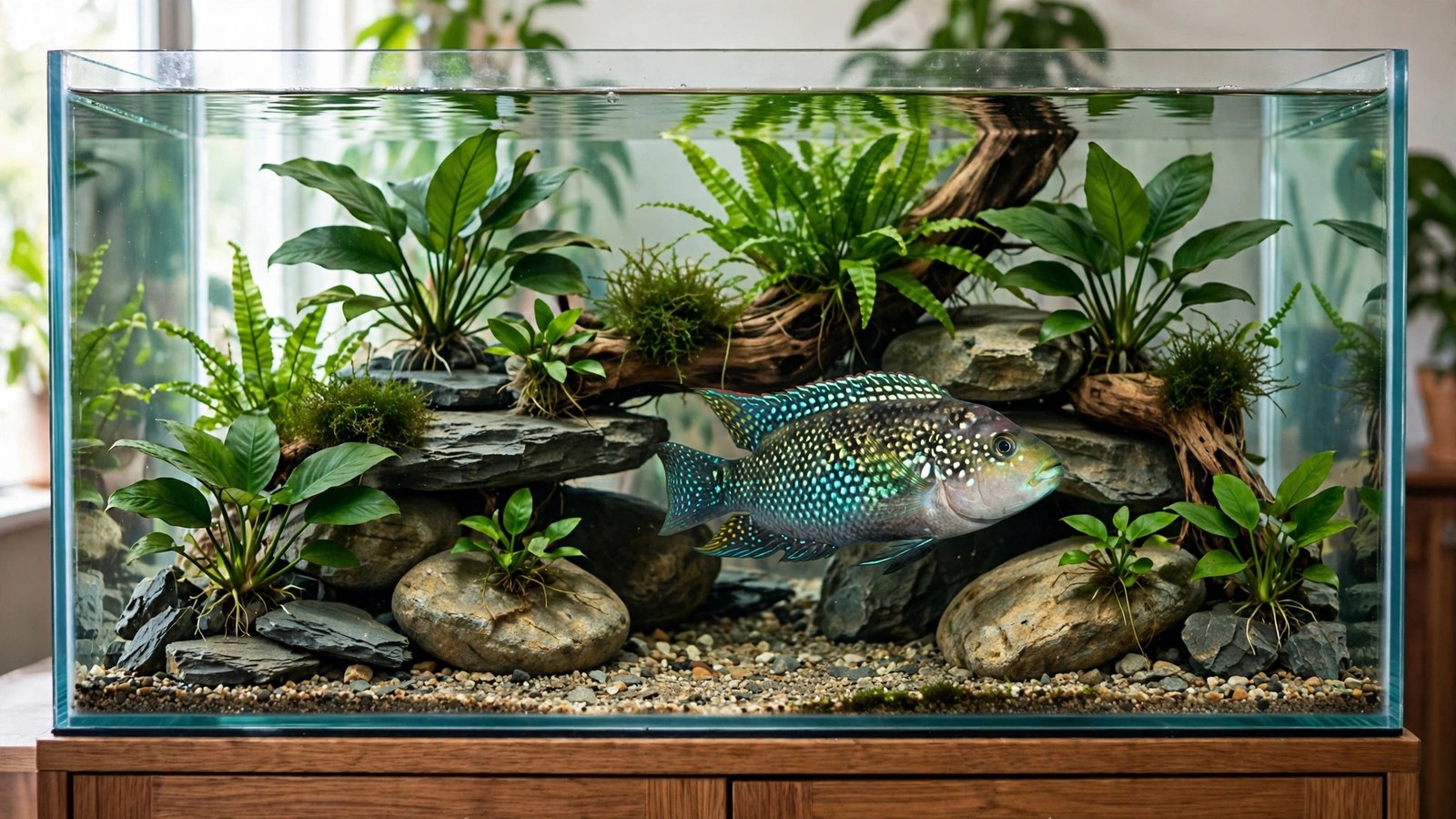
A Jack Dempsey doesn't share its tank with plants — it evicts them. This eight-inch Central American boxer rearranges substrate like a contractor and treats anything rooted in the open as landscaping to demolish. But a jack dempsey planted tank is absolutely possible if you stop planting for the fish and start planting where the fish can't reach. By the end of this guide you'll know exactly which plants survive a Dempsey — and the hardscape tricks that keep them anchored.
This approach follows the same fish-first plant selection for aggressive diggers used across aggressive cichlid setups: choose species for the fish's behavior first, aesthetics second.
Why a Jack Dempsey Planted Tank Needs a Survival Strategy
A breeding pair of Jack Dempseys can excavate a spawning pit to the glass bottom overnight, flinging substrate across the tank. Plants rooted in the open get uprooted, shredded, or buried — sometimes all three. This is normal Dempsey behavior, not a plant problem, so the strategy isn't to find tougher plants for the substrate. It's to take the substrate out of the equation entirely.
Three planting zones survive long-term:
- Zone 1 — Above the substrate: epiphytes tied or glued to driftwood and rock. The Dempsey can dig underneath them all day without dislodging a single leaf.
- Zone 2 — The surface: floating plants with roots dangling below. No substrate involved, and they shade the tank.
- Zone 3 — Armored pots: heavy root-feeders in pots with stones ringed around the base, placed where the fish already accepts hardscape.
Stem plants and carpeting species simply don't survive in Zone 0 (open substrate). Accept that, and the rest is straightforward.
The Digger-Proof Plant Palette
Every plant below survives Dempseys by one of two routes: it doesn't touch the substrate, or it's guarded by stone and clay. Plants with soft, tasty leaves or delicate stems are omitted on purpose.
| Plant | How to place it | Why it survives |
|---|---|---|
| Anubias barteri / nana | Tie or glue rhizome to driftwood or rock | Tough bitter leaves; rhizome never buried |
| Java fern (Microsorum pterotoides) | Tie or glue rhizome to hardscape | Leathery unpalatable fronds; self-propagates on wood |
| Anubias coffeefolia | Attach to rock in shaded spots | Rigid textured leaves fish ignore |
| Water Lettuce (Pistia stratiotes) | Float on the surface | No substrate contact; shades the tank |
| Amazon sword (Echinodorus amazonicus) | Plant in a clay pot, ring stones around the base | Deep roots in the pot; stone guard blocks digging |
| Java moss | Tie to wood and rock crevices | Low profile; grows back from scraps |
Use cotton thread or cyanoacrylate superglue (gel, aquarium-safe) to attach epiphytes — the bond holds through years of Dempsey redecorating. For species profiles and placement advice, Tropica's aquarium plant database is a solid reference; for cichlid-specific picks, see the dig-proof plant picks for cichlid tanks.
Zone 2: Floating Plants Dim the Lights and the Temperament
Water Lettuce is the workhorse floater for this setup. A loose canopy of it does three jobs at once: it dims the lighting (Dempseys color up dramatically under subdued light against a dark background), it absorbs the nitrates a messy carnivore produces, and it breaks sightlines, which reduces territorial flare-ups.
Keep one-third to one-half of the surface covered, corralled with airline tubing rings so floaters don't clog the filter intake, and thin them weekly — healthy Pistia doubles fast. The beginner floating plant guide covers corraling and maintenance in detail.
Hardscape First: Rocks, Caves, and Territory Lines
Plants are decoration in a Dempsey tank; hardscape is the architecture. Build the territory structure first, then plant into it.
- Deep sand, 2–3 inches. Fine pool-filter or play sand — the fish will dig pits in it regardless, so give it depth. Coarse gravel is harder on their mouths and hides waste.
- Rock caves. Stack slate or river rock into at least two caves, one per fish. Caves that touch the bottom are more stable than tall towers a digger can undermine.
- Driftwood anchors. Heavy mopani or spider wood doubles as the mounting surface for all Zone 1 plants. Choose pieces that sit flat and won't topple when sand is excavated around them.
- Dark background. Black or deep blue on the back glass — Dempsey iridescence pops against it and it supports the dim-light strategy.
- Territory sight-breaks. A ridge of rock or a wood mass dividing the tank into two visual halves lets a pair claim separate zones instead of fighting over one.
Similar territory-first layouts work for other digging cichlids — the firemouth cichlid planted tank guide uses the same flat-rock spawning-territory approach, and the convict cichlid planted tank setup shows how cave territories handle relentless breeders.
Feeding and Filtration for a Messy Carnivore
Jack Dempseys are carnivorous omnivores with a heavy bioload. Feed quality cichlid pellets as the staple, supplemented with earthworms, krill, and frozen foods like bloodworms or mysis shrimp. Once or twice daily, in amounts eaten within two minutes; fast one day a week.
Because they're messy eaters, filtration must be strong: a canister filter rated for 1.5–2× the tank volume, plus surface agitation for oxygenation. Run 30–40% water changes weekly — nitrates climb fast, and floaters alone won't keep up. Check filter intakes weekly; dug-up sand migrates everywhere.
Frequently Asked Questions
Will a Jack Dempsey eat aquarium plants?
Dempseys rarely eat plants, but they uproot and shred anything rooted in open substrate, especially when digging spawning pits. Tough epiphytes like Anubias and Java fern are usually left alone — bitter, leathery leaves aren't appealing, and being tied to hardscape keeps them out of the digging zone.
Can I keep a breeding pair of Jack Dempseys in a planted tank?
Yes, but expect maximum excavation. Use a 75+ gallon tank with all plants in the three safe zones: epiphytes on hardscape, floating plants, and potted swords with stone guards. Provide two caves and a sight-break divider so the pair can claim separate territories when they're not breeding.
What substrate is best for a Jack Dempsey planted tank?
Fine sand, 2–3 inches deep — play sand or pool-filter sand both work well. Sand is gentler on digging mouths than gravel, which traps waste and can injure the fish. Nothing should be planted directly in it — use pots, hardscape-mounted epiphytes, and floaters instead.
Do Jack Dempseys need special lighting for their colors?
Dim to moderate lighting with a dark background brings out their best coloration — electric blue speckling and gold flanks intensify under subdued light. A partial canopy of floating plants achieves this naturally while also calming territorial behavior. Bright, bare tanks tend to wash out their colors and raise stress.
How often should I do water changes with a Jack Dempsey?
Change 30–40% weekly. Jack Dempseys are large, messy carnivorous omnivores with a heavy bioload, and nitrates accumulate quickly even with strong filtration. Vacuum the sand surface between changes — dug-up debris settles in their pits — and test nitrates weekly to fine-tune the routine.
Can tankmates work in a Jack Dempsey planted tank?
Tankmates are risky and not recommended for most keepers. Jack Dempseys are aggressive and territorial, and in a 75+ gallon tank a pair alone fills it comfortably. If attempted, only similarly sized, robust cichlids in much larger tanks — and the plants still need the digger-proof strategy regardless of tankmates.
A jack dempsey planted tank will never be a pristine Dutch aquascape — and that's fine. Plant for the digger, not against it.