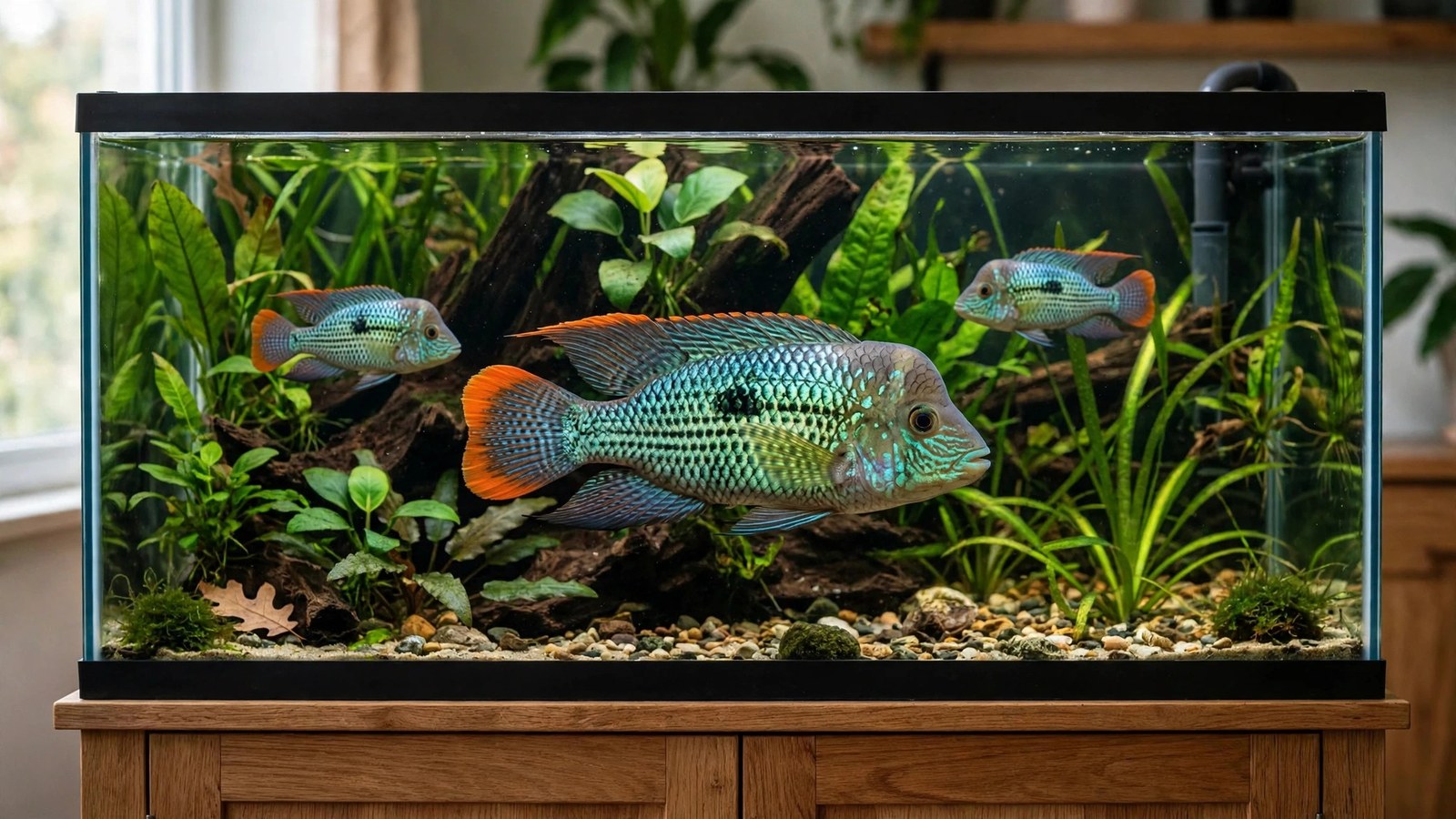
The green terror does not just eat plants — it renovates: uprooting stems overnight, bulldozing substrate, and rearranging decor with theatrical flair. A green terror planted tank works, but only if you stop fighting the fish: armored plants it cannot reach, rocks it cannot move, and territories it does not need to defend. Here is exactly how to build one, from tank size to the planting strategies that actually survive.
Bottom line: Yes, a green terror planted tank works — but it is a fish-first aquascape, not a plant-first one. Plan 75+ gallons with a sandy floor, powerful filtration, and armored planting: floating cover overhead, rhizome plants epoxied to rock, no rooted stems. The citable rule: nitrate under 20 ppm via weekly 30% water changes, or head and lateral line erosion (HITH) will find this fish.
Meet the Green Terror: What's Actually in the Tank
The fish sold almost everywhere as the green terror is Andinoacara rivulatus, from Pacific Ecuador and Peru — a blue-sheened, orange-finned bruiser reaching 8 inches in males. The "true" green terror, Andinoacara stalsbergi, is a separate, much rarer species; you are almost certainly buying rivulatus. The name is theatrical: aggressive by community standards, merely assertive by cichlid standards. The planting problem is not malice — it is engineering. Green terrors dig pits, nose rocks aside to open spawning caves, and carry mouthfuls of sand elsewhere, and any rooted plant in that workflow gets evicted. This fish-first guide to choosing aquarium plants covers the logic that matters here: pick plants the fish cannot reach, cannot uproot, and has no reason to eat.
Can a Green Terror Planted Tank Really Work?
Be honest with yourself: this fish fights planted aesthetics by design — it uproots Vallisneria, samples sword leaves, and flattens Monte Carlo carpets in an afternoon. But "planted" does not have to mean Dutch-style stems. A riverbed biotope works reliably: floating cover overhead, rhizome plants cemented onto rock and driftwood, greenery everywhere the fish cannot touch. That requires abandoning three ideas:
- Delicate rooted plants. Swords, crypts, and carpets are sacrificial, not structural.
- Aquasoil as the visible substrate. Green terrors need fine sand for digging and will redecorate loose substrate nightly. The best substrate for planted tanks roundup still applies — here sand wins for the fish, with any nutrient layer capped well beneath it.
- Perfect symmetry. Anchor the hardscape, then accept that the fish gets a vote.
Tank Size and Setup
A single adult male needs 75 gallons — not because he swims constantly, but because territory needs geometry: a cave at one end, open sand in the middle, and enough distance that he does not treat the whole tank as one defended room. A lone female can be content in 55 gallons; a bonded pair needs 125+, and breeding pairs redecorate with double the enthusiasm. Prefer a long footprint over a tall one: a 48-inch 75-gallon gives a digger more floor for pits and caves.
Stock fine sand 2–3 inches deep, provide two cave options (large flat rocks leaned together, or big driftwood with an overhang), and float tough, cichlid-proof plants up top — the floating layer doubles as shade and nitrate sponge.
Water Parameters: Cool, Clean, Stable
Green terrors are forgiving about chemistry but picky about temperature — their Pacific-slope rivers run cooler than the Amazon, so everything in the tank must be happy at 72–77°F. Cycle fully before adding the fish, and do not under-build filtration: one messy 8-inch omnivore plus disturbed substrate needs a canister rated well above the tank volume. Driftwood tannins are welcome, but keep them moderate so light still reaches the floaters. Planted tank water parameters covers the testing routine this bioload demands.
| Parameter | Target | Notes |
|---|---|---|
| Temperature | 72–77°F (22–25°C) | Cooler than many cichlids; keep under 80°F |
| pH | 6.5–8.0 | Stable matters more than the exact number |
| Ammonia / nitrite | 0 ppm | Big messy fish, big biofilter |
| Nitrate | <20 ppm | Weekly 30% water changes, non-negotiable |
Driftwood tannins are welcome — they mimic the fish's natural water — but keep them moderate so light still reaches the floaters.
Plants That Survive: The Three Tiers
Stop asking which plants a green terror "won't eat." Ask which ones it cannot reach.
Tier 1 — Untouchable: floating plants. Water lettuce, frogbit, and red root floaters have no roots in substrate to pull, and the shade calms a naturally skittish young fish. Corral them with airline-tubing rings so they do not clog the intake.
Tier 2 — Armored: rhizome plants on rock. Anubias and Java fern epoxied into heavy rock crevices survive indefinitely — the fish cannot move the rock or reach the rhizome. Thread gets chewed; epoxy holds.
Tier 3 — Sacrificial: everything rooted. For a temporary burst of green, plant fast growers in terracotta pots buried to the rim — treat them as consumables, not fixtures.
Layout Strategies That Hold
- The riverbed. Sand everywhere, boulder caves at both ends, one big driftwood centerpiece, floating mat overhead — the fish's natural habitat.
- Terraces and barriers. Low rock walls (glued, not stacked) divide dig zones from plant zones. The fish defends its sand; the armored plants hold their ridge.
- The planted sump. The cheat code: a planted tank with a sump lets you run a lush refugium — stems, crypts, even a carpet — in the cabinet where the fish can never reach it. The display stays a riverbed; the sump does the gardening.
 ★3.9
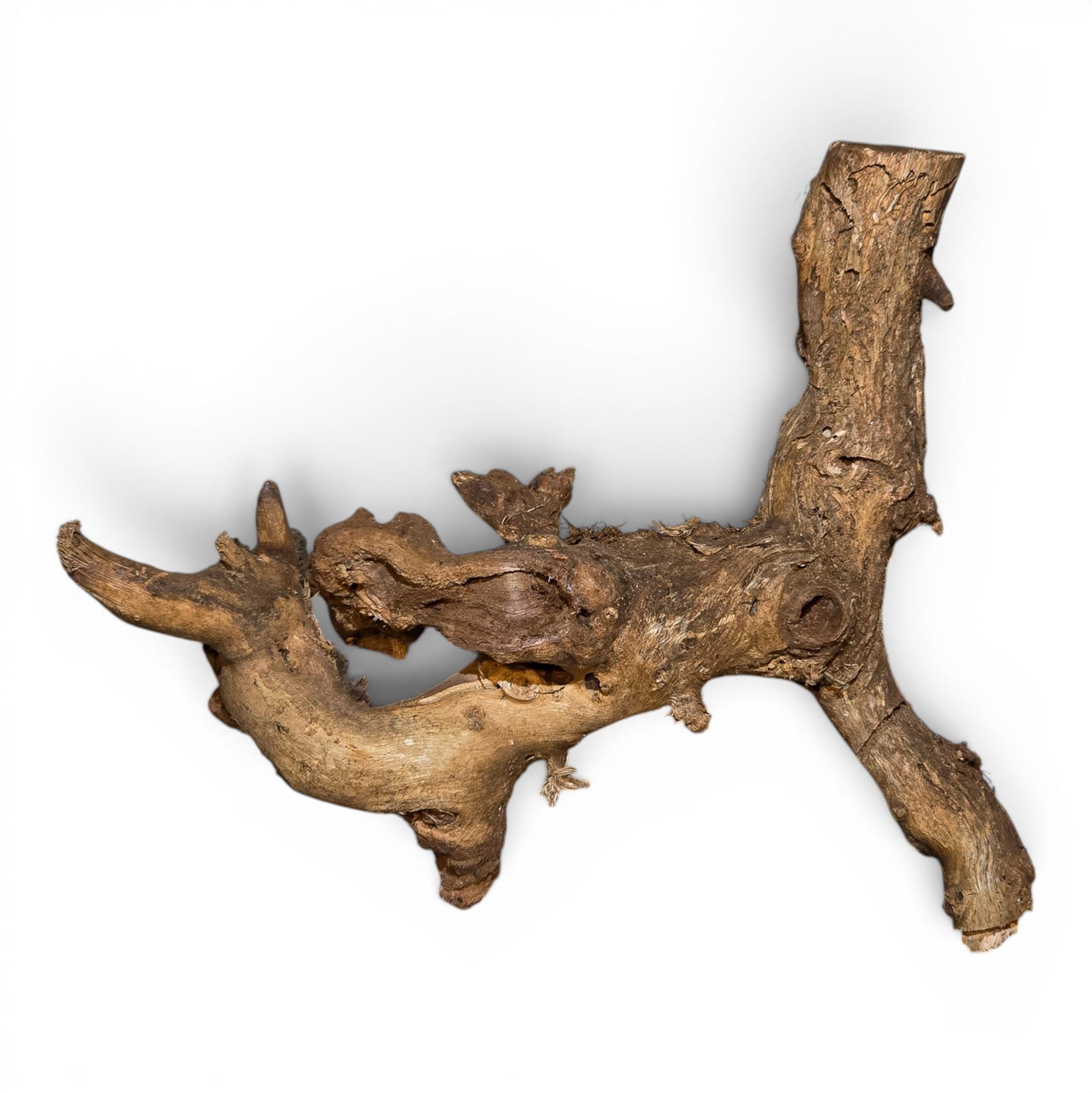
Fluval Mopani Driftwood
Check Price on Amazon ★3.9Tankmates and Diet
Anything that fits in a green terror's mouth is food — tetras, guppies, and small cories are permanently off the table. Workable companions are large, robust cichlids (severums, blue acaras, Jack Dempsey-sized) in 125+ gallons with sightline breaks. A single-specimen tank is the most stable planted option.
Feed a sinking cichlid pellet (35–40% protein) as the base, rotating frozen krill, earthworms, and shrimp — krill's carotenoids deepen the orange fin margins and blue facial sheen. Feed only what disappears in two minutes. Never use feeder goldfish: disease vector and nutritionally poor.
Health: HITH Is the One to Watch
Green terrors are hardy but share the cichlid vulnerability to head and lateral line erosion: pitting along the head and flanks that progresses when water quality slips or diet lacks variety. Prevention is unglamorous — weekly 30% water changes, varied diet, nitrate under 20 ppm. Early HITH often reverses with pristine water alone, which is another reason the planted sump earns its keep: more plant mass, more nitrate uptake, more margin for error.
Frequently Asked Questions
What size tank does a green terror need in a planted setup?
75 gallons minimum for one adult male, 48-inch footprint preferred. A lone female manages in 55 gallons; a breeding pair needs 125+ gallons.
Will green terrors destroy aquarium plants?
They destroy rooted plants — digging pits and uprooting stems is natural behavior, not aggression. Floating plants are safe, and Anubias or Java fern epoxied into heavy rock crevices survives indefinitely. Design around the fish and the tank holds.
Is Andinoacara rivulatus the same as the true green terror?
The fish sold as "green terror" in almost every store is Andinoacara rivulatus, from Pacific Ecuador and Peru. The true green terror, Andinoacara stalsbergi, is a separate, much rarer species.
What plants can survive with a green terror?
Floaters (water lettuce, frogbit, red root floaters) and rhizome plants — Anubias and Java fern — epoxied into immovable rock crevices. Fast-growing stems in buried pots work as temporary, sacrificial greenery.
How do I prevent HITH in my green terror?
Keep nitrate under 20 ppm with weekly 30% water changes and a varied, carotenoid-rich diet. Early head and lateral line erosion often reverses with pristine water alone.
The Fish Gets a Vote — and That's the Point
A green terror planted tank is a negotiation between a fish that needs to dig and a keeper who wants green. Build around it — sand it can move, rocks it cannot, floating cover overhead, armored rhizomes in the crevices — and it still looks intentional on day three hundred.