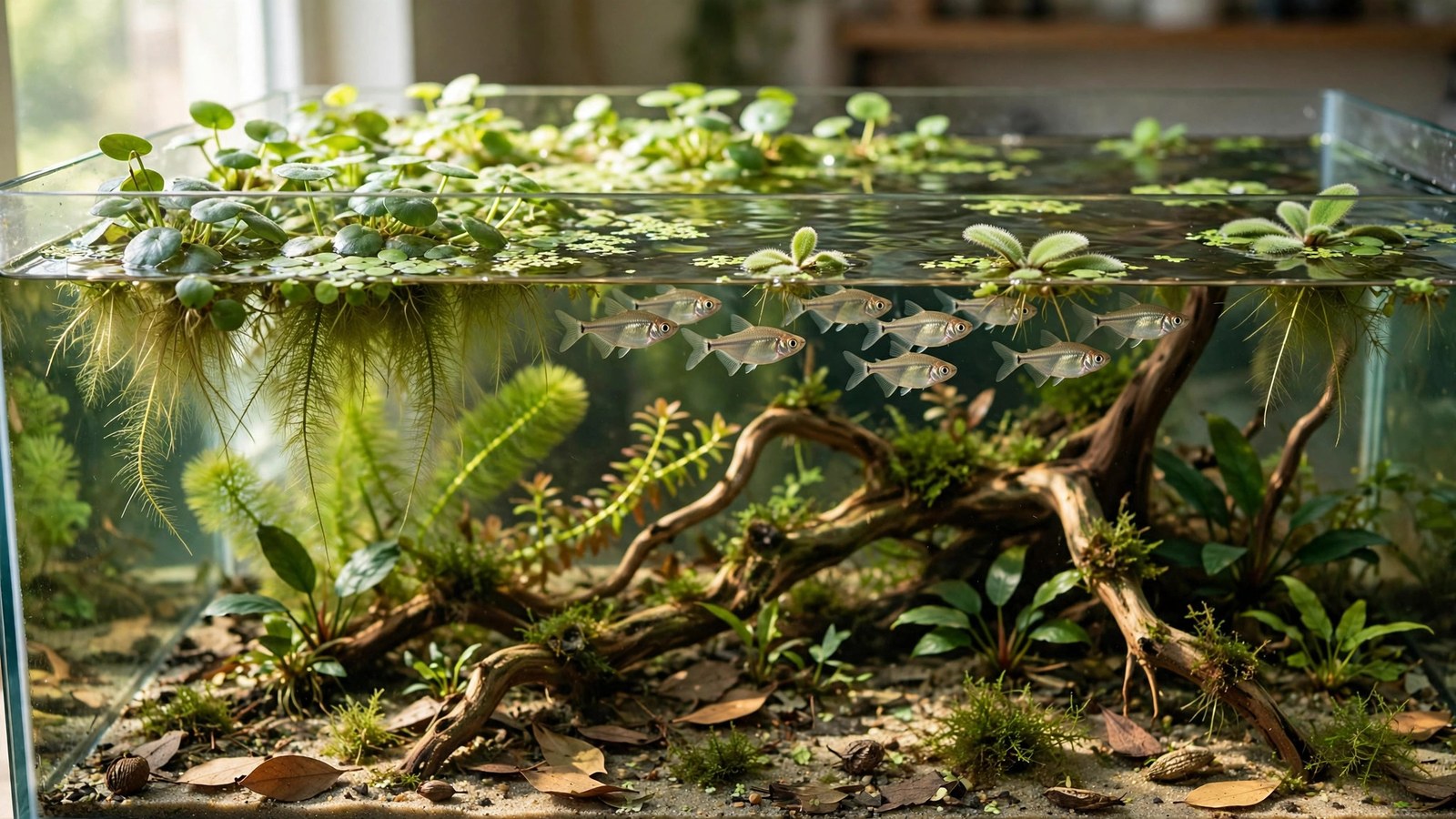
The first time a marble hatchetfish launches itself out of an open-top tank, the lesson is permanent. These hatchet-shaped surface specialists live their entire lives in the top three inches of water, so your hatchetfish planted tank must be designed from the waterline up: tight lid, calm flow, and a canopy of floating plants.
Unlike most schooling fish that use the whole water column, hatchetfish (Carnegiella strigata, the marble hatchetfish, and Gasteropelecus sternicla, the silver hatchetfish) almost never dive deeper than a few inches. They feed at the surface, rest at the surface, and startle upward rather than down — which is exactly why standard planted-tank layouts fail them.
Why Hatchetfish Belong in a Planted Tank
Most community fish ignore floaters. Hatchetfish make them the centerpiece: a floating carpet gives overhead cover like the shaded Amazon streams they come from, blocking aerial predators. The result is a school that stays near the front glass instead of cowering in a corner.
They also fill a niche few other fish occupy: the surface layer of a planted tank is often dead space nobody uses. Hatchetfish turn it into the busiest zone — hovering and jostling at the waterline. They pair naturally with other calm schooling fish for planted tanks, since midwater species like ember tetras and chili rasboras never compete for the same feeding zone.
Hatchetfish Planted Tank Setup: The Core Requirements
The tank itself needs less height than you'd expect. A 20-gallon long beats a 20-gallon high every time — footprint matters more than depth when your fish never visit the lower half. More surface area means more territory for the school and more room for floaters.
Background stems fill the lower tank, but the star layer is the floating canopy — frogbit, salvinia minima, and red root floaters all work. Compare options in our best floating aquarium plants for beginners, or plan plant-first with our fish-first guide to aquarium plants for fish tanks.
| Requirement | Target | Why it matters |
|---|---|---|
| Tank volume | 20+ gallons | Room for a proper school |
| Footprint | Long over tall | Surface area is everything |
| Temperature | 24–28°C (75–82°F) | Warm, stable conditions |
| pH / hardness | 6.0–7.0, soft | Blackwater-like; hard water stresses them |
| Floating cover | 40–70% of surface | Security without blocking light |
| Filtration | Gentle, baffled flow | Strong current exhausts them |
| Lid | Tight-fitting, gapless | They startle upward — any gap is an exit |
The Lid: Non-Negotiable for Famous Jumpers
This is the rule that separates hatchetfish keepers from former hatchetfish keepers. These fish are among the most committed jumpers in the hobby — a startled school can clear several inches of water, aiming for exactly the gaps around filter pipes, heater cords, and feeding hatches. An open-top aquascape, however beautiful, is a death trap for them.
Use a glass or polycarbonate lid cut to fit, and seal the gaps around equipment with filter sponge or port covers. Keep the feeding hatch closed between meals, and re-check lid seating at every water change — lids warp, and a millimeter-wide gap at the back is an open door. The same gap-proofing principles appear in our sparkling gourami surface-dweller setup guide.
Floating Plants: Your Hatchetfish's Security Blanket
No single change improves hatchetfish behavior more than a floating canopy. Without overhead cover, the school huddles and startles at every shadow. With frogbit or salvinia above them, the same fish spread out, feed boldly, and show their natural hovering posture.
Aim for 40–70% surface coverage. Less and the security effect fades; much more and you starve the submerged plants of light. Thinning floaters weekly is part of the routine — frogbit doubles fast. Buy nursery-grown portions so you don't import snails or unwanted duckweed. Our floating plants for betta tanks guide compares growth rates and light needs.
Surface Flow: Keep It Calm
Aim the outflow toward the glass, angle a spray bar downward, or baffle with a sponge pre-filter — whatever produces a gentle ripple. A canister with a lily pipe, or a gentle internal sponge filter, both work. Calm surface water also protects injected CO2.
Feeding Hatchetfish at the Surface
Hatchetfish feed with their mouths pointed up — their jaws are built for grabbing insects above the waterline. Sinking pellets are wasted on them; they watch food drift down and refuse to dive. Feed only foods that float, at least for a while.
Feed floating micro-pellets as the staple, crushed flake for variety, and freeze-dried daphnia for protein — only what they finish in two minutes, once or twice daily. Uneaten floating food rots the surface film fast. This surface-only habit is why they make such clean tank mates for chili rasboras and ember tetras: everyone eats in a different zone, so nobody competes.
Tank Mates for the Top Layer
The best tank mates are calm, small, and occupy the middle and bottom — leaving the surface entirely to the hatchetfish. Ember tetras, chili rasboras, and celestial pearl danios are ideal midwater companions; kuhli loaches add bottom activity without bothering the surface, and a honey gourami works as a peaceful centerpiece.
Avoid anything nippy or boisterous at the top: tiger barbs, large danios, and most rainbowfish turn the surface into a raceway. Also skip aggressive surface feeders — hatchetfish are timid eaters and lose every scramble for floating food.
Acclimation: Treat Them Like Fragile Cargo
Hatchetfish are delicate shippers, and many losses blamed on "bad stock" are really just rushed acclimation. Drip-acclimate over 45–60 minutes to match temperature, pH, and hardness — osmotic shock hits them harder than hardier tetras. Keep lights off for the first few hours and have the floating canopy in place before they arrive — a bare, bright surface invites a jumping incident on day one. Quarantine newcomers for two to three weeks — wild-caught fish can carry parasites, and treating a bare quarantine tank beats treating a full planted display. For species-level parameters, Seriously Fish's marble hatchetfish profile is an excellent reference, and Practical Fishkeeping’s hatchetfish species guide regularly covers surface-dweller care in depth.
Frequently Asked Questions
How many hatchetfish should I keep together?
Keep at least 6, but 8–12 is the sweet spot. Smaller groups stay chronically skittish and hide constantly, while a proper school spreads out, feeds boldly, and shows natural hovering behavior. Don't try them in tanks under 20 gallons — the group never settles.
Can I keep hatchetfish in an open-top aquascape?
No — this is the most common and most fatal mistake with hatchetfish. They are famous jumpers that startle upward, and they will eventually exit any uncovered tank, usually at night or during a water change. A tight-fitting lid with no gaps around equipment is mandatory.
Why won't my hatchetfish eat sinking pellets?
Their upturned mouths are built for surface feeding, and they rarely dive for food. Switch to floating micro-pellets, crushed flake, or freeze-dried daphnia, and use an airline-tubing ring to keep a clear feeding lane. Live flightless fruit flies trigger natural surface strikes.
Do hatchetfish need floating plants?
Technically they can survive without them, but floating plants are the single biggest factor in confident behavior. Overhead cover mimics their Amazon habitat and dramatically reduces skittishness. Frogbit, salvinia, and red root floaters all work — aim for 40–70% surface coverage.
Are marble hatchetfish hard to keep alive?
They're intermediate, not beginner fish. The difficulty is mostly sourcing and acclimation — they're delicate shippers that need slow drip acclimation and stable, soft, slightly acidic water. Once settled in a calm, covered, planted tank, healthy hatchetfish are hardy and live 3–5 years.
Lock the lid, grow the floating canopy, calm the current, and feed at the waterline — your school of little silver aircraft will do the rest.