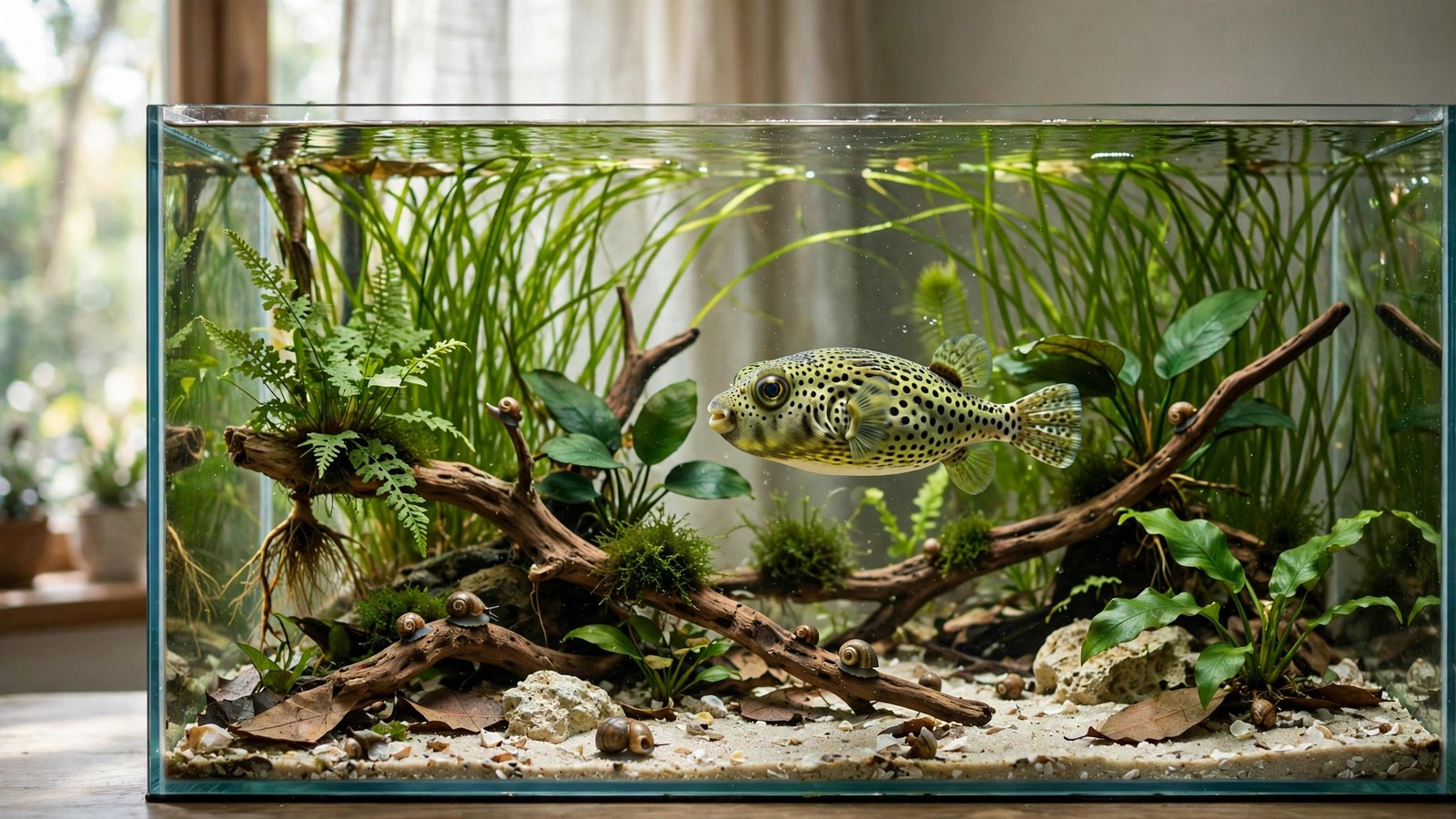
Almost every green spotted puffer dies of the same preventable mistake: it is bought as a freshwater fish and kept as one. Shops sell thumb-sized juveniles labeled "freshwater puffer," and for a few months they look fine — then adults held in fresh water sicken, bloat, and fade years early. A green spotted puffer planted tank is a brackish project from day one: you plant around the salt, ramp the salinity as the fish grows, and end up with a curious, dog-like predator that can live 10–15 years.
Why green spotted puffers die in freshwater
In the wild, Dichotomyctere nigroviridis starts in coastal fresh water and migrates toward brackish and marine water as it matures. Shops hold juveniles in fresh water because it is convenient, and buyers assume the fish is freshwater. It isn't: adults in permanent fresh water lose immunity, pick up parasites, and die at 3–5 years instead of 10–15. Salt is the baseline for a healthy adult — the species profile of Dichotomyctere nigroviridis documents the migration this setup recreates.
Setting up a green spotted puffer planted tank
Start with 30 gallons for one puffer. Use inert sand — salt degrades aquasoil's buffering chemistry and can release ammonia, so soil methods like the Walstad method planted tank belong in freshwater. Sand, rocks, and sturdy hardscape the puffer can nose around without toppling.
Filter with a canister rated for double the tank volume — puffers are messy eaters and unforgiving of ammonia. Add caves and rocks for sight-line breaks. Plant at the juvenile's low salinity and let the plants root for a month before ramping. If you've read our figure 8 puffer brackish setup, the mechanics are familiar — but figure 8s stay low-end brackish while a green spotted puffer climbs toward marine.
Plants that survive the salt — and ones that don't
The brackish planting list is short: java fern and anubias on the hardscape, vallisneria in the sand, hornwort added early in the ramp while salinity is low. Everything else is a waste of money at adult salinity.
| Plant | Salt tolerance | Verdict |
|---|---|---|
| Java fern | Up to SG ~1.015 | Survives — anchor to hardscape |
| Anubias (barteri types) | Up to SG ~1.015 | Survives — slow and tough-leaved |
| Vallisneria | Up to SG ~1.018 | Best background option |
| Hornwort | Up to SG ~1.010 | Works if salt rises gradually |
| Java moss, Amazon sword, crypts, rotala | Freshwater to trace salt | Melt or rot in brackish — avoid |
| Carpeting plants (HC Cuba, Monte Carlo) | Freshwater only | Fail completely |
| Cryptocoryne, rotala | Freshwater to trace salt | Melt with salt swings — avoid |
The fish-first guide to aquarium plants explains choosing plants for the fish, and the complete guide to freshwater aquarium plants covers the species you are leaving behind.
Water parameters and the salinity ramp
Walk the tank up the salinity ladder over months — never faster than 0.002 specific gravity per week.
| Parameter | Juvenile | Adult target |
|---|---|---|
| Specific gravity | 1.002–1.005 | 1.008–1.018 |
| Temperature | 24–28°C (75–82°F) | 24–28°C (75–82°F) |
| pH | 7.0–7.8 | 7.5–8.2 |
| Hardness | 10–20 dGH, hard and alkaline | 10–20 dGH, hard and alkaline |
| Ammonia / nitrite | 0 ppm | 0 ppm |
| Nitrate | Under 20 ppm | Under 20 ppm |
- Settle the juvenile in near-fresh water (SG 1.002–1.005, hard and alkaline) for 2–4 weeks after purchase.
- Mix salt outside the tank — dissolve a marine salt mix in a bucket of dechlorinated water; tonic or table salt lacks the right buffers.
- Raise SG by 0.002 per week, maximum, through water changes: 1.008–1.012 for sub-adults, 1.015–1.018 past 4 inches. Premix every change to the tank's SG — swings stress fish and melt plants.
- Measure with a refractometer calibrated with distilled water. Swing-arm hydrometers can read 0.003 off — your entire week's adjustment.
Target values line up with The Tropical Tank's green spotted puffer profile, which recommends brackish water from around SG 1.010 up to full marine for adults.
The beak-trimming diet
A puffer's teeth grow continuously, and hard-shelled prey files them down. In your tank, that job belongs to whole snails: pond, bladder, and ramshorn snails, fed in the shell so the puffer must crunch them. A separate 2-gallon jar colony gives you an endless supply — a handful 2–3 times a week, plus cockle or mussel in the shell and peeled prawn. Bloodworms are treats, not beak maintenance. Feed juveniles daily, adults every other day.
On a soft-only diet, the beak overgrows until the fish can't close its mouth. After wrong salinity, this is the most common captive killer.
One wet pet, not a community
Green spotted puffers are intelligent, interactive, and genuinely recognize their keeper — and they are predators that treat tank mates as rivals or food. One puffer in 30 gallons is the setup that works for decades. Groups raised together can coexist in 75+ gallons, but expect injuries and keep a backup tank ready.
Small fish are food; slow or long-finned fish get bitten. Large, robust brackish fish like archers, scats, and monos can work in 100+ gallons — the puffer stays a risk regardless. For gentler options, a planted pea puffer tank is a freshwater nano predator, and the amazon puffer planted tank stays freshwater and social. Or go the opposite direction with a planted neon tetra tank. Treat your puffer like a planted betta tank setup: one fish, one personality, all the attention on it.
Frequently Asked Questions
Can a green spotted puffer live in freshwater permanently?
No. Juveniles tolerate fresh water briefly, but adults suffer weakened immunity, chronic parasites, and organ stress. A freshwater green spotted puffer typically dies at 3–5 years; in high-end brackish water it can live 10–15. The salinity ramp is the price of admission.
How fast can I raise the salinity?
No faster than 0.002 specific gravity per week. Faster raises shock osmoregulation and melt plants overnight. From a juvenile's SG 1.002 to an adult's 1.015, expect a 3–4 month ramp through weekly water changes. Always premix the salt in a bucket of dechlorinated water and measure with a refractometer — never estimate.
Can I keep two green spotted puffers together?
Not in a normal home tank. Two adults in 30–55 gallons will fight, often to the death, over feeding territories. Groups raised together from juveniles can work in 75+ gallons with heavy sight-line breaks — but expect injuries and keep a backup tank ready.
What happens if the puffer's beak overgrows?
The fish can't close its mouth and will starve in front of food. Prevention is dietary: feed whole, in-shell snails 2–3 times a week so the crunching wears the teeth down. Soft-only diets of bloodworms and brine shrimp are the usual cause — vary the diet and the problem never starts.
Do I need a protein skimmer for a brackish puffer tank?
No. Skimmers need full marine salinity and add nothing at SG 1.018. A canister filter rated for double the tank volume, weekly 30–50% water changes with premixed brackish water, and live plants handle the bioload. Spend the skimmer budget on a refractometer instead.
A puffer worth the ramp
This setup asks more than a freshwater tank: salt mixing, refractometer readings, months of patient ramping, a one-fish tank. What it pays back is a pet, not a decoration — a fish that watches you, learns routines, and lives a decade or more when the water is right.